Long-Term Effects of GLP-1 Medications on Metabolic Health
Here’s the short answer: GLP-1 drugs can improve weight, blood sugar, waist size, blood pressure, and some heart and kidney outcomes while you stay on them – but much of that progress can fade after you stop.
If I boil the article down, the message is simple:
- During treatment, results are often strong.
- Semaglutide and tirzepatide can lead to double-digit weight loss
- Tirzepatide lowered A1c by about 1.9 to 2.6 points in type 2 diabetes studies
- Semaglutide 2.4 mg cut major heart events by 20% in SELECT
- Semaglutide also lowered a kidney composite outcome by 24% in FLOW
- After treatment stops, regain is common.
- In STEP 1, people who stopped semaglutide regained 11.6 percentage points of body weight by week 120
- In SURMOUNT-4, people switched from tirzepatide to placebo regained about 14%
- Not all outcomes mean the same thing.
- Lower A1c, lower fasting insulin, and lower blood pressure are marker changes
- Fewer heart attacks, strokes, and kidney events are patient outcomes
- Right now, semaglutide has the clearest proof for those harder outcomes
- Are all GLP-1 drugs the same? These drugs are not interchangeable.
- Semaglutide is a GLP-1 receptor agonist
- Tirzepatide acts on GLP-1 and GIP
- That means trial results should be read drug by drug, not mixed together
- Safety still matters over time.
- Common issues: nausea, vomiting, diarrhea
- Other risks: gallbladder disease, dehydration, acute kidney injury, pancreatitis
- Low blood sugar risk goes up more when used with insulin or a sulfonylurea
What I take from the evidence is this: these medicines can work well for long-term metabolic control, but most of the benefit depends on continued use, close follow-up, and realistic expectations about what happens if treatment is reduced or stopped.
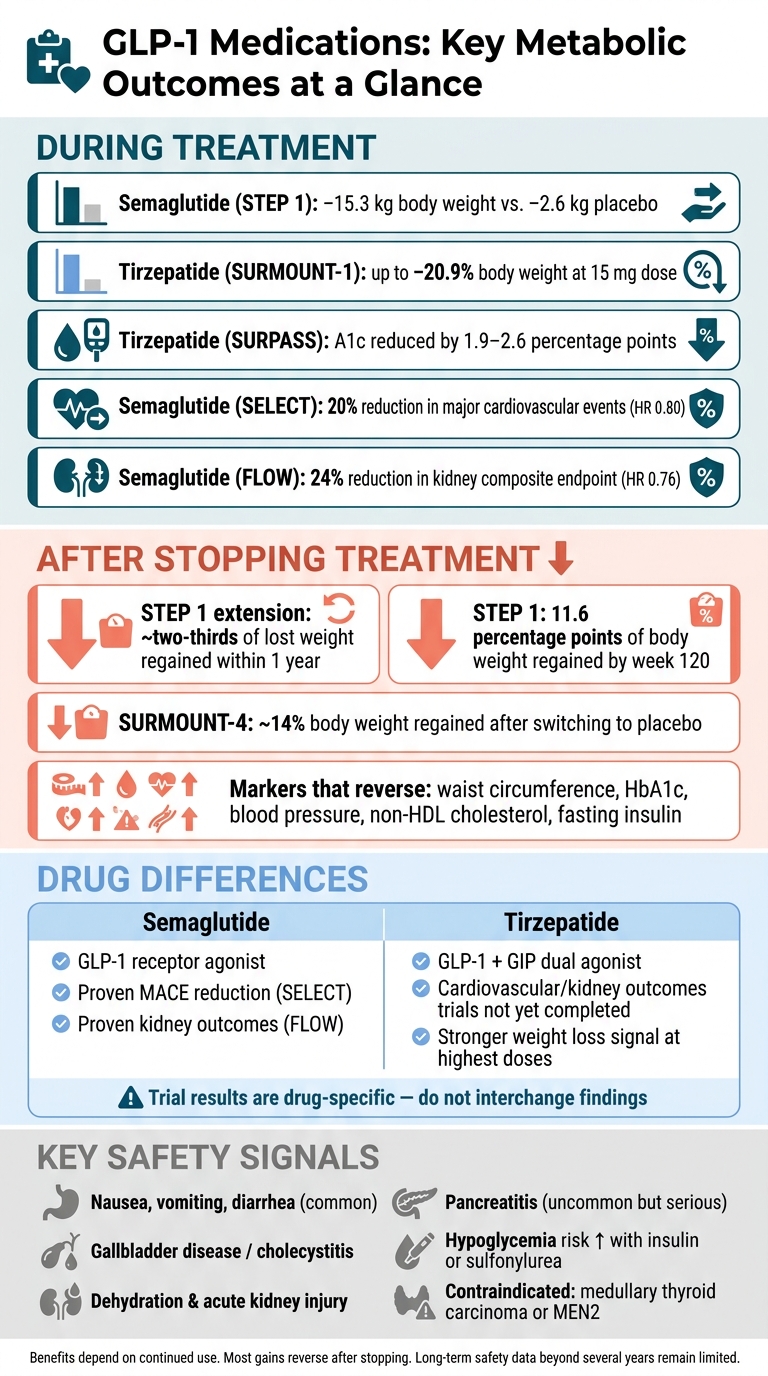
GLP-1 Medications: Key Outcomes During vs. After Treatment
Rethinking GLP-1s: A Smarter Policy for Long-Term Metabolic Health
sbb-itb-e2779c3
Metabolic Effects During Continued Treatment
Long-term trials show a clear pattern: metabolic gains can last as long as treatment continues. In practice, that shows up across A1c, body weight, waist circumference, blood pressure, fasting glucose, and lipid markers. But the mix of results changes by group. In people with type 2 diabetes, glycemic control tends to lead the story. In people with obesity without diabetes, weight and waist size tend to matter most.
Glycemic Control, Insulin Sensitivity, and Weight Over Time
For type 2 diabetes, A1c is the main endpoint. Across the SURPASS program, tirzepatide lowered A1c by about 1.9 to 2.6 percentage points over as long as 104 weeks, with bigger drops at higher doses. In STEP 2, which included adults with overweight or obesity and type 2 diabetes, semaglutide 2.4 mg led to about 9.6% weight loss versus 3.4% with placebo over 68 weeks. Glycemic control also improved.
In obesity without diabetes, the focus shifts. Weight and waist circumference are the main endpoints. STEP 5 showed that semaglutide 2.4 mg kept effects going through 104 weeks, with reductions in weight (−15.2% vs. −2.6%), waist circumference (−14.4 cm vs. −5.2 cm), and systolic blood pressure (−5.7 vs. −1.6 mmHg). In SURMOUNT-1, tirzepatide produced dose-based weight loss through 72 weeks: about 15.0% at 5 mg, 19.5% at 10 mg, and 20.9% at 15 mg, compared with 3.1% with placebo.
Fasting insulin and HOMA-IR usually play a supporting role rather than serving as primary endpoints. Blood pressure and lipid changes also tend to move alongside weight loss, so they’re usually treated as secondary outcomes.
One point matters here. A person can reach an A1c in the nondiabetic range during treatment, but that is not the same thing as drug-free remission. In SURMOUNT-2, which enrolled adults with obesity and type 2 diabetes, nearly half of participants on tirzepatide reached nondiabetic A1c levels during the study. That shows glycemic control while on therapy, not remission after stopping it.
The table below pulls together the main long-term trials.
Study Evidence Table for Major Long-Term Trials
| Trial | Medication and population | Duration and comparator | Key endpoints | Principal findings |
|---|---|---|---|---|
| STEP 1 | Semaglutide 2.4 mg; adults with overweight or obesity, no diabetes | 68 weeks; placebo + lifestyle | Body weight | −15.3 kg vs. −2.6 kg; estimated difference −12.7 kg |
| STEP 2 | Semaglutide 2.4 mg; adults with overweight or obesity and type 2 diabetes | 68 weeks; placebo | Weight, glycemic control | About 9.6% weight loss vs. 3.4%; A1c also improved |
| STEP 5 | Semaglutide 2.4 mg; adults with overweight or obesity, no diabetes | 104 weeks; placebo | Weight, waist circumference, systolic BP | −15.2% vs. −2.6% weight; −14.4 vs. −5.2 cm waist; −5.7 vs. −1.6 mmHg systolic BP |
| SURPASS program | Tirzepatide; adults with type 2 diabetes | Up to 104 weeks; placebo or active comparators | A1c, weight, fasting glucose, lipids | A1c fell about 1.9–2.6 points across studies, with greater weight loss at higher doses. |
| SURPASS-4 (post hoc) | Tirzepatide; adults with type 2 diabetes on metformin and/or sulfonylurea | 104 weeks; insulin glargine | A1c, fasting glucose, weight, BMI, waist, BP, lipids | Sustained improvements across glycemic, anthropometric, blood pressure, and lipid markers vs. insulin glargine |
| SURMOUNT-1 | Tirzepatide 5/10/15 mg; adults with obesity, no diabetes | 72 weeks; placebo | Body weight | About 15.0%, 19.5%, and 20.9% weight loss by dose vs. 3.1% placebo |
| SURMOUNT-2 | Tirzepatide; adults with obesity and type 2 diabetes | 72 weeks; placebo | Weight, A1c, systolic BP, triglycerides, non-HDL cholesterol | Weight fell 12.8% and 14.7% vs. 3.2%; systolic BP fell 6.3 vs. 1.2 mmHg; triglycerides fell 27.2% vs. 3.3%; non-HDL cholesterol also decreased more than with placebo, and nearly half of participants reached nondiabetic A1c levels |
The SURPASS-4 104-week analysis is post hoc and should not be treated as a prespecified primary endpoint.
Cardiometabolic and Organ Outcomes Beyond Weight Loss
Lower A1c, a smaller waistline, and better blood pressure numbers are good signs. But those numbers matter most when they lead to fewer heart attacks, strokes, and kidney problems. That’s the main issue here: do these improvements lead to fewer major cardiovascular and kidney events?
Clinical Outcomes vs. Surrogate Metabolic Markers
A surrogate marker is a measurable change, like lower triglycerides or lower systolic blood pressure, that points to lower risk. A clinical outcome is something the patient actually goes through, such as a heart attack, stroke, or kidney failure.
That difference matters. Better markers can be useful in practice, but they do not prove that a drug prevents the events people care about most.
| Evidence type | Examples | What it tells you |
|---|---|---|
| Major cardiovascular events | Cardiovascular death, nonfatal heart attack, nonfatal stroke (MACE) | The strongest proof comes from randomized outcomes trials with prespecified endpoints |
| Hard kidney outcomes | Kidney failure, sustained major eGFR decline, kidney replacement therapy | Strongest when tested in a dedicated kidney-outcomes trial |
| Intermediate markers | Systolic blood pressure, triglycerides, LDL cholesterol, A1c, eGFR slope, albuminuria | Good changes, but not the same as proven reductions in clinical events |
This also explains why you can’t assume every GLP-1 drug has the same level of proof. A result from one drug, at one dose, in one group of patients does not automatically apply to another drug or another population.
What Research Shows for Heart and Kidney Health
The clearest cardiovascular evidence comes from SELECT. In that trial, semaglutide 2.4 mg lowered MACE by 20% versus placebo (HR 0.80; 95% CI 0.72–0.90) in 17,604 adults with overweight or obesity, established cardiovascular disease, and no diabetes. Mean follow-up was about 3.3 years.
That’s a big deal because it moves beyond “better lab values” and into fewer major cardiovascular events.
SELECT also included a prespecified kidney analysis. The composite kidney endpoint occurred in 1.8% of people on semaglutide versus 2.2% on placebo (HR 0.78). The signal was favorable, but there’s an important catch: most of those events were driven by persistent macroalbuminuria, not kidney failure. So this does not prove prevention of kidney failure across all patient groups.
For kidney outcomes, the more direct trial is FLOW. This study was built to test kidney results specifically. It enrolled about 3,533 adults with type 2 diabetes and chronic kidney disease (CKD).
Over a median follow-up of about 3.4 years, semaglutide lowered the primary composite kidney endpoint – which included kidney disease progression and death from cardiovascular or kidney causes – by 24% (HR 0.76; 95% CI 0.66–0.88). It also slowed eGFR decline and lowered cardiovascular events and all-cause death.
That kind of evidence is still limited for other GLP-1 drugs and for dual incretin drugs.
Semaglutide, tirzepatide, and other dual incretin agents do not yet have completed cardiovascular and kidney outcomes trials at the same level. The blood pressure and lipid improvements seen in SURMOUNT-2 and the SURPASS program matter in practice, but they are still intermediate markers.
Next, the focus shifts to what happens after treatment stops – and how long-term safety is tracked.
What Happens After Stopping Treatment and How Safety Is Monitored
Outcomes During Treatment vs. After Stopping
When people stop GLP-1 therapy, a large share of the metabolic gains often fades. That’s the big takeaway from withdrawal data: long-term metabolic improvement usually depends on staying on treatment.
The STEP 1 extension makes this pretty clear. Adults who stopped semaglutide 2.4 mg after 68 weeks regained about two-thirds of the weight they had lost over the next year. So the main challenge isn’t only losing weight in the first place. It’s keeping it off.
SURMOUNT-4 showed much the same pattern with tirzepatide. People who stayed on tirzepatide lost another 5.5% of body weight over 52 weeks. Those switched to placebo regained about 14%. Even so, the withdrawal group still finished 9.9% below baseline, though much of the earlier gain had slipped away.
That reversal didn’t just show up on the scale. As weight came back, other markers tended to move in the wrong direction too. Greater regain was linked with larger increases in waist circumference, systolic blood pressure, non-HDL cholesterol, HbA1c, and fasting insulin. In plain terms, the more weight returned, the more metabolic benefit was lost.
| Outcome | During continued treatment | After stopping (approx. 1-year follow-up) |
|---|---|---|
| Body weight | Maintained or further reduced | About two-thirds of semaglutide losses returned within 1 year |
| Waist circumference | Improved alongside weight loss | Increases as weight returns |
| HbA1c and fasting glucose | Supported while treatment continues | Rises with greater regain |
| Insulin sensitivity | Gains maintained with active treatment | Fasting insulin rises as weight returns |
| Blood pressure | Remains improved during active therapy | Reverts toward baseline within 1 year |
| Non-HDL cholesterol | Improved during treatment | Worsens as weight returns |
There’s one important limit here: most withdrawal studies track people for about 1 year after stopping. Data past that point are still thin. And right now, there isn’t a validated tapering plan that has been shown to reliably prevent regain.
Long-Term Safety, Contraindications, and Monitoring
Long-term use also means keeping a close eye on safety.
Persistent nausea, vomiting, or diarrhea can lead to dehydration and acute kidney injury. That risk matters most in older adults, people with kidney disease, and those taking diuretics. It also matters for a simpler reason: if side effects are hard to live with, people may stop treatment or struggle to stay on dose.
Gallstones and cholecystitis are known risks during fast weight loss. Patients should report right-upper-abdominal pain, fever, or jaundice right away. Pancreatitis is uncommon, but it’s serious. Severe abdominal pain that radiates to the back, especially with vomiting, needs urgent evaluation. If pancreatitis is confirmed, treatment should not be restarted.
Hypoglycemia risk stays low when a GLP-1 medication is used by itself. But that risk goes up when it’s paired with insulin or a sulfonylurea. In those cases, the doses of the other drugs may need to be adjusted.
Contraindications differ by product, so prescribing information needs a close review, especially for personal or family history of medullary thyroid carcinoma or MEN2.
| Issue | Evidence strength | Clinical relevance | Applies broadly or selectively |
|---|---|---|---|
| Weight and cardiometabolic improvement during treatment | Strong randomized-trial evidence | Supports ongoing treatment when benefits outweigh risks | Broadly relevant; response varies |
| Weight regain after stopping | Strong withdrawal-trial evidence | Critical for maintenance planning and informed consent | Broadly relevant |
| Reversal of blood pressure, lipid, glycemic, and insulin-sensitivity gains | Moderate withdrawal evidence | Supports monitoring after discontinuation | Broadly relevant; magnitude varies |
| Gastrointestinal adverse effects | Strong prescribing-information and trial evidence | May affect adherence, hydration, and dose escalation | Broadly relevant; severity varies |
| Gallbladder disease | Established labeling warning | Requires symptom education | Higher risk during rapid weight loss |
| Dehydration and acute kidney injury | Established warning | Important when vomiting or diarrhea limits fluid intake | Particularly relevant to kidney disease, older adults, and diuretic users |
| Pancreatitis | Important but uncommon safety warning | Requires urgent evaluation and treatment interruption if suspected | Relevant to all users |
| Hypoglycemia | Strong interaction warning | May require adjustment of insulin or secretagogue doses | Mainly applies to patients using those medicines |
| Medullary thyroid carcinoma or MEN2 | Strong contraindication | Medication should not be used in affected patients | Specific patient groups only |
These safety concerns help shape how clinicians monitor treatment over time and how they think about staying on therapy versus stopping it. The next section looks at how these outcomes line up with evidence quality and day-to-day care decisions.
Reading the Evidence and Applying It in Ongoing Care
Evidence Quality, Limits, and Key Takeaways
The evidence is most solid when people are actively taking treatment. During that period, studies show clear gains in weight loss, blood sugar control, and insulin sensitivity.
Where things get less clear is what happens later. Data on durability after stopping treatment, tapering off, and safety over periods longer than several years are still limited. That’s the gap. We know a lot about what happens during treatment. We know less about what happens after.
Here’s the clearest way to read the evidence:
| Finding | Evidence Strength | Key Limitation |
|---|---|---|
| Active-treatment weight loss and glycemic improvement | Strong | Long-term data beyond several years are limited |
| Insulin sensitivity gains during active treatment | Moderate | Part of the effect may reflect weight loss |
| Weight regain and reversal of metabolic gains after stopping | Moderate | Outcomes after discontinuation are still being studied |
| Tapering to prevent regain | Emerging | No validated protocol exists yet |
| Long-term safety | Emerging | Long-term follow-up is still limited |
A simple takeaway: the case for active treatment is strong, especially for weight and glycemic outcomes. The case gets less firm when the conversation shifts to stopping, tapering, or very long follow-up. That doesn’t mean the treatment stops making sense. It means care decisions should stay grounded in what the evidence can support today.
Where TrimRX Fits Into Medically Supervised Long-Term Care
For long-term care, follow-up matters just as much as the medication itself. That’s often the part people overlook. The drug matters, of course, but so does having a clinician track progress, adjust treatment when needed, and help manage what happens over time.
TrimRX offers medically supervised GLP-1 weight-loss programs using semaglutide or tirzepatide. The program includes clinician consultations, custom prescriptions, free delivery, and ongoing support. Pricing starts at $179/month.
FAQs
How long do I need to stay on a GLP-1 medication?
Most evidence-based guidance points to the same idea: GLP-1 medications usually aren’t a one-and-done fix for long-term metabolic health.
In most cases, the benefits continue while treatment continues. Once treatment stops, those gains often start to fade.
After meaningful weight loss, stopping the medication can lead to weight regain and a decline in metabolic health. About two-thirds of lost weight may return within about a year.
There is one important catch. If someone maintains their weight through lifestyle changes alone, improvements in insulin resistance can last. But that usually takes steady, long-term effort.
Will the weight come back if I stop treatment?
Often, yes. After stopping GLP-1 treatment, weight regain is common, and many metabolic gains tend to fade. In semaglutide studies, about two-thirds of lost weight came back within a year, along with poorer insulin sensitivity and HbA1c.
For people with type 2 diabetes, blood sugar levels also usually climb again after stopping. Some gains may last if a person sticks with long-term diet and exercise changes, but staying on treatment often helps keep results more steady.
Which long-term benefits are proven beyond weight loss?
Beyond weight loss, GLP-1 receptor agonists keep helping in other ways too. Studies show lasting gains for metabolic and heart health. People often see better insulin sensitivity, lower fasting insulin, and, in many cases, a shift from prediabetes back to normal glucose levels.
The upside doesn’t stop there. These drugs can lower inflammation, improve lipid levels, cut visceral fat, and help support NASH resolution. They also reduce major cardiovascular events by 20% – including heart attack and stroke – even apart from weight loss.
Related Blog Posts

Transforming Lives, One Step at a Time
Keep reading

Weight Loss Progress Tracker
Track your weight loss over time, see progress clearly, and stay motivated with simple charts, summaries, and goal-based insights.

How to Create a Personalized Adherence Plan
Build a one-page GLP-1 adherence plan: record dose, pick a weekly time, set reminders, log side effects, and review monthly.

Weight Loss Medication Dosage Calculator
Estimate weight loss medication doses by weight and drug type, with starting guidance, dose progression info, and a clear medical disclaimer.


