Can You Split a Zepbound Dose? Safety and Risks Explained

Introduction
Starting a weight loss journey with a GLP-1 medication can feel like a major step toward reclaiming your health. However, the logistical side of managing prescriptions—dealing with costs, supply shortages, or side effects—often creates unexpected hurdles. If you are using Zepbound®, you may have wondered if you can split a higher-dose pen into two or more smaller doses to save money or manage your schedule. This practice is frequently discussed in online forums, but the clinical reality is far more complex than it appears on the surface. At TrimRx, we believe that sustainable weight loss must be built on a foundation of safety and medical accuracy. If you are still deciding whether prescription treatment is the right fit, you can take the free assessment quiz to see whether a personalized program makes sense for you.
Quick Answer: You should not attempt to split a Zepbound® dose. The medication comes in a single-use, preservative-free autoinjector pen designed to deliver one full dose at a time. Attempting to manually extract or divide the medication carries a high risk of bacterial contamination, dosing errors, and loss of medication potency.
How the Zepbound Delivery System Works
To understand why splitting a dose is problematic, it is important to first understand the technology behind the delivery system. Zepbound® contains the active ingredient tirzepatide. Tirzepatide is a dual-acting receptor agonist. A receptor agonist is a type of medication that mimics hormones in your body to trigger specific health benefits. In this case, tirzepatide mimics two hormones: glucagon-like peptide-1 (GLP-1) and glucose-dependent insulinotropic polypeptide (GIP). These hormones help your body regulate blood sugar, slow down how quickly your stomach empties, and signal to your brain that you feel full. If you want a broader overview of the hormone class behind this medication, our guide to what GLP-1 is is a helpful companion read.
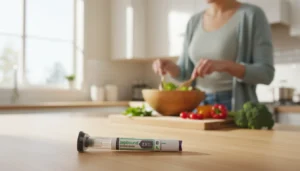
The medication is packaged in a sophisticated autoinjector pen. Unlike some older insulin pens where you “dial” a specific number of units, these pens are “all-or-nothing” mechanical devices. When you press the purple or gray button, a spring-loaded mechanism is triggered. This mechanism automatically deploys the needle and pushes the entire volume of liquid into your subcutaneous (under the skin) tissue.
The Single-Use Engineering
The manufacturer designed these pens with sterility and simplicity in mind. The needle is hidden and retracted before and after use to prevent accidental injuries. Because the system is completely sealed, there is no built-in way to pause the injection or measure out a partial dose. The device is intended to be used once and then discarded in a sharps container. Any attempt to stop the injection midway usually results in a mechanical failure or a messy, inaccurate delivery of the drug.
The Physical Risks of Manual Extraction
When people talk about splitting a dose, they are usually referring to a process of “transferring” the medication. This involves “firing” the autoinjector into a separate sterile glass vial and then using a standard insulin syringe to draw up a smaller portion. While this might seem like a clever workaround, it introduces several clinical hazards that can jeopardize your health.
Bacterial Contamination and Infection
This is the most critical safety concern. The liquid inside the pen is sterile and contains no preservatives. This is because it is meant to be injected immediately. The moment the medication leaves the protected environment of the pen and enters a secondary vial, it is exposed to the air.
If the vial, the needle used for extraction, or the surface you are working on is not perfectly sterile, bacteria can grow rapidly in the liquid. Injecting contaminated medication can lead to serious health issues, including:
- Skin Abscesses: Painful, pus-filled lumps at the injection site.
- Cellulitis: A deep bacterial skin infection that causes redness, swelling, and pain.
- Systemic Infections: If bacteria enter the bloodstream, it can lead to more severe complications that require hospitalization.
Medication Degradation and Potency Loss
Tirzepatide is a peptide. A peptide is a short chain of amino acids that is chemically quite fragile. These molecules are sensitive to light, temperature changes, and even physical agitation. When the medication is forced out of the autoinjector under high pressure—essentially “sprayed” into a vial—the force can potentially damage the peptide structure.
Furthermore, without preservatives like benzyl alcohol, which are found in multi-dose vials, the active ingredient begins to break down almost immediately. By the time you attempt to take the second “split” dose a week later, the medication may have lost a significant portion of its effectiveness. You would essentially be injecting a degraded version of the drug that cannot provide the weight loss support you need.
Key Takeaway: The Zepbound® autoinjector is a closed, preservative-free system. Any attempt to manually extract the liquid risks introducing dangerous bacteria and destroying the fragile peptide molecules that make the medication effective.
The Challenge of Dosing Inaccuracy
Precision is vital when using GLP-1 or GIP medications. Your body needs a very specific amount of the hormone mimic to achieve weight loss results without overwhelming your system with side effects. When you try to “DIY” your dose, you introduce significant human error. For a closer look at how side effects can influence dose changes, see our article on common GLP-1 side effects.
Concentration and Calculation Errors
Different strengths of the medication may have different volumes of liquid. Calculating exactly how many “units” on a syringe equal a specific milligram dose from a higher-strength pen requires precise mathematics. Even a tiny mistake in your calculation or a slight tremor in your hand while drawing the liquid can lead to an accidental overdose or underdose.
Residual Loss and “Dead Space”
Whenever you transfer a liquid between containers, some of it is lost. A small film of medication will always stick to the sides of the vial. Additionally, standard syringes have what is called “dead space”—a small amount of liquid that remains in the needle or the tip after the plunger is pushed down. While this is negligible in a single full dose, it becomes very significant when you are trying to divide a small volume into multiple parts. You may end up getting 20% or 30% less medication than you intended, which can stall your progress and lead to “weight loss plateaus.”
Why People Consider Dose Splitting
It is important to acknowledge that the desire to split a dose usually comes from a place of genuine frustration. We understand that the weight loss journey can be expensive and logistically difficult. Most people investigate splitting for three main reasons:
- Cost Management: Some try to buy the highest dose (15 mg) and split it into several smaller 5 mg doses to make the prescription last longer.
- Supply Shortages: When lower-dose pens are out of stock at the pharmacy, patients may feel forced to use a higher-dose pen and split it to avoid skipping a week of treatment.
- Managing Side Effects: If the jump between standard titration steps (like moving from 2.5 mg to 5 mg) feels too intense, a patient might want to create an “in-between” dose to help their body adjust.
While these concerns are valid, splitting a single-dose pen is not the solution. There are safer, medically supervised ways to address these issues. If you want to see whether a personalized treatment plan is a better fit, you can complete the free assessment quiz before making any changes to your medication plan.
Myth: “Splitting my dose will help me avoid side effects.” Fact: Splitting a single-dose pen on your own actually increases the risk of side effects because you cannot guarantee the accuracy or sterility of the dose. It is much safer to work with a provider to adjust your official titration schedule.
The Role of Personalized Programs and Compounded Alternatives
If you find that the standard branded pen system is not meeting your needs due to cost, supply, or dosing flexibility, a personalized program might be a better fit. At TrimRx, we connect you with licensed healthcare providers who can evaluate your health history and goals. Our platform provides access to treatments that can be tailored to your specific situation.
Understanding Compounded Tirzepatide
One alternative that many patients find helpful is compounded tirzepatide. It is crucial to understand the difference between this and the branded product. Compounded medications are not FDA-approved, but they are prepared in FDA-registered and inspected compounding pharmacies.
Unlike the branded single-use pens, compounded medications are often provided in multi-dose vials. These vials are fundamentally different because they are specifically formulated to be used over several weeks.
Why Multi-Dose Vials are Safer for Gradual Dosing
When a pharmacy prepares a multi-dose vial, they include bacteriostatic preservatives, such as benzyl alcohol. These preservatives inhibit the growth of bacteria, making it safe to draw multiple doses from the same vial over a 28-day period.
This format allows for much greater flexibility. If your provider determines that you need a custom dose—perhaps 3.5 mg instead of the standard 5 mg jump—you can easily draw that exact amount with an insulin syringe. This removes the need for dangerous “DIY” extraction and ensures you are receiving a sterile, accurate dose every time. For readers comparing branded pens with custom dosing options, our explanation of how Zepbound dosing works covers the differences in more detail.
Clinical Dosing and the Titration Process
The key to success with any GLP-1 or GIP medication is a process called titration. Titration means starting at a very low dose and gradually increasing it over several months. This allows your body, and specifically your digestive system, to adapt to the medication.
The Standard Schedule
Most people follow a schedule that looks like this:
- Month 1: 2.5 mg once weekly.
- Month 2: 5 mg once weekly.
- Month 3: 7.5 mg once weekly (if needed).
The goal is to find the “lowest effective dose”—the amount that helps you feel full and lose weight without causing significant nausea or discomfort. If you try to split doses without medical oversight, you disrupt this carefully planned schedule. This can lead to your hormone levels fluctuating wildly, which often results in increased hunger “noise” and unpredictable side effects.
What to Do If You Experience Side Effects
If you are struggling with nausea or other gastrointestinal issues, the answer is not to split your pen. Instead, you should consult with your healthcare provider. They may recommend:
- Staying on a lower dose for an extra month to give your body more time to adjust.
- Adjusting your diet to include more bland, high-protein foods.
- Using supportive supplements, such as products designed to help with nutrition during treatment.
Safety First: Steps to Take Before Changing Your Dose
If you are feeling tempted to split your medication, we recommend taking a step back and following these professional guidelines. Your health is too important to risk on a “hack” you found on the internet.
Step 1: Consult a Licensed Provider
Never change how you take a prescription medication without talking to a doctor or nurse practitioner. They can offer legitimate solutions to supply or cost issues that do not involve compromising your safety.
Step 2: Check Your Injection Technique
Sometimes, what feels like a “dose” issue is actually an injection issue. Ensure you are rotating your injection sites—switching between your abdomen, thighs, and upper arms—to reduce skin irritation and improve absorption.
Step 3: Explore Personalized Platform Options
If the pharmacy experience is becoming too stressful, consider a telehealth-based program. At TrimRx, our process is designed to be transparent and supportive. By taking our free assessment quiz, you can start a conversation with a provider about which medication and delivery format is right for your lifestyle.
Step 4: Focus on Nutrient Support
Success on a GLP-1 medication involves more than just the injection. Ensuring you have the right vitamins and minerals can help you feel better throughout the titration process. Our Weight Loss Boost supplement can be an excellent addition to your routine to support energy levels and metabolic health.
The Importance of Professional Supervision
Telehealth has transformed how we access weight loss care, but it shouldn’t mean “do-it-yourself” care. A personalized program provides more than just a prescription; it provides a dedicated team to guide you. When you use our platform, you have 24/7 access to specialists who understand the nuances of these medications.
We help you navigate the journey without hidden fees or the stress of waiting rooms. Our goal is to ensure you have a consistent supply of medication and the clinical support needed to manage your dose safely. This comprehensive approach is much more effective for long-term health than attempting to split medications in your kitchen.
Bottom Line: Splitting a single-dose autoinjector pen is clinically dangerous. It risks infection, inaccurate dosing, and medication failure. If you need more flexibility or a more sustainable way to access treatment, a personalized program with multi-dose vials is the safer, more reliable path.
Conclusion
The question “can you split a Zepbound dose” usually stems from a real need for better access or fewer side effects. However, the mechanical design of the branded pen and the chemical nature of the medication make splitting a dangerous choice. From bacterial growth to dosing errors, the risks far outweigh any potential savings.
Our mission at TrimRx is to help you achieve sustainable health through science and empathy. We provide a transparent, telehealth-first approach that prioritizes your safety and simplifies the weight loss process. You don’t have to resort to risky workarounds to reach your goals. By working with a dedicated team and following a medically supervised plan, you can navigate your journey with confidence.
If you are ready for a personalized weight loss program that fits your life, your next step is simple. Take our free assessment quiz to see which options are right for you and start your journey toward a healthier, more vibrant you.
FAQ
Is it safe to use a needle to draw Zepbound out of the pen?
No, it is not safe because the medication is preservative-free and intended for immediate use. Drawing the medication out into a separate vial or syringe exposes it to bacteria and causes the fragile peptide to break down, which can lead to infections or ineffective treatment.
Can I save half of my Zepbound pen for later if I pull the needle out early?
No, you cannot stop the injection mid-way because the autoinjector is a mechanical, “all-or-nothing” device. Attempting to pull the needle out early will likely cause the medication to spray externally, leading to a wasted dose and an inaccurate amount of medication in your system.
Why do some people on the internet say they split their doses?
Some individuals use a “transfer to vial” method to try and save money, but this is a high-risk practice not supported by medical professionals or manufacturers. These people are risking serious bacterial infections and medication degradation, and their results are often inconsistent due to dosing errors.
What is the safest way to get a custom dose of tirzepatide?
The safest way to receive a custom or flexible dose is through a personalized program that uses multi-dose vials prepared by a licensed compounding pharmacy. These vials contain preservatives that make it safe to draw multiple doses, and a healthcare provider will guide you on the exact amount to use.
Disclaimer: This content is for informational purposes only and does not constitute medical advice. It is not intended to diagnose, treat, cure, or prevent any disease or condition. Individual results may vary. Always consult a qualified healthcare professional before starting any weight loss program or medication.

Transforming Lives, One Step at a Time
Keep reading

Can You Lower Your Zepbound Dose Without Losing Your Progress?
Often yes, and the honest caveat is that the evidence for dose reduction specifically is thinner than the evidence for stopping. We know a…
Why Is There a Bruise Where I Injected My Zepbound?
A bruise means a small blood vessel was disturbed under the skin and blood spread into the surrounding tissue. It is one of the…
My Zepbound Pen Won’t Click Past a Certain Dose
Start by checking which device you are holding, because the answer depends entirely on that. Zepbound has commonly been supplied in the United States…


