Compounded Semaglutide: Complete Cost and Safety Guide
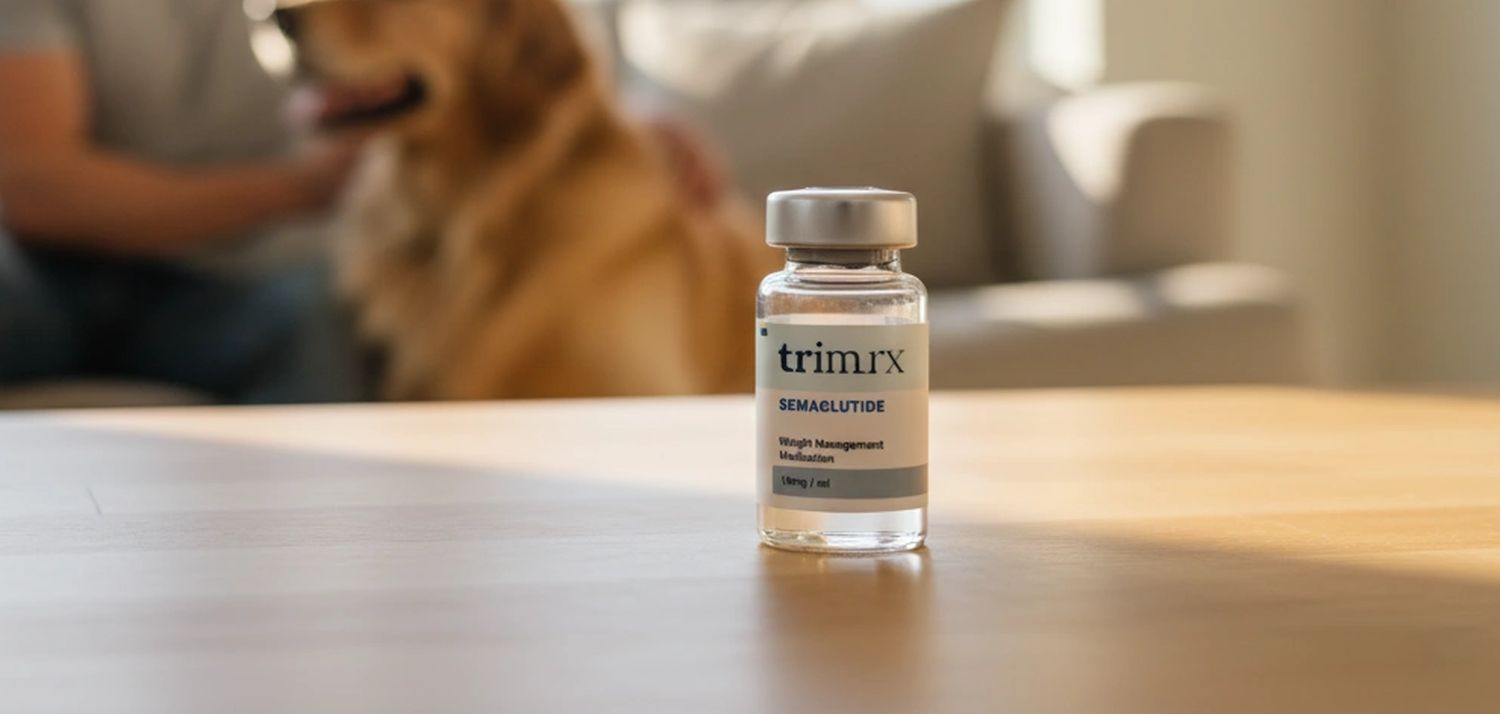
If you’ve looked into semaglutide for weight loss, you’ve probably experienced sticker shock. Wegovy costs $1,349 per month. Ozempic runs $969 monthly. Even with insurance, copays often hit $100 to $300. For most people, these prices make long-term treatment financially impossible.
That’s where compounded semaglutide enters the conversation. You might have seen it advertised online for $200 to $400 monthly, wondered if it’s legitimate, questioned whether it actually works, or worried about safety compared to brand-name versions.
Here’s the truth: compounded semaglutide contains the same active ingredient as Ozempic and Wegovy. When prepared by FDA-registered compounding pharmacies following proper standards, it works identically. The cost difference comes from eliminating branded packaging, marketing expenses, and pharmaceutical company profit margins. This guide covers everything you need to know about compounded semaglutide, from how it’s made to what you should look for in a legitimate provider.
Key Takeaways: Compounded Semaglutide
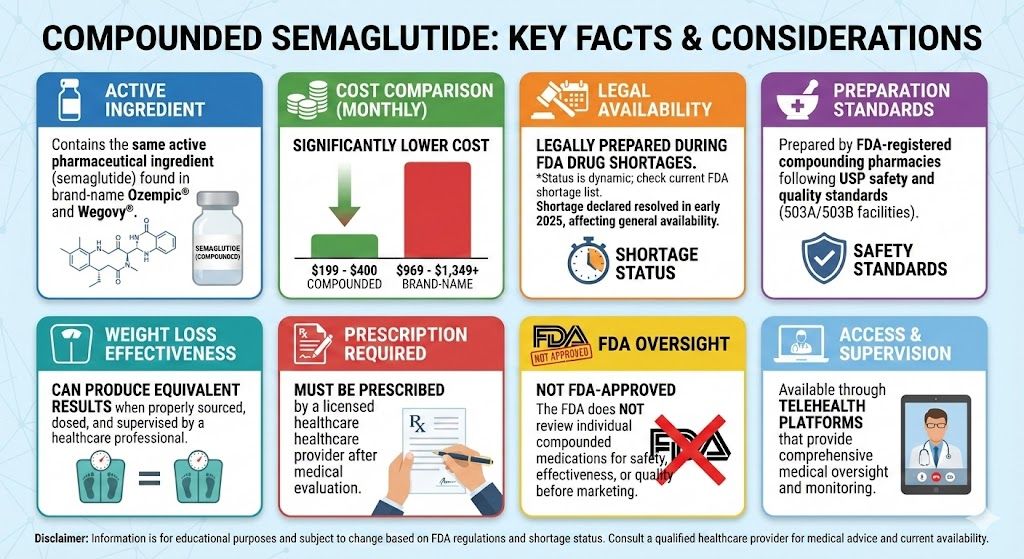
- Contains the same active ingredient (semaglutide) as brand-name Ozempic and Wegovy
- Costs $199 to $400 monthly compared to $969 to $1,349 for brand-name options
- Legally available when brand-name medications are in shortage (current status)
- Prepared by FDA-registered compounding pharmacies following safety standards
- Produces equivalent weight loss results when properly sourced and dosed
- Requires prescription from licensed healthcare provider
- Not FDA-approved but FDA doesn’t regulate individual compounded medications
- Available through telehealth platforms with comprehensive medical oversight
What Is Compounded Semaglutide?
Compounded semaglutide is a custom-prepared version of the same medication found in Ozempic and Wegovy. Instead of coming from a large pharmaceutical manufacturer in pre-filled branded pens, it’s prepared by specialized compounding pharmacies.
Compounding pharmacies have existed for decades, creating customized medications when patients need different doses, formulations, or combinations than what’s commercially available. They operate under strict regulations and must register with the FDA and state pharmacy boards.
When you get compounded semaglutide, you’re receiving the identical active pharmaceutical ingredient that Novo Nordisk uses in their brand-name products. The difference lies in how it’s packaged and delivered. Compounded versions typically come in vials that you draw from using standard insulin syringes rather than pre-filled pens.
Think of it like generic versus brand-name medications, except compounding happens before a generic version officially exists. The active ingredient remains the same, but you’re not paying for branded packaging, extensive marketing campaigns, or pharmaceutical company profit margins.
Is Compounded Semaglutide Legal?
Yes, compounded semaglutide is legal under specific circumstances defined by federal law. The legality depends on drug shortage status and proper pharmacy compliance.
When Compounding Is Allowed
Federal law permits compounding pharmacies to create versions of FDA-approved medications when those medications are in short supply. Both Ozempic and Wegovy have been on the FDA drug shortage list at various times since 2022. When a drug appears on this shortage list, compounding pharmacies can legally prepare versions to meet patient demand.
As of early 2025, semaglutide medications continue experiencing supply constraints, making compounded versions legally available. The FDA maintains an active drug shortage database that you can check to verify current status.
Compounding is also allowed when patients need customized doses not available commercially or when they have allergies to inactive ingredients in brand-name formulations.
Regulatory Oversight
Compounding pharmacies operate under FDA and state pharmacy board oversight. They must register with the FDA, follow current good manufacturing practices, maintain sterile compounding environments, test products for potency and contamination, and document all processes thoroughly.
Reputable providers work exclusively with compounding pharmacies that maintain these standards. When evaluating any provider, verify their pharmacy is registered with the FDA and licensed in their operating state.
Legal vs Legitimate
Just because something is legal doesn’t automatically make every provider legitimate. Some companies cut corners, use questionable sources for ingredients, or operate without proper oversight. That’s why choosing a reputable provider matters significantly. More on this later.
How Compounded Semaglutide Is Made
Understanding the compounding process helps address safety concerns and quality questions.
Source of Active Ingredient
Legitimate compounding pharmacies source semaglutide from FDA-registered suppliers that provide pharmaceutical-grade active ingredients. These suppliers must document ingredient purity, provide certificates of analysis, and meet strict quality standards.
The semaglutide powder used in compounding comes from the same or equivalent chemical synthesis processes that pharmaceutical manufacturers use. It’s not a different substance or inferior version.
Compounding Process
The pharmacy receives pharmaceutical-grade semaglutide powder and compounds it into injectable solutions in sterile cleanroom environments. Pharmacists calculate precise concentrations based on prescribed doses, mix the active ingredient with sterile water and appropriate stabilizers, filter the solution to ensure sterility, fill vials in controlled conditions, and test samples for potency and contamination.
This process follows United States Pharmacopeia (USP) standards for sterile compounding, particularly USP Chapter 797 which governs preparation of sterile medications.
Quality Control
Reputable compounding pharmacies implement multiple quality checks throughout the process. They test raw ingredients before use, verify concentrations in finished products, check for bacterial contamination, confirm pH levels and stability, and maintain detailed batch records.
These quality measures ensure the final product contains the correct amount of active ingredient and remains safe for injection.
Compounded Semaglutide vs Brand-Name: Effectiveness
The most important question: does compounded semaglutide work as well as Ozempic or Wegovy?
Same Active Ingredient
When properly compounded from pharmaceutical-grade semaglutide, compounded versions contain the identical chemical structure as brand-name products. Semaglutide is semaglutide, regardless of who prepares it.
The medication works through the same mechanism, activating GLP-1 receptors in your brain and gut to suppress appetite, slow gastric emptying, and improve blood sugar control. These effects don’t depend on branded packaging.
Expected Weight Loss Results
Clinical trials showing 14.9% average weight loss over 68 weeks used semaglutide at 2.4 mg weekly. This is the same dose available through compounding. People using properly dosed compounded semaglutide should expect similar results to those seen in clinical trials and real-world use of brand-name versions.
For detailed expectations, read our complete guide to semaglutide weight loss results.
Potential Variables
The effectiveness of compounded semaglutide depends on proper compounding practices. If a pharmacy uses insufficient active ingredient, stores medication incorrectly, or allows contamination, effectiveness could be compromised. This is why choosing a reputable provider with proper quality controls is critical.
When sourced from legitimate compounding pharmacies following proper standards, compounded semaglutide performs equivalently to brand-name versions. The clinical mechanisms don’t change based on who prepared the medication.
Cost Comparison: Compounded vs Brand-Name
The price difference between compounded and brand-name semaglutide is dramatic.
Brand-Name Costs
Wegovy: $1,349 per month without insurance Ozempic: $969 per month without insurance
Even with insurance coverage, copays often range from $100 to $300 monthly. Many insurance plans exclude weight loss medications entirely, forcing patients to pay full retail prices or abandon treatment.
Over a year, brand-name semaglutide costs $11,600 to $16,200 out of pocket. For many people, this makes long-term treatment impossible regardless of how effective the medication is.
Compounded Semaglutide Costs
Compounded semaglutide typically costs $199 to $400 monthly depending on the provider and what’s included in the price.
TrimRx offers compounded semaglutide at $199 per month, all-inclusive. This covers consultation with a licensed medical provider, the compounded medication at appropriate doses, all injection supplies (syringes, needles, alcohol pads, sharps container), cold-chain shipping to maintain medication stability, monthly follow-up appointments and dose adjustments, and ongoing access to medical support.
No hidden fees, no separate charges for consultations or supplies, no membership costs.
Annual Cost Comparison
Brand-name Wegovy: $16,188 annually Brand-name Ozempic: $11,628 annually
Compounded semaglutide (TrimRx): $2,388 annually
Using compounded semaglutide saves $9,240 to $13,800 annually compared to brand-name options. For most people, this difference determines whether long-term treatment is financially feasible.
What About Insurance?
Most insurance plans don’t cover compounded medications. However, since many plans also don’t cover brand-name weight loss medications, this often becomes a moot point. When insurance denies brand-name coverage, paying $199 monthly out-of-pocket for compounded semaglutide beats paying $969 or $1,349 for brand-name versions.
If your insurance does cover brand-name semaglutide with a reasonable copay (under $100 monthly), staying with brand-name often makes sense. But when insurance denies coverage or charges high copays, compounded versions provide accessible alternatives.
Safety Considerations
Legitimate concerns about safety deserve thorough answers.
FDA Oversight of Compounding
The FDA doesn’t approve individual compounded medications the way it approves brand-name drugs. However, the FDA does regulate compounding pharmacies through registration requirements, inspection authority, and enforcement actions against pharmacies violating standards.
State pharmacy boards provide additional oversight, licensing compounding pharmacies and conducting regular inspections.
This regulatory structure differs from the rigorous approval process brand-name drugs undergo, which includes extensive clinical trials and manufacturing oversight. Compounded medications don’t go through this process, which is why choosing reputable compounding pharmacies matters.
Potential Risks
Risks with compounded semaglutide primarily relate to pharmacy quality and practices:
Dosing inconsistencies can occur if pharmacies don’t maintain proper quality control, leading to vials containing more or less semaglutide than labeled.
Contamination becomes possible if pharmacies don’t maintain sterile compounding environments or follow proper aseptic techniques.
Ingredient quality varies if pharmacies source from unreliable suppliers or use substandard raw materials.
Improper storage can degrade medication effectiveness if pharmacies or patients don’t maintain appropriate refrigeration.
These risks are minimized when working with FDA-registered compounding pharmacies that follow USP standards and implement rigorous quality controls.
Comparing Safety to Brand-Name
Brand-name medications undergo more extensive testing and oversight than compounded versions. Pharmaceutical manufacturers must prove safety and efficacy through clinical trials, maintain strict manufacturing standards, and conduct ongoing quality monitoring.
However, properly compounded semaglutide from reputable pharmacies following established standards presents minimal additional risk. The active ingredient is the same, the mechanism of action is identical, and the side effect profile doesn’t change based on who prepared the medication.
The key differentiator is choosing legitimate providers who prioritize quality and safety over profit maximization.
How to Choose a Legitimate Provider
Not all compounded semaglutide providers operate with equal quality and integrity. Here’s what to look for.
Verify Pharmacy Credentials
Ask which compounding pharmacy prepares the medication. Verify the pharmacy is registered with the FDA (check FDA.gov database), licensed in their operating state, and accredited by PCAB (Pharmacy Compounding Accreditation Board) if possible.
Legitimate providers readily share this information. Companies that won’t disclose their pharmacy source raise red flags.
Require Medical Oversight
Weight loss medications should only be prescribed after proper medical evaluation. Legitimate providers require comprehensive health assessments, prescribe through licensed healthcare providers, conduct follow-up appointments to monitor progress, and adjust doses based on individual response and tolerability.
Avoid providers offering semaglutide without medical consultations or oversight. These arrangements compromise safety and often indicate broader quality issues.
Check What’s Included
Understand exactly what the quoted price covers. Better providers include consultations, medication, supplies, shipping, and follow-ups in one flat rate. Less reputable providers advertise low medication costs but add fees for consultations, supplies, shipping, or follow-up appointments.
Look for Transparency
Quality providers are transparent about their sources, processes, and credentials. They clearly explain where medication comes from, how it’s compounded, what quality controls exist, and what medical oversight is provided.
Companies that make vague claims, can’t answer basic questions about compounding sources, or use high-pressure sales tactics warrant skepticism.
Avoid Red Flags
Steer clear of providers who offer semaglutide without prescriptions, advertise prices that seem unrealistically low (under $150 monthly), make guarantees about specific weight loss amounts, won’t disclose their compounding pharmacy, or pressure you to purchase multiple months upfront.
For comprehensive guidance, read our detailed article on how to buy semaglutide online safely and legally.
Getting Started with Compounded Semaglutide
The process of accessing compounded semaglutide through legitimate telehealth providers is straightforward.
Initial Consultation
You’ll complete a comprehensive medical intake form covering your health history, current medications, weight loss goals, previous weight loss attempts, and any relevant medical conditions. This typically takes 10 to 15 minutes.
A licensed healthcare provider reviews your information and determines if semaglutide is appropriate for you. Factors they consider include your BMI (typically need 30 or higher, or 27 with weight-related health conditions), overall health status, contraindications, and realistic treatment goals.
Prescription and Fulfillment
If approved, the provider writes a prescription for compounded semaglutide at an appropriate starting dose. The prescription goes to the partnered compounding pharmacy, which prepares your medication and ships it directly to you with all necessary supplies and detailed instructions.
Cold-chain shipping maintains proper refrigeration during transit, ensuring medication stability.
Starting Treatment
You’ll begin at the standard starting dose of 0.25 mg weekly. Most providers include video instructions or written guides explaining injection technique, proper storage, dose administration, and what to expect during the first few weeks.
The injection process is straightforward. After cleaning your injection site (abdomen, thigh, or upper arm), you draw the prescribed amount into a small insulin syringe and inject subcutaneously. The needles are thin and short, making injections relatively comfortable.
Ongoing Support
Legitimate providers include monthly follow-ups to monitor your progress, assess side effects, adjust doses as you titrate up, and provide ongoing support throughout your weight loss journey.
You’ll gradually increase doses following the standard escalation schedule, reaching maintenance doses within 16 to 20 weeks.
Compounded Semaglutide vs Compounded Tirzepatide
If you’re considering compounded medications, you might also be wondering about compounded tirzepatide as an alternative.
Effectiveness Comparison
Tirzepatide (the active ingredient in Mounjaro and Zepbound) produces higher average weight loss than semaglutide in clinical trials. The SURMOUNT-1 trial showed 22.5% average weight loss with tirzepatide versus 14.9% with semaglutide in the STEP-1 trial.
Both medications work remarkably well, but tirzepatide shows a clear advantage in head-to-head comparisons. For detailed analysis, see our complete comparison of semaglutide versus tirzepatide.
Cost Difference
Compounded tirzepatide costs $349 monthly through TrimRx, compared to $199 for compounded semaglutide. That $150 monthly difference adds up to $1,800 annually.
The question becomes whether the additional weight loss potential (roughly 7 to 8 percentage points more on average) justifies the higher cost for your situation.
Choosing Between Them
Many people start with compounded semaglutide given its lower cost and excellent effectiveness. If results are good and side effects manageable, staying with semaglutide makes practical sense. If weight loss plateaus or you want to maximize results, switching to tirzepatide becomes a logical next step.
For details on tirzepatide pricing specifically, check our compounded tirzepatide cost guide.
Common Misconceptions About Compounded Semaglutide
Several myths and misunderstandings circulate about compounded medications.
“It’s Fake or Diluted Semaglutide”
When properly sourced from FDA-registered compounding pharmacies, compounded semaglutide contains pharmaceutical-grade active ingredient at proper concentrations. It’s not fake, diluted, or somehow inferior. The chemical structure is identical to brand-name versions.
Quality issues arise only when working with disreputable providers using questionable sources or improper compounding practices. This is why provider selection matters.
“It Won’t Work as Well”
Properly compounded semaglutide at correct doses produces equivalent results to brand-name versions. The mechanism of action doesn’t change based on who prepared the medication. Clinical effects depend on the active ingredient and dose, not the packaging or brand name.
“It’s Not FDA Approved So It’s Dangerous”
The FDA doesn’t approve individual compounded medications, but this doesn’t mean they’re dangerous. Compounding pharmacies operate under FDA and state board oversight. When pharmacies follow proper standards, compounded medications are safe and effective.
The distinction is between FDA-approved drugs (which undergo extensive clinical trials) and FDA-regulated pharmacies (which must follow manufacturing and safety standards).
“Insurance Will Never Cover It”
This is generally true, but it often doesn’t matter. Most insurance plans also don’t cover brand-name semaglutide for weight loss. When insurance denies brand-name coverage anyway, the inability to use insurance for compounded versions becomes irrelevant. Out-of-pocket costs for compounded semaglutide are often lower than insurance copays for brand-name versions.
“You Can’t Trust Online Providers”
While caution is warranted, many legitimate telehealth providers offer compounded semaglutide with proper medical oversight and quality standards. The key is doing due diligence, verifying credentials, checking pharmacy sources, and ensuring comprehensive medical supervision.
Legitimate telehealth providers aren’t inherently less trustworthy than traditional in-person care. They simply offer a different access model.
Side Effects and What to Expect
Compounded semaglutide causes the same side effects as brand-name versions since it’s the same active ingredient working through identical mechanisms.
Common Side Effects
Nausea affects about 30 to 44% of people, especially during the first few weeks at each new dose. It typically peaks shortly after your injection and improves over several days.
Diarrhea occurs in roughly 30% of users, usually mild and temporary.
Constipation affects approximately 24% of people due to slowed gastric emptying and reduced food intake.
Reduced appetite is the intended effect, though sometimes it feels extreme.
Fatigue hits some people during initial adjustment periods.
Vomiting happens less frequently but can occur if you eat too much despite reduced appetite.
For detailed guidance on managing these effects, see our complete guide to Ozempic for weight loss, which covers semaglutide side effects comprehensively.
Managing Side Effects
Start with smaller, more frequent meals instead of three large ones. Avoid fatty, greasy, or spicy foods initially. Stay well hydrated throughout each day. Take your injection on a convenient day when you can rest if needed. Stop eating when satisfied, even if food remains on your plate. Give side effects time to improve, as most decrease substantially after 2 to 3 weeks at each dose.
Serious Side Effects
Rare but serious side effects include pancreatitis, gallbladder problems, kidney issues (usually from dehydration), and thyroid concerns. Don’t use semaglutide if you have personal or family history of medullary thyroid cancer or Multiple Endocrine Neoplasia syndrome type 2.
Contact your provider immediately if you experience severe abdominal pain, persistent vomiting, signs of kidney problems, or significant changes in health status.
Frequently Asked Questions
Is compounded semaglutide as effective as Ozempic or Wegovy?
When properly compounded from pharmaceutical-grade ingredients at correct doses, compounded semaglutide works identically to brand-name versions. The active ingredient is the same, the mechanism of action is identical, and expected weight loss results are equivalent. Effectiveness depends on choosing reputable providers who work with quality compounding pharmacies.
How much does compounded semaglutide cost?
Prices typically range from $199 to $400 monthly depending on the provider and what’s included. TrimRx offers compounded semaglutide at $199 per month with everything included. This compares to $969 monthly for Ozempic and $1,349 for Wegovy, representing savings of $770 to $1,150 monthly.
Is compounded semaglutide legal?
Yes, compounded semaglutide is legal when prepared by licensed compounding pharmacies during periods when brand-name versions are in shortage. Both Ozempic and Wegovy have experienced supply constraints, making compounded versions legally available under federal compounding regulations.
Will my insurance cover compounded semaglutide?
Insurance typically doesn’t cover compounded medications. However, many insurance plans also don’t cover brand-name semaglutide for weight loss, making this distinction less relevant. When paying out of pocket, compounded versions at $199 monthly cost significantly less than brand-name options even with insurance copays.
How do I know if a compounded semaglutide provider is legitimate?
Verify the compounding pharmacy is FDA-registered and state-licensed. Ensure the provider requires comprehensive medical evaluations and oversight from licensed healthcare professionals. Check that pricing is transparent with no hidden fees. Look for clear information about medication sources and quality controls. Avoid providers offering semaglutide without prescriptions or making unrealistic promises.
Can I switch from Ozempic or Wegovy to compounded semaglutide?
Yes, switching is straightforward since it’s the same medication. Your provider can convert your current dose directly. For example, if you’re stable on 1 mg weekly of brand-name semaglutide, you’d continue at 1 mg weekly with compounded version. The transition is seamless.
What supplies do I need for compounded semaglutide?
You’ll need insulin syringes (typically 0.5 mL or 1 mL capacity), alcohol pads for cleaning injection sites, a sharps container for safe needle disposal, and refrigeration for medication storage. Reputable providers include all necessary supplies with your medication at no additional cost.
How long can I stay on compounded semaglutide?
You can continue compounded semaglutide as long as brand-name versions remain in shortage and you benefit from treatment. Many people use it indefinitely for weight maintenance. When people stop semaglutide, they typically regain much of the lost weight within 6 to 12 months, making long-term treatment often necessary.
What’s the difference between compounded semaglutide and compounded tirzepatide?
They’re different medications with different active ingredients. Semaglutide (in Ozempic/Wegovy) acts on GLP-1 receptors only. Tirzepatide (in Mounjaro/Zepbound) acts on both GLP-1 and GIP receptors, producing higher average weight loss but at higher cost. Compounded semaglutide costs $199 monthly while compounded tirzepatide costs $349 monthly through TrimRx.
Do I need a prescription for compounded semaglutide?
Yes, semaglutide is a prescription medication regardless of whether it’s brand-name or compounded. Legitimate providers require consultations with licensed healthcare providers who evaluate your medical appropriateness before prescribing. Any source offering semaglutide without prescriptions is operating illegally and should be avoided.
Making Your Decision
Compounded semaglutide provides a practical, affordable path to accessing one of the most effective weight loss medications available. When sourced from legitimate providers working with FDA-registered compounding pharmacies, it offers equivalent effectiveness to brand-name versions at a fraction of the cost.
The decision to use compounded versus brand-name semaglutide often comes down to practical considerations around cost and access. If your insurance covers brand-name with reasonable copays, staying with brand-name makes sense. If insurance denies coverage or charges prohibitive copays, compounded semaglutide at $199 monthly makes long-term treatment financially feasible.
The most important factors are choosing reputable providers with proper medical oversight, verifying compounding pharmacy credentials and quality standards, and maintaining realistic expectations about the commitment required for successful weight loss.
TrimRx provides compounded semaglutide at $199 per month with comprehensive support throughout your journey. All-inclusive pricing covers consultations, medication, supplies, and ongoing medical oversight. Get started with a simple online consultation and begin working toward your weight loss goals with affordable access to proven medication.

Transforming Lives, One Step at a Time
Keep reading

Construction Work in Summer on a GLP-1
Summer on a job site means early starts, heavy physical work, direct sun or hot interiors, and lunch from a cooler or the back…

Colonoscopy Prep on a GLP-1
If you are on a GLP-1 and have a colonoscopy, upper endoscopy, or any procedure with sedation coming up, the single most important step…

Clergy and Community Meals on a GLP-1
For pastors, priests, rabbis, imams, chaplains, and other community leaders, food is part of the work. Potlucks, fellowship dinners, holiday meals, funeral receptions, and…


