How Long Does Tirzepatide Stay in Your System? (2026 Guide)
If you’re taking tirzepatide and dealing with side effects, planning to stop treatment, thinking about pregnancy, or just want to understand how the medication works in your body, knowing how long it stays in your system helps you make informed decisions.
Here’s what you need to know: tirzepatide has a half-life of approximately five days, which is slightly shorter than semaglutide’s seven-day half-life. After your last injection, it takes about three to four weeks for tirzepatide to completely leave your system. The exact timeline varies based on individual factors like kidney function, body weight, and how long you’ve been on treatment.
This guide explains what this timeline means in practical terms, why tirzepatide was designed with this specific duration, what happens as it clears from your body, and why understanding this matters for various situations you might face.
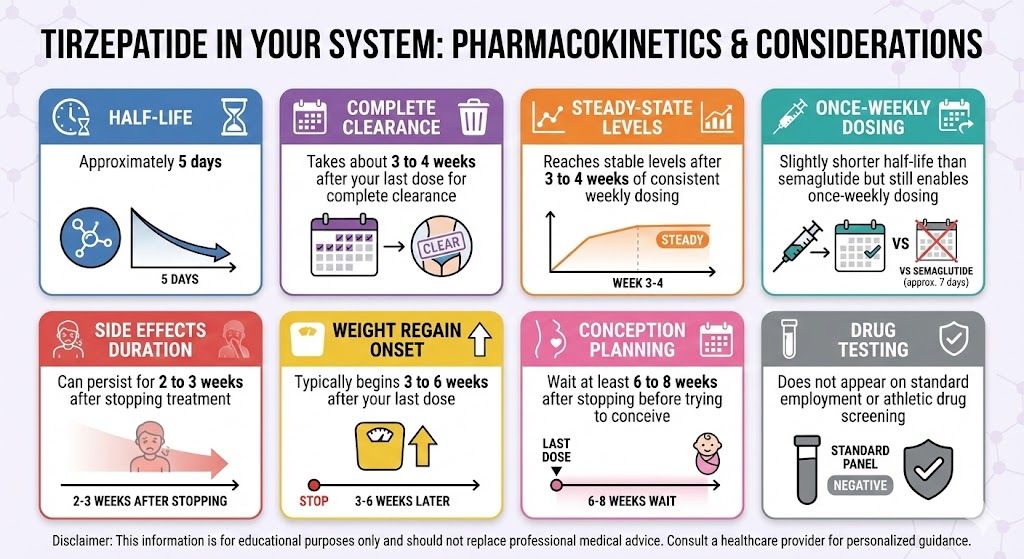
Key Takeaways: Tirzepatide in Your System
- Tirzepatide has a half-life of approximately 5 days
- Takes about 3 to 4 weeks after your last dose for complete clearance
- Reaches steady-state levels after 3 to 4 weeks of consistent weekly dosing
- Slightly shorter half-life than semaglutide but still enables once-weekly dosing
- Side effects can persist for 2 to 3 weeks after stopping treatment
- Weight regain typically begins 3 to 6 weeks after your last dose
- Wait at least 6 to 8 weeks after stopping before trying to conceive
- Does not appear on standard employment or athletic drug screening
What Half-Life Means for Tirzepatide
Understanding half-life helps make sense of how tirzepatide works in your body over time.
A medication’s half-life is the time required for your body to eliminate half of the drug. For tirzepatide, that’s approximately five days. If you inject 10 mg of tirzepatide on Monday, by Saturday roughly 5 mg remains in your system. By Thursday of the next week, about 2.5 mg remains. The amount continues halving every five days.
This doesn’t mean the medication stops working after five days. Enough remains between your weekly injections to maintain continuous effects. This is exactly why tirzepatide only needs weekly dosing instead of daily injections. The five-day half-life creates sustained medication levels that last throughout the week.
Compare this to medications with very short half-lives that require multiple doses throughout the day. Tirzepatide’s pharmaceutical design specifically aimed to create a long-lasting version that patients would find convenient enough to use consistently over months or years.
The medication achieves this extended duration through molecular modifications that protect it from rapid breakdown. Natural GLP-1 and GIP hormones that tirzepatide mimics last only minutes in your body. Tirzepatide’s engineered structure extends this to days, making practical treatment possible.
Timeline from First Dose to Complete Clearance
Let’s walk through what happens to tirzepatide levels from the moment you start treatment through complete elimination.
Building to Steady State: First Few Weeks
When you begin tirzepatide at the standard 2.5 mg starting dose, medication levels start accumulating in your system. After your first injection, some tirzepatide remains when you take your second dose one week later. This building process continues with each weekly injection.
It takes approximately three to four weeks of consistent weekly dosing for tirzepatide to reach steady state. At this point, the amount your body eliminates between doses equals the amount you’re adding with each injection. Medication levels stabilize within a relatively consistent range.
This is why many people don’t experience full effects during the first few weeks. You’re still building toward therapeutic levels. The appetite suppression and metabolic benefits become more pronounced once steady-state levels are established.
Tirzepatide reaches steady state slightly faster than semaglutide (3 to 4 weeks versus 4 to 5 weeks) due to its shorter half-life. This means you might notice effects somewhat sooner with tirzepatide, though the difference is modest.
During Treatment: Maintaining Steady Levels
Once you achieve steady state, weekly injections keep tirzepatide levels relatively constant. You’ll have a small peak shortly after injection and a gradual decline before your next dose, but the range stays narrow enough to produce consistent effects throughout the week.
This stability creates the continuous appetite suppression and metabolic improvements you experience on tirzepatide. The medication doesn’t have dramatic ups and downs in effectiveness like drugs with very short half-lives might.
After Stopping: The Elimination Process
When you take your final tirzepatide dose, here’s how the clearance unfolds:
Days 1 to 5 after last dose: About 50% of the medication remains. You’ll still experience strong appetite suppression and other effects. Most people don’t notice significant changes during this initial period.
Days 6 to 10 after last dose: About 25% remains. Effects start diminishing more noticeably. Appetite often begins returning, though not to pre-treatment levels yet.
Days 11 to 15 after last dose: About 12.5% remains. Appetite continues increasing. Weight loss typically stops during this period, and some people start regaining small amounts.
Days 16 to 20 after last dose: About 6% remains. Effects are minimal at this point. Hunger and food thoughts usually return close to pre-treatment levels.
Days 21 to 28 after last dose: About 3% or less remains. For practical purposes, tirzepatide is mostly eliminated. Any remaining trace amounts produce negligible effects.
Beyond 4 weeks: Tirzepatide is considered completely cleared from your system.
This timeline assumes normal organ function. People with significant kidney or liver impairment might clear tirzepatide somewhat more slowly.
For context on what weight loss to expect during treatment, see our complete guide to tirzepatide results month by month.
Why Tirzepatide Has This Specific Half-Life
The pharmaceutical engineering behind tirzepatide involved deliberate choices to achieve optimal duration in your body.
Natural GIP and GLP-1 hormones that tirzepatide mimics have half-lives measured in minutes. Your body rapidly breaks them down after release. This created a major challenge for developing medications based on these hormones because they would require constant infusion to maintain levels.
Eli Lilly solved this through strategic molecular modifications. They attached chemical groups that allow tirzepatide to bind to albumin in your blood, protecting it from rapid degradation. They engineered resistance to enzymes that normally break down GIP and GLP-1 quickly. These changes extended the half-life from minutes to five days.
The five-day half-life specifically was chosen because it’s long enough to enable convenient once-weekly dosing but short enough to allow relatively quick dose adjustments and faster clearance if needed compared to even longer-acting alternatives.
Tirzepatide’s half-life falls between older GLP-1 medications like liraglutide (requiring daily dosing) and semaglutide (seven-day half-life). This middle ground provides a good balance of convenience and flexibility.
Factors Affecting Tirzepatide Clearance
While five days represents the average half-life, individual variation exists based on several factors.
Kidney Function
Your kidneys play a limited role in eliminating tirzepatide. Most breakdown happens through general protein degradation throughout your body rather than specific kidney processing. However, people with moderate to severe kidney impairment might clear tirzepatide slightly more slowly.
If you have chronic kidney disease, your provider will consider this during treatment, though significant dose adjustments typically aren’t necessary unless kidney function is severely compromised.
Body Weight
Larger individuals might have slightly different medication distribution, but this doesn’t dramatically change the half-life. Clinical studies showed that tirzepatide clearance doesn’t vary significantly across different body weight ranges.
The standard dosing schedule works effectively for people across a wide weight spectrum from 150 pounds to 400-plus pounds.
Age Considerations
Older adults generally process medications more slowly due to age-related changes in organ function and metabolism. However, clinical trials with tirzepatide showed no clinically meaningful differences in clearance between younger and older adults.
Age alone doesn’t require dose modifications or extended clearance expectations.
Metabolic Rate
Individual differences in overall metabolism create minor variations in how quickly people process tirzepatide. These differences are usually small and don’t meaningfully impact treatment effectiveness or clearance timelines.
Treatment Duration
How long you’ve been taking tirzepatide doesn’t change its half-life. Someone on treatment for three months clears it at roughly the same rate as someone who’s been on it for two years. The medication doesn’t accumulate beyond steady-state levels regardless of how long you’ve been taking it.
What Happens After You Stop Tirzepatide
The clearance timeline directly affects what you experience after discontinuing treatment.
Return of Appetite
Appetite returns gradually over two to three weeks after your last dose. During the first few days, you’ll likely still feel significant appetite suppression. By week two, hunger starts returning but remains somewhat reduced compared to pre-treatment. By weeks three and four, appetite often returns close to or even above pre-treatment levels.
Some people report particularly intense hunger during weeks two through four after stopping, possibly as their body readjusts to the absence of GIP and GLP-1 receptor activation it had adapted to during treatment.
The dual-receptor action of tirzepatide means you’re not just losing GLP-1 effects but also GIP effects when it clears. Some people find this creates a more noticeable rebound in appetite compared to stopping single-action GLP-1 medications.
Weight Regain Patterns
Clinical studies tracking people after stopping tirzepatide show that weight regain typically begins within three to six weeks. The regain often happens gradually at first, then accelerates over the following months.
One study following participants for a year after stopping tirzepatide found that they regained about two-thirds of their lost weight on average. This pattern mirrors what happens with semaglutide and other GLP-1 medications.
The weight regain isn’t inevitable for everyone. Some people maintain portions of their loss through sustained lifestyle changes, but this requires significant ongoing effort and proves challenging for most people without continued medication support.
Side Effect Resolution
The positive side of clearance is that unwanted side effects also resolve as tirzepatide leaves your system. Nausea, if you were experiencing it, typically improves within one to two weeks after your last dose. Digestive issues like diarrhea or constipation usually normalize within two weeks. Reduced appetite returns to normal over two to three weeks.
If you stopped specifically because of intolerable side effects, you should see substantial improvement within 10 to 14 days and near-complete resolution by three weeks.
Metabolic Effects
Tirzepatide doesn’t permanently reset your metabolism or change your body’s weight set point. Once it clears, your metabolic rate and appetite regulation return to their pre-treatment state. This is why long-term weight maintenance typically requires either continued medication use or substantial, sustained lifestyle modifications.
Some metabolic improvements like better insulin sensitivity or lower blood pressure can persist if you’ve maintained significant weight loss through other means, but the direct medication effects disappear once tirzepatide is eliminated.
Tirzepatide and Pregnancy Planning
The three-to-four-week clearance timeline matters significantly if you’re considering pregnancy.
Recommended Waiting Period
Tirzepatide hasn’t been adequately studied in pregnant women. Animal studies showed potential risks to fetal development. The medication is not recommended during pregnancy or while actively trying to conceive.
Most healthcare providers recommend stopping tirzepatide and waiting at least six to eight weeks after your last dose before attempting pregnancy. This allows complete clearance (3 to 4 weeks) plus an additional safety buffer.
The waiting period for tirzepatide is somewhat shorter than for semaglutide (6 to 8 weeks versus 8 to 10 weeks) due to tirzepatide’s faster clearance. However, you should always follow your specific healthcare provider’s recommendations based on your individual situation.
Unplanned Pregnancy During Treatment
If you discover you’re pregnant while taking tirzepatide, stop the medication immediately and contact your healthcare provider. While concerning, exposure during very early pregnancy doesn’t automatically mean problems will occur. Your provider will ensure appropriate pregnancy monitoring and discuss relevant considerations.
Breastfeeding Considerations
Limited data exists about whether tirzepatide passes into breast milk or affects nursing infants. Most providers recommend avoiding tirzepatide while breastfeeding until more safety information becomes available.
If you’re planning to breastfeed, discuss appropriate timing for restarting tirzepatide with your healthcare team after delivery.
Male Partners and Conception
Current evidence doesn’t indicate that tirzepatide affects male fertility or requires men to stop treatment when their partner is trying to conceive. However, weight loss in men can improve fertility parameters, so timing of treatment might be a consideration worth discussing with your provider.
Tirzepatide and Drug Testing
People sometimes worry about whether tirzepatide will appear on various types of drug screening.
Employment and Standard Screening
Tirzepatide does not show up on standard drug tests used for pre-employment screening, random workplace testing, probation monitoring, or similar purposes. These tests screen for controlled substances and common drugs of abuse. Tirzepatide is a prescription peptide medication, not a controlled substance, and isn’t included in standard drug testing panels.
Athletic Drug Testing
Tirzepatide is not currently on the World Anti-Doping Agency (WADA) prohibited substance list or banned by most professional sports organizations. Athletes with legitimate medical prescriptions can use tirzepatide without violating anti-doping rules.
However, sports organizations periodically update prohibited substance lists, so athletes should verify current regulations with their specific governing body.
Medical Testing Considerations
If you’re undergoing medical procedures or testing that might be affected by tirzepatide, always inform your healthcare team. Tirzepatide affects glucose metabolism and might influence interpretation of metabolic tests.
Blood tests can detect tirzepatide if specifically tested for, though this rarely happens outside clinical research settings or unusual medical circumstances.
Switching Between Weight Loss Medications
Understanding tirzepatide’s clearance helps when transitioning to or from other medications.
Switching from Tirzepatide to Semaglutide
If you’re switching from tirzepatide to semaglutide, most providers recommend taking your first semaglutide dose one week after your last tirzepatide dose. This maintains some GLP-1 effect during the transition.
You’ll start semaglutide at its standard 0.25 mg beginning dose even if you were on high-dose tirzepatide. While you’re adapted to GLP-1 effects from tirzepatide, you’re losing the GIP component, and semaglutide has a different pharmacological profile that requires gradual introduction.
For detailed comparison of these medications, see our semaglutide vs tirzepatide guide.
Switching from Other Medications to Tirzepatide
If you’re coming from semaglutide or other GLP-1 medications, your provider will likely have you start tirzepatide at its standard 2.5 mg weekly dose. Take your first tirzepatide injection about one week after your last dose of the previous medication.
Even though you’re already adapted to GLP-1 effects, tirzepatide adds GIP receptor activation that’s new to your system. The standard titration schedule helps you adjust to this dual action.
Switching to Non-GLP-1 Medications
If you’re transitioning from tirzepatide to weight loss medications that don’t work through GLP-1/GIP mechanisms, timing depends on the specific medication. Some can start immediately, while others benefit from waiting until tirzepatide largely clears.
Discuss optimal switching strategies with your provider based on what you’re transitioning to and your specific circumstances.
Restarting Tirzepatide After a Break
If you stop tirzepatide and later want to restart, the approach depends on how long you’ve been off treatment.
Short Breaks (1 to 3 Weeks)
If you’ve only been off tirzepatide for one to three weeks, you might be able to resume at or near your previous dose rather than starting from the beginning. Some tirzepatide remains in your system during this window, and your body retains much of its adaptation.
Your provider might recommend dropping back one dose level for safety, then returning to your previous dose if you tolerate it well. For example, if you were stable at 10 mg and took a two-week break, you might restart at 7.5 mg for one or two weeks before going back to 10 mg.
Longer Breaks (More Than 3 Weeks)
If you’ve been off treatment for more than three weeks, most providers recommend starting over at 2.5 mg weekly and following the standard titration schedule. By three to four weeks off treatment, tirzepatide has fully cleared and your body has lost most of its adaptation.
Trying to restart at your previous therapeutic dose would likely cause significant side effects, much like starting at a high dose initially would.
Second Time Around
People restarting tirzepatide often find the experience somewhat easier than their first time. You know what to expect at each dose level, you’ve developed strategies for managing side effects, and you understand the pace of weight loss progression.
However, you’ll still need to work back up to therapeutic doses gradually. Be patient with the titration process even though you remember the effects from higher doses.
Comparing Tirzepatide to Semaglutide Clearance
If you’re deciding between these medications or considering switching, understanding their pharmacokinetic differences helps.
Tirzepatide’s five-day half-life is shorter than semaglutide’s seven-day half-life. This means tirzepatide clears from your system somewhat faster. Complete elimination takes about three to four weeks for tirzepatide versus five weeks for semaglutide.
Practically, this difference matters in a few situations. Tirzepatide clears faster if you need to stop for pregnancy planning or medical procedures. Side effects resolve somewhat sooner after stopping tirzepatide. Weight regain might begin slightly earlier after stopping tirzepatide since it clears faster.
However, during regular treatment, the difference is largely irrelevant. Both medications maintain excellent steady-state levels with once-weekly dosing. Both produce consistent appetite suppression throughout the week. The half-life difference doesn’t make either medication more or less effective for weight loss.
For detailed information about semaglutide’s timeline, see our guide to how long semaglutide stays in your system.
Practical Implications of Tirzepatide’s Clearance Timeline
Understanding how long tirzepatide remains in your body affects various practical decisions during treatment.
Managing Severe Side Effects
If you develop intolerable side effects, knowing they’ll persist for two to three weeks after stopping helps you make informed decisions. Some people experiencing severe nausea feel discouraged learning it takes several weeks to fully resolve.
However, you can often address side effects through dose reduction rather than complete discontinuation. Dropping back to your previous dose level might resolve issues while maintaining some treatment benefit and avoiding the need to restart from the beginning later.
Missed Dose Considerations
The five-day half-life provides some buffer if you miss a dose. Missing one weekly injection doesn’t mean levels immediately drop to zero. Partial medication effects continue for several days.
However, don’t interpret this as permission for inconsistent dosing. Regular weekly injections produce optimal results. The half-life provides a safety net, not a reason for carelessness.
Cost and Access Interruptions
If you experience temporary interruptions in medication access due to insurance issues, supply problems, or cost concerns, the clearance timeline affects how these gaps impact your treatment.
A one-week gap is easily managed. A two-week gap starts becoming more significant. A four-week gap means starting titration over. Understanding these thresholds helps you prioritize resolving access issues quickly.
Compounded tirzepatide at $349 monthly through TrimRx provides more affordable access than brand-name options ($1,069 monthly), reducing likelihood of cost-related treatment interruptions. For even more affordable options, compounded semaglutide costs $199 monthly.
Medical Procedures and Surgery
If you need surgery or procedures requiring temporary tirzepatide discontinuation, medical teams consider how long it stays in your system when planning. The delayed gastric emptying effect persists while medication remains, which can affect anesthesia timing and safety.
Always inform all healthcare providers about your tirzepatide use, including when you took your last dose.
Dosing Implications of Half-Life
Tirzepatide’s five-day half-life directly influences its dosing schedule and recommendations.
Why Weekly Dosing Works
The five-day half-life is long enough that meaningful medication levels persist throughout a full week between doses. By the time your next injection is due (seven days later), enough tirzepatide remains to bridge to the next dose without losing therapeutic effect.
This is why tirzepatide effectively suppresses appetite all week, not just for the first few days after injection.
Why You Can’t Dose More Frequently
Some people wonder if taking tirzepatide twice weekly would produce better results. This doesn’t work because the medication accumulates. Taking it more frequently than weekly would cause levels to build excessively, dramatically increasing side effects without proportionally improving weight loss.
The weekly schedule was carefully determined through clinical trials to optimize effectiveness while managing side effects.
Flexibility With Injection Day
While consistency matters, the five-day half-life provides some flexibility if you need to shift your injection day. If you normally inject on Mondays but need to move to Wednesdays for scheduling reasons, you can make this transition without major issues.
Take your injection on the new day and continue from there. The overlap in medication levels from your previous schedule bridges the transition smoothly.
For complete dosing information including the full titration schedule, see our comprehensive tirzepatide dosing guide.
Frequently Asked Questions
How long does tirzepatide take to completely leave your system?
Tirzepatide takes approximately 3 to 4 weeks after your last injection to completely clear from your body. The medication has a half-life of about 5 days, meaning levels halve every five days. After 3 to 4 weeks, remaining amounts are negligible and no longer produce meaningful effects.
Is tirzepatide cleared faster than semaglutide?
Yes, tirzepatide clears somewhat faster than semaglutide. Tirzepatide’s 5-day half-life means complete elimination in 3 to 4 weeks, compared to semaglutide’s 7-day half-life and 5-week clearance timeline. This one-to-two-week difference matters mainly for pregnancy planning or stopping due to side effects, but has minimal impact during regular treatment.
Will side effects continue after I stop taking tirzepatide?
Yes, side effects typically persist for 1 to 3 weeks after your last dose as medication gradually clears. Nausea usually improves within 1 to 2 weeks. Digestive issues normalize within 2 weeks. Appetite suppression wears off over 2 to 3 weeks. By week 4, most people experience complete resolution of both therapeutic effects and side effects.
How soon will I regain weight after stopping tirzepatide?
Most people begin regaining weight within 3 to 6 weeks after their last tirzepatide dose. Weight regain typically starts gradually, then accelerates over the following months. Studies show that one year after stopping, most people regain approximately two-thirds of their lost weight unless they’ve implemented substantial lifestyle changes or started alternative weight management approaches.
Can I take a break from tirzepatide and restart later?
Yes, you can take breaks and restart, but if you’re off treatment for more than 3 weeks, you’ll typically need to start over at the 2.5 mg beginning dose and work back up through the full titration schedule. Your body loses its adaptation once tirzepatide fully clears, making resumption at previous therapeutic doses likely to cause significant side effects.
How long after stopping tirzepatide should I wait before getting pregnant?
Most healthcare providers recommend waiting at least 6 to 8 weeks after your last tirzepatide dose before trying to conceive. This allows complete clearance (3 to 4 weeks) plus an additional safety margin. Tirzepatide isn’t recommended during pregnancy due to limited safety data and potential risks shown in animal studies.
Does tirzepatide show up on drug tests?
No, tirzepatide does not appear on standard drug screening tests used for employment, legal, or similar purposes. These tests look for controlled substances and common drugs of abuse. Tirzepatide is a prescription peptide medication that isn’t included in standard testing panels. It’s also not currently banned by major athletic organizations.
Can anything speed up how quickly tirzepatide leaves your body?
No, there’s no way to accelerate tirzepatide elimination. The medication breaks down naturally through protein degradation at a rate determined by its inherent half-life. Drinking more water, exercising, or other interventions won’t meaningfully speed clearance. Your body processes it at its own genetically and physiologically determined pace.
How long does tirzepatide stay effective between weekly doses?
Tirzepatide maintains therapeutic levels throughout the full week between injections due to its 5-day half-life. You’ll experience consistent appetite suppression and metabolic benefits from Monday’s injection all the way until the following Monday. The medication doesn’t wear off mid-week, though some people notice slightly more hunger the day or two before their next dose.
If I miss a dose, how much tirzepatide is still in my system?
If you miss your weekly dose, approximately 40 to 50% of your steady-state level remains from previous doses. This provides some continued effect, though reduced compared to consistent dosing. If you miss by just a day or two, take your dose when you remember. If you miss by several days or more, consult your provider about whether to take the missed dose or resume on your regular schedule.
Understanding Your Treatment Timeline
Tirzepatide’s five-day half-life and three-to-four-week clearance create important considerations throughout your treatment. The relatively long half-life enables convenient once-weekly dosing while maintaining consistent appetite suppression between injections. It provides some forgiveness for occasional missed doses and creates gradual side effect resolution after stopping.
However, the extended presence also means side effects persist for weeks after discontinuation, weight regain typically begins within several weeks of stopping, and pregnancy planning requires waiting at least six to eight weeks after your last dose.
This clearance timeline isn’t a flaw or concern. It’s an intentional pharmaceutical design that makes tirzepatide practical for long-term weight management while balancing convenience with flexibility. Understanding how long tirzepatide stays in your system helps you make informed decisions about starting treatment, managing side effects, planning breaks, considering pregnancy, or switching to alternative medications.
Whether you’re using brand-name Mounjaro or Zepbound, or choosing more affordable compounded tirzepatide, the pharmacokinetics remain identical. TrimRx provides compounded tirzepatide at $349 per month with comprehensive medical oversight to support you throughout your treatment journey. Get started with an online consultation and begin working toward your weight loss goals with full understanding of how the medication works in your body over time.

Transforming Lives, One Step at a Time
Keep reading

Cruise on a GLP-1: Seasickness, Buffets and Storage
A cruise combines three things that each interact with these medications: motion, unlimited food, and a week away from your usual routine and pharmacy….

Getting Married on a GLP-1: Planning Dose Timing, Fittings and the Day
A wedding puts three things on a calendar that do not usually meet: a medication with a weekly rhythm, a garment fitted to a…

Running Out of Your GLP-1 Abroad
Your bag went missing, the cooler failed, or you simply counted wrong. You are in another country and the next dose is due. Here…


