Semaglutide Half-Life and Duration: What You Need to Know

When you read about semaglutide, you’ll often see references to its “half-life” of about seven days. If you’re like most people, you might understand this has something to do with how long the medication lasts in your body, but the practical implications might not be immediately clear.
Understanding semaglutide’s half-life helps explain several important aspects of treatment. Why do you only need to inject once weekly instead of daily? How long does it take for the medication to start working fully? What happens if you miss a dose? Why do side effects persist for weeks after stopping? The seven-day half-life answers all these questions.
This guide breaks down what half-life means in practical terms, how it affects semaglutide’s duration of action, why this specific half-life makes the medication so effective, and what it means for your day-to-day experience on treatment.
Key Takeaways: Semaglutide Half-Life
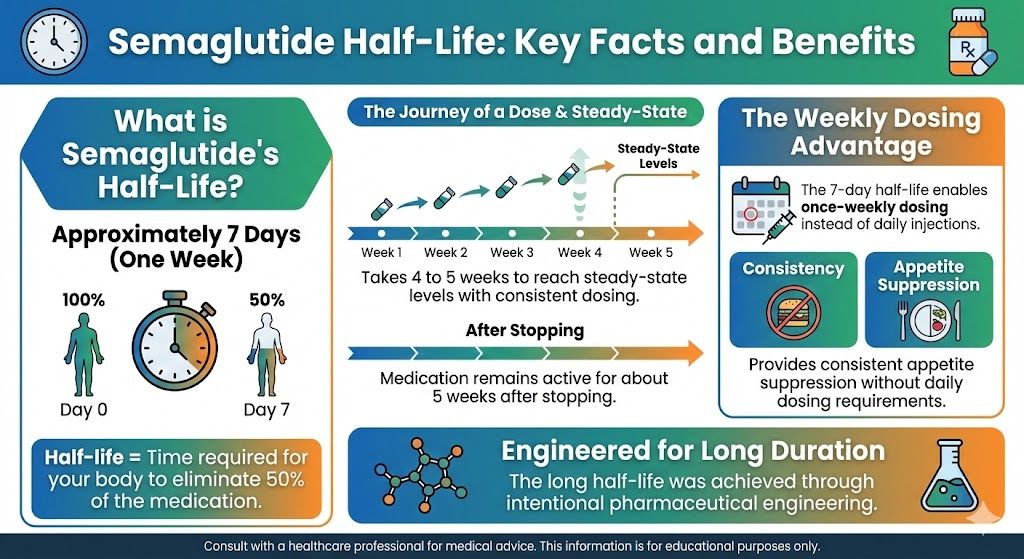
- Semaglutide has a half-life of approximately 7 days (one week)
- Half-life refers to time required for your body to eliminate 50% of the medication
- The 7-day half-life enables once-weekly dosing instead of daily injections
- Takes 4 to 5 weeks to reach steady-state levels with consistent dosing
- Duration of action extends throughout the full week between injections
- Medication remains active in your system for about 5 weeks after stopping
- The long half-life was achieved through intentional pharmaceutical engineering
- Provides consistent appetite suppression without daily dosing requirements
What Half-Life Actually Means
The term “half-life” sounds technical, but the concept is straightforward once you understand it.
A medication’s half-life is the time it takes for the amount in your body to reduce by half. For semaglutide, this happens every seven days. If you inject 1 mg of semaglutide today, one week from now approximately 0.5 mg remains in your system. After another week, about 0.25 mg remains. After a third week, roughly 0.125 mg remains. The amount keeps halving every seven days.
This gradual reduction happens because your body constantly breaks down and eliminates semaglutide through natural metabolic processes. The medication doesn’t suddenly disappear all at once. Instead, levels decline predictably according to the mathematical curve defined by the half-life.
Think of it like a slowly deflating balloon rather than a popped one. The air (or in this case, medication) escapes gradually over time rather than all at once.
The half-life is an inherent property of the medication itself, determined by its chemical structure and how your body processes it. Pharmaceutical companies can’t arbitrarily decide a medication should have a certain half-life. The molecular design determines how quickly or slowly your body breaks it down.
Why Semaglutide’s 7-Day Half-Life Matters
The seven-day half-life isn’t random. It represents a breakthrough in pharmaceutical design that solved a major challenge in developing GLP-1 medications.
Natural GLP-1, the hormone semaglutide mimics, has a half-life of only about two minutes. Your body breaks it down almost instantly after it’s released from your intestines. This presented an enormous obstacle for creating GLP-1 medications. A drug that disappears in two minutes would require continuous intravenous infusion to maintain any effect.
Early GLP-1 medications partially solved this problem. Exenatide, one of the first approved, extended the half-life enough to allow twice-daily injections. Liraglutide improved further to once-daily dosing with a half-life of about 13 hours. But patients still needed daily injections, and adherence proved challenging.
Novo Nordisk aimed higher with semaglutide. They engineered molecular modifications that extended the half-life to seven days, enabling truly once-weekly dosing. This represented a genuine advance in convenience and likely improved treatment adherence significantly.
The seven-day half-life specifically balances several competing factors. It’s long enough to maintain therapeutic levels throughout a full week between doses. It’s short enough that dose adjustments take effect within reasonable timeframes. It allows complete clearance within a predictable period if stopping becomes necessary. Any shorter and weekly dosing wouldn’t work reliably. Much longer and the medication might accumulate excessively or take too long to clear.
How Semaglutide Achieves Its Long Half-Life
The pharmaceutical chemistry behind semaglutide’s seven-day half-life involves sophisticated molecular engineering.
Novo Nordisk started with the structure of natural GLP-1 and made several key modifications. They attached a C-18 fatty acid chain to the molecule. This fatty acid acts like an anchor, allowing semaglutide to bind strongly to albumin, a protein abundant in your blood. When bound to albumin, semaglutide is protected from the enzymes and processes that would normally break it down quickly.
They also made specific amino acid substitutions that provide resistance to DPP-4, an enzyme that rapidly degrades natural GLP-1. These changes prevent the quick breakdown that limits natural GLP-1 to a two-minute half-life.
The albumin binding is particularly clever. Albumin has a long half-life itself, about 20 days. By piggybacking on albumin, semaglutide essentially borrows some of that longevity. The medication slowly releases from albumin over time, maintaining steady levels in your bloodstream while being protected from rapid elimination.
These modifications don’t change how semaglutide activates GLP-1 receptors or its therapeutic effects. They simply extend how long it remains active in your body. The medication still works the same way as natural GLP-1 at its target receptors. It just lasts dramatically longer.
This type of pharmaceutical engineering has become increasingly sophisticated. Researchers can now design molecules with specific half-lives targeted to optimal dosing schedules. Semaglutide represents one successful example of this approach.
Understanding Steady-State Concentrations
Half-life directly determines how long it takes to reach steady-state medication levels, which matters for when you’ll experience full effects.
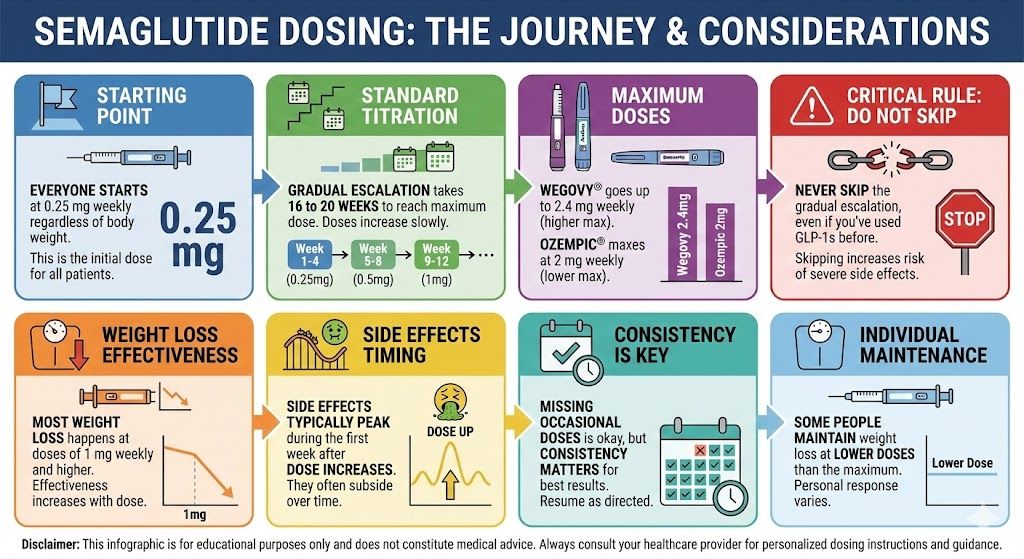
When you start semaglutide at 0.25 mg weekly, medication begins accumulating in your system. After your first injection, levels rise and then start declining according to the seven-day half-life. Before levels drop too far, you inject your second dose one week later. This new dose adds to the remaining amount from the first injection.
This accumulation continues with each weekly dose. Levels build higher and higher until eventually reaching a plateau called steady state. At steady state, the amount your body eliminates between doses equals the amount you’re adding with each injection. Levels stabilize within a relatively narrow range that fluctuates slightly but remains generally constant.
For semaglutide, reaching steady state takes approximately four to five weeks of consistent weekly dosing. This timeline comes directly from the seven-day half-life. A general rule in pharmacology is that steady state is reached after about 4 to 5 half-lives. With a seven-day half-life, that works out to 28 to 35 days.
This is why many people don’t experience dramatic effects during their first few weeks of treatment. You’re still building toward therapeutic levels. The appetite suppression, weight loss, and other benefits become more pronounced once steady-state concentrations are achieved.
Understanding this timeline helps set appropriate expectations. Don’t judge semaglutide’s effectiveness based on your first two weeks. Give it at least a month of consistent weekly dosing to reach steady state and experience its full effects.
For comprehensive information about expected results over time, see our complete guide to semaglutide weight loss results month by month.
Duration of Action vs Half-Life
People sometimes confuse half-life with duration of action, but these are related yet distinct concepts.
Half-life refers specifically to how long it takes for medication levels to drop by half. Duration of action describes how long the medication produces therapeutic effects. These aren’t always the same thing.
For semaglutide, the duration of action closely matches the dosing interval. You inject once weekly, and the medication maintains therapeutic effects throughout that full week. This happens because even as levels gradually decline over seven days, enough semaglutide remains bound to GLP-1 receptors to continue producing appetite suppression and metabolic benefits.
By the time your next dose is due (after seven days), medication levels have dropped but not to zero. Roughly 50% of the previous dose remains, which is still enough to maintain effects. Your new injection brings levels back up, and the cycle continues.
This is different from medications with short half-lives where duration of action might be much shorter than the half-life. Those medications need multiple daily doses to maintain therapeutic levels throughout the day.
Semaglutide’s long half-life means its duration of action conveniently extends through the full week between doses. You don’t experience wearing off mid-week or need to time injections carefully around meals. The medication just keeps working consistently day after day.
Some people report feeling slightly more hungry the day or two before their next injection, suggesting levels might dip enough at the end of the week to slightly reduce effects. However, this varies individually, and most people don’t notice any mid-week gap in effectiveness.
Why Once-Weekly Dosing Works
The seven-day half-life is precisely why semaglutide only requires weekly injections instead of daily ones.
Think about what would happen if semaglutide had a much shorter half-life, say 12 hours like liraglutide. Within a day of injecting, most of the medication would be gone. By the end of a week, practically nothing would remain. Weekly dosing wouldn’t maintain any consistent therapeutic effect.
With the seven-day half-life, the situation is completely different. One week after injecting, about 50% remains. That’s enough to bridge to the next dose while maintaining appetite suppression and metabolic benefits. The medication never drops to negligible levels between weekly doses.
This makes treatment dramatically more convenient than daily injections. You only need to remember one injection per week rather than daily dosing. You only need to deal with injection supplies, site rotation, and the hassle of administration once weekly. The reduction in injection frequency likely improves adherence, meaning more people stick with treatment long enough to see results.
The once-weekly schedule also makes semaglutide practical for telehealth-based weight loss programs. Patients can receive monthly supplies and manage treatment largely independently rather than needing frequent in-person visits for daily injection supplies.
Some people ask why not dose even less frequently if the half-life is seven days. The answer is that by two weeks after an injection, levels have dropped to about 25% of peak, which starts getting too low to maintain consistent effects. The weekly schedule hits the sweet spot between convenience and maintaining therapeutic levels.
How Half-Life Affects Side Effects
The seven-day half-life directly influences both when side effects occur and how long they persist.
Side effects like nausea typically appear shortly after injections when semaglutide levels are rising toward their peak. Many people notice the worst nausea within the first day or two after each weekly injection. As levels stabilize between days two and six, side effects often improve. Then the cycle repeats with the next injection.
The long half-life means that even after stopping treatment, side effects can persist for several weeks. Since semaglutide remains in your system for about five weeks after your last dose, side effects gradually diminish over that same timeframe rather than resolving immediately.
This can feel frustrating if you stop due to intolerable side effects. You might expect immediate relief after stopping, but nausea, digestive issues, or other problems continue for two to three weeks as medication clears. However, most people notice significant improvement within the first week even though complete resolution takes longer.
The flip side is that the long half-life also creates relatively stable medication levels between doses, which can actually reduce side effect intensity compared to medications with more dramatic peaks and troughs. The gradual rise and fall of semaglutide levels creates less dramatic swings than you’d see with shorter-acting medications.
This is why the gradual dose escalation schedule works so well. Starting at 0.25 mg and slowly increasing allows your body to adapt to progressively higher steady-state levels while managing side effects at each stage.
For detailed strategies on managing side effects throughout treatment, see our guide to Ozempic for weight loss, which covers semaglutide side effect management comprehensively.
What Happens After Your Last Dose
The seven-day half-life determines exactly how medication levels decline after you stop treatment.
Following your final injection, semaglutide doesn’t immediately disappear. Instead, levels follow a predictable exponential decay curve based on the half-life. After 7 days (one half-life), about 50% remains. After 14 days (two half-lives), about 25% remains. After 21 days (three half-lives), roughly 12.5% remains. After 28 days (four half-lives), approximately 6% remains. After 35 days (five half-lives), around 3% remains.
For practical purposes, semaglutide is considered essentially cleared from your system after five half-lives, which works out to about 35 days or five weeks. At that point, any remaining trace amounts produce negligible effects.
This timeline directly affects several important outcomes. Appetite suppression gradually diminishes over three to four weeks as levels drop. Weight regain typically begins around week four to six after stopping. Side effects progressively resolve over two to three weeks. Metabolic effects like improved insulin sensitivity fade as medication clears.
The mathematical precision of half-life elimination means these timelines are remarkably consistent across different people (assuming normal organ function). If someone asks when semaglutide will be completely out of their system, the answer is reliably five weeks after the last dose.
This contrasts with medications that don’t follow simple half-life elimination, where clearance timelines might be more variable and harder to predict.
For complete information about what happens after stopping, including weight regain patterns and timeline, see our detailed guide on how long semaglutide stays in your system.
Comparing Semaglutide’s Half-Life to Other Medications
Putting semaglutide’s seven-day half-life in context helps appreciate its significance.
Most oral medications have half-lives measured in hours. Metformin, a common diabetes drug, has a half-life of about 4 to 6 hours. Aspirin’s half-life is about 20 minutes for low doses. Even many injectable medications have relatively short half-lives requiring frequent dosing.
Among GLP-1 medications specifically, semaglutide has one of the longest half-lives:
- Exenatide (Byetta): approximately 2.4 hours, requires twice-daily injections
- Liraglutide (Saxenda, Victoza): approximately 13 hours, requires once-daily injections
- Dulaglutide (Trulicity): approximately 5 days, requires once-weekly injections
- Semaglutide (Ozempic, Wegovy): approximately 7 days, requires once-weekly injections
- Tirzepatide (Mounjaro, Zepbound): approximately 5 days, requires once-weekly injections
Semaglutide’s seven-day half-life ties it with dulaglutide for the longest among currently approved GLP-1 medications. This positions it well for patient convenience and adherence.
Some medications have even longer half-lives. Certain immunosuppressants used after organ transplantation can have half-lives of weeks. However, for weight loss and diabetes medications, semaglutide represents the long end of the spectrum.
The pharmaceutical industry continues developing even longer-acting formulations. Monthly injection versions of GLP-1 medications are in clinical trials. These would likely have half-lives measured in weeks rather than days.
For detailed comparison of semaglutide with tirzepatide including their different half-lives, see our comprehensive semaglutide vs tirzepatide guide.
Half-Life and Dose Adjustments
The seven-day half-life affects how quickly dose changes take effect.
When you increase from one semaglutide dose to the next, say from 0.5 mg to 1 mg, it takes about four to five weeks (four to five half-lives) to reach the new steady-state level at that higher dose. During this adjustment period, levels are building toward the new plateau.
This is why providers typically wait at least four weeks at each dose before increasing again. It gives adequate time for levels to stabilize so you can judge the effect of that specific dose. Increasing too quickly means you’re piling dose increases on top of each other before reaching steady state at any of them, making it impossible to know which dose is producing which effects.
If you need to reduce your dose due to side effects, the reverse happens. Dropping from 1 mg back to 0.5 mg means levels will gradually decline over several weeks rather than immediately dropping. You might notice some improvement in side effects within the first week, but it takes three to four weeks to fully reach the new lower steady-state level.
The long half-life creates a buffering effect that prevents dramatic swings in medication levels. This generally works in your favor by creating stable, consistent effects. However, it also means patience is required when making dose adjustments. Changes don’t take full effect immediately.
This is quite different from medications with short half-lives where dose changes produce rapid effects. With those medications, you might see full impact within days. With semaglutide, think in terms of weeks.
For comprehensive dosing information including the complete titration schedule, see our detailed guide to semaglutide dosage for weight loss.
Half-Life and Missed Doses
The seven-day half-life provides some forgiveness if you miss a weekly injection.
If you forget your Monday injection and remember on Tuesday, no problem. Take it Tuesday and shift your schedule to that day going forward. The medication levels from your previous doses provide substantial coverage, and a one-day delay doesn’t create a problematic gap.
Even if you remember several days late, say Thursday or Friday, you still have options. You can take the missed dose and adjust your schedule, or skip it and resume on your regular day. Consult your provider, but the seven-day half-life means you’re not starting from zero even after missing a week.
Contrast this with shorter-acting medications where missing even a single dose might mean levels drop to therapeutically insignificant levels. With semaglutide, the slow decline provides a buffer.
However, don’t interpret this as permission for inconsistent dosing. The long half-life provides a safety net for occasional missed doses, but optimal results require regular weekly injections. Frequent missed doses lead to fluctuating levels that can increase side effects when you do inject and reduce effectiveness overall.
Set phone reminders, pick a consistent day and time, and maintain your schedule as reliably as possible. The half-life helps when life occasionally gets in the way, but consistency remains important for best results.
Clinical Implications of the 7-Day Half-Life
The seven-day half-life has several important clinical implications beyond just dosing convenience.
For pregnancy planning, the half-life determines how long to wait after stopping. Most providers recommend waiting five half-lives (about 8 to 10 weeks) after your last dose before trying to conceive. This ensures complete clearance plus an extra safety margin.
For drug interactions, the long half-life means semaglutide provides sustained GLP-1 receptor activation that can affect how your body handles other medications. The delayed gastric emptying persists throughout the week, potentially affecting absorption of oral medications. Your provider needs to consider this when prescribing other treatments.
For clinical trials and research, the seven-day half-life affects study design. Washout periods before starting new medications need to account for five weeks of semaglutide clearance. Switching between medications requires appropriate timing based on half-lives.
For cost and access, the weekly dosing enabled by the seven-day half-life makes treatment more manageable. One monthly shipment provides four doses. Supply disruptions are less immediately problematic than with daily medications. Compounded semaglutide at $199 monthly through TrimRx provides affordable access with convenient monthly refills.
For treatment adherence, studies consistently show that less frequent dosing improves medication adherence. The once-weekly schedule likely helps more people stick with semaglutide long enough to see meaningful results compared to medications requiring daily injections.
Individual Variation in Half-Life
While seven days represents the average half-life, some individual variation exists.
Kidney function can slightly affect semaglutide elimination, though the kidney’s role is minor since most breakdown happens through general protein degradation. People with severe kidney impairment might have modestly longer half-lives, perhaps 8 to 9 days instead of 7.
Liver function has minimal impact on semaglutide half-life since the liver isn’t the primary organ for its elimination.
Age doesn’t significantly affect half-life in most people. Clinical studies showed similar half-lives across age groups from younger adults through elderly patients.
Body weight creates minimal variation. Larger individuals don’t have dramatically different half-lives, though the volume of distribution might differ.
These individual differences are usually small enough that they don’t require dose adjustments or modified dosing schedules. The standard weekly dosing works effectively across diverse patient populations.
In rare cases where someone seems to metabolize semaglutide much faster or slower than average, providers might adjust timing between doses, but this is unusual. The seven-day half-life is consistent enough across populations that it reliably supports weekly dosing for nearly everyone.
Frequently Asked Questions
What is the half-life of semaglutide?
Semaglutide has a half-life of approximately 7 days or one week. This means that seven days after an injection, about half of the medication remains in your system. The seven-day half-life enables convenient once-weekly dosing rather than requiring daily injections.
How long does semaglutide stay in your system after stopping?
Based on the seven-day half-life, semaglutide takes approximately 5 weeks (35 days) to completely clear from your system after your last dose. This represents about five half-lives, which is the standard timeframe for considering a medication essentially eliminated. Effects gradually diminish as levels drop over this period.
Why does semaglutide have such a long half-life?
Semaglutide’s long half-life results from intentional pharmaceutical engineering. Novo Nordisk modified the GLP-1 molecule by attaching a fatty acid chain that allows binding to albumin in your blood, protecting the medication from rapid breakdown. These modifications extended the half-life from 2 minutes (natural GLP-1) to 7 days (semaglutide).
Does semaglutide work throughout the full week between doses?
Yes, semaglutide maintains therapeutic levels and continues producing effects throughout the entire week between injections. The seven-day half-life means enough medication remains at the end of the week (approximately 50% of peak levels) to maintain appetite suppression and metabolic benefits until your next dose.
How long until semaglutide reaches steady state in your body?
Semaglutide reaches steady-state levels after approximately 4 to 5 weeks of consistent weekly dosing. This timeline comes directly from the seven-day half-life, following the general pharmacological rule that steady state is achieved after 4 to 5 half-lives. This is when you’ll experience the full effects of your current dose.
Is semaglutide’s half-life longer than other GLP-1 medications?
Yes, semaglutide has one of the longest half-lives among GLP-1 medications. Liraglutide has a 13-hour half-life requiring daily dosing. Dulaglutide has a 5-day half-life. Tirzepatide has a 5-day half-life. Semaglutide’s 7-day half-life matches or exceeds other options, contributing to its once-weekly convenience.
Does the half-life affect how quickly side effects resolve?
Yes, the seven-day half-life means side effects gradually resolve over several weeks after stopping rather than immediately. Since medication remains in your system for about five weeks after your last dose, side effects like nausea typically improve over 2 to 3 weeks as semaglutide levels decline. Complete resolution usually occurs by week 4 or 5.
Can you take semaglutide less frequently than once weekly?
No, weekly dosing is required to maintain therapeutic levels. By two weeks after an injection, levels drop to about 25% of peak, which becomes too low to maintain consistent appetite suppression and weight loss effects. The seven-day half-life specifically enables weekly dosing, not longer intervals.
Does age affect semaglutide’s half-life?
Age generally doesn’t significantly affect semaglutide’s half-life. Clinical studies showed similar half-lives across younger and older adults. Older patients don’t require dose adjustments based on age alone, and the standard weekly dosing schedule works effectively across all adult age groups.
What is the half-life of compounded semaglutide compared to brand-name?
Compounded semaglutide has the same half-life as brand-name versions because it contains the identical active ingredient. The seven-day half-life is a property of the semaglutide molecule itself, not the packaging or brand. Whether you use Ozempic, Wegovy, or compounded semaglutide, the pharmacokinetics remain identical.
Understanding Semaglutide’s Half-Life in Practical Terms
Semaglutide’s seven-day half-life represents a significant pharmaceutical achievement that makes weekly weight loss treatment practical and effective. This carefully engineered characteristic enables convenient once-weekly dosing, creates stable medication levels that produce consistent appetite suppression, provides some forgiveness for occasionally missed doses, and allows predictable timelines for dose adjustments and discontinuation.
Understanding the half-life helps explain many aspects of your treatment experience. Why does it take several weeks to feel full effects? The steady-state process. Why do side effects persist after stopping? The gradual elimination over five weeks. Why does once-weekly dosing work so well? The sustained therapeutic levels throughout the week.
The seven-day half-life isn’t just a technical detail buried in pharmaceutical literature. It’s a fundamental characteristic that shapes everything about how semaglutide works as a weight loss medication. This intentional design feature represents years of pharmaceutical research aimed at creating a medication that’s both highly effective and practical for long-term use.
Whether you’re using brand-name semaglutide or more affordable alternatives, the half-life remains constant because it’s inherent to the medication’s molecular structure. TrimRx provides compounded semaglutide at $199 per month with the same seven-day half-life and therapeutic benefits as brand-name versions. Get started with an online consultation and begin treatment with full understanding of how this carefully designed medication works in your body over time.

Transforming Lives, One Step at a Time
Keep reading

Best GLP-1 for Weight Loss in 2026
Choosing the best GLP-1 medication for weight loss in 2026 depends on your weight loss goals, medical history, budget, and how your body responds…

Construction Work in Summer on a GLP-1
Summer on a job site means early starts, heavy physical work, direct sun or hot interiors, and lunch from a cooler or the back…

Colonoscopy Prep on a GLP-1
If you are on a GLP-1 and have a colonoscopy, upper endoscopy, or any procedure with sedation coming up, the single most important step…


