Ozempic Cost Without Insurance: Affordable Alternatives Guide 2026
You’re interested in starting Ozempic for weight loss, but when you call the pharmacy to check pricing, the number stops you cold. Nearly $1,000 per month. Over $11,000 per year. For a medication you’ll likely need for 12 to 18 months or longer. You don’t have insurance that covers weight loss medications, and even if you did, many plans exclude Ozempic for this purpose. You’re wondering if effective weight loss treatment is simply out of reach.
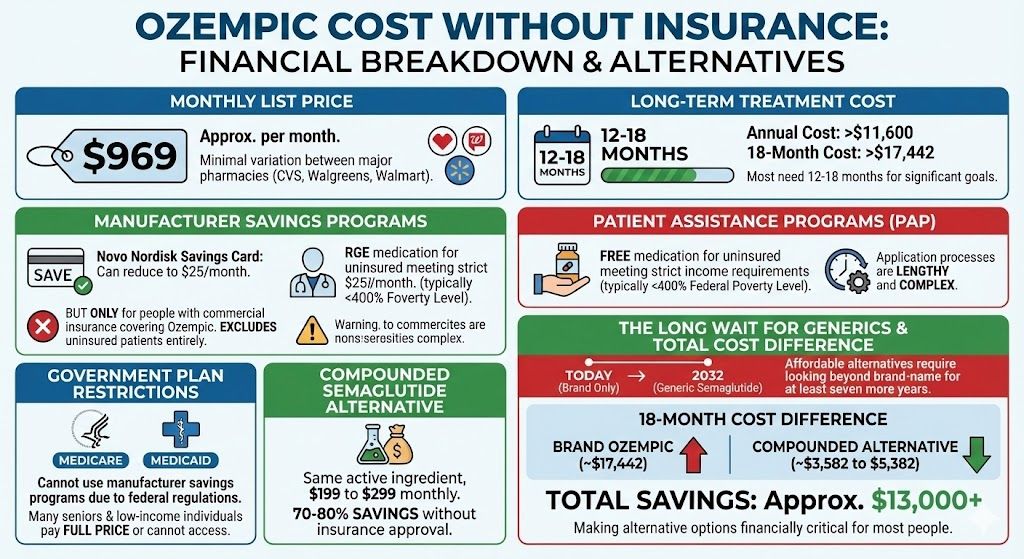
Here’s what you need to know: brand-name Ozempic costs approximately $969 per month without insurance, totaling over $11,600 annually. Novo Nordisk offers savings programs that can reduce costs to as low as $25 monthly, but these programs have strict eligibility requirements that exclude most people who need help paying. The good news is that compounded semaglutide provides the same active ingredient at $199 to $299 per month without requiring insurance approval, representing 70 to 80% savings compared to brand-name pricing. This makes effective GLP-1 treatment accessible to people who otherwise couldn’t afford it.
This guide covers everything about Ozempic costs without insurance, including exact pricing at major pharmacies, why the medication is so expensive, detailed information on manufacturer savings programs and their limitations, patient assistance programs and eligibility requirements, comparison of total treatment costs over 12 to 18 months, affordable compounded alternatives that work the same way, strategies for budgeting treatment costs, and insurance appeal processes if you have coverage that denied your claim.
Key Takeaways: Ozempic Cost Without Insurance
- Ozempic’s list price is approximately $969 per month without insurance, with minimal price variation between major pharmacy chains like CVS, Walgreens, and Walmart.
- Annual cost exceeds $11,600 for continuous treatment, and most people need at least 12 to 18 months to achieve significant weight loss goals.
- Novo Nordisk’s savings card can reduce costs to $25 monthly, but only for people with commercial insurance whose plans cover Ozempic, excluding uninsured patients entirely.
- Patient assistance programs provide free medication to uninsured people meeting strict income requirements (typically under 400% of federal poverty level), but application processes are lengthy and complex.
- Medicare and Medicaid cannot use manufacturer savings programs due to federal regulations, leaving many seniors and low-income individuals paying full price or unable to access the medication.
- Compounded semaglutide contains the same active ingredient as brand-name Ozempic at $199 to $299 monthly, representing 70 to 80% savings without requiring insurance approval.
- Generic semaglutide won’t be available until patents expire around 2032, meaning affordable alternatives require looking beyond brand-name options for at least seven more years.
- The total cost difference between brand-name Ozempic and compounded alternatives over 18 months of treatment is approximately $13,000, making alternative options financially critical for most people.
Understanding Ozempic’s Actual Cost
Before exploring alternatives, it’s important to understand the true cost of brand-name Ozempic without insurance assistance.
List Price at Major Pharmacies
Novo Nordisk sets the wholesale acquisition cost for Ozempic at approximately $935 to $969 per month. Individual pharmacies add their own markup to this base price, creating slight variations in retail pricing.
CVS typically prices Ozempic at $950 to $975 per month without insurance. Walgreens pricing is similar at $945 to $970 per month. Walmart offers slightly lower pricing at $920 to $950 per month. Costco (which requires membership) often has the lowest pricing among major chains at $875 to $925 per month, though this still represents a substantial monthly cost.
These prices apply to all dose strengths. Whether you’re taking 0.25mg, 0.5mg, 1mg, or 2mg weekly, the pen costs approximately the same because each pen contains the same total amount of medication, just delivered at different dose increments.
Price Per Dose
Each Ozempic pen contains enough medication for one month of treatment at most doses. Breaking down the monthly cost into weekly doses, you’re paying approximately $240 per injection. This makes each weekly dose more expensive than many people’s weekly grocery budgets.
For people who need the medication for 18 months (a common treatment duration to achieve significant weight loss), the total cost at list price is $17,442 without any assistance or discounts.
Why Prices Are Consistent
Unlike some medications where shopping around can save significant money, Ozempic pricing is relatively consistent across pharmacies. The manufacturer sets the base price, and individual pharmacies have limited flexibility to discount substantially without losing money.
Pharmacy discount cards (like GoodRx, RxSaver, or SingleCare) typically provide minimal savings on Ozempic, perhaps reducing the price from $969 to $850 to $900. While any savings help, these discounts still leave the medication financially out of reach for most people paying out of pocket.
Factors Affecting Individual Cost
Your actual cost depends on whether you have insurance that covers Ozempic (and for what indication), whether you qualify for manufacturer savings programs, whether you meet income requirements for patient assistance programs, and your pharmacy’s specific markup and policies.
Understanding these factors helps you navigate toward the most affordable option for your specific situation.
Why Ozempic Is So Expensive
Several factors contribute to Ozempic’s high price tag, understanding which helps explain why affordable alternatives are so important.
Patent Protection and Market Exclusivity
Novo Nordisk holds patents on semaglutide that extend through approximately 2032. During this exclusivity period, no generic manufacturers can legally produce equivalent versions in the United States. This monopoly allows the manufacturer to set prices without competition from lower-cost alternatives.
Patent protection is standard in pharmaceutical development, designed to help companies recoup the substantial costs of research, development, and clinical trials. However, it also means patients pay monopoly prices for years before generic competition can drive costs down.
Research and Development Costs
Developing new medications requires enormous investment. Novo Nordisk spent years and billions of dollars developing semaglutide, conducting extensive clinical trials involving thousands of participants over multiple years. The STEP trial program alone (which demonstrated semaglutide’s effectiveness for weight loss) involved over 4,500 participants across multiple studies.
Pharmaceutical companies typically price medications to recoup these development costs plus generate profit during the patent protection period. The limited years of exclusivity before generic competition creates pressure to maximize revenue during that window.
Manufacturing Complexity
Semaglutide is a GLP-1 receptor agonist peptide that requires sophisticated biotechnology manufacturing processes. Unlike simple chemical compounds that can be synthesized relatively easily, peptide medications involve complex molecular structures that are expensive to produce.
The manufacturing requires specialized facilities, extensive quality control processes, sophisticated testing, and cold-chain logistics for storage and distribution. These factors add to the base cost of production.
Demand Exceeding Supply
The explosive popularity of GLP-1 medications for weight loss has created supply constraints where demand far exceeds production capacity. When demand significantly outpaces supply, basic economics suggest prices increase.
Novo Nordisk has struggled to keep up with demand, leading to periodic shortages. In a shortage environment with years-long waiting lists in some areas, there’s little economic incentive for the manufacturer to lower prices voluntarily.
Marketing and Distribution Costs
Pharmaceutical companies spend substantial amounts on marketing to healthcare providers and consumers, patient support programs, training materials for providers, and extensive distribution networks. While these costs are controversial, they factor into the medication’s pricing structure.
Comparing to Other Markets
Ozempic costs significantly less in other countries where government healthcare systems negotiate medication prices. Patients in Canada, the UK, and many European countries pay far less for the same medication. This price difference reflects different healthcare systems and regulatory approaches rather than differences in manufacturing costs.
However, importing medications from other countries involves legal complications and risks regarding medication authenticity and proper storage during transit, making it not a practical solution for most people.
Novo Nordisk Savings Programs
The manufacturer offers savings programs that can substantially reduce costs, but eligibility requirements exclude many people who need assistance.
Ozempic Savings Card
Novo Nordisk’s most prominent savings program is a card that can reduce monthly out-of-pocket costs to as little as $25 for commercially insured patients. This sounds like an excellent solution, but the restrictions are substantial.
Eligibility Requirements:
You must have commercial (private) health insurance. The card doesn’t work if you’re uninsured. Your insurance must provide some coverage for Ozempic. If your insurance denies the claim entirely, the savings card cannot be used. Even if your insurance covers it with a high copay or coinsurance, the card helps, but if coverage is denied completely, you’re out of luck.
You cannot use the card with government insurance including Medicare, Medicaid, TRICARE, or Veterans Affairs coverage. Federal regulations prohibit manufacturers from offering copay assistance for government insurance programs.
There’s typically a maximum annual benefit, often around $150 per fill with certain yearly caps. Once you reach these limits, you’re responsible for remaining costs.
You must meet certain BMI requirements (typically 27+ with weight-related comorbidity or 30+ without comorbidity) and have your prescription written for an FDA-approved indication.
How the Savings Card Works:
Your insurance processes the claim first and determines your copay or coinsurance amount. The savings card then covers up to $150 of your out-of-pocket cost per prescription, reducing it to as low as $25 per month. You present the card at the pharmacy along with your insurance card when filling the prescription.
Reality Check:
The savings card helps people who already have insurance coverage for Ozempic but face high copays. It does virtually nothing for the uninsured or those whose insurance explicitly denies coverage for weight loss medications. This is the majority of people seeking financial assistance.
If your insurance covers Ozempic for diabetes but not weight loss, and your doctor prescribes it off-label for weight loss, your insurance will likely deny the claim entirely. In this scenario, the savings card cannot be used, and you pay full retail price.
Obtaining the Savings Card:
The savings card is available on Novo Nordisk’s website (ozempic.com) and can be downloaded or printed immediately. You can also request a physical card be mailed to you. Your healthcare provider may have cards available in their office.
Enrollment is free and doesn’t require extensive application processes, but again, the card is useless without qualifying insurance coverage.
Patient Assistance Programs
For uninsured or underinsured patients meeting income requirements, Novo Nordisk offers patient assistance that can provide medication at no cost.
Novo Nordisk Patient Assistance Program
This program provides free medication to eligible patients who cannot afford their prescriptions and meet specific criteria.
Eligibility Requirements:
You must be a U.S. citizen or legal resident. You must be uninsured or underinsured (meaning insurance doesn’t cover Ozempic). Your household income must fall below certain thresholds, typically 400% of the federal poverty level or less, depending on household size.
For 2025, 400% of federal poverty level is approximately:
- 1 person household: $58,320 annual income
- 2 person household: $78,880 annual income
- 3 person household: $99,440 annual income
- 4 person household: $120,000 annual income
These thresholds adjust annually and vary by program details.
You must not have insurance coverage that would pay for Ozempic, including government insurance programs. You must be willing to provide extensive financial documentation including tax returns, pay stubs, bank statements, and verification of household income.
Application Process:
The application requires detailed financial documentation. You’ll submit tax returns from the most recent year, recent pay stubs from all employed household members, bank statements showing account balances, and documentation of any other income sources.
Your healthcare provider must complete their portion of the application, confirming medical necessity and diagnosis. Processing typically takes 4 to 6 weeks, during which time you won’t have medication. You must reapply annually to maintain enrollment, repeating the entire documentation process each year.
Reality Check:
Many people fall into a gap where they earn too much to qualify for patient assistance programs but not enough to comfortably afford $900+ monthly medication costs. If your household income exceeds the thresholds by even $1, you’re ineligible.
The application process is time-consuming and invasive, requiring disclosure of detailed personal financial information. For people already struggling financially, gathering all required documentation can be challenging.
The wait time for approval means you can’t start treatment immediately, and gaps in coverage occur during annual renewal processes.
Other Patient Assistance Resources
Several nonprofit organizations help patients access medications:
Partnership for Prescription Assistance (www.pparx.org) connects patients with assistance programs. NeedyMeds (www.needymeds.org) provides comprehensive database of assistance programs. RxAssist (www.rxassist.org) offers information about patient assistance programs.
These organizations primarily help you navigate manufacturer programs and connect you with available resources rather than providing direct financial assistance themselves. For weight loss medications specifically, assistance options are more limited than for medications treating acute serious conditions.
Medicare and Medicaid Coverage Issues
Government insurance programs present unique challenges for accessing Ozempic affordably.
Medicare Limitations
Medicare Part D prescription drug plans can only cover Ozempic if it’s prescribed for type 2 diabetes management, not for weight loss. Federal law prohibits Medicare from covering weight loss medications, even when prescribed by physicians for obesity management.
If you have diabetes and Ozempic is prescribed for that indication, your Part D plan may cover it, though you’ll face copays, coinsurance, and deductibles based on your specific plan. Costs vary but typically range from $200 to $600 monthly even with Medicare coverage.
The manufacturer savings card cannot be used with Medicare due to federal anti-kickback regulations. Medicare beneficiaries pay whatever their plan charges with no additional manufacturer assistance.
For Medicare beneficiaries wanting Ozempic for weight loss without a diabetes diagnosis, you’re looking at full retail price of approximately $969 monthly with no available assistance programs.
Medicaid Coverage
Medicaid coverage varies dramatically by state. Some states cover GLP-1 medications for diabetes but not weight loss. Other states have implemented strict prior authorization requirements, step therapy protocols requiring failure on multiple other medications first, or quantity limits restricting how much can be filled.
Many states’ Medicaid programs specifically exclude coverage for weight loss medications regardless of medical necessity. Even in states that theoretically cover these medications, approval processes can be lengthy and denials common.
Like Medicare, Medicaid programs cannot use manufacturer savings programs due to federal best price regulations. Medicaid beneficiaries pay whatever their state program charges (often a small copay for covered medications) or full retail price if the medication isn’t covered for their indication.
The Coverage Gap
Many people needing Ozempic for weight loss fall into coverage gaps. Medicare beneficiaries over 65 who need weight loss medication but don’t have diabetes. Medicaid recipients in states that don’t cover weight loss medications. People with Medicare or Medicaid who exceed income limits for patient assistance programs but can’t afford $900+ monthly out of pocket.
This coverage gap makes affordable alternatives particularly important for people on government insurance programs.
Compounded Semaglutide: The Affordable Alternative
The most practical solution for people without insurance coverage or those facing unaffordable costs is compounded semaglutide.
What Is Compounded Semaglutide?
Compounded medications are prepared by licensed pharmacies that combine active pharmaceutical ingredients into customized formulations. During periods when FDA-approved medications are in shortage (as semaglutide has been intermittently), compounding pharmacies can legally prepare medications using the same active ingredient.
Compounded semaglutide contains the identical active ingredient as brand-name Ozempic (semaglutide) but is typically provided in vials for injection rather than the pre-filled pen devices that brand-name products use. The medication works exactly the same way in your body and follows the same dosing schedules.
Cost Comparison
Compounded semaglutide through TrimRx costs $199 per month, representing an 79% savings compared to Ozempic’s $969 monthly price. Over an 18-month treatment course, the cost difference is substantial:
Brand-name Ozempic: $17,442 (at $969/month) Compounded semaglutide: $3,582 (at $199/month) Total savings: $13,860
This dramatic price difference makes treatment accessible to people who would otherwise be unable to afford it at brand-name prices, even with good insurance coverage and copays.
How Compounded Medications Work
Licensed compounding pharmacies purchase pharmaceutical-grade semaglutide (the active ingredient) from FDA-registered facilities. They prepare the medication following strict pharmaceutical standards, including testing for potency, sterility, and stability.
The resulting product contains the same active ingredient at the same concentrations as brand-name Ozempic. The difference is the delivery method (vial and syringe versus pre-filled pen) and the absence of brand-name marketing and patent premiums.
Safety and Effectiveness
Compounded semaglutide uses the same active pharmaceutical ingredient as brand-name Ozempic. The chemical compound (semaglutide) is identical. The effectiveness depends on the active ingredient reaching your system at appropriate doses, which properly compounded medications achieve.
Reputable telehealth platforms like TrimRx work with FDA-registered compounding pharmacies that follow strict quality standards. These pharmacies must meet the same pharmaceutical manufacturing requirements as brand-name facilities. Compounded medications undergo testing for potency (ensuring correct concentration), sterility (absence of contamination), and stability (maintaining effectiveness over the storage period).
Our complete guide to semaglutide weight loss results shows that the active ingredient produces consistent outcomes regardless of whether it’s brand-name or compounded.
Delivery Method Differences
The primary practical difference is the delivery method. Brand-name Ozempic uses pre-filled pen devices with a click mechanism that makes dosing simple. You attach a needle, dial your dose, and inject with minimal preparation.
Compounded semaglutide typically comes in vials, requiring you to draw up each dose with a syringe. This involves attaching a needle to the syringe, pulling back to draw air equal to your dose, injecting air into the vial, inverting the vial, drawing your dose into the syringe, removing air bubbles, and then injecting.
While this requires slightly more preparation time and skill, most people find the process straightforward after initial instruction. Our guide on how to inject Ozempic covers injection technique in detail, and the same principles apply to compounded semaglutide from vials.
For the vast majority of people, the minor inconvenience of measuring doses from vials is a worthwhile trade-off for 80% cost savings.
Legal Status and Availability
The legal status of compounded GLP-1 medications depends on shortage designations. When the FDA lists semaglutide on the drug shortage list (as it has been periodically), compounding pharmacies can legally prepare these medications.
Given persistent supply constraints from manufacturers struggling to meet demand, semaglutide has remained on shortage lists for extended periods. However, regulations can change, so ongoing availability of compounded versions depends partly on shortage status.
Importantly, compounded medications are only legal when prepared by licensed compounding pharmacies following proper protocols. Avoid purchasing semaglutide from unlicensed sources, international sellers of questionable legitimacy, or “research chemical” suppliers. These sources may provide counterfeit, contaminated, or improperly stored medications that pose serious health risks.
Legitimate telehealth platforms like TrimRx connect you with licensed healthcare providers who can prescribe compounded semaglutide and partner with FDA-registered compounding pharmacies that prepare it properly.
Total Cost of Treatment Comparison
Understanding total treatment costs over the typical duration needed for significant weight loss reveals the full financial impact.
18-Month Treatment Comparison
Most people need at least 18 months of treatment to achieve substantial weight loss and transition to maintenance. Clinical trials showing semaglutide’s effectiveness typically ran for 68 weeks (about 16 months) or longer.
Brand-name Ozempic without assistance: $17,442 (18 months at $969/month)
Brand-name Ozempic with maximum savings card benefit (best-case scenario for commercially insured): $450 (18 months at $25/month assuming you qualify and maintain eligibility)
Compounded semaglutide: $3,582 (18 months at $199/month)
The cost difference between brand-name without assistance and compounded alternatives is $13,860 over 18 months. For most households, this represents a substantial portion of annual income.
12-Month Treatment Comparison
For people who achieve their goals faster or decide to discontinue earlier:
Brand-name Ozempic: $11,628 Compounded semaglutide: $2,388 Difference: $9,240
Even over shorter treatment periods, the savings from compounded alternatives are substantial.
Cost Per Pound Lost
Clinical trials showed average total body weight loss of 14.9% with semaglutide. For a 220-pound person, that’s approximately 33 pounds lost over 16 months.
At brand-name prices ($16,000 for 16 months): approximately $485 per pound lost At compounded prices ($3,184 for 16 months): approximately $96 per pound lost
This per-pound calculation illustrates how much more cost-effective compounded alternatives are.
Maintenance Phase Costs
Many people require ongoing medication to maintain weight loss. Research shows significant weight regain when semaglutide is discontinued, with participants in the STEP 4 trial regaining approximately two-thirds of lost weight within one year of stopping medication.
If long-term or indefinite maintenance is necessary, the cost difference between brand-name and compounded becomes even more dramatic:
5 years brand-name Ozempic: $58,140 5 years compounded semaglutide: $11,940 Difference: $46,200
For people requiring long-term treatment, compounded alternatives transform weight loss medication from financially impossible to manageable.
Budgeting Strategies for Treatment Costs
If you’re determined to use brand-name Ozempic despite the cost, or while you’re exploring alternatives, these strategies can help manage expenses.
Health Savings Accounts (HSA) and Flexible Spending Accounts (FSA)
If you have an HSA or FSA through your employer, you can use these pre-tax dollars to pay for Ozempic prescriptions. This doesn’t reduce the medication’s base cost, but it provides tax advantages that effectively lower your out-of-pocket expense.
For example, if you’re in the 22% federal tax bracket plus state taxes, using HSA/FSA funds saves you approximately 25 to 30% compared to paying with after-tax dollars. On $969, that’s about $240 to $290 in tax savings monthly.
Some HSAs and FSAs require documentation that the medication is prescribed for a medical condition (such as obesity with BMI over 30) rather than cosmetic weight loss. Check with your plan administrator about their requirements.
Payment Plans Through Pharmacies
Some pharmacies offer payment plans or credit programs for expensive medications. These typically involve applying for medical credit cards (like CareCredit) that offer promotional periods with no interest if paid in full within a certain timeframe (often 6 to 24 months).
Be cautious with these programs. If you don’t pay the full balance within the promotional period, you’re charged retroactive interest on the entire original amount, often at rates exceeding 25%. Only use medical credit if you’re confident you can pay the full amount before interest accrues.
Pharmacy Shopping
While Ozempic prices don’t vary dramatically, checking multiple pharmacies might save $50 to $100 monthly. As mentioned earlier, Costco often has the lowest prices among major chains, though membership is required.
Independent pharmacies sometimes offer competitive pricing, especially if you’re a regular customer. It’s worth calling several pharmacies to compare prices before filling your first prescription.
Manufacturer Rebate Programs
Some employer health plans negotiate rebates directly with manufacturers. These rebates don’t help you at the pharmacy counter but are credited back to you later. Check with your HR department or insurance company about whether such programs exist for your plan.
Realistic Assessment
Even with these strategies, brand-name Ozempic remains expensive for most people paying without insurance assistance. HSA/FSA benefits save roughly $200 to $300 monthly through tax advantages, still leaving you paying $600 to $700 monthly. Payment plans just spread the cost over time without reducing total expense. Pharmacy shopping might save $50 to $100 monthly, a modest improvement but still leaving costs very high.
These strategies are worth pursuing if you’re committed to brand-name medication, but for most people, compounded alternatives provide far more meaningful cost reduction.
Insurance Appeals and Prior Authorization
If you have insurance that denied coverage for Ozempic, you may be able to appeal the decision.
Understanding Why Insurance Denies Coverage
Common reasons for denial include prescription written for weight loss when your plan excludes weight loss medications, lack of documentation showing medical necessity, failure to meet plan’s criteria (certain BMI thresholds, previous attempts at other weight loss methods), prescription written by provider not in your plan’s network, or requirement for prior authorization that wasn’t completed.
The Prior Authorization Process
Many insurance plans require prior authorization before covering Ozempic, meaning your doctor must submit documentation proving medical necessity before the insurance approves coverage.
Your healthcare provider submits a prior authorization request including your diagnosis, BMI documentation, documentation of previous weight loss attempts, explanation of weight-related comorbidities (high blood pressure, high cholesterol, sleep apnea, etc.), and justification for why this medication is medically necessary.
The insurance reviews this documentation and approves or denies within a specified timeframe (typically 72 hours for urgent requests, 14 days for routine requests). If denied, you receive a letter explaining the reason.
How to Appeal a Denial
Request a detailed explanation of the denial reason in writing. Your healthcare provider can help prepare an appeal letter addressing the specific reasons for denial.
For appeals, gather documentation of previous weight loss attempts (diet programs, other medications tried, documentation from nutritionists or weight loss programs), medical records showing weight-related health conditions, letter from your doctor explaining medical necessity and why other treatments have been insufficient, and peer-reviewed research supporting semaglutide’s effectiveness.
Submit your appeal within the timeframe specified in your denial letter (typically 180 days). If the appeal is denied, you can request an external review by an independent third party not affiliated with your insurance company.
Success Rates and Reality
Appeals succeed more often when the medication is prescribed for diabetes (an FDA-approved indication) with clear documentation of need. Appeals for weight loss prescriptions face higher denial rates because many plans explicitly exclude weight loss medications regardless of medical necessity.
Even successful appeals often come with restrictions like step therapy requirements (must try other medications first), quantity limits, or required regular check-ins with providers.
The appeals process can take weeks to months, during which time you’re without medication unless you pay out of pocket.
When Appeals Aren’t Worth the Effort
If your plan has an explicit exclusion for weight loss medications, appeals are unlikely to succeed. The plan simply doesn’t cover this category of drugs regardless of medical necessity.
For plans that theoretically cover weight loss medications but require extensive documentation and have history of denials, you might spend months fighting appeals while paying full price for medication. For many people, the time and stress involved in appeals processes isn’t worth it when compounded alternatives are immediately available at a fraction of brand-name cost.
Alternative GLP-1 Medications and Their Costs
Several other GLP-1 receptor agonists exist, though their costs are similarly high.
Wegovy (Semaglutide for Weight Loss)
Wegovy is the same active ingredient as Ozempic (semaglutide) but FDA-approved specifically for weight loss at a maximum dose of 2.4mg weekly. The list price is approximately $1,349 monthly, even more expensive than Ozempic.
Wegovy has similar savings programs with similar restrictions. The savings card can reduce costs for commercially insured patients, but the same limitations apply (must have insurance coverage, can’t use with Medicare/Medicaid, income restrictions for patient assistance).
For people without insurance or whose insurance doesn’t cover weight loss medications, Wegovy faces the same problems as Ozempic at an even higher price point.
Mounjaro and Zepbound (Tirzepatide)
Tirzepatide is a newer GLP-1 medication that showed superior weight loss compared to semaglutide in clinical trials (22.5% versus 14.9% average total body weight loss). Mounjaro is approved for diabetes, while Zepbound is approved for weight loss.
List prices are approximately $1,069 monthly for both, slightly higher than Ozempic. Eli Lilly (the manufacturer) offers savings programs similar to Novo Nordisk’s, with the same restrictions about insurance requirements and government program exclusions.
Our complete comparison of Ozempic versus Mounjaro covers differences between these medications in detail.
Compounded Tirzepatide
Just as compounded semaglutide provides an affordable alternative to brand-name Ozempic, compounded tirzepatide offers a cost-effective option at $349 monthly through TrimRx. While more expensive than compounded semaglutide, this represents 67% savings compared to brand-name tirzepatide prices.
For people who achieve better results on tirzepatide, this compounded alternative makes the more effective medication accessible.
Older GLP-1 Medications
Older GLP-1 medications like Victoza, Byetta, and Trulicity exist but typically aren’t used for weight loss anymore because semaglutide and tirzepatide show superior results. These older medications also cost $800 to $900+ monthly without insurance, providing no cost advantage.
When Generic Semaglutide Might Become Available
Many people hope generic versions will eventually solve the cost problem. Here’s the realistic timeline.
Patent Expiration Timeline
Novo Nordisk holds multiple patents on semaglutide covering the compound itself, formulations, delivery methods, and manufacturing processes. The primary patents extend through approximately 2032, though the exact date depends on potential patent extensions and legal challenges.
This means at least seven more years (from 2025) before generic manufacturers can legally produce semaglutide in the United States without infringing patents.
Generic Development Process
Even after patent expiration, generic availability isn’t immediate. Generic manufacturers must conduct bioequivalence studies proving their version works identically to the brand-name product, submit these studies to the FDA for approval (a process taking months to years), and then begin manufacturing and distribution.
Realistically, widely available generic semaglutide is unlikely before 2033 to 2034.
Biosimilar Considerations
Semaglutide is a biologic (complex protein-based medication) rather than a simple chemical compound. Biologics don’t have traditional “generics” but rather “biosimilars” that are highly similar but not identical to the original product.
Biosimilars typically offer smaller discounts compared to the brand-name than traditional generic medications do. While a generic small-molecule drug might cost 80 to 90% less than the brand-name, biosimilars typically cost only 15 to 35% less.
If biosimilar semaglutide becomes available around 2033 at 30% discount, you’d still pay approximately $680 monthly instead of $969, still quite expensive for most people.
Why Waiting Isn’t Practical
Waiting 7+ years for generic availability isn’t a realistic strategy for people who would benefit from treatment now. The years lost waiting represent years when the medication could be helping with weight management, metabolic health improvements, and reducing obesity-related health risks.
Current compounded alternatives provide immediate access at affordable prices without waiting nearly a decade for potential generic competition.
International Medication Purchasing: Risks and Reality
Some people consider purchasing Ozempic from other countries where prices are lower. Understanding the risks is important.
International Price Differences
Ozempic costs significantly less in Canada (approximately $300 to $400 USD monthly), the UK (approximately $200 to $300 USD monthly through NHS or private prescription), and many European countries where government healthcare systems negotiate prices.
These lower prices reflect different healthcare systems and regulatory approaches rather than differences in the medication itself.
Legal Issues
Importing prescription medications from other countries for personal use exists in a legal gray area. The FDA generally doesn’t allow importation of prescription drugs, though enforcement is inconsistent. Some states have programs allowing importation from Canadian pharmacies specifically. Federal law technically prohibits importation, but individual shipments for personal use are rarely prosecuted.
The legal uncertainty means your medication shipment might be confiscated at customs, potentially without refund.
Safety Concerns
Purchasing medications internationally involves significant risks. Medication authenticity is uncertain when purchased outside regulated U.S. supply chains. Counterfeit medications are common in international markets, potentially containing incorrect dosages, wrong ingredients, or dangerous contaminants.
Storage conditions during international shipping are uncontrolled. Ozempic requires specific temperature ranges, and medications shipped across borders may be exposed to freezing or excessive heat that degrades effectiveness.
Online pharmacies claiming to ship internationally often are not legitimate pharmacies at all, potentially sending fake products or nothing after taking payment.
Recommendation
While international purchasing might seem appealing given price differences, the safety risks, legal uncertainty, lack of recourse if problems occur, and potential for counterfeit products make this approach not advisable.
Legitimate compounded alternatives through licensed U.S. telehealth platforms provide safe, legal access at comparable or lower prices than international purchasing without the associated risks.
Frequently Asked Questions
How much does Ozempic cost at Walmart without insurance?
Ozempic costs approximately $920 to $950 per month at Walmart without insurance or any assistance programs, making it one of the slightly less expensive options among major pharmacy chains, though still quite costly. Walmart’s pricing is generally $20 to $50 lower than CVS or Walgreens, but this modest savings still leaves the medication at nearly $1,000 monthly. Sam’s Club (Walmart’s membership warehouse) sometimes offers prices similar to Costco at around $875 to $900 monthly with membership. Using pharmacy discount cards like GoodRx at Walmart might reduce the price to $850 to $900, but these discounts are minimal compared to the total cost. For meaningful cost reduction, compounded semaglutide at $199 monthly provides far more substantial savings than pharmacy shopping for brand-name medication.
Can I get Ozempic for $25 per month without insurance?
No, you cannot get Ozempic for $25 monthly without insurance. The Novo Nordisk savings card that reduces costs to $25 monthly requires that you have commercial health insurance that covers Ozempic. If you’re uninsured, the savings card cannot be used at all, and you’ll pay full retail price of approximately $969 monthly. The $25 pricing only applies to people whose insurance covers Ozempic but with high copays or coinsurance. The savings card then covers up to $150 of your out-of-pocket cost, potentially reducing it to $25. For uninsured individuals, the only affordable options are patient assistance programs (if you meet strict income requirements) or compounded semaglutide alternatives at $199 monthly. The widely advertised $25 pricing is misleading because it excludes the majority of people who need help paying, specifically those without insurance coverage.
Is compounded semaglutide as effective as brand-name Ozempic?
Yes, compounded semaglutide contains the same active ingredient (semaglutide) as brand-name Ozempic and works identically in your body when properly prepared by licensed compounding pharmacies. The chemical compound is the same, the molecular structure is the same, and the mechanism of action (GLP-1 receptor agonist activity) is the same. The effectiveness depends on the active ingredient reaching your system at appropriate doses, which properly compounded medications achieve. Reputable compounding pharmacies test their preparations for potency, sterility, and stability to ensure they meet pharmaceutical standards. The primary difference is the delivery method: brand-name Ozempic uses pre-filled pens while compounded versions typically come in vials requiring measurement with syringes. Clinical outcomes from weight loss depend on consistent semaglutide dosing following the same titration schedule, which works identically whether the source is brand-name or compounded.
Does GoodRx work for Ozempic without insurance?
GoodRx and similar pharmacy discount cards provide only minimal savings on Ozempic, typically reducing the price from approximately $969 to $850 to $900 monthly. While any savings help, this $70 to $120 reduction still leaves the medication at $850+ monthly, which is unaffordable for most people paying out of pocket. These discount cards work by negotiating rates with pharmacies, but they have limited negotiating power for expensive brand-name medications under patent protection. GoodRx coupons cannot be combined with insurance or manufacturer savings programs, so you must choose one or the other. For people without insurance or whose insurance doesn’t cover Ozempic, GoodRx provides marginally better pricing than full retail but doesn’t come close to making the medication affordable. Compounded semaglutide at $199 monthly provides far more meaningful savings (approximately 78% off retail) compared to GoodRx discounts of roughly 10 to 15%.
What is the cheapest way to get Ozempic?
The cheapest way to get Ozempic depends on your specific situation. For people with commercial insurance that covers Ozempic, using the Novo Nordisk savings card can reduce costs to $25 monthly, making this the cheapest option if you qualify. For uninsured people meeting strict income requirements (typically household income below 400% of federal poverty level), Novo Nordisk’s patient assistance program provides free medication, though the application process is lengthy and invasive. For everyone else, including uninsured individuals who don’t meet income requirements, people with Medicare or Medicaid, and those whose insurance explicitly excludes weight loss medications, compounded semaglutide at $199 monthly is by far the most affordable option. This provides 79% savings compared to retail pricing without requiring insurance approval or meeting income restrictions. The compounded alternative is immediately accessible, legally obtained, prepared by licensed pharmacies, and contains the same active ingredient as brand-name Ozempic.
Why doesn’t Medicare cover Ozempic for weight loss?
Medicare is prohibited by federal law from covering weight loss medications regardless of medical necessity or doctor prescription. This exclusion was written into the Medicare Part D prescription drug program when it was created, reflecting the political reality that weight loss medications were viewed as lifestyle drugs rather than treatments for serious medical conditions. Medicare can only cover Ozempic if it’s prescribed for type 2 diabetes, one of its FDA-approved indications. Even for beneficiaries with severe obesity and multiple weight-related health conditions, Medicare cannot cover medications prescribed specifically for weight loss. This creates a significant access problem for seniors who often face the highest rates of obesity and weight-related health conditions but cannot access effective treatments through their Medicare coverage. Medicare beneficiaries seeking Ozempic for weight loss face full retail pricing of $969 monthly with no available manufacturer assistance (the savings card cannot be used with Medicare due to federal anti-kickback regulations). Compounded alternatives provide the only affordable option for Medicare beneficiaries.
Can my doctor help me get Ozempic for free?
Your doctor can help you apply for Novo Nordisk’s patient assistance program that provides free medication to qualifying uninsured patients, but they cannot directly give you free Ozempic. The patient assistance application requires your doctor to complete their portion, documenting medical necessity and confirming your diagnosis. However, you must still meet the program’s strict income requirements and provide extensive financial documentation. Doctors do not have free samples of Ozempic to distribute because GLP-1 medications require titration over weeks and months, making single-dose samples impractical. Some doctors may be aware of local resources, charitable programs, or clinical trials that could provide access to medication, though these are rare for weight loss medications specifically. Your doctor’s main role in accessing affordable medication is prescribing compounded alternatives if appropriate, helping complete prior authorization or appeal paperwork if you have insurance, and connecting you with telehealth platforms that offer compounded semaglutide at affordable prices.
How long do I need to take Ozempic for weight loss?
Most people need at least 12 to 18 months of Ozempic to achieve significant weight loss goals, making total treatment cost a critical consideration. Clinical trials demonstrating semaglutide’s effectiveness typically ran for 68 weeks (approximately 16 months) or longer, with average weight loss of 14.9% of total body weight. Many people require continued medication even after reaching goal weight because research shows significant weight regain when semaglutide is discontinued. The STEP 4 trial showed participants regaining approximately two-thirds of lost weight within one year of stopping medication. This suggests that long-term or potentially indefinite use may be necessary for sustained results. Given this timeline, the cost difference between brand-name Ozempic and affordable alternatives becomes enormous: 18 months of brand-name costs $17,442 versus $3,582 for compounded alternatives, a difference of $13,860. If lifelong maintenance is necessary, the cumulative cost difference grows even larger, making affordable alternatives essential for sustainable access.
What happens if I can’t afford to continue Ozempic?
If you discontinue Ozempic due to cost, clinical research shows you’ll likely regain significant weight. The STEP 4 trial found that participants who stopped semaglutide regained approximately two-thirds of their lost weight within one year. This weight regain occurs because the medication’s appetite suppression effects wear off, hunger and cravings return, and without ongoing treatment, the physiological factors that contributed to weight gain resume. If brand-name Ozempic becomes financially unsustainable, transitioning to compounded semaglutide at $199 monthly allows you to continue treatment at far lower cost rather than discontinuing entirely. This prevents the weight regain that typically follows medication discontinuation. Planning for total treatment cost before starting helps prevent the situation of needing to stop mid-course for financial reasons. If discontinuation is necessary, our guide to stopping Ozempic and managing weight regain provides strategies, though maintaining treatment through affordable alternatives is preferable if possible.
Are there coupons that make Ozempic affordable without insurance?
No, there are no coupons that make Ozempic truly affordable without insurance. The Novo Nordisk savings card requires insurance coverage to be used, making it unavailable to uninsured patients. Pharmacy discount cards like GoodRx, RxSaver, and SingleCare provide only modest discounts of $70 to $120, reducing the price from $969 to approximately $850 to $900 monthly, which remains unaffordable for most people. Some pharmacies offer their own discount programs, but these provide similar minimal savings. No legitimate coupon reduces Ozempic to genuinely affordable levels (under $300 monthly) without insurance. Any offer claiming to provide brand-name Ozempic for extremely low prices without insurance should be viewed with extreme skepticism, as it’s likely fraudulent or involves counterfeit medications. The only legitimate way to access semaglutide affordably without insurance is through compounded versions at $199 monthly from licensed telehealth platforms and FDA-registered compounding pharmacies. These aren’t “coupons” but rather different formulations of the same active ingredient prepared by compounding pharmacies during shortage periods.
Making GLP-1 Treatment Accessible
The reality is stark: brand-name Ozempic at $969 monthly is financially impossible for most people without substantial insurance assistance. Even with excellent insurance, copays can be prohibitive. The manufacturer savings programs that advertise $25 monthly pricing exclude the vast majority of people who need help, specifically those without insurance or with government insurance programs.
Patient assistance programs provide free medication to qualifying low-income uninsured patients, but strict income cutoffs exclude many people who earn too much to qualify yet not enough to afford $900+ monthly medication costs. The application processes are lengthy, invasive, and must be repeated annually.
This creates a situation where effective weight loss medication is available but inaccessible to most people who would benefit from it. The good news is that compounded semaglutide changes this calculation entirely. At $199 monthly, treatment becomes financially manageable for many people within normal household budgets. The 79% savings compared to brand-name pricing represents the difference between treatment being impossible and possible.
The emergence of affordable compounded alternatives democratizes access to GLP-1 medications. What was once available only to people with excellent insurance or substantial disposable income becomes accessible to a much broader population who can benefit from effective weight loss treatment.
Whether you’re uninsured, have insurance that doesn’t cover weight loss medications, are on Medicare or Medicaid facing coverage restrictions, or simply cannot afford brand-name costs even with insurance, compounded semaglutide through TrimRx at $199 monthly provides legitimate access to the same active ingredient at a fraction of brand-name pricing.
For those who achieve better results with tirzepatide, compounded tirzepatide at $349 monthly offers another affordable option with potentially superior effectiveness compared to semaglutide.
Get started with comprehensive medical support, affordable pricing without insurance requirements, clear guidance on dosing schedules, and convenient online access to GLP-1 treatment. Effective weight loss medication shouldn’t be limited to people who can afford $1,000+ monthly costs. Compounded alternatives make treatment accessible while maintaining the quality and effectiveness that makes GLP-1 medications so valuable for sustainable weight loss.

Transforming Lives, One Step at a Time
Keep reading

What “Ozempic Vulva” Really Is and Why Weight Loss Changes It
If you’ve noticed that your vulva looks different after losing weight on a GLP-1 medication, you’re not imagining it, and you’re not alone. “Ozempic…

Ozempic Alternatives: Your Options Compared
If Ozempic isn’t the right fit, whether because of cost, side effects, availability, or results, you have real alternatives. The closest ones are other…

Ozempic vs Wegovy: Same Drug, Different Purpose
Here’s the fact that surprises most people: Ozempic and Wegovy are the same medication (semaglutide), just sold under different brand names, at different doses,…


