Novo Nordisk shares drop as Alzheimer’s hopes for weight-loss drug fade
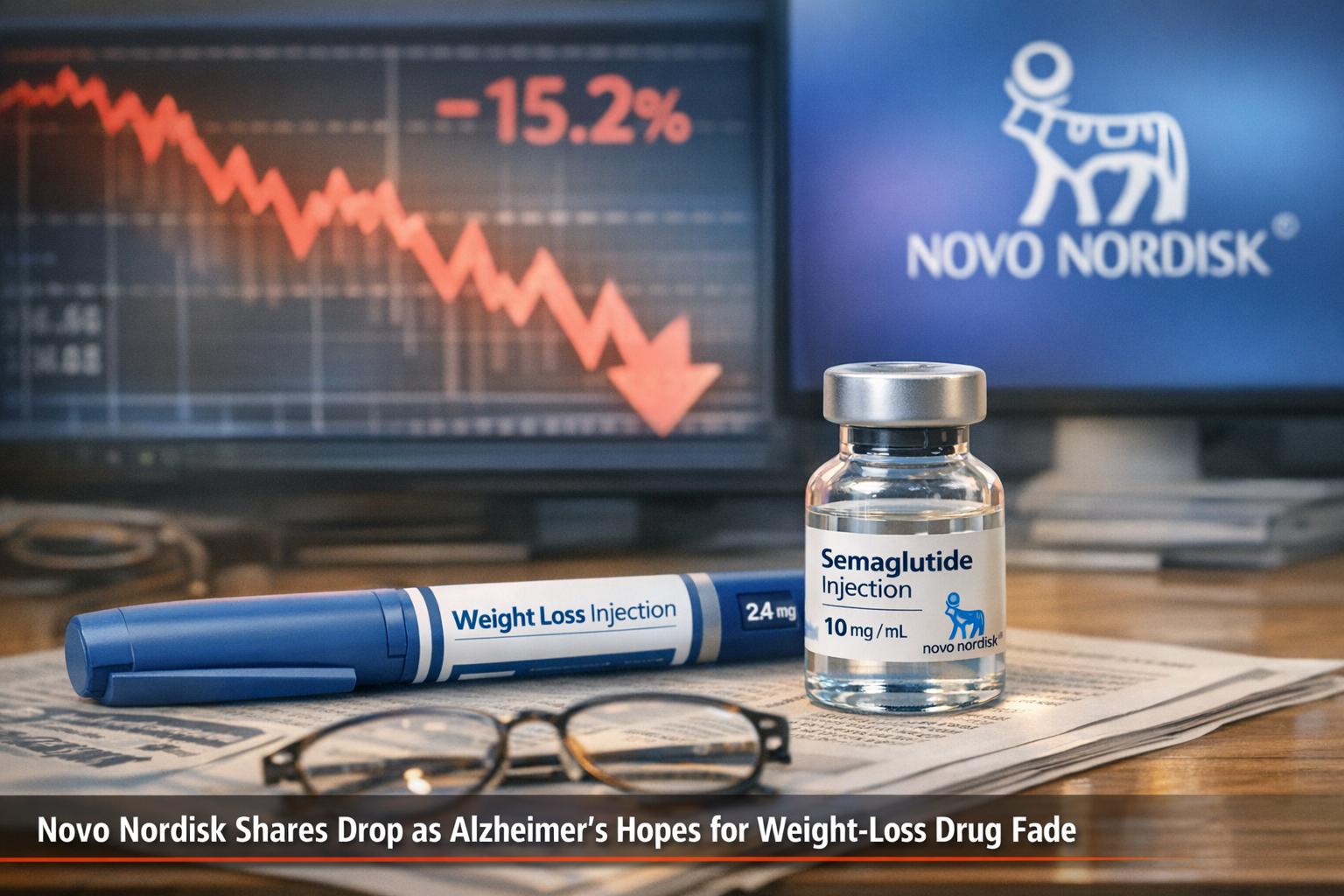
Shares of Danish pharmaceutical company Novo Nordisk plunged by 12 percent after disappointing trial results revealed that its weight-loss drug, semaglutide, did not slow the progression of Alzheimer’s disease. The company’s value has now reached its lowest point in four years.
Novo Nordisk had been exploring the potential of semaglutide, the active ingredient in its popular weight-loss medications Wegovy and Ozempic, as a treatment for patients with mild cognitive impairment or mild dementia due to Alzheimer’s disease. Early indicators had sparked optimism, but the large-scale clinical trials did not deliver the hoped-for results.
Trials fail to meet expectations
The company tested semaglutide in two major studies involving 3,808 participants aged 55 to 85. Half of the participants received the drug in its oral form, while the other half took a placebo. However, the results showed that semaglutide did not significantly reduce the progression of Alzheimer’s compared to the placebo.
"Based on the significant unmet need in Alzheimer’s disease as well as a number of indicative data points, we felt we had a responsibility to explore semaglutide’s potential, despite a low likelihood of success", said Martin Holst Lange, Novo Nordisk’s chief scientific officer and executive vice president of research and development. "While semaglutide did not demonstrate efficacy in slowing the progression of Alzheimer’s disease, the extensive body of evidence supporting semaglutide continues to provide benefits for individuals with type 2 diabetes, obesity, and related comorbidities."
sbb-itb-e2779c3
Reaction from Alzheimer’s experts
The trial’s outcome was met with disappointment by experts and advocates within the Alzheimer’s research community. Fiona Carragher, chief policy and research officer at Alzheimer’s Society, expressed regret over the findings but emphasized the broader value of clinical trials.
"It’s very disappointing that these eagerly awaited results are not what we hoped for", Carragher said. "However, no trial is wasted. Every investigation helps us develop better drugs and design better trials in the future. Research is hope, and there are currently over 130 Alzheimer’s drugs in clinical trials, of which around 30 are in late-stage trials, the final step before they are considered by regulators."
Carragher also stressed the importance of early diagnosis as new treatments continue to be developed. "Despite these results, there is a critical window of opportunity to prepare for other disease-modifying treatments coming down the track. The Government must invest in getting more people diagnosed at an earlier stage, as one in three people with dementia don’t currently have a diagnosis. We must avoid a situation where regulators approve treatments but too many people don’t receive them because they don’t have an early and accurate diagnosis."
Dr. Susan Kohlhaas, executive director of research at Alzheimer’s Research UK, echoed the sense of disappointment but also highlighted the complexity of tackling Alzheimer’s disease.
"Today’s disappointing results on semaglutide will come as a blow for people affected by Alzheimer’s", she said. "These trial results are another reminder that Alzheimer’s is driven by several different biological processes. No single approach is likely to be enough. The field now needs to focus on understanding those processes in much greater detail and developing treatments that can be used together to tackle the disease from multiple angles."
Moving forward
Despite the setback, Novo Nordisk emphasized that the extensive body of evidence supporting semaglutide continues to demonstrate its effectiveness in treating type 2 diabetes and obesity. Meanwhile, Alzheimer’s researchers remain committed to exploring new avenues for developing treatments for the neurodegenerative condition, with many other drugs currently in the pipeline.
As the global pharmaceutical industry races to address Alzheimer’s disease, this latest development is a stark reminder of the complexities involved in tackling such a multifaceted condition.
Read the source

Transforming Lives, One Step at a Time
Keep reading

GLP-1 Medications and Mental Health: What to Expect and When to Get Support
Most of what gets written about GLP-1 medications covers the body. Dosing, appetite, nausea, what to eat, what to expect on the scale. Less…

Mons Pubis Fat Loss on GLP-1s: The “Pubic Area” Change Nobody Mentions
One change that surprises people on GLP-1 medications rarely comes up in conversation: the mons pubis, the soft fat pad over the pubic bone,…

How to Adjust Weight Loss Goals on GLP-1 Medications
Adjust weight goals on GLP-1 meds by tracking body composition and labs, optimizing protein, activity, sleep, and working with your provider on dosing.


