Tirzepatide Results Timeline: Week by Week Guide

Tirzepatide produces some of the most significant weight loss results of any medication currently available, but those results don’t happen overnight.
The drug follows a gradual dose escalation schedule, starting at 2.5 mg per week and increasing every four weeks, which means your experience in week one will look very different from your experience at week 20 or beyond. In the landmark SURMOUNT-1 trial, participants on the highest dose lost an average of 22.5% of their body weight over 72 weeks, but that loss accumulated steadily over time rather than all at once.
So what can you actually expect at each stage? Here’s a realistic, research-backed timeline of how tirzepatide works from your very first injection through the months that follow.
How Tirzepatide’s Dosing Schedule Shapes Your Results
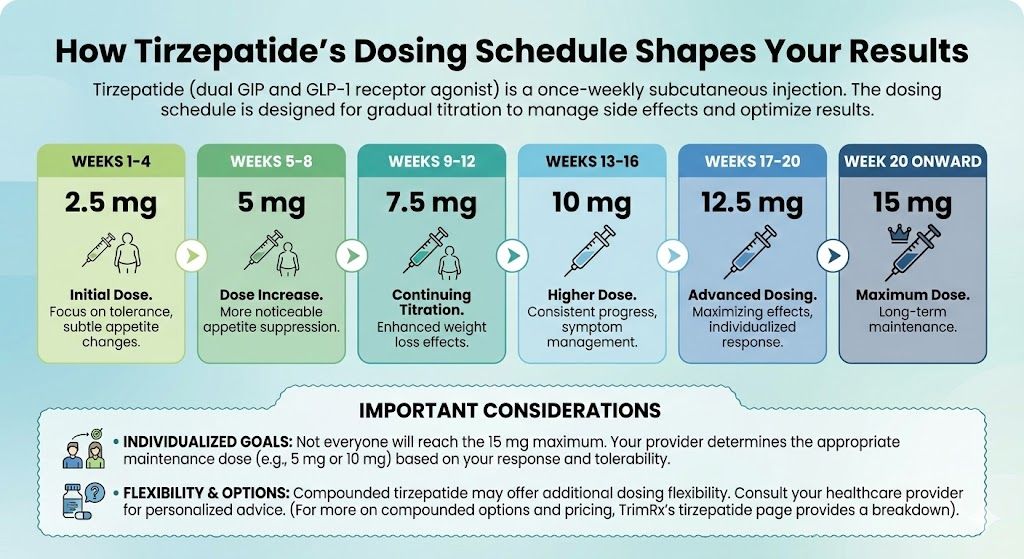
Before walking through the week-by-week breakdown, it helps to understand the dosing structure. Tirzepatide is a dual GIP and GLP-1 receptor agonist, meaning it activates two appetite-regulating hormone pathways instead of one. It’s given as a once-weekly subcutaneous injection and follows this standard titration:
- Weeks 1 through 4: 2.5 mg
- Weeks 5 through 8: 5 mg
- Weeks 9 through 12: 7.5 mg (if moving toward higher doses)
- Weeks 13 through 16: 10 mg
- Weeks 17 through 20: 12.5 mg
- Week 20 onward: 15 mg (maximum dose)
Not everyone will go to 15 mg. Some people reach their goals at 5 mg or 10 mg, and your provider will determine what’s appropriate based on your response and tolerability. Compounded tirzepatide may also offer more flexibility in dosing. If you’re interested in your options, TrimRx’s tirzepatide page has a full breakdown of available doses and pricing.
Weeks 1 Through 4: The Introduction Phase (2.5 mg)
The first four weeks are all about letting your body adjust. At 2.5 mg, you’re on the lowest dose, and the primary goal here is tolerability, not dramatic weight loss.
That said, many people notice appetite changes within the first one to two weeks. You might feel full sooner during meals, find yourself less interested in snacking, or realize you’re simply not thinking about food as much. These shifts can be subtle at first, but they’re signs that tirzepatide is already activating GIP and GLP-1 receptors in your brain and gut.
Common side effects during this phase include mild nausea, some bloating, and occasional changes in bowel habits. These are typical GI effects related to the way tirzepatide slows gastric emptying, and they tend to be manageable. Eating smaller meals, staying hydrated, and avoiding very fatty or greasy foods can help considerably.
Weight loss in weeks one through four is typically modest. Let’s say a patient starts at 230 pounds. They might see a two- to four-pound drop by the end of week four, though some people see more and some see less. The real momentum builds with the dose increases that follow.
Weeks 5 Through 8: First Therapeutic Dose (5 mg)
At week five, you’ll step up to 5 mg, and this is where many people start noticing more tangible changes. Appetite suppression tends to become more pronounced, and the amount of food you need to feel satisfied often drops noticeably.
Clinical data suggests that this is also when measurable weight loss starts to pick up pace. By week eight, many people have lost around 3% to 5% of their starting body weight, though individual variation is significant. Blood sugar improvements also tend to become apparent around this time, which is especially relevant if you have insulin resistance or prediabetes.
You may experience a brief return of GI side effects after the dose increase, but they’re usually milder than what you experienced during the first week and tend to resolve within a few days. For practical tips on managing nausea and digestive discomfort, TrimRx’s sulfur burps article covers strategies that apply to tirzepatide as well.
Weeks 9 Through 16: The Acceleration Phase (7.5 mg to 10 mg)
This is where results tend to become visible, not just on the scale but in the mirror and in how your clothes fit. Research from the SURMOUNT-1 trial indicates that weeks 8 through 12 is when many participants experienced their fastest rate of weekly weight loss.
A post hoc analysis of that trial found that 82% of tirzepatide-treated participants had already lost 5% or more of their body weight by week 12. For someone who started at 230 pounds, a 5% loss would mean roughly 11 to 12 pounds gone. But here’s what’s encouraging: even the 18% of participants who hadn’t hit that 5% mark by week 12 (so-called “late responders”) went on to achieve clinically meaningful weight loss by week 72 in 90% of cases. So if your progress feels slow at this point, that doesn’t mean the medication isn’t working.
During this phase, you might also notice improvements beyond weight loss. Many people report better energy levels, improved sleep, reduced joint pain from carrying less weight, and more stable moods throughout the day. Blood pressure and cholesterol markers often begin improving as well.
Weeks 17 Through 24: Reaching Full Dose (12.5 mg to 15 mg)
If your provider has you titrating to the maximum dose, you’ll reach 15 mg around week 20. By now, the medication is at full strength and your body has had months to adapt.
Weight loss during this period continues at a steady clip. Based on SURMOUNT-1 data, participants on the 15 mg dose were averaging roughly 15% body weight loss by around this point in the trial. For our hypothetical 230-pound patient, that’s approximately 34 to 35 pounds.
Appetite suppression is typically well-established by now. Many people describe a fundamentally different relationship with food. Cravings for high-calorie, high-fat foods tend to diminish, and the feeling of “food noise,” that constant mental chatter about what to eat next, often quiets significantly. Research shows that tirzepatide reduces food preference scores in multiple food categories, particularly for energy-dense options, while preferences for fruits and vegetables tend to remain unchanged.
Months 6 Through 12 and Beyond: Continued Progress and Plateau
After the first six months, weight loss typically continues but at a gradually slowing rate. This is normal biology, not a failure of the medication. As your body gets smaller, it requires fewer calories, and metabolic adaptation plays a role.
In the SURMOUNT-1 trial, published in the New England Journal of Medicine, the final results at 72 weeks showed mean weight reductions of 16% with the 5 mg dose, 21.4% with the 10 mg dose, and 22.5% with the 15 mg dose. Notably, more than half of participants on the two higher doses lost 20% or more of their body weight, and roughly a third lost 25% or more. These are results that were previously only achievable through bariatric surgery.
Most participants reached their weight plateau somewhere between weeks 60 and 72, though this varied based on dose, starting BMI, sex, and other individual factors. People with higher starting BMIs tended to continue losing weight for longer before plateauing.
What Affects Your Personal Timeline
While clinical trial data provides a helpful framework, your individual results will depend on several factors.
Starting weight and BMI. People with more weight to lose often see larger absolute numbers on the scale, though percentage-based losses tend to be somewhat similar across groups.
Dose tolerance. If side effects require you to stay at a lower dose longer or cap out at 10 mg instead of 15 mg, your trajectory will differ from someone on the maximum dose. That’s perfectly fine. Any clinically meaningful weight loss provides health benefits.
Diet and activity level. Tirzepatide does significant heavy lifting on the appetite front, but what you eat still matters. Prioritizing protein, fiber, and nutrient-dense whole foods while staying active (even through moderate walking) amplifies results. For a look at how semaglutide results compare, TrimRx has a detailed breakdown of semaglutide timelines as well.
Consistency. Missing doses reduces the medication’s effectiveness. Tirzepatide needs to be taken on the same day each week to maintain stable levels in your bloodstream.
A Quick Reference Timeline
| Timeframe | Dose Range | What to Expect |
|---|---|---|
| Weeks 1-4 | 2.5 mg | Mild appetite changes, possible GI side effects, minimal scale movement |
| Weeks 5-8 | 5 mg | Noticeable appetite suppression, 3-5% body weight loss for many |
| Weeks 9-16 | 7.5-10 mg | Visible results, fastest rate of weekly loss, 5-10% body weight loss |
| Weeks 17-24 | 12.5-15 mg | Full dose reached, ~15% body weight loss, significant appetite control |
| Months 6-12 | Maintenance dose | Continued loss, 16-22.5% body weight loss on average |
| Month 12+ | Maintenance dose | Weight plateau, focus on sustaining results |
Getting Started With Tirzepatide
If this timeline sounds like what you’ve been looking for, TrimRx offers compounded tirzepatide starting at affordable prices, prescribed through a telehealth consultation with no insurance required. You can take the intake quiz to see if you’re a candidate and have medication delivered directly to your home. For a comparison of tirzepatide’s longer-term results against other options, see TrimRx’s breakdown of tirzepatide weight loss data.
This information is for educational purposes and is not medical advice. Consult with a healthcare provider before starting any medication. Individual results may vary.

Transforming Lives, One Step at a Time
Keep reading

Should You Taper Off Tirzepatide or Just Stop? What the Evidence Says
There is very little direct evidence either way, and anyone who tells you otherwise is filling a gap with confidence. The withdrawal trials that…

Stalled on Tirzepatide Even After a Dose Increase: Your Options
The first thing to check is how long it has been since the increase, because most people ask this question too early. A dose…

Why Did Tirzepatide Stop Working After Three Months of Fast Loss?
Five things explain almost all of it, and the first is the least satisfying: the fast stretch was never going to last. Weight loss…


