Tirzepatide Not Working? What to Try Next

Tirzepatide Not Working? What to Try Next
If tirzepatide doesn’t seem to be working for you, the first thing to know is that this rarely means the medication itself is the problem. Tirzepatide is a dual GIP/GLP-1 receptor agonist, and clinical trials have shown it produces average weight loss of 15% to over 20% of body weight at higher doses. So when results aren’t showing up, the issue is almost always something specific and fixable: your dose, your timing in the titration process, a dietary factor, or something medical happening in the background.
Let’s go through what to look at and, more importantly, what to actually do about it.
First, Define What “Not Working” Means for You
This sounds obvious, but it matters. “Not working” can mean very different things depending on where you are in treatment.
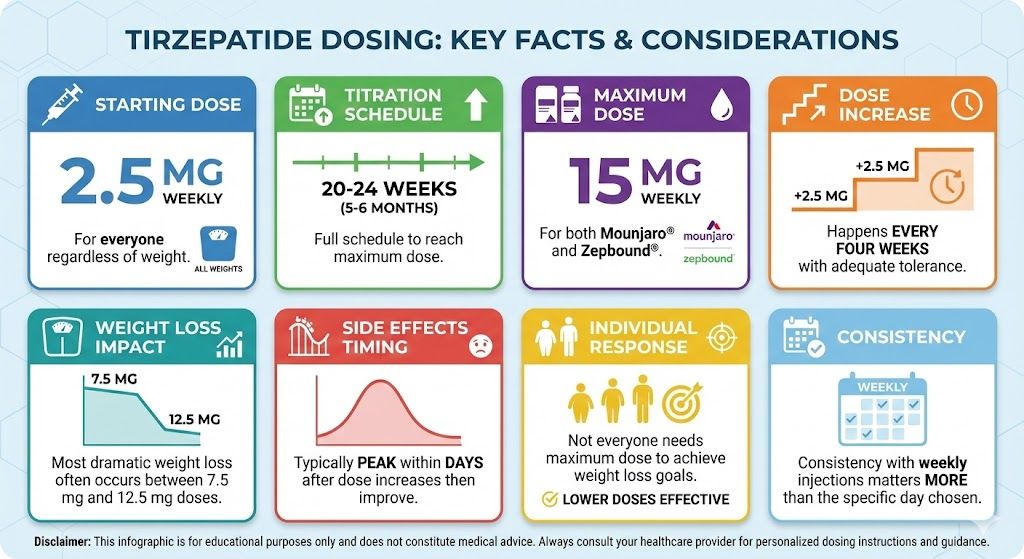
If you’re in the first four to six weeks, you may simply be on a dose that’s too low to produce noticeable weight loss. The 2.5 mg starting dose exists to ease your body into the medication and reduce GI side effects. It’s not a therapeutic weight loss dose for most people. Expecting significant results at 2.5 mg is like expecting a full effect from half a dose of anything else.
If you lost weight initially and then stopped, that’s a plateau, which is a different situation with different solutions. If you’ve been on a moderate or high dose (7.5 mg+) for two or more months and genuinely haven’t lost any weight at all, that’s when it’s time to look deeper.
Understanding which category you fall into changes the approach entirely.
Check Whether You’ve Actually Stalled or Just Slowed Down
Weight loss on GLP-1 medications doesn’t happen in a straight downward line. It happens in steps and waves. You might lose three pounds one week, nothing for two weeks, then drop four pounds seemingly overnight. This is normal physiology. Your body retains water, adjusts hormones, and adapts to changes in calorie intake.
Let’s say a patient loses 8 pounds in their first six weeks on tirzepatide, then sees the scale sit still for 10 days. That’s not a stall. That’s a completely normal fluctuation. Real plateaus are defined by four or more weeks of zero change in weight and body measurements while consistently following your plan.
If you’ve only been “stuck” for a week or two, the best thing you can do is stay the course and avoid making reactive changes.
Your Dose Likely Needs to Go Up
Tirzepatide is designed to be titrated. The dosing schedule moves from 2.5 mg up through 5, 7.5, 10, 12.5, and ultimately 15 mg. Each step up tends to produce additional appetite suppression and metabolic effects. A significant number of people who feel like the medication isn’t working are simply not yet at the dose where their body responds most strongly.
Data from the SURMOUNT-1 trial, published in the New England Journal of Medicine, showed clear dose-dependent results. Participants on 5 mg lost an average of about 15% of their body weight, while those on 15 mg lost over 20% (Jastreboff et al., NEJM, 2022). That’s a meaningful difference driven entirely by dose.
If your provider hasn’t moved you up recently and your side effects are manageable, ask about the next dose level. This single change is the most common fix for people who feel like tirzepatide isn’t doing its job. You can review the tirzepatide results timeline to see how results typically track across dose increases.
Look Hard at What You’re Actually Eating
Tirzepatide reduces appetite. For most people, that naturally leads to eating less. But appetite reduction doesn’t guarantee a calorie deficit, and a calorie deficit is still what drives fat loss.
There are a few common patterns that trip people up. The first is calorie-dense foods in small volumes. A handful of almonds, a drizzle of olive oil, a slice of cheese on everything. These foods are nutritious, but they pack a lot of calories into very small portions. You can eat what feels like a tiny amount of food and still not be in a deficit.
The second pattern is liquid calories. Coffees with cream and sugar, smoothies, juices, alcohol. These often fly under the radar because they don’t feel like “eating.”
The third is weekend drift. Consider this scenario: a patient eats well Monday through Friday, staying around 1,200 to 1,400 calories. Then on Saturday and Sunday, they eat out twice, have a few drinks, and graze through the afternoon. Those two days can easily erase the entire week’s deficit.
Tracking food for even five to seven days can be eye-opening. You don’t have to do it forever. Just long enough to see the reality clearly.
Rule Out Medical Interference
Some medical conditions make weight loss harder even on a potent medication like tirzepatide. The most common offenders are hypothyroidism, insulin resistance, PCOS, and elevated cortisol from chronic stress or Cushing’s syndrome.
If you haven’t had bloodwork done since starting treatment (or in the past six months), ask your provider to run a thyroid panel, fasting glucose, insulin, and HbA1c at minimum. These are simple, inexpensive tests that can reveal whether something metabolic is working against you.
Medications can also interfere. Corticosteroids, certain antidepressants (especially mirtazapine and some SSRIs), beta-blockers, and insulin are all known to promote weight gain. If you’re on any of these, your provider may be able to adjust doses or suggest alternatives that don’t carry the same metabolic penalty.
Don’t Ignore Sleep and Stress
These two factors get dismissed as soft advice, but they have hard, measurable effects on fat loss. Poor sleep (under seven hours consistently) raises ghrelin, lowers leptin, and elevates cortisol. That hormonal cocktail promotes fat storage and increases cravings, particularly for high-carb, high-fat foods. It can directly counteract what tirzepatide is doing to your appetite signaling.
Chronic stress does something similar through sustained cortisol elevation. You don’t need to become a meditation guru, but you do need to honestly assess whether your sleep and stress levels are undermining your results. Small improvements in these areas, getting to bed 30 minutes earlier, reducing caffeine after noon, building in short recovery breaks during the day, can have a disproportionate impact.
Add Movement Strategically
Exercise alone rarely drives dramatic weight loss, but it does two things that matter here. First, it increases your calorie deficit without further restricting food. Second, and more importantly, it helps preserve lean muscle mass during weight loss. Losing muscle slows your metabolism, which can make it progressively harder to keep losing fat.
You don’t need to live at the gym. Walking 7,000 to 10,000 steps a day plus two to three strength training sessions per week is a solid, sustainable target. If you’re currently doing nothing, even adding a daily 20-minute walk can shift your trajectory.
The Mounjaro 3-month results data (Mounjaro uses the same active ingredient, tirzepatide) shows that patients who combined the medication with lifestyle changes consistently outperformed those relying on the drug alone.
When to Talk to Your Provider
Reach out to your prescribing clinician if any of these apply: you’ve been on 7.5 mg or higher for at least eight weeks with no measurable change in weight or body measurements; you’re experiencing side effects that prevent you from eating enough to function normally; you suspect a medication interaction; or you have symptoms that suggest a thyroid issue or other metabolic condition.
Your provider can adjust your dose, order labs, or evaluate whether a different approach, such as switching to compounded tirzepatide for more dosing flexibility, might work better for your situation. If you don’t currently have a provider specializing in GLP-1 treatment, TrimRx’s intake quiz can match you with a licensed clinician who can review your full history and build a plan around your specific needs.
Tirzepatide works. The clinical data is clear on that. When it feels like it’s not working for you personally, the answer is almost always an identifiable, correctable factor, not a fundamental failure of the medication.
This information is for educational purposes and is not medical advice. Consult with a healthcare provider before starting any medication. Individual results may vary.

Transforming Lives, One Step at a Time
Keep reading

Starting Tirzepatide While on the Pill: The First Four Weeks
You have your first box and you take an oral contraceptive. There is a labeled instruction that applies to you, and the mistake almost…

Marathon Training on Tirzepatide When You Can’t Fuel
You have a plan on the fridge and a medication that has made eating feel optional. Those two things are in genuine conflict, and…

Paying Cash for Tirzepatide? Don’t Stretch Your Supply
When every vial comes out of your own pocket, the arithmetic is hard to ignore. If a month’s supply costs what it costs, and…


