Mounjaro to Ozempic: When and Why to Switch
Switching from Mounjaro to Ozempic means moving from tirzepatide (a dual GIP/GLP-1 receptor agonist) to semaglutide (a GLP-1 receptor agonist). This is a less common direction for the switch, since tirzepatide has produced stronger average weight loss in clinical trials. But there are legitimate reasons why patients and providers make this move.
The most frequent drivers are insurance and cost issues, side effect intolerance on tirzepatide, supply shortages, or a clinical decision that semaglutide is better suited for a patient’s specific medical profile. The transition is medically straightforward, though you’re moving to a medication with a single receptor mechanism rather than a dual one, which means the experience may feel different.
Here’s when this switch makes sense, how it works, and what to expect.
When Switching from Mounjaro to Ozempic Makes Sense
This isn’t the direction most clinical guidelines would point you, so it helps to understand the specific situations where it’s the right call.
Insurance or cost forces the change. This is the number one reason. Your plan covers Ozempic but not Mounjaro or Zepbound. Or your Mounjaro copay assistance program expires and the out-of-pocket cost becomes unsustainable. Semaglutide is an effective medication with strong clinical data behind it. Switching to Ozempic to stay on a GLP-1 medication is far better than stopping treatment altogether because of cost.
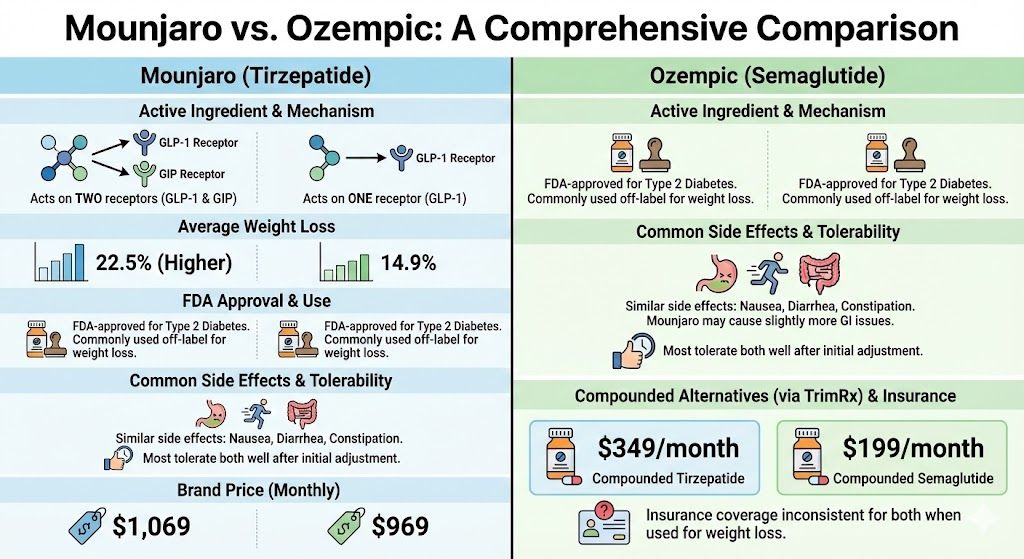
You can’t tolerate tirzepatide’s side effects. While most GI side effects (nausea, diarrhea, constipation) are shared between both medication classes, some patients find tirzepatide’s side effects more intense or persistent than they can manage, even after giving the body time to adjust and trying different doses. Because tirzepatide activates two receptor pathways compared to semaglutide’s one, the GI burden can be greater for certain individuals. Switching to semaglutide sometimes resolves side effects that were driven by the GIP component specifically.
Mounjaro supply is interrupted. Medication shortages have affected both semaglutide and tirzepatide products at various times. If your Mounjaro dose is unavailable and the shortage timeline is uncertain, switching to Ozempic keeps you on active GLP-1 treatment rather than going without.
Your provider recommends it for medical reasons. In some cases, a patient’s medical profile may favor semaglutide. For example, semaglutide has more extensive cardiovascular outcome data (from the SELECT trial), which may matter for patients with significant heart disease risk. If your provider specifically recommends Ozempic based on your comorbidities, that clinical judgment is worth following.
What You’re Giving Up (and What You’re Not)
Let’s be direct about this. Tirzepatide has produced greater average weight loss than semaglutide in clinical trials. The SURMOUNT trials showed tirzepatide at 15 mg producing over 22% body weight loss on average, compared to roughly 15% for semaglutide 2.4 mg in the STEP trials. If you switch from Mounjaro to Ozempic, you’re moving to a medication with a lower efficacy ceiling on a population level.
That said, population averages don’t determine individual outcomes. Some patients respond exceptionally well to semaglutide. Others respond better to tirzepatide. Your personal response depends on your genetics, metabolic profile, and how your body interacts with each specific receptor pathway. It’s possible, though not guaranteed, that you’ll do just fine on Ozempic.
What you’re not giving up is GLP-1 receptor activation. Ozempic still slows gastric emptying, reduces appetite, and improves insulin sensitivity through the same GLP-1 pathway that Mounjaro also uses. You’re losing the GIP component, not the entire mechanism.
You’re also not giving up a proven medication. Semaglutide has years of real-world data, extensive clinical trial support, and a well-understood safety profile. The semaglutide timeline shows that consistent, meaningful weight loss is absolutely achievable on this medication.
How the Transition Works
Like any switch between these two medication classes, there’s no washout period needed. You take your last Mounjaro injection and start Ozempic the following week on the same day.
The dosing translation is where things require provider judgment, since tirzepatide and semaglutide are different molecules and the milligram amounts aren’t directly comparable.
General dosing guidelines for the transition:
If you were on Mounjaro 2.5 mg, you’ll typically start Ozempic at 0.25 mg or 0.5 mg. At this low dose level, a standard Ozempic onboarding approach makes sense.
If you were on Mounjaro 5 mg, starting Ozempic at 0.5 mg is common. Some providers may go directly to 1 mg if the patient had strong GLP-1 tolerance at this level.
If you were on Mounjaro 7.5 mg or higher, most providers start Ozempic at 1 mg. The rationale is that your body is well-adapted to GLP-1 activity, and starting lower risks a significant drop in appetite suppression that could lead to weight regain during the transition. From 1 mg, your provider can titrate to 2 mg if needed.
If you were on Mounjaro 10 mg, 12.5 mg, or 15 mg, you’ll likely start Ozempic at 1 mg and titrate to 2 mg within four weeks. Even at maximum Ozempic dosing, you may notice reduced appetite suppression compared to what you experienced on higher Mounjaro doses, because you’re losing the GIP receptor activity entirely.
Your provider will individualize this based on your tolerance, side effect history, and how much weight you still want to lose.
What to Expect After Switching
The most honest thing to tell you is that the transition may feel like a step backward in appetite control, at least initially. You’re going from a dual-receptor medication to a single-receptor one, and for many patients, that difference is noticeable.
Common experiences during the first few weeks:
Increased appetite compared to your experience on Mounjaro. This doesn’t mean Ozempic isn’t working. It means the GIP-mediated appetite suppression you had on tirzepatide is now absent. GLP-1 activity alone may not produce the same level of food disinterest that the dual mechanism provided. Some patients adjust to this within a few weeks. Others find they need to be more intentional about portion control and food choices.
Potential for weight regain during the transition. If there’s a meaningful drop in appetite suppression during the dose adjustment period, some patients experience a small amount of weight regain (typically two to five pounds, much of which may be water). This usually stabilizes once you reach your effective Ozempic dose.
Possible improvement in certain side effects. If you had persistent GI issues on Mounjaro that you suspected were related to the GIP component (certain types of nausea, specific digestive discomfort), these may improve on Ozempic. Some patients find semaglutide easier on their system.
Let’s say a patient was on Mounjaro 10 mg and switches to Ozempic 1 mg due to insurance changes. During the first two weeks, they notice more hunger in the afternoons than they’d experienced in months. They add a high-protein snack (cottage cheese or a small portion of chicken) to bridge the gap. By week three, they’ve adjusted their eating pattern and the hunger is manageable. At week four, their provider moves them to Ozempic 2 mg, and appetite suppression strengthens noticeably. They don’t regain to their pre-Mounjaro level, but the appetite control isn’t quite as strong as it was at Mounjaro 10 mg.
This is a realistic, common transition experience.
Strategies to Maintain Your Progress
Because you may experience reduced appetite suppression after switching, being proactive about your diet and lifestyle becomes more important during this transition than at other times in your treatment.
Increase protein intake. Protein is the most satiating macronutrient and helps compensate for reduced medication-driven appetite suppression. Aim for at least 30 grams of protein at each meal. This helps you feel full longer and protects muscle mass.
Track your food for the first few weeks. Not as a permanent habit, but as a guardrail during the transition. Knowing exactly what you’re consuming prevents the gradual calorie creep that can happen when appetite suppression weakens.
Maintain or increase your exercise routine. Resistance training preserves muscle mass (protecting your metabolic rate), and daily movement (walking 7,000 to 10,000 steps) helps maintain your calorie deficit even if your intake edges up slightly.
Don’t panic about small fluctuations. A two to three pound increase in the first week or two is likely water retention from dietary changes, not actual fat regain. Look at the four-week trend rather than reacting to daily weigh-ins.
The Ozempic weight loss before and after data shows what semaglutide delivers over time. Your trajectory may differ from someone starting Ozempic fresh, but the medication’s effectiveness at producing and maintaining weight loss is well-documented.
What If Ozempic Isn’t Enough?
This is a real possibility. If you were losing well on Mounjaro at higher doses and you switch to Ozempic’s maximum of 2 mg, you may find that semaglutide alone doesn’t produce the same results. There’s no shame in that. It’s a reflection of pharmacology, not personal failure.
If after two to three months on Ozempic at maximum dose your results are significantly worse than what you achieved on Mounjaro, you have a few options:
Revisit the insurance or cost issue that prompted the switch. Sometimes formularies change, appeals succeed, or new copay programs become available. The barrier that forced the switch might not be permanent.
Explore compounded tirzepatide. TrimRx’s compounded tirzepatide provides the same active ingredient as Mounjaro at lower cost without insurance requirements. This may allow you to return to tirzepatide even if brand Mounjaro isn’t affordable.
Optimize everything around the medication. The Ozempic plateau article covers strategies for maximizing results on semaglutide, including dietary adjustments, resistance training, sleep optimization, and medical workups. Getting these factors dialed in can partially compensate for the difference in medication potency.
A study published in Diabetes, Obesity and Metabolism (Frias et al., 2021) from an early phase 2 comparison found that tirzepatide produced dose-dependent weight loss that exceeded semaglutide 1 mg across all dose levels tested, confirming the advantage of the dual mechanism. If you find Ozempic insufficient after an adequate trial, returning to tirzepatide through an affordable access pathway is a reasonable strategy.
Making the Switch Work
Coordinate with your provider on the appropriate Ozempic starting dose for your situation. Make sure your Ozempic prescription is filled before your last Mounjaro injection to avoid a treatment gap. Be prepared for a period of adjustment where appetite suppression may feel weaker. Use that time to tighten up your nutrition and exercise habits proactively. Plan to titrate to Ozempic 2 mg within four to eight weeks if your starting dose doesn’t provide adequate appetite control.
If you need help navigating this transition or want to explore whether compounded options might keep you on tirzepatide affordably, TrimRx offers telehealth consultations with providers who manage these decisions regularly. The intake quiz is the fastest way to get matched with a clinician who can review your full history and recommend the best path forward.
This information is for educational purposes and is not medical advice. Consult with a healthcare provider before starting any medication. Individual results may vary.

Transforming Lives, One Step at a Time
Keep reading

Mounjaro Alternatives: What Else to Consider
If Mounjaro isn’t the right fit, the closest alternatives are other GLP-1 medications, chiefly semaglutide (Ozempic for diabetes, Wegovy for weight), along with a…

Mounjaro vs Zepbound: Same Drug, Two Brands
Like their semaglutide counterparts, Mounjaro and Zepbound are the same medication (tirzepatide) sold under two names for two purposes: Mounjaro is approved for type…

Retatrutide vs Mounjaro: Triple Agonist vs Dual Agonist
The core difference between retatrutide and Mounjaro comes down to how many hormone targets each hits: retatrutide activates three receptors, while Mounjaro (tirzepatide) activates…


