How Long Do You Take Mounjaro for Weight Loss In 2026?

There is no predetermined endpoint for Mounjaro treatment. Like other GLP-1 based medications used for weight management, Mounjaro (tirzepatide) is designed for long-term, ongoing use. Clinical trials have followed patients on tirzepatide for up to 72 weeks (about 17 months) with sustained weight loss and a consistent safety profile throughout. The current medical consensus treats obesity as a chronic condition requiring chronic treatment, which means most patients who respond well to Mounjaro will continue it indefinitely, as long as it remains effective, tolerated, and accessible.
Here’s what the research shows, how long-term treatment actually works, and how to think about your own timeline.
What the Clinical Data Shows
The SURMOUNT-1 trial (Jastreboff et al., NEJM, 2022) is the landmark study for tirzepatide in weight management. It followed participants for 72 weeks on tirzepatide at doses of 5 mg, 10 mg, and 15 mg. The results were striking: average weight loss of 15% at 5 mg, 19.5% at 10 mg, and 20.9% at 15 mg. Weight loss continued throughout the entire 72-week study period, with no clear plateau at the population level by the end of the trial. This suggests that some patients may still be losing weight beyond 17 months of treatment.
The SURMOUNT-2 trial studied tirzepatide specifically in patients with type 2 diabetes and obesity for 72 weeks and found similar durability. Weight loss was maintained throughout the study with no signal that the medication’s effectiveness was fading.
Perhaps more telling is the SURMOUNT-4 trial, which examined what happens when you stop. Participants who achieved significant weight loss on tirzepatide were randomized to either continue treatment or switch to placebo. Those who continued maintained their results. Those who stopped regained approximately half their lost weight within the following year. The pattern mirrors what’s been seen with semaglutide: continued treatment maintains results, and discontinuation leads to substantial regain.
These trials collectively make a clear case: tirzepatide works for as long as you take it, and the benefits largely disappear when you stop.
Why Mounjaro Is Considered Ongoing Treatment
The expectation that you’ll take Mounjaro for a defined period, hit your goal weight, and then stop is understandable but not well-supported by the biology of weight management.
When you lose a significant amount of weight, your body initiates a series of hormonal and metabolic adaptations designed to push you back toward your previous weight. Ghrelin increases, driving hunger. Leptin decreases relative to your new body size, reducing satiety signals. Your metabolic rate drops, sometimes below what your new weight alone would predict (a phenomenon called adaptive thermogenesis). These changes aren’t temporary. Research has documented their persistence for years after weight loss.
Tirzepatide counteracts these adaptations through dual GIP and GLP-1 receptor activation. It suppresses appetite, improves satiety, enhances insulin sensitivity, and influences fat metabolism. When you remove the medication, those counterregulatory forces no longer have opposition. Hunger returns, metabolic rate stays suppressed, and weight regain begins.
This is why obesity medicine specialists frame Mounjaro treatment the way cardiologists frame statin therapy. You don’t take a statin for six months to lower your cholesterol and then stop expecting it to stay low. The same principle applies to weight management medications. The Mounjaro 3-month results show what active treatment looks like during the weight loss phase, but the long-term picture extends well beyond those initial months.
The Phases of Mounjaro Treatment
Long-term Mounjaro use typically breaks down into three distinct phases.
Phase 1: Dose escalation (weeks 1 through 20 or longer). This is when you titrate from 2.5 mg up through the available doses. Side effects are most common during this phase, and weight loss accelerates as you move to higher doses. The Mounjaro first month article covers what to expect during these early weeks. Most patients spend four to five months in this phase, depending on how quickly they titrate and which dose their provider targets.
Phase 2: Active weight loss (approximately months 3 through 12 to 18). Once you’ve reached your effective dose, this is the period of most consistent, significant weight loss. Your appetite is well-controlled, side effects have typically stabilized or resolved, and the scale moves steadily. Most of your total weight loss occurs during this phase.
Phase 3: Maintenance (ongoing). Weight loss gradually decelerates and eventually levels off. This isn’t a plateau in the problematic sense. It’s your body reaching a new equilibrium where your calorie intake and expenditure are balanced at your lower weight with the medication’s support. The goal during maintenance is sustaining your results, monitoring for any changes, and continuing the lifestyle habits that complement the medication.
The transition from active weight loss to maintenance happens naturally. You don’t need to do anything differently. Your body settles into its new weight over time, and the medication’s role shifts from driving loss to preventing regain.
Is Long-Term Mounjaro Use Safe?
The available evidence supports the safety of extended tirzepatide use, with appropriate caveats about the limits of current data.
GI side effects (nausea, diarrhea, constipation, decreased appetite) are most pronounced during dose escalation and tend to diminish significantly during long-term maintenance. Most patients on a stable dose for six months or more report minimal ongoing GI issues.
Serious but rare risks include pancreatitis, gallbladder events (gallstones, cholecystitis), and a theoretical concern about medullary thyroid carcinoma based on animal data. These risks don’t appear to increase with treatment duration based on available evidence. Standard monitoring (periodic bloodwork, clinical check-ins) helps catch any emerging issues early.
One safety consideration that’s specific to long-term GLP-1 use is bone health. Rapid weight loss from any cause can reduce bone density, and some researchers have flagged this as an area warranting monitoring during extended GLP-1 treatment. Resistance training and adequate calcium and vitamin D intake help mitigate this concern.
The honest caveat: tirzepatide is a newer medication than semaglutide, with a shorter track record. The longest published trial data extends to 72 weeks. Real-world use data is growing rapidly but doesn’t yet span the five-to-ten-year window that provides the most comprehensive safety picture. Nothing in the existing data raises red flags, but complete certainty about very long-term outcomes will require more time.
Your provider can help you weigh the well-documented benefits of continued treatment against the still-developing long-term data, in the context of your specific health profile and risk factors.
What About Dose Reduction for Maintenance?
This is a common question, especially given the cost of long-term treatment. If 15 mg was needed to produce weight loss, can you maintain results at 10 mg or 7.5 mg?
The formal evidence is limited. The SURMOUNT-4 trial compared continued treatment to complete cessation, not to reduced dosing. In practice, however, many providers explore maintenance dose reduction for patients who’ve reached a stable weight.
The typical approach: once your weight has been stable for three or more months at your target dose, your provider gradually reduces the dose (for example, from 15 mg to 12.5 mg, then potentially to 10 mg) while monitoring weight every two to four weeks. If weight remains stable at the lower dose, you stay there. If weight starts increasing, you return to the effective dose before significant regain occurs.
This strategy can work well for some patients and offers two practical advantages: reduced cost and potentially fewer side effects. The risk is that the lower dose doesn’t provide enough hormonal support to prevent regain, and by the time weight gain becomes apparent, some reversal has already occurred.
If cost is driving the interest in dose reduction, exploring compounded tirzepatide through TrimRx may address the financial concern without requiring a dose change. Maintaining your effective dose at a lower cost is generally preferable to reducing a dose that’s working.
The Cost of Long-Term Treatment
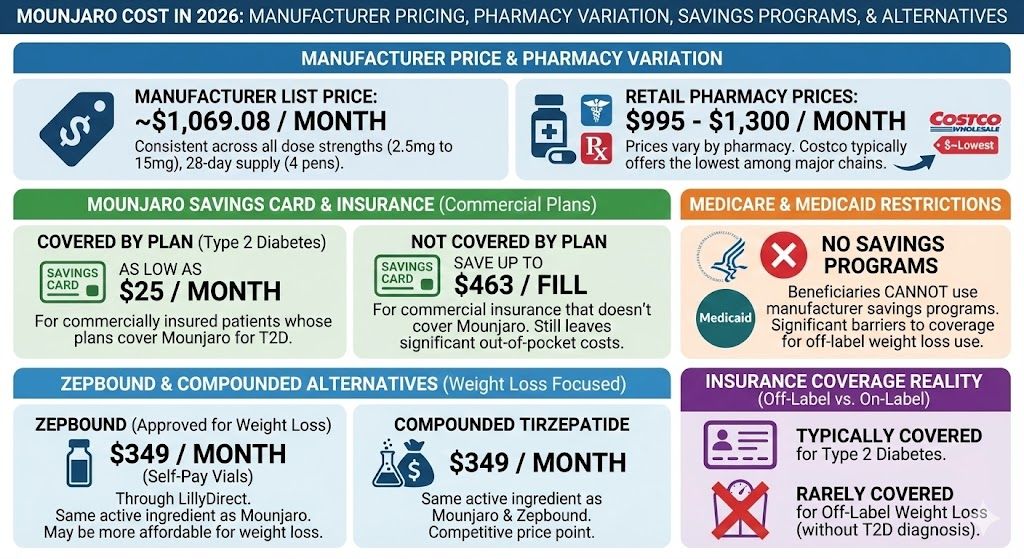
Brand Mounjaro without insurance runs over $1,000 per month. For patients planning years of treatment, the cumulative cost is substantial. Even with insurance, copays, prior authorization renewals, and formulary changes create ongoing uncertainty.
Eli Lilly offers copay assistance programs for eligible patients, which can reduce out-of-pocket costs significantly. However, these programs have eligibility requirements and don’t cover all situations.
Compounded tirzepatide offers an alternative pricing structure that many patients find more sustainable for long-term use. TrimRx provides compounded tirzepatide through a telehealth model at a fraction of brand cost, which changes the long-term affordability equation considerably. When you’re looking at years of treatment rather than months, the monthly savings compound into meaningful financial differences.
Some patients alternate between brand and compounded medication based on their insurance status and available copay programs. Others commit to the compounded route from the beginning for cost predictability. Your provider can help you evaluate which approach works best for your situation.
What Happens If You Need to Stop
Life circumstances sometimes require discontinuation. Insurance changes, pregnancy planning, significant side effects, or personal choice can all lead to stopping Mounjaro.
If you stop, expect appetite to increase within two to four weeks. Weight regain typically begins within one to two months of discontinuation and can be significant over the following year. The SURMOUNT-4 data showed approximately 50% of lost weight regained within a year of stopping.
To minimize regain if you stop, implement intensive lifestyle measures before discontinuing. Increase protein intake, maintain or increase resistance training, and set up regular weigh-ins to catch regain early. If weight starts climbing rapidly, resuming treatment sooner rather than later prevents the need to re-lose a large amount.
The tirzepatide weight loss results article covers the clinical data on what tirzepatide achieves during active treatment. Understanding those benchmarks helps frame what you’re maintaining during long-term use and what’s at risk if you discontinue.
Planning for the Long Term
If you’re on Mounjaro or considering starting, approach it with a long-term mindset from day one.
Discuss duration expectations with your provider early in treatment. Understand that most patients benefit from ongoing use and that stopping typically leads to regain. Establish a monitoring routine that includes bloodwork every six to twelve months, regular weight tracking, and provider check-ins at least quarterly during the first year, then every six months during stable maintenance. Build sustainable lifestyle habits (resistance training, adequate protein, good sleep, stress management) that complement the medication rather than depending on it exclusively. Plan for cost over the long term. Evaluate insurance coverage, copay programs, and compounded options to find an approach you can maintain for years.
If you’re looking for a provider who takes a long-term, sustainable approach to GLP-1 treatment, TrimRx’s intake quiz can match you with a clinician who can help build a treatment plan designed for durability, not just initial results.
This information is for educational purposes and is not medical advice. Consult with a healthcare provider before starting any medication. Individual results may vary.

Transforming Lives, One Step at a Time
Keep reading

Mounjaro Alternatives: What Else to Consider
If Mounjaro isn’t the right fit, the closest alternatives are other GLP-1 medications, chiefly semaglutide (Ozempic for diabetes, Wegovy for weight), along with a…

Mounjaro vs Zepbound: Same Drug, Two Brands
Like their semaglutide counterparts, Mounjaro and Zepbound are the same medication (tirzepatide) sold under two names for two purposes: Mounjaro is approved for type…

Retatrutide vs Mounjaro: Triple Agonist vs Dual Agonist
The core difference between retatrutide and Mounjaro comes down to how many hormone targets each hits: retatrutide activates three receptors, while Mounjaro (tirzepatide) activates…


