Stopping Zepbound: Managing the Transition
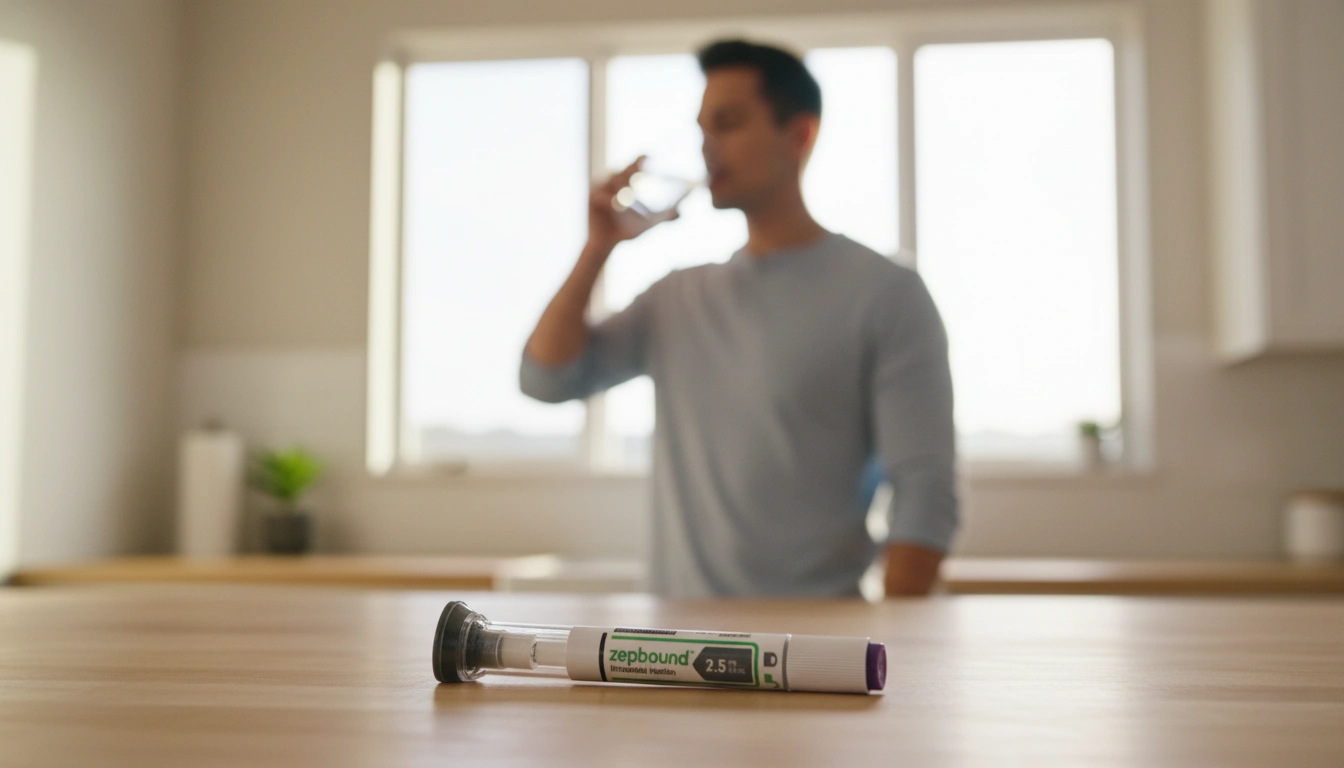
When you stop taking Zepbound, your appetite returns to pre-medication levels within a few weeks and most people regain a meaningful portion of their lost weight over the following months. The SURMOUNT-4 trial showed that participants who switched from tirzepatide to placebo regained roughly two-thirds of their weight loss within a year. Because Zepbound tends to produce greater initial weight loss than semaglutide-based medications, the absolute number of pounds regained can be particularly significant.
That’s the reality, and it applies whether you’re stopping by choice, because of cost, or due to a supply interruption. The good news is that understanding the timeline, preparing for the changes, and knowing your alternatives can make this transition far more manageable than going in blind.
Why Zepbound Is Different to Stop
Zepbound (tirzepatide) is a dual-action medication that activates both GLP-1 and GIP receptors. This dual mechanism is what gives it an edge over semaglutide-only medications in head-to-head trials, producing average weight losses of 20% or more of body weight at the highest dose. But that same dual mechanism means that stopping Zepbound removes two layers of appetite regulation simultaneously.
When you stop a pure GLP-1 medication like Wegovy, you lose one pathway of support. When you stop Zepbound, you lose two. The GLP-1 effects on satiety and gastric emptying fade, and the GIP-mediated effects on fat metabolism and insulin sensitivity fade alongside them. The result is a broader hormonal shift than what people experience coming off semaglutide alone.
Does this mean Zepbound is harder to stop? The clinical data doesn’t directly compare the discontinuation experience between the two drug classes. But the principle holds: the more pharmacological support you remove, the more your body notices.
Tirzepatide’s half-life is approximately five days, slightly shorter than semaglutide’s seven. That means the medication clears your system somewhat faster after your last injection, with most effects gone within three to five weeks rather than five to seven.
Week-by-Week: What to Expect After Your Last Injection
Week one feels almost unchanged. You still have a meaningful amount of tirzepatide in your bloodstream, and appetite suppression remains largely intact. Most people wouldn’t know they’d missed a dose based on how they feel.
Week two brings subtle shifts. Hunger between meals may tick upward slightly. You might notice food looking more appealing, or find yourself thinking about your next meal sooner after finishing the last one. These signals are quiet but present.
Weeks three and four are the transition point. Appetite returns noticeably. The food noise rebuilds. Meals that were completely satisfying start leaving you wanting more. Gastric emptying speeds up, so fullness after eating doesn’t last as long. Cravings that had been dormant for months may resurface, particularly for high-calorie, high-carb foods.
By week five, the medication is functionally cleared. Your appetite is back to its pre-Zepbound baseline. Every hormonal signal that was being managed by the medication, GLP-1, GIP, insulin regulation, gastric motility, is now operating without support.
Months two through six are when weight regain becomes visible and consistent. The trajectory varies by individual, but the direction is the same for the large majority of people who discontinue.
The SURMOUNT-4 Evidence
The SURMOUNT-4 trial, published in JAMA in 2024 by Aronne et al., was specifically designed to answer the maintenance question. Participants who had already lost weight on tirzepatide over 36 weeks were randomized to either continue treatment or switch to placebo for an additional 52 weeks.
The results were definitive. Participants who continued tirzepatide lost an additional 5.5% of body weight on average. Those who switched to placebo regained 14% of body weight. When the dust settled, the gap between the two groups was substantial, roughly 20 percentage points of difference in body weight change.
Let’s make that concrete. Consider a patient who weighed 260 pounds at baseline and lost 55 pounds on Zepbound over nine months, bringing her to 205 pounds. If she stops, the SURMOUNT-4 data suggests she could regain around 35 to 40 pounds over the next year, landing somewhere around 240 to 245. If she continues, she might lose another 10 to 15 pounds, settling around 190 to 195.
That’s a 50-pound difference in outcome based entirely on whether treatment continues. The numbers are hard to argue with.
The Zepbound results data during active treatment is impressive. But those results only hold if treatment holds.
What Changes Beyond Weight
The scale tells one story, but stopping Zepbound affects several systems simultaneously.
Appetite and food preoccupation shift dramatically. On Zepbound, many people describe their relationship with food as transformed. Eating becomes functional rather than emotional. Food noise drops to a whisper. After stopping, that noise returns to full volume. For people who spent decades battling constant food thoughts, losing that quiet can feel devastating.
Metabolic markers reverse. The improvements in fasting glucose, A1C, triglycerides, blood pressure, and inflammatory markers that accompanied weight loss begin eroding as weight returns. A patient whose blood pressure normalized on Zepbound might find it creeping back up three to four months after stopping. These aren’t trivial changes. They carry real cardiovascular and metabolic consequences.
Energy patterns become less stable. Tirzepatide’s glucose-regulating effects smooth out the energy rollercoaster that many people with insulin resistance experience. Without it, the peaks and valleys return. Mid-afternoon crashes, post-meal drowsiness, and sugar cravings tied to blood glucose dips all become more frequent.
GI function normalizes. On the positive side, any gastrointestinal side effects you experienced on Zepbound, nausea, constipation, bloating, sulfur burps, will resolve within a few weeks. If side effects were a significant quality-of-life issue for you, this part of stopping brings genuine relief.
Body composition shifts over time. The weight that returns after stopping a GLP-1 medication tends to come back as fat rather than a proportional mix of fat and muscle. This means your body composition at 240 pounds after regain may be worse than your body composition was at 240 pounds before you ever started treatment. Resistance training during and after the transition can help mitigate this, but it doesn’t fully prevent it.
Why People Stop Zepbound
Cost is the dominant reason. Zepbound runs over $1,000 per month without insurance, and coverage for weight management medications remains unpredictable. Insurers may cover it initially and then deny reauthorization, or exclude it from formularies entirely. If cost is your barrier, switching to compounded tirzepatide through TrimRx keeps you on the same active ingredient without the insurance uncertainty. This is almost always a better option than stopping.
Side effects that don’t resolve push some people to discontinue. Persistent nausea, severe constipation, or injection site reactions that don’t improve with time can make the medication feel untenable. Before quitting, talk to your provider about stepping down to a lower dose. Zepbound’s range of available doses (from 2.5 mg to 15 mg) gives significant room for adjustment. Even 5 mg of tirzepatide provides appetite support that meaningfully outperforms no medication at all.
Reaching a goal weight triggers the desire to stop. This is understandable but not well supported by the evidence. The tirzepatide long-term research points strongly toward continued treatment for sustained results. Your goal weight was achieved with the medication’s help. Maintaining it almost certainly requires the medication’s continued help.
Supply disruptions have been an intermittent problem for tirzepatide products. If you can’t access Zepbound, work with your provider to find a bridge, whether that’s compounded tirzepatide or a temporary switch to semaglutide, rather than simply going weeks without treatment.
Pregnancy planning requires discontinuation. Tirzepatide should be stopped at least one month before attempting to conceive, ideally longer. Coordinate this with your provider well in advance.
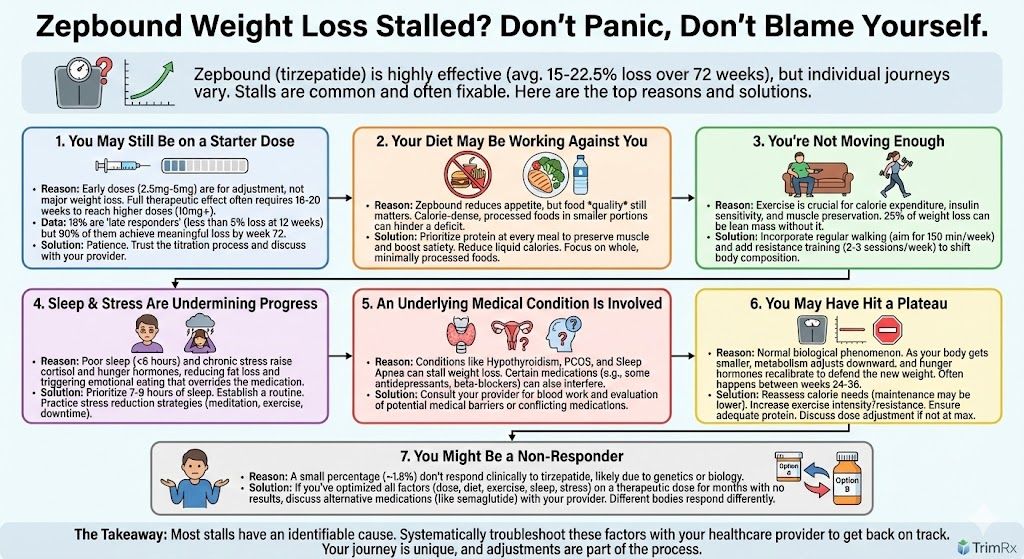
A Smart Transition Plan
If stopping is necessary, structure the process to give yourself the best possible outcome.
Taper through lower doses. If you’re on 15 mg, step to 10 mg for a month, then 7.5 mg, then 5 mg, then 2.5 mg. Each step gives your appetite regulation time to partially adjust before the next reduction. A gradual taper produces a smoother experience than an abrupt stop from a high dose.
Prioritize protein and strength training. These are your two best tools for preserving lean mass during the transition. Aim for 0.7 to 1.0 grams of protein per pound of your goal body weight daily. Lift weights at least twice a week, focusing on compound movements that recruit large muscle groups. Muscle mass supports metabolic rate and improves body composition regardless of what the scale does.
Structure your eating before you stop. Meal planning, consistent meal timing, and portion awareness are all easier to establish while the medication is still dampening your appetite. Build these routines during your taper so they’re habitual by the time the medication fully clears.
Set monitoring boundaries. Weekly weigh-ins, same conditions, same time. Agree with your provider on a threshold, say eight to ten pounds above your lowest weight, that triggers a reassessment conversation. Having a predetermined action plan prevents the gradual drift of denial.
Prepare for the emotional component. The return of food noise and the potential for regain can be psychologically challenging. If you have a therapist, bring this topic into your sessions. If you don’t, consider finding one. The emotional dimension of this transition is real and deserves support, not dismissal.
Alternatives Worth Exploring First
Before stopping Zepbound entirely, consider whether a modification would solve the underlying problem.
If cost is the issue, compounded tirzepatide or compounded semaglutide through TrimRx can reduce your monthly expense dramatically while keeping you on GLP-1 therapy.
If the medication feels like it’s not working as well as it used to, a dose adjustment or lifestyle modification might restart progress without requiring a medication change.
If you want to try a different mechanism, switching to semaglutide is a reasonable step that keeps you in the GLP-1 class while changing the specific drug. Your provider can guide the conversion.
The through-line is this: some form of continued treatment almost always outperforms stopping. If Zepbound in its current form isn’t sustainable, change the form. Don’t abandon the treatment.
If you need help figuring out your next step, take the intake quiz to connect with a TrimRx provider who can help you find a plan that lasts.
This information is for educational purposes and is not medical advice. Consult with a healthcare provider before starting any medication. Individual results may vary.

Transforming Lives, One Step at a Time
Keep reading

Fitness Test Coming Up on Zepbound? Protecting Strength and Endurance
The date changes what you should do, and the most useful adjustments are about fuel and timing rather than about the medication itself. Performance…

Best Diet for Zepbound to Maximize Weight Loss
If you recently started using Zepbound or you are thinking about it, you probably have one big question: what should you eat? The truth…
Lost Weight on Zepbound With a CPAP? When to Recheck Your Settings
Probably yes, and this is a conversation to have with your sleep clinician rather than a change to make yourself. Weight loss can reduce…


