Will Insurance Cover Ozempic for Prediabetes?

In most cases, insurance will not cover Ozempic for prediabetes. Ozempic (semaglutide) is FDA-approved specifically for type 2 diabetes, not prediabetes. Since insurance companies generally tie coverage to FDA-approved indications, a prediabetes diagnosis alone usually isn’t enough to get your claim approved. That said, there are exceptions, workarounds, and alternative paths worth knowing about. Let’s walk through what actually determines coverage and what to do if your insurer says no.
Why Insurance Usually Denies Ozempic for Prediabetes
Insurance coverage decisions follow a predictable logic. The insurer checks whether the medication is FDA-approved for the diagnosis code on your prescription. Ozempic’s approved indication is type 2 diabetes (ICD-10 code E11). Prediabetes carries a different code (R73.03 for impaired fasting glucose or R73.09 for other abnormal glucose). When the pharmacy submits a claim with a prediabetes code, the insurer’s system flags it as off-label and denies it automatically.
This isn’t a judgment about whether Ozempic would help you. It’s a bureaucratic reality. Insurance formulary systems are built around FDA indications, and prediabetes isn’t one of them for semaglutide.
The denial typically comes back as one of three messages: “not medically necessary,” “not indicated for diagnosis,” or “prior authorization required.” Each of these has a slightly different path forward, but they all point to the same underlying issue.
The Exceptions: When Coverage Might Work
While blanket coverage for prediabetes is uncommon, some situations increase the odds of getting Ozempic approved.
Employer-sponsored plans with broad formularies. Large employers sometimes negotiate pharmacy benefits that include off-label coverage for medications with strong clinical evidence. If your company’s plan uses a pharmacy benefit manager (PBM) with more flexible criteria, prediabetes plus obesity or other metabolic risk factors might qualify.
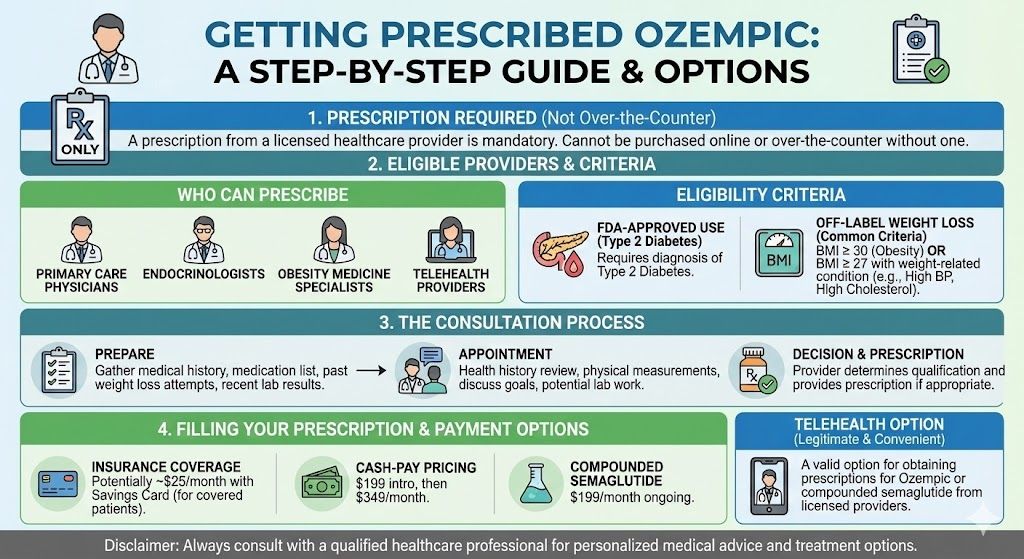
Plans that cover Ozempic for weight management. A growing number of insurance plans now cover GLP-1 medications for weight loss, separate from the diabetes indication. If your plan covers Ozempic or Wegovy for obesity (BMI 30+) or overweight with comorbidities (BMI 27+), your provider can submit the prescription under the weight management indication instead. Prediabetes itself can serve as the qualifying comorbidity alongside a BMI of 27 or higher.
Step therapy completion. Some insurers will cover Ozempic after you’ve tried and failed other treatments first. If you’ve documented attempts with metformin, lifestyle modifications, or other interventions for your prediabetes without adequate results, the insurer may approve Ozempic as a next-step therapy. This process is called step therapy, and it requires patience and documentation.
Prior authorization with strong clinical justification. Your doctor can submit a prior authorization request that makes the case for medical necessity. A strong submission includes your HbA1c trend (showing progression toward diabetes), BMI, family history of type 2 diabetes, failed prior interventions, and any cardiovascular risk factors. Some insurers will approve based on a compelling clinical picture even without the exact FDA indication match.
How to Improve Your Chances of Approval
If you want to try getting insurance coverage for Ozempic with a prediabetes diagnosis, these steps give you the best shot.
Ask your doctor to submit prior authorization proactively. Don’t wait for the pharmacy denial. Have your provider’s office submit prior authorization before you try to fill the prescription. Include comprehensive documentation: lab results, weight history, prior treatment attempts, and a letter of medical necessity.
Frame the clinical picture broadly. Prediabetes rarely exists in isolation. If you also have obesity, metabolic syndrome, elevated triglycerides, hypertension, or a strong family history of diabetes, make sure every relevant diagnosis code appears on the authorization request. The more risk factors documented, the stronger the case.
Ask about the weight management pathway. If your plan covers GLP-1 medications for weight management, your provider may be able to prescribe under that indication instead. This sidesteps the prediabetes coverage gap entirely. Your doctor would need to document your BMI and at least one weight-related comorbidity, which prediabetes itself satisfies.
Request a formulary exception. If standard prior authorization is denied, you can formally request a formulary exception. This is an appeal process where your doctor argues that Ozempic is medically necessary despite not meeting the plan’s standard criteria. Success rates vary, but it’s always worth pursuing before giving up.
Check your plan’s appeals process. After a denial, you typically have the right to at least one level of internal appeal, and in many states, an external review by an independent party. The appeals process can take weeks, but overturned denials do happen, especially with strong clinical documentation.
What the Research Says About Semaglutide and Prediabetes
The clinical argument for using semaglutide in prediabetes is actually quite strong, even if insurance hasn’t caught up yet.
A 2024 analysis from the STEP trials data, published in Nature Medicine, found that semaglutide 2.4 mg reduced the risk of progressing from prediabetes to type 2 diabetes by 79% over a 68-week period. Participants with prediabetes who took semaglutide also saw significant improvements in HbA1c, fasting glucose, and body weight compared to placebo.
Citation: Garvey, W.T., et al. “Semaglutide effects on the progression to type 2 diabetes among individuals with prediabetes.” Nature Medicine, 2024. PubMed
That’s a 79% risk reduction. From a clinical standpoint, treating prediabetes with semaglutide isn’t just reasonable. It’s preventive medicine with strong evidence behind it. The disconnect between the research and insurance coverage is frustrating but not unusual. Insurance policies often lag behind clinical evidence by years.
The Wegovy Angle
Here’s something many patients and even some providers overlook. Wegovy is the same molecule as Ozempic, semaglutide, but it’s FDA-approved for chronic weight management rather than diabetes. If your insurer covers Wegovy for obesity, and you meet the BMI criteria (30+ or 27+ with a comorbidity like prediabetes), you may have an easier path to coverage.
The practical difference between Ozempic and Wegovy for a prediabetes patient is mostly administrative. Both contain semaglutide. Both reduce weight, improve insulin sensitivity, and lower the risk of diabetes progression. But because Wegovy’s indication aligns with weight management, it may fit your insurance criteria more cleanly.
Ask your provider whether submitting for Wegovy instead of Ozempic might change your coverage outcome. In some cases, this simple switch resolves the issue entirely. For more on Wegovy’s weight loss results and what to expect, we’ve covered that in detail.
What to Do If Insurance Won’t Cover It
If you’ve exhausted the insurance routes and still can’t get coverage, you have options beyond paying $1,000 or more per month for brand-name Ozempic.
Compounded semaglutide offers the same active ingredient at a dramatically lower cost. TrimRx provides compounded semaglutide starting at $179 per month, no insurance needed. For prediabetes patients, this removes the coverage barrier entirely. You get the same medication, prescribed by a licensed provider, without waiting for authorization or fighting appeals.
The cost difference is especially meaningful for prediabetes patients because the goal is often preventive. You’re trying to avoid progressing to type 2 diabetes, which means you may need several months to a year of treatment to achieve enough weight loss and metabolic improvement to change your trajectory. Paying $179 per month is sustainable over that timeline. Paying $1,000 per month usually isn’t.
Metformin remains an inexpensive, well-studied option for prediabetes. It’s available as a generic for under $10 per month at most pharmacies and has decades of safety data. While it produces less weight loss than semaglutide, it does improve insulin sensitivity and modestly reduces diabetes risk. Some patients use metformin alongside semaglutide for a combined approach.
Lifestyle intervention programs like the CDC’s National Diabetes Prevention Program (DPP) are evidence-based and often covered by insurance. These programs focus on dietary changes, physical activity, and behavioral strategies. While they require more personal effort than medication, they produce meaningful results for many participants and can complement pharmacotherapy.
The Bottom Line on Coverage
Insurance coverage for Ozempic with a prediabetes diagnosis is possible but unlikely without extra effort. Your best strategies are working with your doctor on prior authorization, exploring the weight management indication pathway, and considering Wegovy as an alternative submission. If insurance still says no, compounded semaglutide provides an affordable way to access the same medication without waiting for the system to catch up to the science.
Ready to explore your options? TrimRx’s intake quiz takes a few minutes and connects you with a provider who can help determine the right approach for your situation.
This information is for educational purposes and is not medical advice. Consult with a healthcare provider before starting any medication. Individual results may vary.

Transforming Lives, One Step at a Time
Keep reading

State Fair on Ozempic: Fair Food, Heat and Rides
The state fair, or the county fair, is a celebration of food that exists nowhere else: deep-fried butter, funnel cakes, corn dogs, turkey legs,…

Real Estate Agents on Ozempic
Real estate has no typical day. A morning of paperwork turns into four showings across town, a client calls with an offer at dinner,…

Call Center Job on Ozempic: Managing Side Effects on Shift
Call center and customer service work has a rhythm that few other jobs share. Your breaks are scheduled to the minute, adherence targets track…


