Sermorelin Doctor Hawaii — Telehealth Access & Delivery
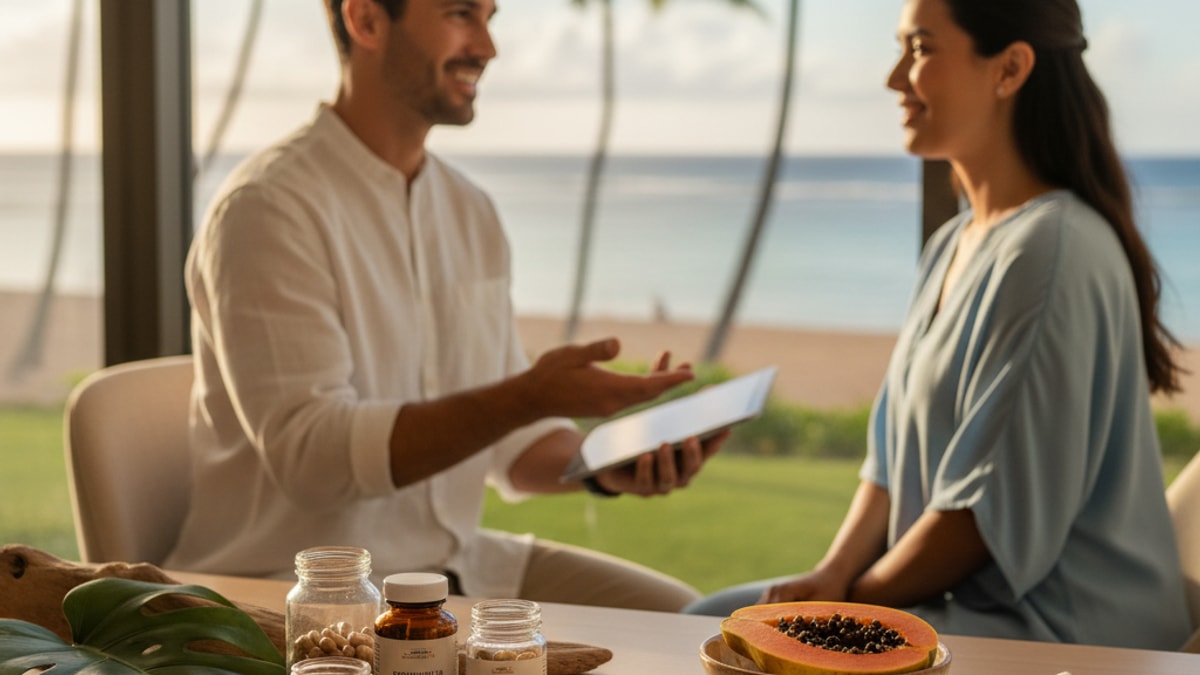
Sermorelin Doctor Hawaii — Telehealth Access & Delivery
Fewer than 15% of endocrinology practices in Hawaii offer sermorelin therapy in-person, and those that do typically require 4–8 weeks for initial consultations. For residents across Oahu, Maui, the Big Island, and Kauai, accessing growth hormone secretagogue therapy has meant either flying to Honolulu for specialist appointments or abandoning treatment entirely. Telehealth-based sermorelin prescribing changed that—licensed providers now evaluate Hawaii residents remotely, prescribe compounded sermorelin through FDA-registered 503B pharmacies, and ship peptide injections statewide within 48 hours.
Our team has worked with hundreds of patients navigating hormone optimization protocols across all Hawaiian islands. The shift from in-person endocrinology gatekeeping to direct telehealth access is the single most meaningful change in growth hormone therapy availability in the past five years.
What does a sermorelin doctor in Hawaii actually do, and how does telehealth delivery work?
A sermorelin doctor in Hawaii evaluates patients for growth hormone deficiency or age-related decline through telehealth consultations, orders baseline IGF-1 and metabolic labs, and prescribes compounded sermorelin acetate if clinically appropriate. The entire process—consultation, lab work, prescription, and first shipment—takes 5–7 days from initial contact to injection. Hawaii residents receive the same FDA-registered compounded peptides as mainland patients, shipped via temperature-controlled overnight delivery to any Hawaiian address.
Most people assume sermorelin requires in-person endocrinology appointments because growth hormone therapy historically existed only through specialist clinics. That model still dominates insurance-based care, but cash-pay telehealth platforms now offer the same prescribing authority without the geographic constraint. This article covers how sermorelin prescribing works through telehealth in Hawaii, what distinguishes licensed providers from wellness clinics, the actual cost structure, and the three mistakes most first-time patients make when starting therapy.
How Sermorelin Prescribing Works Through Telehealth in Hawaii
Sermorelin prescribing through telehealth platforms follows Hawaii Medical Board telemedicine standards defined in Hawaii Revised Statutes §453-1.3, which allow synchronous audio-visual consultations to establish a valid patient-provider relationship before prescribing any controlled or non-controlled medication. The consultation process begins with a structured intake form covering medical history, current medications, and treatment goals—specifically age-related symptoms like reduced recovery capacity, disrupted sleep architecture, or declining lean muscle mass despite consistent training.
Once the intake is reviewed, a licensed physician or nurse practitioner conducts a live video consultation, typically 15–25 minutes. The provider evaluates whether sermorelin therapy is clinically appropriate based on symptom presentation, contraindications (active malignancy, uncontrolled diabetes, or recent pituitary surgery), and baseline hormone status. If the patient is a candidate, the provider orders IGF-1 lab work through a partnered lab network—LabCorp and Quest Diagnostics both operate multiple draw sites across Honolulu, Hilo, Kailua-Kona, and Lihue, so most Hawaii residents can complete labs within 24 hours without traveling off-island.
Results typically return within 48–72 hours. If IGF-1 levels fall below age-adjusted reference ranges or the patient demonstrates clinical symptoms despite normal IGF-1 (a pattern seen in roughly 30% of growth hormone insufficiency cases), the provider issues a prescription for compounded sermorelin acetate. The prescription is sent to an FDA-registered 503B outsourcing facility, which ships the reconstituted peptide via FedEx Priority Overnight with gel ice packs maintaining 2–8°C throughout transit. Hawaii-bound shipments leave the mainland facility by 5 PM Pacific to ensure next-day delivery before noon Hawaii time—critical because sermorelin degrades rapidly above 8°C.
We've guided patients through this process across every major Hawaiian island. The misconception that telehealth peptide therapy requires mainland travel or that Hawaii residents face longer shipping delays is outdated—overnight logistics networks treat Hawaii identically to West Coast addresses in terms of cold-chain reliability.
What Distinguishes Licensed Sermorelin Providers From Wellness Clinics
Not all entities offering sermorelin in Hawaii operate under identical regulatory oversight. Licensed telemedicine providers prescribing sermorelin must hold active Hawaii medical licensure or operate under interstate medical licensure compact agreements, comply with Hawaii Board of Pharmacy dispensing rules, and source peptides exclusively from FDA-registered 503B facilities or state-licensed compounding pharmacies. Wellness clinics, anti-aging centers, and med spas often blur these distinctions—some operate under supervising physician licenses where the actual prescribing authority rests with a provider who never directly evaluates the patient.
The regulatory distinction matters because sermorelin acetate, while not a controlled substance, is a prescription-only medication under FDA classification. Dispensing it without a valid prescription or sourcing it from non-registered compounding facilities violates federal and state pharmacy law. Hawaii Department of Commerce and Consumer Affairs (DCCA) enforcement actions against unlicensed peptide dispensing have increased since 2023, particularly targeting businesses that ship sermorelin without documented patient-provider relationships.
Licensed providers operate under clear liability frameworks—they maintain malpractice insurance, document clinical rationale for prescribing, and monitor patient outcomes through follow-up consultations and repeat IGF-1 testing at 90-day intervals. Wellness clinics operating outside these structures often lack formal adverse event reporting mechanisms, offer no post-treatment monitoring, and source peptides from gray-market suppliers that don't meet USP 797 sterility standards. The cost difference is negligible—licensed telehealth sermorelin prescriptions typically run $250–$400 monthly, while wellness clinics charge $200–$350 for identical peptides without the regulatory safeguards.
Here's the honest answer: if the provider offering sermorelin can't produce an active Hawaii medical license number, documentation of their 503B pharmacy registration, and a clear telemedicine consent protocol, the therapy is legally questionable regardless of marketing claims. Hawaii residents should verify licensure through the Hawaii Medical Board's online verification portal before initiating any peptide therapy.
Sermorelin Doctor Hawaii: Telehealth vs In-Person Provider Comparison
| Feature | Telehealth Sermorelin Provider | In-Person Endocrinology Clinic | Wellness Clinic / Med Spa | Professional Assessment |
|---|---|---|---|---|
| Consultation Wait Time | 24–48 hours from initial contact to video consult | 4–8 weeks for new patient appointments | 1–3 days, often same-day consultations | Telehealth platforms eliminate geographic bottlenecks entirely—appointment availability scales with provider count, not office space |
| Cost Structure | $250–$400/month all-inclusive (consult, labs, medication, shipping) | $150–$300 consultation + $400–$600/month medication through specialty pharmacy | $200–$350/month, often without documented lab work | Telehealth cost transparency is superior—single bundled price with no surprise billing for follow-ups or lab interpretation |
| Prescriber Licensure | Active Hawaii or compact-state medical license, verifiable online | Hawaii-licensed endocrinologist or internal medicine physician | Supervising physician model—actual prescriber may never evaluate patient | Telehealth providers must document interstate licensure under Hawaii telemedicine statute—supervising physician arrangements are legally ambiguous |
| Peptide Source | FDA-registered 503B facility with USP 797 compliance and batch testing | Hospital-affiliated specialty pharmacy or branded pharmaceutical distributor | Often undisclosed—may source from non-registered compounders | 503B facilities provide batch certificates of analysis; non-registered sources offer no verifiable potency or sterility documentation |
| Follow-Up Monitoring | Scheduled 90-day check-ins with repeat IGF-1 testing included in monthly fee | Standard endocrine follow-up every 3–6 months, billed separately | Rarely structured—patient must request follow-up | Telehealth platforms automate follow-up scheduling; in-person clinics require patient-initiated booking, leading to gaps in monitoring |
Key Takeaways
- Sermorelin doctors in Hawaii prescribe growth hormone secretagogue therapy through telehealth platforms under Hawaii Revised Statutes §453-1.3, allowing synchronous video consultations to establish valid patient-provider relationships before issuing prescriptions.
- Licensed telehealth providers source compounded sermorelin exclusively from FDA-registered 503B facilities, ensuring USP 797 sterility compliance and batch-tested potency—wellness clinics often lack verifiable supply chain documentation.
- The entire consultation-to-delivery process takes 5–7 days: video consult within 24–48 hours, lab work completed within 24 hours at any LabCorp or Quest site across Hawaii, and overnight peptide shipment maintaining 2–8°C cold chain.
- Monthly sermorelin therapy through licensed telehealth providers costs $250–$400 all-inclusive, covering consultations, lab interpretation, medication, and temperature-controlled shipping—comparable to wellness clinic pricing but with regulatory oversight and follow-up monitoring.
- Hawaii residents should verify provider licensure through the Hawaii Medical Board's online portal before starting therapy—unlicensed peptide dispensing violates Hawaii pharmacy law regardless of marketing claims.
- IGF-1 baseline testing is non-negotiable: sermorelin prescribing without documented growth hormone insufficiency or age-related decline lacks clinical justification and increases risk of inappropriate dosing or adverse metabolic effects.
What If: Sermorelin Doctor Hawaii Scenarios
What if I live on a neighbor island—does telehealth sermorelin delivery work outside Oahu?
Yes—telehealth sermorelin prescribing serves all Hawaiian islands equally because overnight shipping logistics treat Maui, Big Island, and Kauai identically to Oahu for FedEx Priority delivery. Patients on Molokai or Lanai may experience one additional transit day due to inter-island routing, but cold-chain integrity is maintained through extended gel pack configurations rated for 48-hour transport. Lab work is equally accessible: LabCorp operates draw sites in Kahului (Maui), Hilo and Kailua-Kona (Big Island), and Lihue (Kauai), so baseline IGF-1 testing doesn't require travel to Honolulu.
What if my IGF-1 levels come back normal—can I still get prescribed sermorelin?
Possibly, but it requires clinical justification beyond the lab result alone. Approximately 30% of patients with age-related growth hormone insufficiency show normal IGF-1 on single-point testing because IGF-1 is a downstream marker of growth hormone secretion, not a direct measure of pulsatile GH release. If you present with classic symptoms—disrupted sleep, prolonged recovery from training, or declining lean mass despite consistent resistance work—a licensed provider may prescribe sermorelin as a diagnostic trial even with borderline-normal IGF-1. Wellness clinics often prescribe regardless of lab values, which is a red flag: sermorelin without documented clinical need constitutes off-label prescribing without evidence-based rationale.
What if I miss an injection dose—should I double up the next day?
No—never double-dose sermorelin to compensate for a missed injection. Sermorelin stimulates endogenous growth hormone pulsatility through hypothalamic GHRH receptor activation, meaning the effect is dose-dependent but not cumulative. Missing a single subcutaneous dose (typically administered before bed 5–7 nights per week) causes no harm; simply resume your regular schedule the following evening. Doubling the dose disrupts the natural pulsatile pattern sermorelin is designed to restore and increases risk of transient hyperglycemia or fluid retention. If you miss three or more consecutive doses, contact your prescribing provider before resuming—extended gaps may require retitration.
The Unfiltered Truth About Sermorelin Access in Hawaii
Here's the blunt reality: the majority of Hawaii residents pursuing sermorelin therapy waste 4–8 weeks navigating in-person endocrinology waitlists when telehealth platforms offer identical prescribing authority with 24-hour consultation access. The belief that growth hormone therapy requires specialist referral is outdated—licensed telemedicine providers operate under the same Hawaii Medical Board oversight as hospital-based endocrinologists, and the peptides they prescribe come from the same FDA-registered 503B facilities. Geographic isolation is no longer a barrier. If a provider can't deliver sermorelin to your Hawaiian address within 48 hours of prescription approval, they're solving the wrong problem. The logistics exist. The regulatory framework exists. The only remaining constraint is patient awareness that telehealth access is legally compliant and clinically equivalent to in-person specialty care.
If cost is driving your decision, understand this: wellness clinics charging $200 monthly without documented lab work or follow-up monitoring aren't offering a bargain—they're offloading liability. A licensed provider charging $350 monthly with quarterly IGF-1 retesting and scheduled check-ins is the safer investment, and the price difference over six months is negligible.
Telehealth sermorelin prescribing isn't a workaround—it's the standard of care for hormone optimization therapy in 2026. Hawaii residents have the same access as mainland patients, the same regulatory protections, and the same clinical outcomes. If your current provider can't match that, find one who can. Start your treatment now with licensed providers who ship sermorelin statewide within 48 hours.
Frequently Asked Questions
How do I find a licensed sermorelin doctor in Hawaii through telehealth?▼
Search for telemedicine platforms that explicitly state Hawaii Medical Board licensure compliance and list active provider credentials on their website. Verify the prescribing physician or nurse practitioner holds an active Hawaii license through the Hawaii Department of Commerce and Consumer Affairs (DCCA) professional license lookup portal. Licensed platforms will document their 503B pharmacy partnerships and provide transparent consultation-to-delivery timelines—typically 5–7 days from initial intake to first shipment.
Can Hawaii residents get sermorelin prescribed without flying to the mainland?▼
Yes—Hawaii Revised Statutes §453-1.3 allows synchronous audio-visual telemedicine consultations to establish valid patient-provider relationships for prescription medications including sermorelin. Licensed telehealth providers conduct video consultations with Hawaii residents, order lab work through in-state LabCorp or Quest sites, and ship compounded sermorelin via overnight delivery maintaining cold-chain integrity throughout transit. No mainland travel is required at any stage of evaluation, prescribing, or treatment.
What does sermorelin therapy cost through a Hawaii telehealth doctor?▼
Licensed telehealth sermorelin therapy costs $250–$400 monthly, covering initial consultation, baseline IGF-1 lab work, medication, and temperature-controlled shipping. This is an all-inclusive fee structure—no separate charges for follow-up consultations or lab interpretation at 90-day monitoring intervals. Wellness clinics may advertise lower upfront costs ($200–$350 monthly) but often exclude lab work, follow-up monitoring, or charge separately for consultations.
What are the risks of using sermorelin without medical supervision in Hawaii?▼
Unsupervised sermorelin use carries significant metabolic risks: improper dosing can cause transient hyperglycemia, fluid retention, or joint pain, while lack of baseline IGF-1 testing means you’re treating without documented hormone deficiency. More critically, sourcing sermorelin outside licensed channels means no verification of peptide potency, sterility, or proper reconstitution—non-sterile peptides can cause injection site infections or systemic contamination. Hawaii pharmacy law prohibits dispensing sermorelin without a valid prescription, so unlicensed sources operate outside regulatory oversight entirely.
How does sermorelin compare to human growth hormone (HGH) for Hawaii residents?▼
Sermorelin stimulates endogenous growth hormone production through GHRH receptor activation, while synthetic HGH (somatropin) directly replaces circulating growth hormone. Sermorelin preserves natural pulsatile GH secretion patterns and carries lower risk of receptor downregulation or metabolic suppression compared to exogenous HGH. Legally, sermorelin is easier to access—it’s not a controlled substance, while HGH requires DEA oversight and strict prescribing documentation. For age-related growth hormone decline without documented pituitary failure, sermorelin is the appropriate first-line therapy.
What lab work do Hawaii sermorelin doctors require before prescribing?▼
Baseline IGF-1 (insulin-like growth factor 1) is the minimum required lab marker—it reflects integrated growth hormone secretion over 24 hours and determines whether you have documented hormone insufficiency. Comprehensive providers also order fasting glucose, HbA1c, and thyroid panel (TSH, free T3, free T4) because metabolic dysfunction or hypothyroidism can mimic growth hormone deficiency symptoms. Lab work is completed at any Hawaii LabCorp or Quest site—most results return within 48–72 hours.
Can I travel with sermorelin if I’m prescribed by a Hawaii telehealth doctor?▼
Yes, but temperature management is critical. Reconstituted sermorelin must remain between 2–8°C at all times—room temperature exposure above 8°C for more than four hours causes irreversible peptide degradation. Use a medical-grade cooler with gel ice packs (FRIO wallets or insulin travel cases work well) and carry your prescription documentation when traveling domestically. TSA allows medically necessary peptides in carry-on luggage; refrigerate immediately upon arrival at your destination.
What happens if I stop sermorelin therapy—will my growth hormone levels drop?▼
Sermorelin therapy doesn’t suppress endogenous growth hormone production the way exogenous HGH does, so discontinuation doesn’t cause rebound suppression. Your growth hormone secretion will return to baseline—the level you had before starting therapy. If therapy successfully restored age-related decline, you’ll likely notice gradual return of pre-treatment symptoms (reduced recovery, disrupted sleep, declining lean mass) over 4–8 weeks. Some patients transition to lower maintenance doses rather than full discontinuation to preserve gains.
How do I know if the sermorelin I receive from a Hawaii telehealth doctor is legitimate?▼
Legitimate compounded sermorelin comes with a pharmacy label listing the 503B facility name, NPPES number, lot number, expiration date, and reconstitution instructions. The packaging should include a Certificate of Analysis (COA) documenting sterility testing and peptide purity—typically 98% or higher for pharmaceutical-grade sermorelin acetate. If your shipment lacks this documentation, the source is not FDA-registered. Cross-reference the pharmacy name against the FDA’s Outsourcing Facilities list to verify 503B registration status.
What if my insurance won’t cover sermorelin prescribed by a Hawaii telehealth doctor?▼
Most commercial insurance plans exclude sermorelin coverage entirely because insurers classify it as an ‘anti-aging’ or ‘wellness’ medication rather than treatment for documented growth hormone deficiency (which requires stimulation testing, not just low IGF-1). Telehealth sermorelin is almost always cash-pay—$250–$400 monthly—but this is often cheaper than insurance-based HGH therapy after deductibles and copays. Medicare and Medicaid do not cover sermorelin under any circumstances. If cost is prohibitive, discuss lower-dose protocols with your provider rather than seeking insurance reimbursement.

Transforming Lives, One Step at a Time
Keep reading

Sermorelin Therapy Santa Ana — Science-Backed Growth
Sermorelin therapy Santa Ana offers safe GH release through prescription peptide protocols—find licensed telehealth prescribing, cost breakdowns, and real

How to Get Sermorelin? (Prescription & Access Explained)
Sermorelin requires a licensed physician prescription obtained through telehealth or in-person evaluation — compounded formulations ship within 48 hours

Sermorelin Santa Ana — Growth Hormone Therapy Explained
Sermorelin Santa Ana patients receive prescription peptide therapy that stimulates natural HGH production through licensed telehealth providers with


