Can You Split Doses of Zepbound Safely?

Table of Contents
- Introduction
- What Is Zepbound and How Does It Work?
- Can You Split Doses of Zepbound?
- The Physical Risks of Manual Dose Splitting
- Why the Urge to Split Doses Exists
- Safer Alternatives for Flexible Dosing
- The Science of Titration: Why Precision Matters
- How to Handle Side Effects Without Splitting Pens
- Navigating Supply Shortages Safely
- What to Expect from a Personalized Weight Loss Program
- Conclusion
- FAQ
Introduction
Finding a rhythm with your weight loss medication can feel like a balancing act. You might be experiencing significant results with Zepbound® but find that the standard doses are either hard to source during a shortage or a bit too strong for your system to handle at first. In these moments, it is natural to wonder: can you split doses of zepbound to make your supply last longer or to manage side effects? At TrimRx, we believe that navigating the complexities of metabolic health requires both clinical transparency and a commitment to safety. This article explores the mechanical and medical reasons why splitting branded autoinjector pens is not recommended, the potential risks involved in “pen hacking,” and the safer, medically supervised alternatives for those who need more flexibility in their dosing. Understanding the science behind your treatment is the first step toward a sustainable and safe weight loss journey.
If you are exploring whether a personalized prescription program may be appropriate for you, you can complete a free eligibility assessment.
What Is Zepbound and How Does It Work?
To understand why dosing is so specific, it is helpful to look at what is inside the pen. Zepbound® is a branded medication containing the active ingredient tirzepatide. Tirzepatide is a dual-receptor agonist, meaning it mimics two different hormones in the body: glucagon-like peptide-1 (GLP-1) and glucose-dependent insulinotropic polypeptide (GIP).
Tirzepatide works by targeting two hormone pathways in the body: glucagon-like peptide-1 (GLP-1) and glucose-dependent insulinotropic polypeptide (GIP).
Glucagon-like peptide-1 (GLP-1) is a hormone naturally produced in the gut that tells your brain you are full and helps regulate blood sugar levels by prompting insulin release. Glucose-dependent insulinotropic polypeptide (GIP) is another hormone that works alongside GLP-1 to improve how the body breaks down sugar and fats. By targeting both receptors, tirzepatide may support weight loss more effectively for some individuals than medications that target only the GLP-1 receptor.
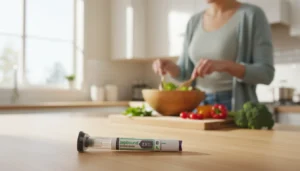
The delivery system for this medication is a single-dose autoinjector pen. Each pen is pre-filled with a specific amount of medication—ranging from 2.5 mg to 15 mg—intended to be delivered in one single “click.” The pen is designed for convenience and ease of use, but its mechanical nature is exactly what makes splitting a dose so complicated and potentially dangerous.
Can You Split Doses of Zepbound?
Quick Answer: No, you should not attempt to split doses of Zepbound®. The autoinjector pen is a single-use device designed to deliver the entire internal volume of medication at once; tampering with the pen to divide the dose can lead to inaccurate dosing, loss of medication, and serious risk of infection.
For additional context, learn why tirzepatide doses should not be split without medical guidance.
The manufacturer has engineered the Zepbound® pen as a “closed system.” This means there is no built-in way to stop the needle mid-injection or to measure out a partial dose. When the button is pressed, a high-tension spring is released, which drives the needle into the skin and empties the entire chamber in seconds.
Some individuals on social media or online forums describe “pen hacking”—a process where the medication is injected into a separate sterile vial and then drawn up with a different syringe. While this is physically possible, it is medically discouraged by healthcare providers and the manufacturer alike. The medication inside the pen is formulated for a single exit from the device directly into the subcutaneous tissue.
The Physical Risks of Manual Dose Splitting
Attempting to bypass the design of a branded autoinjector introduces several physical and medical hazards. When you move medication from its original, sterile environment into another container, you break the “sterile chain.”
Sterility and Infection Risk
The most significant danger of splitting doses is contamination. Zepbound® pens are manufactured in a highly controlled, sterile environment. Once the medication is released from the pen into an external vial, it is exposed to the air and any bacteria present on the surfaces you are using. Even if you use a “sterile” vial, the act of transferring the liquid increases the risk of introducing pathogens. Because the liquid in these pens often does not contain the same preservative levels as multi-use vials, bacteria can grow rapidly, leading to skin infections or systemic illness.
Dosing Inaccuracy
Precision is vital when dealing with dual-receptor agonists like tirzepatide. The difference between a 2.5 mg dose and a 5 mg dose may seem small, but to your metabolic system, it is a 100% increase. When you manually transfer medication to a vial, some of the liquid inevitably stays behind in the pen’s needle or on the walls of the vial. This makes it nearly impossible to know exactly how many milligrams you are actually injecting. An under-dose may stall your progress, while an accidental over-dose can lead to severe gastrointestinal distress.
For more detail on dose progression, review this guide to tirzepatide dose strengths and titration.
Medication Stability
Medications are sensitive to light, temperature, and agitation. The Zepbound® pen provides a protective barrier for the tirzepatide molecule. When the medication is “shot” into a vial, the force of the injection can potentially damage the peptide structure. Furthermore, once the medication is removed from its original housing, it may lose its potency much faster than it would have inside the pen.
Key Takeaway: The Zepbound® autoinjector is a precision medical instrument. Tampering with the device to split doses compromises sterility, accuracy, and the stability of the medication, putting your health at risk.
Why the Urge to Split Doses Exists
Despite the risks, many patients find themselves considering dose splitting for logical reasons. Understanding these motivations helps us address the underlying issues through safer clinical pathways.
Managing Supply Shortages
The demand for tirzepatide medications has frequently outpaced the supply. When a specific dose, such as the 5 mg or 7.5 mg pen, is on backorder, patients sometimes receive a higher-dose prescription (like 10 mg) with the intent of splitting it to make the supply last twice as long. While this seems like a practical solution to a supply chain problem, the safety risks of contamination remain the same.
Titrating for Side Effects
Some individuals are particularly sensitive to GLP-1 and GIP receptor agonists. If the jump from 2.5 mg to 5 mg causes intense nausea or fatigue, a patient might want to try a 3.5 mg dose to ease the transition. Because the branded pens only come in fixed increments, splitting seems like the only way to achieve a “micro-dose.”
For a closer look at managing these concerns, read about tirzepatide side effects and what to expect.
Economic Concerns
Because the branded pens are often the same price regardless of the dosage strength, splitting a high-strength pen into multiple lower doses is seen as a way to reduce the monthly cost of treatment. However, the potential medical costs of treating an infection or a severe adverse reaction from an incorrect dose far outweigh the initial savings.
Safer Alternatives for Flexible Dosing
If you find that the fixed doses of branded pens do not meet your needs, there are medically supervised ways to achieve a more personalized experience. We focus on providing options that allow for clinical oversight without the risks of DIY medication tampering.
Compounded Tirzepatide
One of the most effective ways to achieve flexible dosing is through compounded tirzepatide. Unlike branded autoinjectors, compounded medications often come in a multi-dose vial. This allows the patient, under the guidance of a healthcare provider, to draw up a specific volume of medication using a standard insulin syringe.
- Precision: You can measure out an exact dose (e.g., 3.0 mg instead of being forced to choose between 2.5 mg and 5.0 mg).
- Safety: The medication is prepared by FDA-registered, inspected compounding pharmacies that follow strict quality standards.
- Intended Use: Vials are designed for this type of delivery, meaning the medication remains stable and sterile when handled according to professional instructions.
For more background, review this overview of compounded tirzepatide and dosing considerations.
Note: Compounded tirzepatide is not FDA-approved. However, it is a widely used option when branded medications are in shortage or when a patient requires a more customized dosage than what is available in a standard pen.
Personalized Onboarding
When you use a platform like TrimRx, you are not just getting a prescription; you are getting a program tailored to your health profile. If you are struggling with side effects, your provider can adjust your titration schedule—the speed at which your dose increases—to ensure your body has time to adapt. This eliminates the “need” to split doses because your treatment plan is designed around your specific tolerance from the start.
If you are considering medically supervised treatment, begin with a free assessment quiz.
The Science of Titration: Why Precision Matters
The process of slowly increasing your dose is called titration. The reason tirzepatide starts at a low “loading dose” (2.5 mg) is to allow your gastrointestinal system to get used to the delayed gastric emptying that the medication causes.
When you take a dose that is too high—even by a small margin—you risk more than just a stomach ache. Severe side effects can include:
- Persistent vomiting leading to dehydration
- Severe abdominal pain
- Acute pancreatitis (in rare cases)
- Significant drops in blood sugar if used with other medications
When you split a dose manually, you lose the ability to titrate safely. If you accidentally take 6 mg instead of your intended 5 mg because of a measurement error during a transfer, your body may react poorly. A personalized program ensures that your titration is based on clinical evidence, not guesswork.
For another perspective, review how to adjust tirzepatide during dose escalation.
How to Handle Side Effects Without Splitting Pens
If your primary reason for wanting to split a Zepbound® dose is to avoid side effects, there are several evidence-based strategies you can use instead of tampering with your medication.
1. Adjust Your Injection Site
Many patients report that injecting into the thigh or back of the arm results in fewer gastrointestinal side effects than injecting into the abdomen. While the medication still enters your system, the rate of absorption can vary slightly by location.
2. Focus on Hydration and Electrolytes
GLP-1 medications can change your thirst cues. Staying ahead of dehydration can significantly reduce the “GLP-1 headache” and nausea often associated with dose increases. Supplements like GLP-1 Daily Support can help provide the nutrients your body needs during this transition. You can also review these hydration strategies for people using GLP-1 medications.
3. Modify Your Diet Leading Up to Injection Day
In the 24 hours before your injection, focus on small, bland meals. Avoid high-fat or fried foods, which stay in the stomach longer and can exacerbate the nausea caused by the medication’s effect on digestion.
4. Consult Your Healthcare Provider
If a dose feels unmanageable, your doctor may suggest staying at a lower dose for an extra month. There is no rule that says you must increase your dose every four weeks if you are already seeing results and want to minimize discomfort.
Navigating Supply Shortages Safely
Shortages are a reality of the current weight loss medication landscape. If you cannot find your prescribed strength of Zepbound®, do not see splitting a higher dose as your only option.
Bottom line: If your branded medication is unavailable, the safest next step is to speak with a provider about alternative formulations or different GLP-1/GIP medications that may be in stock.
Our platform connects you with licensed providers who can help navigate these shortages. By completing the free assessment quiz, you can explore whether compounded versions of these medications are a suitable alternative for you. This ensures you stay on track with your weight loss goals without resorting to unsafe at-home chemistry.
What to Expect from a Personalized Weight Loss Program
A modern approach to weight loss moves away from the “one size fits all” model of traditional prescriptions. When you choose a telehealth-first platform, you are opting for a system designed for flexibility.
- No Waiting Rooms: You can consult with a provider from the comfort of your home to discuss dosage concerns.
- Continuous Support: If you have questions about how a dose is affecting you, you have 24/7 access to specialists.
- Direct-to-Door Shipping: For programs utilizing compounded medications, your treatment is shipped from inspected pharmacies directly to you, often bypassing the traditional pharmacy “out of stock” frustrations.
Through TrimRx, we aim to make the process as transparent as possible. We provide the tools—including doctor consultations and lab work—to ensure that your journey with tirzepatide or semaglutide is monitored every step of the way.
Conclusion
The question of whether can you split doses of zepbound has a clear clinical answer: while the desire for flexibility is understandable, the risks to your safety and the integrity of the medication are too high. Tampering with an autoinjector pen can lead to infection, inaccurate dosing, and wasted medication. Instead of DIY solutions, look toward personalized, medically supervised programs that offer the dosing precision you need.
At TrimRx, our mission is to help you embrace a healthier lifestyle through a transparent and science-backed approach. We believe that sustainable weight loss is achieved when you have the right tools, the right dose, and a dedicated team supporting you. If you are looking for a weight loss program that prioritizes your unique health profile and provides safe alternatives to branded pens, the first step is simple.
Take the next step in your health journey:
- Complete our free assessment quiz to see if a personalized program is right for you.
- Consult with a licensed provider about the benefits of flexible dosing through compounded medications.
- Explore our targeted supplements like Weight Loss Boost for energy support during weight loss to support your body’s natural pathways.
FAQ
Is there a way to split the Zepbound pen without “hacking” it?
No, the Zepbound® autoinjector is a mechanical device designed for a single, complete delivery of its contents. There are no settings or “clicks” that allow for a partial dose, and any attempt to stop the injection mid-way will likely result in a needle injury or spilled medication. For additional context, review why branded tirzepatide pens should not be split.
Can I spray the Zepbound pen into a vial and use it later?
While this is a method discussed in some online communities, it is highly dangerous. The medication in the pen is meant to be sterile and single-use; transferring it to a vial exposes it to bacteria and may cause the peptide to break down, making it ineffective or causing a serious infection.
Why does compounded tirzepatide come in a vial instead of a pen?
Compounded tirzepatide is often provided in vials to allow for the very dosing flexibility that branded pens lack. This format allows a patient, under medical supervision, to use an insulin syringe to draw up a precise amount of medication, which is particularly helpful for those who need to titrate slowly to manage side effects.
What should I do if my Zepbound dose is too strong?
If you feel your current dose is causing unmanageable side effects, do not attempt to split the next pen. Instead, contact your healthcare provider to discuss staying at a lower dose for a longer period or switching to a program that allows for more granular control over your dosage increments. If you need help determining whether a personalized program may be appropriate, start with the free assessment quiz.
Disclaimer: This content is for informational purposes only and does not constitute medical advice. It is not intended to diagnose, treat, cure, or prevent any disease or condition. Individual results may vary. Always consult a qualified healthcare professional before starting any weight loss program or medication.

Transforming Lives, One Step at a Time
Keep reading

Can You Lower Your Zepbound Dose Without Losing Your Progress?
Often yes, and the honest caveat is that the evidence for dose reduction specifically is thinner than the evidence for stopping. We know a…
Why Is There a Bruise Where I Injected My Zepbound?
A bruise means a small blood vessel was disturbed under the skin and blood spread into the surrounding tissue. It is one of the…
My Zepbound Pen Won’t Click Past a Certain Dose
Start by checking which device you are holding, because the answer depends entirely on that. Zepbound has commonly been supplied in the United States…


