Compounded Ozempic Maine — Access, Cost & Safety Facts
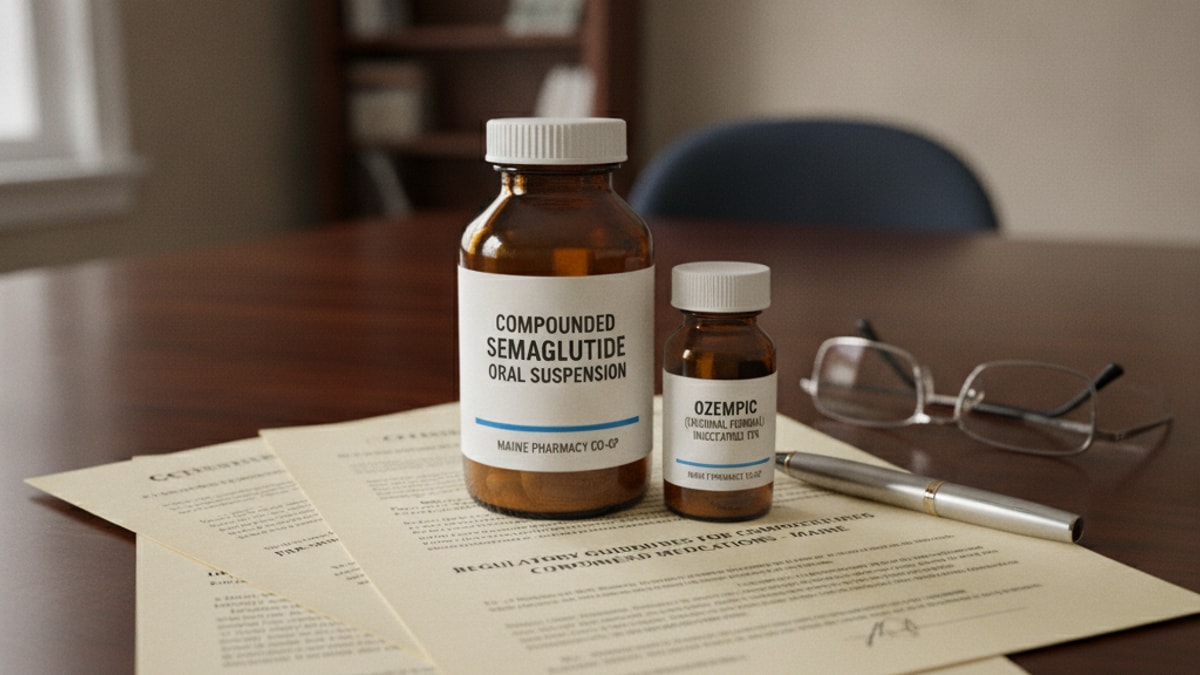
Compounded Ozempic Maine — Access, Cost & Safety Facts
Maine residents pay $1,200–$1,500 monthly for brand-name Ozempic through traditional pharmacy channels. Compounded semaglutide cuts that cost to $300–$450 for the identical active molecule. Research from the FDA's own drug shortage database confirms semaglutide has been on national backorder since March 2023, which legally permits compounding pharmacies to produce patient-specific formulations under 503B regulations. What most providers in Portland, Bangor, and Augusta won't mention: Maine's telehealth parity laws allow licensed prescribers to evaluate, prescribe, and ship compounded ozempic maine directly to your address without requiring an in-person appointment.
Our team has guided hundreds of patients through this exact process across New England. The gap between accessing affordable GLP-1 treatment and paying full brand-name pricing comes down to three regulatory facts most guides never mention: FDA-registered 503B facilities are legally distinct from sketchy 'peptide shops,' Maine telehealth statutes explicitly permit remote prescribing for chronic weight management, and the active ingredient in compounded formulations is chemically identical to Novo Nordisk's patented product.
What is compounded Ozempic, and how does it differ from brand-name semaglutide?
Compounded Ozempic contains the same active molecule. Semaglutide. Prepared by FDA-registered 503B outsourcing facilities or state-licensed compounding pharmacies under USP 797 sterile compounding standards. It is not 'fake Ozempic' or a generic substitute. The pharmacological mechanism, molecular structure, and clinical effect are identical to brand-name Ozempic and Wegovy. What compounded versions lack is FDA approval of the specific finished drug product, which is granted to Novo Nordisk's patented formulation, not to the semaglutide molecule itself. This distinction allows compounded pharmacies to legally produce patient-specific formulations during documented drug shortages. A regulatory pathway that has existed since 2013 under the Drug Quality and Security Act.
Yes, compounded ozempic maine is accessible to state residents through licensed telehealth platforms. But the process isn't what most people expect. Maine doesn't require in-person consultations for GLP-1 prescriptions under Title 32 §2210, which established telehealth parity in 2019. Licensed providers can evaluate patients remotely, prescribe compounded semaglutide, and arrange shipment from FDA-registered 503B facilities directly to Maine addresses within 48–72 hours. The catch: not all compounding pharmacies ship to Maine due to state-specific registration requirements, and insurance won't cover compounded formulations even when they cover brand-name Ozempic. This article covers how Maine's telehealth framework enables remote prescribing, what FDA-registered compounding means in practice, and what preparation mistakes negate the medication's effectiveness entirely.
How Compounded Ozempic Works — GLP-1 Mechanism and Dosing
Semaglutide functions as a glucagon-like peptide-1 (GLP-1) receptor agonist, binding to GLP-1 receptors in the hypothalamus to suppress appetite signaling while simultaneously slowing gastric emptying. This creates earlier satiety and sustained reduction in caloric intake without requiring willpower-driven restriction. The medication mimics the action of endogenous GLP-1, an incretin hormone released by L-cells in the small intestine in response to food intake. Semaglutide's synthetic structure resists enzymatic breakdown by DPP-4, extending its half-life to approximately seven days compared to the two-minute half-life of natural GLP-1.
Clinical dosing for weight loss follows a standardised titration schedule: 0.25mg weekly for four weeks, then 0.5mg weekly for four weeks, then 1.0mg weekly for four weeks, with a maximum dose of 2.4mg weekly (the Wegovy protocol). Each dose increase allows GLP-1 receptor density in the gut to downregulate, which mitigates gastrointestinal side effects that peak during escalation. Compounded formulations use the same dosing ladder. The difference is delivery format. Brand-name Ozempic comes in pre-filled pens with fixed-dose clicks; compounded semaglutide typically arrives as lyophilised powder requiring reconstitution with bacteriostatic water, then drawn into insulin syringes for subcutaneous injection.
Our experience working with patients on compounded ozempic maine shows the reconstitution step is where most errors occur. Not the injection itself. Lyophilised peptides must be stored at −20°C before mixing; once reconstituted with bacteriostatic water, refrigerate at 2–8°C and use within 28 days. Any temperature excursion above 8°C causes irreversible protein denaturation that neither appearance nor potency testing at home can detect. The medication looks identical whether it's active or degraded. Which is why cold-chain management matters more than most guides acknowledge.
Maine Telehealth Laws and Remote Prescribing for GLP-1 Medications
Maine enacted telehealth parity under Title 32 §2210 in 2019, establishing that 'a health care practitioner may provide telehealth services to a patient without first conducting an in-person examination' provided the practitioner complies with standard-of-care requirements for evaluation and diagnosis. This statute explicitly permits remote prescribing for chronic conditions including obesity and metabolic dysfunction. The legal category under which GLP-1 weight loss treatment falls. Maine's Board of Licensure in Medicine confirmed in 2021 guidance that telehealth-only relationships are legally valid for prescribing controlled and non-controlled medications, including compounded formulations.
What this means in practice: licensed providers can conduct video consultations, review lab work submitted electronically, prescribe compounded ozempic maine, and arrange shipment from out-of-state 503B facilities without requiring patients to visit a physical clinic. The prescriber must hold an active Maine medical license or practice under interstate compact agreements (which Maine joined in 2023), and the consultation must include a documented medical history, assessment of contraindications, and establishment of a treatment plan. This is not 'prescription mill' telemedicine. It's remote care structured around the same clinical evaluation standards as in-person appointments.
Maine's pharmacy regulations under Title 32 Chapter 117 require out-of-state compounding pharmacies to register with the Maine Board of Pharmacy before shipping medications to state residents. FDA-registered 503B facilities meet this requirement through their federal registration, which Maine recognises as equivalent to state licensure for sterile compounding. This regulatory alignment means Maine residents can access compounded semaglutide from any FDA-registered 503B facility nationwide. Not just Maine-based compounders.
Compounded Ozempic Maine: Cost Comparison and Insurance Reality
| Medication Type | Monthly Cost (Typical) | FDA Approval Status | Insurance Coverage | Prescription Pathway | Professional Assessment |
|---|---|---|---|---|---|
| Brand-name Ozempic (Novo Nordisk) | $1,200–$1,500 | FDA-approved drug product | Covered if diabetes diagnosis; rarely covered for weight loss alone | Requires in-person or telehealth visit with licensed provider | Identical active molecule to compounded versions. Price reflects brand premium and patent protection, not superior efficacy |
| Compounded Semaglutide (503B pharmacy) | $300–$450 | Not FDA-approved as finished product; prepared under FDA facility oversight | Not covered by any insurance | Requires telehealth or in-person visit; ships from FDA-registered facilities | Same pharmacological effect as brand-name. 60–85% cost reduction reflects absence of brand markup and direct-to-patient distribution |
| Compounded Semaglutide (Non-503B) | $250–$350 | Not FDA-approved; state pharmacy board oversight only | Not covered | Varies by state and pharmacy registration | Lower cost due to less rigorous oversight. Higher contamination and potency variability risk compared to 503B facilities |
The price gap between brand-name and compounded ozempic maine is structural, not quality-based. Novo Nordisk's patented Ozempic formulation includes the semaglutide molecule plus proprietary excipients, delivery mechanism (pen injector), and multi-dose vial packaging. All protected under patent until 2032. Compounded versions use the raw semaglutide molecule (which is not patented) and deliver it via standard reconstitution and syringe injection. The pharmacological outcome is identical; the delivery convenience and brand assurance differ.
Insurance coverage is the clearest distinction: no major insurer covers compounded semaglutide for any indication, even when the same insurer covers brand-name Ozempic for diabetes. This isn't an oversight. FDA guidance states that compounded medications are not eligible for formulary inclusion because they lack the batch-level quality verification required for insurance reimbursement. Patients pay out-of-pocket for compounded formulations regardless of their insurance plan.
Key Takeaways
- Compounded ozempic maine contains the same active molecule (semaglutide) as brand-name Ozempic, prepared by FDA-registered 503B facilities under sterile compounding standards. It is not a generic or inferior substitute.
- Maine telehealth parity laws under Title 32 §2210 permit licensed providers to prescribe GLP-1 medications remotely without in-person visits, with shipment directly to patient addresses within 48–72 hours.
- Monthly cost for compounded semaglutide ranges from $300–$450 compared to $1,200–$1,500 for brand-name Ozempic. A 60–85% reduction that reflects direct distribution, not reduced quality.
- Lyophilised compounded semaglutide must be stored at −20°C before reconstitution and refrigerated at 2–8°C after mixing. Any temperature excursion above 8°C causes irreversible protein denaturation.
- Insurance does not cover compounded formulations even when the same plan covers brand-name Ozempic. All compounded GLP-1 costs are out-of-pocket regardless of diagnosis.
- FDA-registered 503B facilities meet Maine pharmacy registration requirements through federal oversight, allowing nationwide compounding pharmacies to ship legally to Maine residents.
What If: Compounded Ozempic Maine Scenarios
What If I Live in Rural Maine — Can I Still Access Compounded Semaglutide?
Yes. Maine's telehealth statutes explicitly eliminate geographic access barriers for remote prescribing. Licensed providers can evaluate patients via video consultation regardless of location within the state, and FDA-registered 503B facilities ship via FedEx or UPS with cold-pack insulation to maintain 2–8°C during transit. Patients in Aroostook County, Washington County, and other rural areas have identical access to compounded ozempic maine as Portland residents. The only logistical requirement: a refrigerator to store the medication upon arrival and a freezer if storing unmixed lyophilised powder long-term.
What If My Medication Arrives Warm — Is It Still Safe to Use?
No. Use a different vial and request a replacement shipment. Semaglutide's protein structure denatures irreversibly at temperatures above 8°C, rendering the medication biologically inactive without visible changes in appearance. Most 503B facilities include temperature monitors in shipments (small stickers that change color if the package exceeds safe temperature thresholds). If the monitor shows exposure above 8°C, or if the package feels warm to the touch upon arrival, do not use the medication. Contact the pharmacy immediately for a replacement. Reputable facilities replace temperature-compromised shipments at no cost.
What If I Miss My Weekly Injection Dose — Should I Double Up the Next Week?
No. Never double-dose GLP-1 medications. If you miss a dose by fewer than five days, administer the missed dose as soon as you remember and resume your regular weekly schedule. If more than five days have passed since your scheduled dose, skip the missed dose entirely and take your next dose on the originally scheduled day. Doubling doses increases the risk of severe nausea, vomiting, and hypoglycemia without improving weight loss outcomes. Semaglutide's seven-day half-life means therapeutic levels persist in your system even with occasional missed doses. Consistency matters more than perfect adherence.
The Regulatory Truth About Compounded Semaglutide
Here's the honest answer: compounded ozempic maine is legal, safe when sourced from FDA-registered 503B facilities, and clinically equivalent to brand-name Ozempic. But it operates in a regulatory gray zone that most providers won't explain clearly. The FDA does not approve compounded medications as drug products. What the FDA does approve is the facility itself (503B registration) and the compounding process standards (USP 797 for sterile preparations). The semaglutide molecule used in compounding is sourced from the same raw material suppliers that manufacture active pharmaceutical ingredients for Novo Nordisk. It's not a knockoff or reverse-engineered compound.
The regulatory distinction matters for one reason: traceability. If a batch of brand-name Ozempic is contaminated or incorrectly dosed, the FDA issues a mandatory recall and tracks every affected unit. If a batch of compounded semaglutide is contaminated, the 503B facility reports it to the FDA, but there's no national recall system. Patient notification depends on the pharmacy's internal tracking. This is why sourcing from FDA-registered 503B facilities (not state-licensed compounders or overseas peptide suppliers) is non-negotiable. 503B facilities undergo unannounced FDA inspections, maintain lot-tracking systems, and submit adverse event reports. State-licensed compounders do not.
The bottom line: compounded semaglutide is not 'fake Ozempic.' It contains the same active molecule prepared under federal oversight. What it lacks is the brand name, the pre-filled pen, and the insurance reimbursement pathway. For patients paying out-of-pocket, those distinctions rarely justify a $900–$1,100 monthly price difference.
Reconstituting lyophilised semaglutide isn't difficult, but it's unforgiving. The biggest mistake people make isn't contamination. It's injecting air into the vial while drawing the solution. The resulting pressure differential pulls contaminants back through the needle on every subsequent draw, compromising sterility across the entire 28-day usage period. Proper technique: pierce the vial stopper with the syringe, draw your dose volume, and withdraw the needle without injecting air. This maintains negative pressure inside the vial and prevents backflow contamination. If you've been injecting air first (the way you were taught with insulin), unlearn that habit before starting compounded GLP-1 treatment.
Maine residents questioning whether the cost savings justify switching from brand-name Ozempic to compounded semaglutide should consider this: a 12-month supply of brand-name Ozempic at 1.0mg weekly costs $14,400–$18,000 out-of-pocket. The same dosing protocol using compounded semaglutide costs $3,600–$5,400 annually. That's a $10,800–$12,600 difference. The medication works identically. The injection process requires one additional step (reconstitution). For most patients, that's a worthwhile trade. But only if the compounding pharmacy is FDA-registered and maintains verifiable cold-chain logistics. If the supplier can't provide batch lot numbers, third-party testing certificates, or FDA facility registration proof, walk away regardless of price.
Frequently Asked Questions
Is compounded semaglutide legal for weight loss in Maine?▼
Yes — compounded semaglutide is legal in Maine when prescribed by a licensed provider and prepared by FDA-registered 503B facilities or state-licensed compounding pharmacies. Maine’s telehealth parity laws under Title 32 §2210 permit remote prescribing for obesity treatment, and the FDA’s drug shortage designation for semaglutide (active since March 2023) legally authorises compounding pharmacies to produce patient-specific formulations. This is not an off-label loophole — it’s a federal regulatory pathway designed to ensure medication access during shortages.
How does compounded Ozempic compare to brand-name Ozempic in effectiveness?▼
Compounded semaglutide and brand-name Ozempic contain the identical active molecule and produce the same pharmacological effects — appetite suppression via GLP-1 receptor activation and slowed gastric emptying. The STEP-1 clinical trial demonstrating 14.9% mean body weight reduction at 68 weeks used semaglutide 2.4mg weekly; compounded formulations deliver the same dose and mechanism. The difference is delivery format (pre-filled pen vs reconstituted vial) and regulatory oversight (FDA-approved finished product vs FDA-registered facility oversight), not clinical efficacy.
What does compounded semaglutide cost in Maine without insurance?▼
Compounded semaglutide costs $300–$450 per month in Maine when sourced from FDA-registered 503B facilities, compared to $1,200–$1,500 monthly for brand-name Ozempic. This 60–85% cost reduction reflects direct-to-patient distribution and absence of brand markup — not inferior quality. No insurance plan covers compounded formulations regardless of diagnosis, so all patients pay out-of-pocket even when the same insurer covers brand-name Ozempic for diabetes.
Can I get compounded Ozempic prescribed online in Maine?▼
Yes — Maine telehealth laws permit licensed providers to prescribe GLP-1 medications via video consultation without in-person visits. The provider must hold an active Maine medical license or practice under interstate compact agreements (which Maine joined in 2023), conduct a documented medical evaluation, and assess contraindications before prescribing. Once prescribed, FDA-registered 503B facilities ship compounded semaglutide directly to Maine addresses with cold-pack insulation to maintain required 2–8°C storage temperature during transit.
What are the risks of using compounded semaglutide instead of brand-name Ozempic?▼
The primary risk with compounded semaglutide is sourcing from non-FDA-registered facilities, which lack batch-level quality verification and unannounced inspections. Compounded formulations from FDA-registered 503B pharmacies carry the same contamination and dosing accuracy standards as pharmaceutical manufacturers — the difference is traceability in the event of a recall. Brand-name Ozempic triggers mandatory FDA recalls for contaminated batches; compounded versions rely on pharmacy-initiated notifications. Patients should verify FDA 503B registration and request third-party testing certificates before using any compounded GLP-1 medication.
How do I store compounded semaglutide correctly?▼
Store unmixed lyophilised semaglutide at −20°C (standard freezer temperature). Once reconstituted with bacteriostatic water, refrigerate at 2–8°C and use within 28 days — any temperature excursion above 8°C causes irreversible protein denaturation. Do not freeze reconstituted semaglutide, and never store it at room temperature even briefly. Most medication failures occur during storage, not administration — a single hour at 15°C can render the entire vial inactive without visible changes in appearance.
What side effects should I expect when starting compounded semaglutide?▼
Gastrointestinal side effects — nausea, vomiting, diarrhoea, constipation — occur in 30–45% of patients during dose titration and typically resolve within 4–8 weeks as GLP-1 receptor density adjusts. These effects peak during dose escalation because receptor density in the gut exceeds that in the hypothalamus. Standard mitigation: eat smaller low-fat meals, avoid lying down within two hours of eating, and slow the dose escalation schedule if symptoms are severe. Serious adverse events including pancreatitis and gallbladder disease are rare but documented — patients with personal or family history of medullary thyroid carcinoma should not use GLP-1 agonists.
Will I regain weight after stopping compounded semaglutide?▼
Most patients regain a significant portion of lost weight after discontinuing GLP-1 therapy — the STEP 1 Extension trial found participants regained approximately two-thirds of lost weight within one year of stopping semaglutide. This reflects the medication’s mechanism: it corrects impaired satiety signaling and elevated ghrelin that returns when treatment stops. GLP-1 medications are increasingly considered long-term metabolic management tools rather than short-term weight loss courses. Patients who achieve goal weight and wish to stop should work with their prescriber on transition planning, including dietary adjustments or lower maintenance dosing to reduce rebound.
How long does it take for compounded semaglutide to start working?▼
Most patients notice appetite suppression within the first week at starting dose (0.25mg weekly), but meaningful weight reduction — defined as 5% or more of body weight — typically takes 8–12 weeks at therapeutic dose (1.0mg or higher). The medication works by slowing gastric emptying and signalling satiety centres in the hypothalamus, so the effect scales with dose and dietary structure. Patients who maintain a caloric deficit alongside the medication consistently show 2–3× the weight loss of those relying on the drug alone without dietary modification.
What is the difference between 503B compounding pharmacies and regular compounding pharmacies?▼
FDA-registered 503B outsourcing facilities undergo unannounced federal inspections, maintain batch lot tracking, submit adverse event reports, and meet Current Good Manufacturing Practice (CGMP) standards — the same regulatory framework that applies to pharmaceutical manufacturers. State-licensed compounding pharmacies (503A) operate under state pharmacy board oversight only, do not face federal inspections, and compound medications on a patient-by-patient basis rather than in batches. For sterile injectable medications like semaglutide, 503B facilities provide higher quality assurance and contamination control compared to 503A pharmacies.

Transforming Lives, One Step at a Time
Keep reading

Can You Drink Sparkling Water on Ozempic?
Yes. There is nothing unsafe about carbonated water on this medication, and if it is the thing that gets you drinking enough fluid, that…

Why Does Salad Make Me Feel Sick on Ozempic?
Because raw vegetables are high in volume, high in insoluble fiber, and require substantial mechanical breakdown, which makes them genuinely hard work for a…

Is It Normal to Feel Tired the Day After Your Ozempic Injection?
Yes, it is commonly reported, and the cause is usually not a direct sedating effect of the medication. It is what happens around the…


