How Long Can You Stay on Wegovy In 2026?

There is no maximum time limit for staying on Wegovy. The medication is FDA-approved for chronic weight management, and the word “chronic” is intentional. Current clinical evidence supports ongoing, indefinite use for as long as Wegovy remains effective, tolerated, and medically appropriate. Clinical trials have tracked patients on semaglutide 2.4 mg (Wegovy’s active ingredient and dose) for up to two years with sustained weight loss and no new safety concerns emerging over time. Most obesity medicine specialists now treat Wegovy the same way they treat medications for blood pressure or cholesterol: as long-term therapy for a chronic condition, not a temporary intervention.
Here’s what the evidence says, how long-term treatment works in practice, and what you should consider when thinking about your own timeline.
The Clinical Evidence for Long-Term Use
The STEP clinical trial program provides the strongest evidence base for Wegovy’s long-term use.
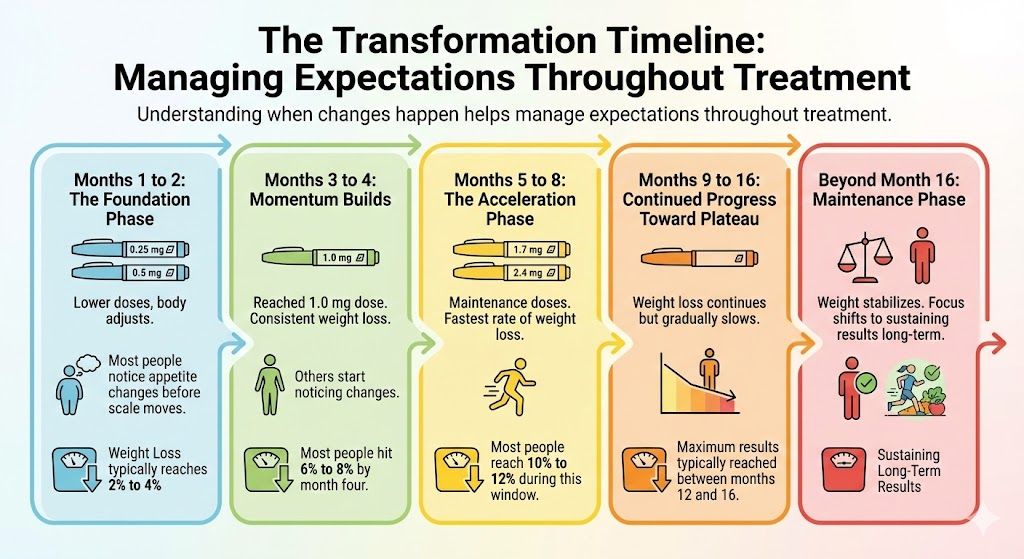
STEP 1 followed participants on semaglutide 2.4 mg for 68 weeks (roughly 16 months). Average weight loss was 14.9% of body weight, and participants who remained on the medication maintained their results throughout the study. The safety profile was consistent from beginning to end, with no new adverse event categories appearing during extended treatment.
STEP 5 extended the observation window to 104 weeks (two full years). Participants maintained their weight loss across the entire period. The study confirmed that semaglutide’s efficacy doesn’t fade with time. It continues working for as long as you continue taking it.
Real-world data extends even further. Semaglutide has been available in various forms since 2017 (initially as Ozempic for diabetes), and patients who’ve been on it continuously for four or more years show sustained benefits without emerging safety problems.
The FDA’s approval of Wegovy for chronic weight management reflects this evidence. The prescribing information doesn’t include a recommended stopping point or maximum treatment duration. The expectation built into the approval is that many patients will use it long-term (Wilding et al., NEJM, 2021).
Why Long-Term Use Is the Default Recommendation
This catches many patients off guard. The assumption going in is often: take Wegovy for a year, lose the weight, stop the medication, keep the results. The research tells a different story.
Obesity involves persistent changes in the hormones that regulate hunger, fullness, and metabolic rate. When you lose weight, your body responds with what researchers call counterregulatory adaptation. Ghrelin (hunger hormone) increases. Leptin (fullness hormone) decreases relative to your new body size. Your metabolic rate drops below what your new weight alone would predict. These adaptations aren’t temporary. Studies have shown they persist for years after weight loss, continuously pushing your body back toward its previous weight.
Wegovy works by counteracting these adaptations. It suppresses appetite, enhances satiety, and helps stabilize your weight at a lower level. When the medication is removed, those counterregulatory forces reassert themselves. Appetite returns, often stronger than before, and weight regain follows.
The STEP 1 trial extension demonstrated this clearly. Participants who stopped semaglutide after 68 weeks regained approximately two-thirds of their lost weight within the following year. This wasn’t because they made poor choices. It was because the biological drivers of regain were no longer being managed.
This is why most obesity medicine specialists frame Wegovy as a long-term treatment rather than a short-term tool. You wouldn’t expect blood pressure to stay controlled after stopping blood pressure medication. The same logic applies here.
Is Staying on Wegovy Long-Term Safe?
Based on all available evidence, yes. The safety profile of semaglutide at the 2.4 mg dose has been consistent across both short-term and extended studies.
The most common side effects are gastrointestinal: nausea, diarrhea, constipation, and vomiting. These are most pronounced during the dose escalation phase (the first 16 to 20 weeks) and typically improve significantly once you reach your maintenance dose. In long-term studies, GI side effects continued to decrease over time. Most patients on Wegovy for a year or more report minimal ongoing GI issues.
Serious but uncommon risks include pancreatitis, gallbladder disease (gallstones and cholecystitis), and a theoretical risk of medullary thyroid carcinoma based on animal studies. These risks exist at any point during treatment and don’t appear to increase with longer use. Regular monitoring helps catch any issues early.
The cardiovascular data is actually encouraging for long-term use. The SELECT trial (a large cardiovascular outcomes study) demonstrated that semaglutide reduced major adverse cardiovascular events by 20% in patients with obesity and established cardiovascular disease. This suggests that long-term semaglutide use may provide protective cardiovascular benefits beyond weight loss alone.
Areas where long-term data is still developing include outcomes beyond five years and effects on body composition over very extended treatment periods. The existing data is reassuring, but complete long-term pictures take time to build. Your provider can help you weigh the known benefits against the remaining uncertainties.
What Long-Term Wegovy Use Looks Like in Practice
Once you’ve completed the dose escalation and reached 2.4 mg, the maintenance phase of treatment is relatively straightforward.
You continue weekly injections at 2.4 mg indefinitely. Most patients establish a consistent day and time that works for their schedule and stick with it. The injection itself takes seconds and becomes routine quickly.
Provider check-ins typically happen every three to six months during stable maintenance. These visits include weight assessment, discussion of any side effects or concerns, and periodic bloodwork. A standard monitoring panel includes a metabolic panel, thyroid function, lipids, and HbA1c if relevant to your history.
Lifestyle habits remain important throughout long-term use. Wegovy works best when combined with consistent nutrition, regular physical activity (including resistance training to preserve muscle mass), adequate sleep, and stress management. The medication handles the hormonal and appetite aspects. You handle the behavioral foundations. Together, the results are stronger and more sustainable than either approach alone.
The Wegovy first month results article covers the initial treatment phase. Long-term maintenance looks very different from those early weeks. Side effects are usually minimal, the injection is routine, and the focus shifts from active weight loss to weight maintenance and overall health optimization.
Can You Use a Lower Dose for Maintenance?
This is a question many patients ask, and it’s a reasonable one. If 2.4 mg was needed to produce weight loss, maybe a lower dose could maintain the results at reduced cost and with fewer side effects.
The formal evidence for reduced-dose maintenance is limited. The STEP 4 trial showed that patients who continued at 2.4 mg maintained their weight loss, while those switched to placebo regained substantially. What wasn’t tested was a middle ground, continuing at 1 mg or 1.7 mg for maintenance.
In clinical practice, some providers do experiment with dose reduction during the maintenance phase. The approach typically involves stepping down gradually (2.4 mg to 1.7 mg, then potentially to 1 mg) while monitoring weight closely. If weight remains stable at the lower dose, you stay there. If weight starts creeping up, you return to the effective dose promptly.
This strategy can work for some patients, but it requires close monitoring and a willingness to increase the dose again if needed. It’s not a guaranteed approach, and the safest course based on current evidence is to maintain the dose that produced your results.
If cost is the primary motivator for exploring dose reduction, compounded semaglutide through TrimRx may solve the problem more directly by reducing your monthly cost at your effective dose rather than reducing the dose itself.
The Cost Reality of Long-Term Treatment
Brand Wegovy without insurance costs over $1,300 per month. Over a year, that’s more than $15,000. Over five years, it exceeds $75,000. Even with insurance coverage, copays, prior authorizations, and annual re-approvals create ongoing friction.
This cost reality is the single biggest barrier to long-term adherence. Research published in JAMA Network Open has shown that cost and insurance disruptions are the leading reasons patients discontinue GLP-1 medications, often resulting in weight regain that could have been prevented with continued treatment.
Options for managing long-term costs include manufacturer copay assistance programs (Novo Nordisk offers a savings card for eligible patients), insurance advocacy through your provider’s office for prior authorization renewals, and compounded semaglutide as an alternative to brand pricing.
TrimRx offers compounded semaglutide through a telehealth model that includes provider consultation, prescription, and home delivery at a fraction of brand cost. For patients planning years of treatment, this price difference is substantial.
When Stopping Might Be Appropriate
While long-term use is the default recommendation, there are situations where discontinuation is reasonable.
If you develop a contraindication or serious adverse event (pancreatitis, significant allergic reaction, medullary thyroid carcinoma risk factors), stopping is medically necessary.
If you become pregnant or plan to become pregnant, Wegovy should be discontinued. Current guidelines recommend stopping semaglutide at least two months before attempting conception.
If your weight loss goals have been fully achieved and you’re willing to accept the risk of some regain while implementing intensive lifestyle maintenance, a carefully monitored trial off medication is a personal choice you can make with your provider.
If cost makes continued use impossible and compounded alternatives aren’t accessible, a structured discontinuation with a robust lifestyle maintenance plan is better than abruptly stopping without a plan.
In any of these scenarios, gradual tapering is preferred over abrupt discontinuation, and close weight monitoring for the following six to twelve months is strongly recommended. The Wegovy weight loss results article provides context for what semaglutide delivers during active treatment, which helps frame realistic expectations for the maintenance phase.
Planning Your Long-Term Approach
If you’re on Wegovy or considering starting, think about the timeline from the beginning. This isn’t a six-month project. It’s an ongoing treatment strategy.
Discuss long-term plans with your provider early. Understand the expectation that maintenance will likely require continued medication. Establish a monitoring routine that includes regular check-ins and periodic bloodwork. Build sustainable lifestyle habits that support the medication rather than relying on it entirely. Evaluate cost and access for the long term, and explore compounded options if brand pricing isn’t sustainable.
If you’re looking for a provider who takes a long-term approach to GLP-1 treatment, TrimRx’s intake quiz can connect you with a clinician who can help you build a plan that’s both clinically sound and financially sustainable over time. Whether you’re considering switching to compounded tirzepatide for stronger results or optimizing your current semaglutide regimen, having a provider who thinks in terms of years rather than months makes a real difference.
This information is for educational purposes and is not medical advice. Consult with a healthcare provider before starting any medication. Individual results may vary.

Transforming Lives, One Step at a Time
Keep reading

Wegovy Results at 6 Months: What the Data Shows
Six months into Wegovy is when the medication starts showing its full potential. By this point most patients have reached or are approaching the…

Wegovy Results at 3 Months: A Realistic Progress Check
Three months into Wegovy, you’re at a turning point. The early adjustment phase is behind you, the dose escalation is well underway, and your…

How to Get Wegovy Online: Step-by-Step
The process of getting Wegovy used to mean scheduling an in-person appointment with a physician, waiting weeks for availability, and then navigating pharmacy stock…


