How Long Can You Take Mounjaro?

You can take Mounjaro for as long as it continues to be effective, well-tolerated, and medically appropriate. There is no established maximum treatment duration. Tirzepatide (Mounjaro’s active ingredient) has been studied in clinical trials for up to 72 weeks with sustained weight loss and consistent safety, and many patients in real-world practice have now been on it for two or more years without issues. The FDA does not set a time limit on Mounjaro use, and the current medical consensus treats it as ongoing therapy for a chronic condition rather than a short-term intervention with a defined endpoint.
This article covers what we know about extended use, how it differs from the question of how long you should take it, and how to plan for a treatment timeline that may span years.
How This Differs from “How Long Should You Take It”
“How long can you” and “how long should you” are related but different questions. The first asks about safety limits. The second asks about clinical strategy.
From a safety standpoint, no maximum has been established. The available data supports continued use without a hard cutoff.
From a strategy standpoint, most obesity medicine providers recommend continuing Mounjaro indefinitely for patients who are responding well. The rationale is the same as for any chronic disease medication: the condition doesn’t resolve when the symptoms improve. Obesity involves persistent hormonal and metabolic dysregulation that reasserts itself when treatment is withdrawn. Stopping Mounjaro typically leads to weight regain, just as stopping blood pressure medication leads to rising blood pressure.
That said, “indefinitely” doesn’t mean “no matter what.” Your treatment strategy should be reassessed periodically based on your results, side effects, overall health, and evolving goals. Ongoing treatment is the default, but it’s not the only option, and individual circumstances matter.
What the Long-Term Data Shows
The SURMOUNT trial program provides the best evidence for extended tirzepatide use.
SURMOUNT-1 followed patients for 72 weeks on tirzepatide at 5 mg, 10 mg, and 15 mg. Weight loss was sustained throughout, with average reductions of 15%, 19.5%, and 20.9% of body weight at those respective doses. The weight loss curves hadn’t fully plateaued by week 72 at the higher doses, suggesting some patients may continue losing beyond 17 months of treatment (Jastreboff et al., NEJM, 2022).
SURMOUNT-4 addressed duration directly. Patients who achieved significant weight loss on tirzepatide were randomized to continue treatment or switch to placebo at week 36. By week 88, the continuation group maintained their results while the placebo group regained roughly half of what they’d lost. This trial is the strongest evidence that tirzepatide’s benefits require ongoing use to be sustained.
SURMOUNT-3 studied tirzepatide after an initial intensive lifestyle intervention and found that adding tirzepatide produced additional, sustained weight loss beyond what lifestyle changes alone achieved. This is relevant to long-term planning because it suggests the medication provides durable benefits even in patients who’ve already optimized their behavioral approach.
Real-world data on tirzepatide is still accumulating since the medication is newer than semaglutide (Mounjaro was approved in 2022). But the existing data from both clinical trials and early real-world use is consistently positive regarding sustained effectiveness and safety over time.
The Three Phases of Long-Term Treatment
Understanding where you are in the treatment arc helps frame expectations about duration.
Dose escalation (weeks 1 through 16 to 24). You titrate from 2.5 mg upward, increasing by 2.5 mg every four weeks as tolerated. Side effects are most common during this phase. Weight loss begins, sometimes modestly at lower doses and then accelerating as you reach higher levels. The Mounjaro first month article covers what to expect during these initial weeks.
Active weight loss (approximately months 4 through 12 to 18). This is the period of most significant, consistent weight loss. You’re at or near your target dose, side effects have stabilized, and the medication is operating at full effect. Most of your total weight loss occurs during this phase. The Mounjaro 3-month results provide benchmarks for this period.
Weight maintenance (ongoing from month 12 to 18 forward). Weight loss gradually decelerates and your body settles into a new equilibrium. You’re not failing or plateauing. You’re stabilizing at a lower weight with the medication’s ongoing support. The treatment focus shifts from losing weight to sustaining the loss, optimizing body composition, and managing overall metabolic health.
Most patients who ask “how long can I take this” are either approaching or already in the maintenance phase. The answer is: as long as needed, which for most people means indefinitely.
Safety During Extended Use
The safety data for tirzepatide across 72 weeks of clinical trials shows a consistent profile without new concerns emerging over time.
GI side effects improve. Nausea, diarrhea, constipation, and vomiting are most common during dose escalation. By the time patients reach stable maintenance, these effects are typically minimal or absent. Long-term studies show continued improvement in GI tolerability over time, not worsening.
Metabolic markers improve and stay improved. Blood sugar, insulin sensitivity, triglycerides, and blood pressure all tend to improve during tirzepatide treatment. These improvements are maintained during continued use, providing metabolic benefits that extend well beyond weight loss alone.
Serious risks remain low. Pancreatitis, gallbladder events, and the theoretical medullary thyroid carcinoma risk exist but are uncommon and don’t appear to increase with treatment duration. Standard clinical monitoring catches these issues early in the rare cases where they occur.
Areas still being studied. The effects of very long-term tirzepatide use (five or more years) on bone density, lean muscle mass, and other body composition parameters are still being evaluated. Early data suggests that resistance training and adequate protein intake effectively mitigate concerns about muscle and bone loss during GLP-1 treatment, but more long-term data will continue to build the picture.
Monitoring recommendations. Most providers recommend bloodwork every six to twelve months during stable treatment: metabolic panel, thyroid function, lipids, HbA1c, and potentially bone density screening for higher-risk patients (postmenopausal women, patients with history of osteopenia). Regular clinical check-ins every three to six months keep treatment on track.
The Weight Regain Question
This is the central reason long-term use is recommended. Every major study on GLP-1 medications has shown substantial weight regain after discontinuation.
The SURMOUNT-4 data showed roughly 50% regain within a year of stopping tirzepatide. The STEP 1 extension showed approximately 67% regain within a year of stopping semaglutide. These aren’t isolated findings. They reflect the fundamental biology of weight regulation.
Your body maintains a complex hormonal defense against sustained weight loss. Hunger hormones increase. Satiety hormones decrease. Metabolic rate drops below predicted levels. These adaptations persist for years, continually pushing your body back toward its previous weight. Tirzepatide counteracts these forces. Remove it, and the forces reassert themselves.
This doesn’t mean every patient who stops will regain everything. Some patients, particularly those who’ve made substantial lifestyle changes during treatment, may maintain a portion of their loss. But the data is clear that most patients regain most of the weight, and the regain begins relatively quickly after discontinuation.
Understanding this reality is essential for making informed decisions about treatment duration. It’s not about scaring you into staying on medication. It’s about giving you accurate information so your expectations match the biology.
When Stopping or Pausing Makes Sense
Despite the general recommendation for ongoing use, there are legitimate situations where stopping or pausing Mounjaro is appropriate.
Pregnancy planning. Tirzepatide should be discontinued before attempting conception. Current guidelines recommend stopping at least one month before, though some providers prefer a longer washout. Discuss timing with your provider based on your specific situation.
Serious adverse events. Pancreatitis, severe allergic reactions, or other significant medical issues warrant immediate discontinuation and evaluation.
Intolerable side effects. If side effects remain problematic despite dose adjustments and supportive measures, switching to a different medication (like compounded semaglutide) may be preferable to continuing a drug you can’t tolerate.
Financial necessity. If cost makes continued use impossible and no affordable alternatives are available, a planned discontinuation with intensive lifestyle preparation is better than running out of medication unexpectedly. Increase protein intake, intensify exercise, set up frequent weigh-ins, and develop a plan to resume treatment if regain exceeds a defined threshold.
Personal choice after thorough discussion. Some patients, fully informed about the regain risk, choose to try maintaining without medication. This is a valid choice when made with open eyes. The key is having a monitoring plan and a low threshold for resuming treatment if needed.
Making Long-Term Use Affordable
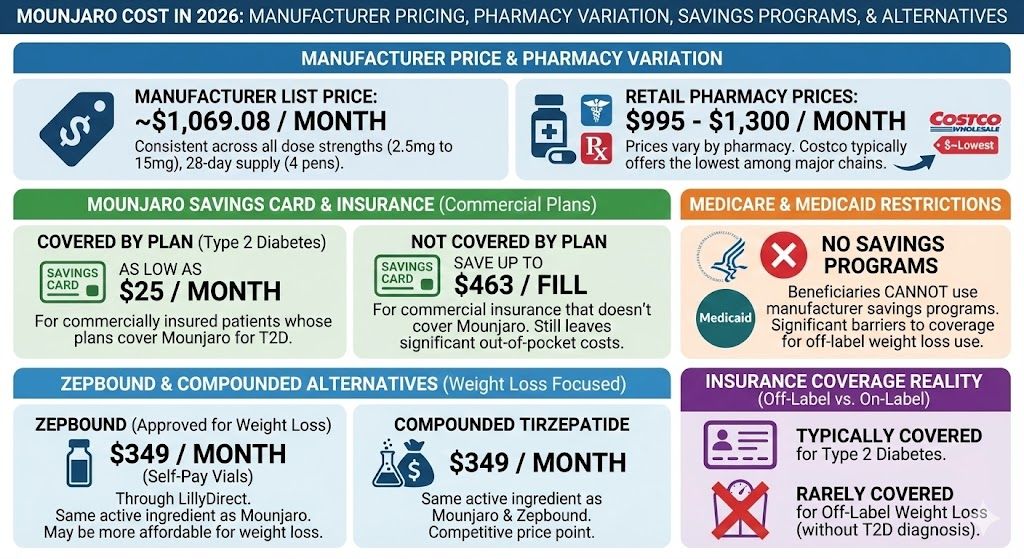
Cost is the biggest practical barrier to extended Mounjaro treatment. Brand pricing exceeds $1,000 monthly without insurance, and even insured patients face copays, prior authorizations, and the constant possibility of formulary changes.
Strategies for long-term affordability include Eli Lilly’s copay assistance programs for eligible commercially insured patients, insurance advocacy through your provider’s office for prior authorization approvals and renewals, and compounded tirzepatide as an alternative to brand pricing.
TrimRx offers compounded tirzepatide at a fraction of brand cost through a telehealth model that includes provider consultation, prescription management, and home delivery. For patients planning years of treatment, the monthly savings on compounded medication add up to thousands of dollars annually.
Some patients ask about using a lower maintenance dose to reduce cost. This can work for some individuals, but the evidence base for reduced-dose maintenance is still limited. Maintaining your effective dose at a lower cost through compounding is generally a more reliable strategy than hoping a lower dose will hold your results.
Your Long-Term Treatment Framework
If you’re on Mounjaro or considering starting, here’s how to think about duration:
Accept the likelihood of long-term use from the beginning. This reframes your approach to cost planning, lifestyle habits, and provider relationships. Build the lifestyle foundation that complements the medication. Resistance training, protein-focused nutrition, quality sleep, and stress management aren’t add-ons. They’re the base that maximizes what the medication can do and supports your health independently. Establish a monitoring routine with your provider. Regular bloodwork, weight tracking, and clinical check-ins keep treatment optimized and catch any issues early. Plan for cost sustainability. Evaluate brand vs. compounded options, insurance coverage, and copay programs before you’re forced to make a rushed decision. Reassess periodically. Every six to twelve months, review your results, goals, side effects, and financial situation with your provider. Long-term treatment should be intentional, not automatic.
If you need a provider who thinks about GLP-1 treatment as a long-term strategy, TrimRx’s intake quiz can match you with a clinician experienced in both the clinical and practical aspects of sustained weight management.
This information is for educational purposes and is not medical advice. Consult with a healthcare provider before starting any medication. Individual results may vary.

Transforming Lives, One Step at a Time
Keep reading

Mounjaro Results at 6 Months: What to Expect
Six months into Mounjaro treatment, most patients are well past the early adjustment phase and seeing some of their most significant weight loss. At…

How to Get Mounjaro in Texas: Telehealth Options
Getting Mounjaro (tirzepatide) in Texas is accessible through your existing doctor, a weight loss clinic, or a telehealth provider that prescribes and ships compounded…

How to Get Mounjaro in California: Step-by-Step
Getting Mounjaro (tirzepatide) in California is a straightforward process whether you go through your primary care doctor, an in-person weight loss clinic, or a…


