How Long Does It Take to Lose Weight on Semaglutide?

People often start seeing measurable weight loss within the first month on semaglutide, with results accelerating through months 3 to 6.
Clinical trial data from the STEP 1 study shows that weight loss was observed from the first assessment at week 4, continued steadily through treatment, and reached its lowest point around week 60. The average total weight loss at 68 weeks was 14.9%.
Understanding this timeline helps set realistic expectations. Semaglutide isn’t a quick fix. It’s a medication designed for gradual, sustainable weight loss that unfolds over months, not days.
The Complete Semaglutide Weight Loss Timeline
Here’s what clinical research shows about weight loss progression on semaglutide:
| Timeframe | Average Weight Loss | What’s Happening |
|---|---|---|
| Week 4 | 2-4% | Body adjusting, appetite changes begin |
| Week 12 | 6-10% | Therapeutic doses reached, steady loss |
| Week 28 | 12-13% | Peak rate of weight loss |
| Week 60 | 15-17% | Weight reaches lowest point |
| Week 68+ | 14-15% | Maintenance phase |
The STEP 1 trial specifically noted that weight loss reached its nadir (lowest point) at week 60, with weight stabilizing thereafter. This means most of the transformation happens within the first 12 to 15 months.
Phase 1: The Adjustment Period (Weeks 1 to 4)
What to expect: Modest changes as your body adapts to the medication.
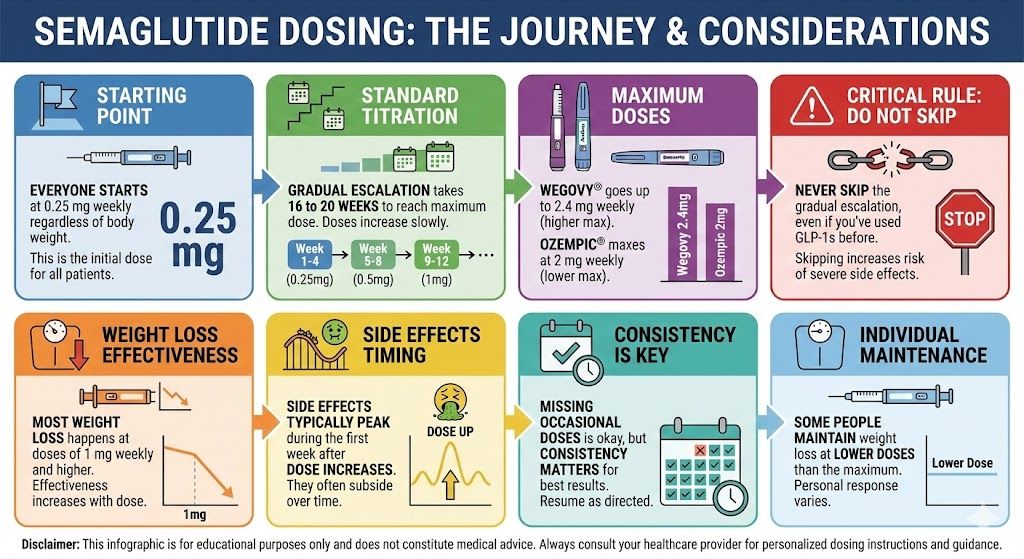
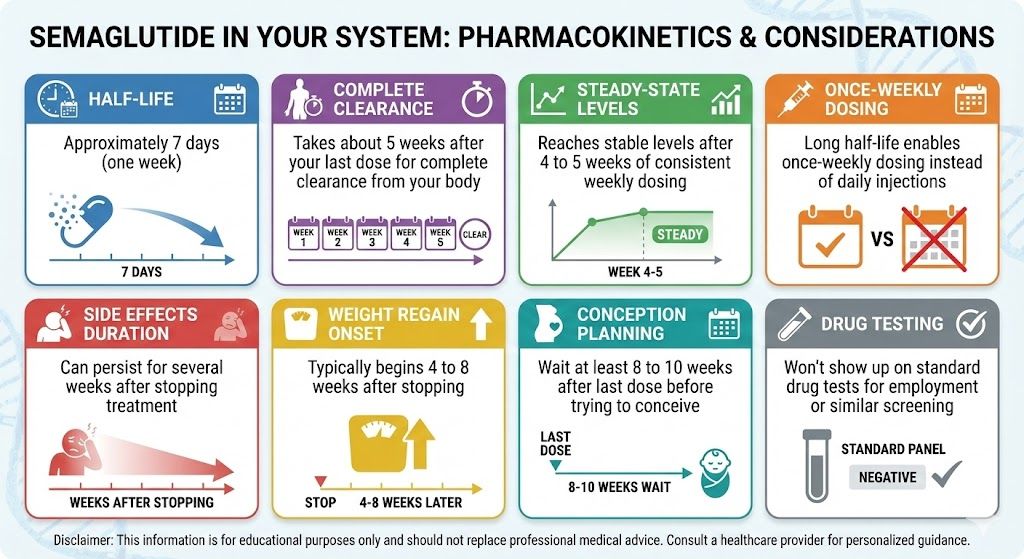
During the first month, you’re on the 0.25 mg starter dose, which prioritizes tolerability over results. The medication takes 4 to 5 weeks to reach steady state in your bloodstream.
Weight loss: Approximately 2% to 4% of body weight (3 to 8 pounds for most people).
Appetite changes: Many people notice reduced hunger within the first week or two. You might feel satisfied with smaller portions or find yourself thinking about food less often.
Side effects: Gastrointestinal effects like nausea commonly appear during this phase but typically improve as your body adjusts.
This phase is about building the foundation. Don’t be discouraged by modest scale movement.
Phase 2: Acceleration (Weeks 5 to 20)
What to expect: Noticeable, consistent weight loss as doses increase.
This is when semaglutide starts delivering visible results. You’ll progress through the 0.5 mg, 1.0 mg, and 1.7 mg doses, with each increase typically bringing stronger appetite suppression.
Weight loss: By week 12, most people have lost 6% to 10% of body weight. By week 20, this increases to approximately 10% to 12%.
Appetite changes: Most people experience significant reduction in hunger and cravings. Food preferences often shift naturally toward lighter, healthier options.
Side effects: May temporarily return with each dose increase, then subside.
This phase often produces the fastest rate of weight loss. Many people report that others start noticing their transformation during months 3 to 5.
Phase 3: Maximum Effect (Weeks 20 to 60)
What to expect: Continued weight loss at a gradually slowing rate.
You’ve reached or are approaching the maintenance dose (2.4 mg for Wegovy). Weight loss continues but the rate naturally decreases as you get closer to your body’s new equilibrium.
Weight loss: Most people reach 13% to 15% total weight loss by week 52. The STEP 1 trial showed weight continued declining until approximately week 60.
Appetite changes: Appetite suppression remains stable. Most people have established new eating patterns by this point.
Side effects: Generally minimal by this phase for most users.
This phase is about reaching your maximum results and transitioning into long-term maintenance.
Phase 4: Maintenance (Week 60+)
What to expect: Weight stabilization and long-term management.
After reaching your lowest weight, the goal shifts to maintaining results. Clinical data shows weight tends to stabilize rather than continue declining indefinitely.
Weight maintenance: Continuing semaglutide helps maintain the weight you’ve lost. The STEP 4 trial showed that people who stopped medication regained significant weight, while those who continued maintained their results.
Real-World Results vs Clinical Trials
Clinical trials occur under controlled conditions. How do real-world results compare?
A study published in JAMA Network Open tracked patients in regular clinical practice and found results closely matched trial outcomes:
- 3 months: 5.9% average weight loss
- 6 months: 10.9% average weight loss
These findings suggest that the timeline from clinical trials applies well to everyday use of semaglutide.
Factors That Affect Your Timeline
Several variables influence how quickly you’ll see results:
Dose progression matters significantly. People who tolerate and reach higher doses typically see faster and greater weight loss. If side effects slow your titration, results may take longer.
Diabetes status affects outcomes. The JAMA study found people without type 2 diabetes lost more weight than those with diabetes (6.3% vs 3.9% at 3 months).
Starting weight influences the timeline. People with higher starting weights often lose more total pounds but may see similar or slightly lower percentage changes.
Lifestyle factors play a role. Clinical trials included dietary guidance (500 calorie deficit) and exercise recommendations (150 minutes weekly). Following similar guidelines maximizes results.
Medication adherence is critical. Consistent weekly dosing produces the best outcomes. Missing doses can slow progress.
When to Expect Specific Milestones
Based on clinical data, here’s when most people reach key weight loss milestones:
5% weight loss: Typically achieved by weeks 8 to 12. In STEP 1, 86% of participants reached this milestone.
10% weight loss: Usually achieved by weeks 20 to 28. In STEP 1, 69% of participants reached this milestone.
15% weight loss: Typically achieved by weeks 40 to 60. In STEP 1, 50% of participants reached this milestone.
20%+ weight loss: Achieved by approximately one-third of participants, usually by weeks 52 to 68.
Signs Semaglutide Is Working Before the Scale Moves
Weight loss isn’t linear. Some weeks the scale moves; others it doesn’t. Look for these signs that the medication is working:
Reduced appetite is the clearest indicator. Feeling satisfied with less food means the medication is doing its job.
Quieter “food noise” means fewer intrusive thoughts about eating throughout the day.
Smaller portions becoming satisfying suggests your satiety signals are changing.
Reduced cravings for high-calorie foods indicates the medication is affecting your food preferences.
Better blood sugar control may appear before significant weight loss, particularly if you have prediabetes or diabetes.
Managing Side Effects Along the Timeline
Sulfur burps and other gastrointestinal effects are common but typically follow a predictable pattern:
Weeks 1 to 4: Side effects may appear as your body adjusts.
Dose increases: Symptoms often return temporarily with each dose increase, then subside within 1 to 2 weeks.
Maintenance phase: Most people experience minimal side effects once on a stable dose.
Strategies that help throughout treatment include eating smaller meals, avoiding fatty foods, staying hydrated, and eating slowly.
What Happens If You Stop
The STEP 4 trial examined what happens when people discontinue semaglutide after achieving results. Participants who stopped medication regained approximately two-thirds of their lost weight within a year.
This finding underscores that semaglutide works best as ongoing treatment. The biological factors that contributed to weight gain don’t disappear. Long-term success typically requires either continued medication or significant, sustained lifestyle changes.
How Semaglutide Compares to Alternatives
Tirzepatide (Mounjaro/Zepbound): Produces faster and greater weight loss, averaging 20% to 22% at 72 weeks compared to semaglutide’s 15%.
Diet and exercise alone: Typically produces 3% to 5% weight loss that’s difficult to maintain long-term.
Older weight loss medications: Generally produce 5% to 10% weight loss.
Getting Started With Semaglutide
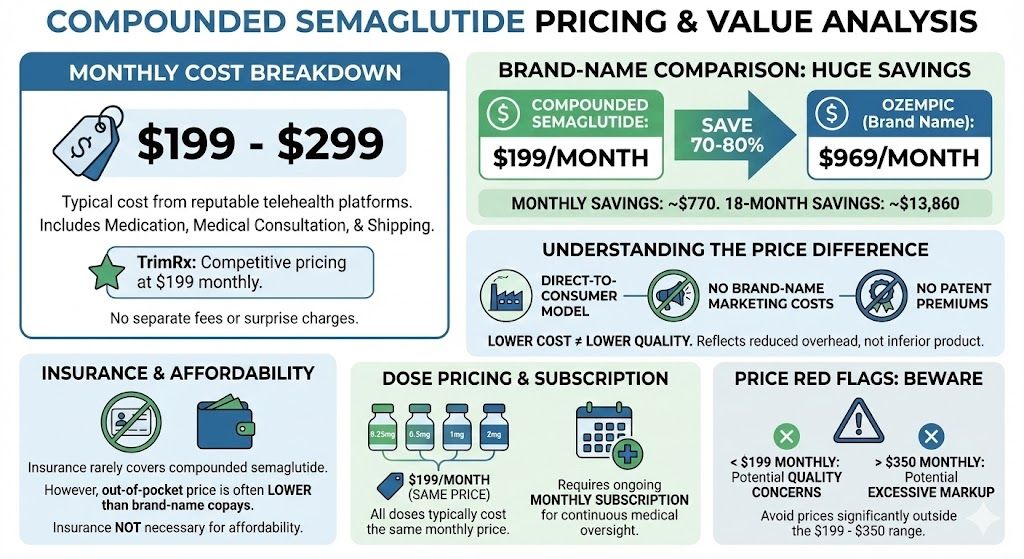
If you’re considering semaglutide for weight loss, TrimRx offers telehealth consultations to help you understand your options. Compounded semaglutide provides the same active ingredient at more accessible prices.
You can take the intake quiz to see if you qualify.
The Bottom Line
Semaglutide produces gradual, sustainable weight loss that unfolds over months. Most people see appetite changes within weeks, measurable weight loss by month one, and significant transformation by months 6 to 12. Weight typically reaches its lowest point around week 60, with maintenance thereafter.
Patience pays off. The people who achieve the best results are those who stay consistent through the entire timeline rather than expecting overnight transformation.
This information is for educational purposes and is not medical advice. Consult with a healthcare provider before starting any medication. Individual results may vary.

Transforming Lives, One Step at a Time
Keep reading

How Fast Does Semaglutide Work: Early Signs It’s Working
Semaglutide begins acting in your body within the first 24 to 48 hours of your initial injection, but the effects most people care about,…

Creatine on Semaglutide: Does It Help Preserve Muscle
One of the most practical questions people ask once they’re a few months into semaglutide treatment is how to protect their muscle mass while…

Vitamin D and Semaglutide: What Patients Should Know
Vitamin D deficiency is remarkably common in people with obesity, and it’s one of the micronutrients most worth paying attention to when you start…


