How Long Does Semaglutide Stay in Your System?

Whether you’re experiencing side effects and wondering when they’ll resolve, planning to stop treatment, thinking about pregnancy, or simply curious about how the medication works in your body, understanding how long semaglutide stays in your system provides important context.
The straightforward answer: semaglutide has a half-life of approximately seven days, meaning it takes about one week for half the dose to clear from your body. After you take your last injection, it takes roughly five weeks for semaglutide to completely leave your system. However, the timeline varies somewhat based on individual factors like kidney function, metabolism, and how long you’ve been taking the medication.
This guide explains what half-life means in practical terms, why semaglutide is designed to stay in your system longer than many medications, what happens during and after the clearance process, and why this timeline matters for various situations.
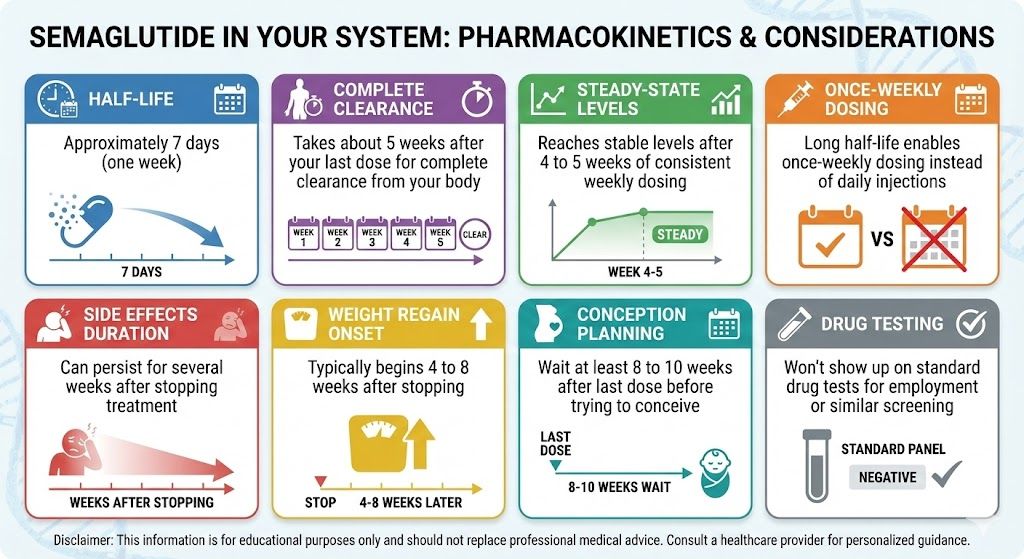
Key Takeaways: Semaglutide in Your System
- Semaglutide has a half-life of approximately 7 days (one week)
- Takes about 5 weeks after your last dose for complete clearance from your body
- Reaches steady-state levels after 4 to 5 weeks of consistent weekly dosing
- Long half-life enables once-weekly dosing instead of daily injections
- Side effects can persist for several weeks after stopping treatment
- Weight regain typically begins 4 to 8 weeks after stopping
- Wait at least 8 to 10 weeks after last dose before trying to conceive
- Won’t show up on standard drug tests for employment or similar screening
Understanding Half-Life: What Does It Mean?
The concept of half-life sounds technical, but it’s fairly straightforward once you break it down.
A medication’s half-life is the time it takes for your body to eliminate half of the drug from your system. For semaglutide, that’s approximately seven days. If you inject 1 mg of semaglutide on Monday, by the following Monday about 0.5 mg remains in your system. By the Monday after that, about 0.25 mg remains. The amount keeps halving every seven days.
This doesn’t mean the medication stops working after one week. Even as levels decline, enough remains in your system to continue producing effects. This is actually why semaglutide only requires weekly dosing. The long half-life maintains therapeutic levels between injections.
Compare this to medications with short half-lives that require daily or multiple-daily dosing. Metformin, a common diabetes medication, has a half-life of about 4 to 6 hours. If you only took it once weekly, levels would drop too low between doses to remain effective.
The pharmaceutical industry specifically designed semaglutide with a long half-life by modifying the molecule to resist breakdown in the body. This modification makes weekly dosing possible and more convenient than daily injections.
Timeline: From First Dose to Complete Clearance
Let’s walk through what happens to semaglutide levels in your body over time.
First Few Weeks: Building Up to Steady State
When you start semaglutide at the standard 0.25 mg dose, levels begin accumulating in your system. After your first injection, some medication remains when you take your second dose a week later. This continues building with each weekly injection.
It takes approximately four to five weeks of consistent weekly dosing for semaglutide to reach what’s called steady state. This means the amount you’re eliminating between doses equals the amount you’re adding with each new injection. Your body maintains relatively stable medication levels from that point forward.
This is why people often don’t see dramatic effects during the first few weeks of treatment. You’re still building up to therapeutic levels. The appetite suppression and weight loss effects become more noticeable once steady-state levels are achieved.
During Regular Treatment: Maintaining Steady Levels
Once you reach steady state, weekly injections maintain consistent semaglutide levels. The peaks after injection and troughs before the next dose stay within a relatively narrow range.
This stability is what produces the continuous appetite suppression you experience on the medication. Unlike drugs with shorter half-lives that might have more noticeable ups and downs in effectiveness, semaglutide’s long half-life creates a smooth, sustained effect throughout the week.
After Stopping: The Clearance Process
When you take your final dose of semaglutide, the clearance timeline looks like this:
Week 1 after last dose: About 50% of the medication remains. You’ll still experience significant appetite suppression and other effects. Most people don’t notice dramatic changes during this first week.
Week 2 after last dose: About 25% remains. Effects start diminishing noticeably. Appetite often begins returning, though not to pre-treatment levels yet.
Week 3 after last dose: About 12.5% remains. Appetite continues increasing. Weight loss typically stops, and some people begin regaining small amounts of weight.
Week 4 after last dose: About 6% remains. Effects are minimal at this point. Hunger and food thoughts usually return close to pre-treatment levels.
Week 5 after last dose: About 3% remains. For practical purposes, the medication is mostly cleared. Any remaining trace amounts have negligible effects.
Beyond week 5: Semaglutide is considered completely eliminated from your system.
This timeline assumes normal kidney and liver function. People with kidney or liver impairment might clear semaglutide more slowly, extending the timeline somewhat.
Why Semaglutide Has a Long Half-Life
The pharmaceutical chemistry behind semaglutide’s extended presence in your body involves intentional molecular modifications.
Natural GLP-1, the hormone semaglutide mimics, has a half-life of only about 2 minutes. Your body breaks it down almost immediately after it’s released. This made developing GLP-1 medications challenging because they would need to be injected continuously to maintain levels.
Novo Nordisk solved this by modifying the GLP-1 molecule in several ways. They attached a fatty acid chain that allows semaglutide to bind to albumin, a protein abundant in your blood. This binding protects semaglutide from rapid breakdown. They made changes that resist DPP-4, an enzyme that normally degrades GLP-1 quickly. These modifications extended the half-life from 2 minutes to 7 days, making once-weekly dosing feasible.
This pharmaceutical achievement transformed GLP-1 medications from theoretical possibilities to practical treatments. Earlier GLP-1 drugs like exenatide required twice-daily injections. Liraglutide improved to once-daily. Semaglutide further extended to once-weekly. Newer modifications are being developed that might eventually enable monthly dosing.
Factors That Affect How Long Semaglutide Stays in Your System
While seven days is the average half-life, individual variation exists based on several factors.
Kidney Function
Your kidneys play a minor role in eliminating semaglutide. Most breakdown happens through general protein degradation throughout your body, not specific kidney or liver processing. However, people with significantly impaired kidney function might clear semaglutide slightly more slowly.
If you have chronic kidney disease, your healthcare provider will consider this when prescribing and monitoring treatment, though dose adjustments usually aren’t necessary for mild to moderate kidney impairment.
Body Weight and Composition
Larger body size doesn’t dramatically affect semaglutide half-life, but it can influence the volume of distribution. This means heavier individuals might have slightly different peak and trough levels with the same dose, though the clearance rate remains similar.
Body composition (muscle versus fat) has minimal impact on semaglutide clearance since the medication doesn’t preferentially accumulate in fat tissue the way some drugs do.
Age
Older adults generally clear medications more slowly due to age-related changes in kidney function and metabolism. However, clinical trials showed no clinically significant difference in semaglutide clearance between younger and older adults. Age alone doesn’t require dose adjustments.
Metabolic Rate
Individual differences in metabolism can create minor variations in how quickly your body processes semaglutide. People with faster overall metabolisms might clear it slightly quicker, while those with slower metabolisms might retain it slightly longer. These differences are usually small and don’t meaningfully impact treatment.
Duration of Treatment
Interestingly, how long you’ve been taking semaglutide doesn’t significantly change its half-life. Someone who’s been on treatment for six months clears it at roughly the same rate as someone who’s been on it for two years. The medication doesn’t accumulate beyond steady-state levels regardless of treatment duration.
What Happens When You Stop Taking Semaglutide
Understanding the clearance timeline helps explain what to expect after stopping treatment.
Return of Appetite
Appetite typically returns gradually over 2 to 4 weeks after your last dose. During week one, you’ll likely still feel significant appetite suppression. By week two, hunger starts returning but remains somewhat muted compared to pre-treatment. By weeks three and four, appetite often returns to pre-treatment levels or sometimes even higher.
Some people report that hunger feels especially intense during weeks three through six after stopping, possibly due to your body readjusting to the absence of appetite suppression it had adapted to.
Weight Regain Timeline
Clinical studies show that most people begin regaining weight within 4 to 8 weeks after stopping semaglutide. The regain typically happens gradually at first, then accelerates. One-year follow-up studies after stopping treatment found that participants regained approximately two-thirds of the weight they had lost.
This doesn’t mean stopping semaglutide inevitably leads to complete weight regain. Some people maintain portions of their weight loss through sustained lifestyle changes, but maintaining without medication requires significant ongoing effort that proves difficult for most.
For insights on maintaining weight loss, see our guide on semaglutide weight loss results, which discusses long-term maintenance strategies.
Side Effects After Stopping
The good news is that side effects also resolve as semaglutide clears from your system. Nausea, if you were experiencing it, typically improves within one to two weeks after your last dose. Digestive issues like constipation or diarrhea usually normalize within two to three weeks. Reduced appetite, which was the intended effect, returns to normal over three to four weeks.
If you stopped semaglutide specifically because of intolerable side effects, you should see substantial improvement within two weeks and near-complete resolution by four weeks.
Metabolic Changes
Semaglutide doesn’t permanently change your metabolism or reset your body’s weight set point. Once it clears from your system, your body returns to its previous metabolic state. This is why long-term weight maintenance typically requires either continued medication use or substantial lifestyle modifications.
Some people maintain portions of their metabolic improvements (better insulin sensitivity, lower blood pressure) if they’ve maintained weight loss through other means, but the direct medication effects disappear once semaglutide is eliminated.
Semaglutide and Pregnancy Planning
The five-week clearance timeline has important implications if you’re considering pregnancy.
Why Wait After Stopping
Semaglutide hasn’t been adequately studied in pregnant women, and animal studies showed some concerning effects on fetal development. The medication is not recommended during pregnancy or while trying to conceive.
If you’re planning pregnancy, most healthcare providers recommend stopping semaglutide and waiting at least two months (8 to 10 weeks) after your last dose before trying to conceive. This ensures complete clearance plus an additional safety margin.
If You Become Pregnant While Taking Semaglutide
If you discover you’re pregnant while taking semaglutide, stop immediately and contact your healthcare provider. While concerning, exposure during very early pregnancy doesn’t automatically indicate problems. Your provider will monitor your pregnancy appropriately and discuss any relevant considerations.
Breastfeeding Considerations
Limited data exists about semaglutide levels in breast milk or effects on nursing infants. Most providers recommend avoiding semaglutide while breastfeeding until more information becomes available. If you’re considering breastfeeding, discuss the timing of restarting semaglutide with your healthcare team.
Male Fertility Considerations
Current evidence doesn’t suggest semaglutide affects male fertility or requires men to stop treatment before attempting conception. However, this area hasn’t been extensively studied, so discussing your specific situation with a provider makes sense.
Semaglutide and Drug Testing
People sometimes worry about whether semaglutide will show up on drug tests for employment, athletics, or other purposes.
Standard Drug Screening
Semaglutide does not appear on standard drug tests used for employment, probation, or similar screening. These tests look for substances like marijuana, cocaine, opioids, amphetamines, and similar controlled substances. Semaglutide is a prescription peptide medication, not a controlled substance, and isn’t included in standard screening panels.
Athletic Drug Testing
Semaglutide is not currently banned by major sports organizations like the World Anti-Doping Agency (WADA) or most professional sports leagues. Athletes can use prescribed semaglutide for legitimate medical purposes without violating anti-doping rules.
However, athletic organizations sometimes update their prohibited substance lists, so athletes should verify current regulations with their specific organization.
Medical Testing
If you’re undergoing medical testing that might be affected by semaglutide use, inform your healthcare providers. For example, semaglutide affects glucose levels and might influence the interpretation of glucose tolerance tests or other metabolic assessments.
Blood tests can detect semaglutide if specifically tested for, though this is rarely done outside of clinical research settings or specific medical situations.
Switching Between GLP-1 Medications
Understanding semaglutide’s clearance timeline matters when switching to or from other medications.
Switching from Semaglutide to Tirzepatide
If you’re switching from semaglutide to tirzepatide, most providers recommend taking your first tirzepatide dose one week after your last semaglutide dose. This maintains some GLP-1 effect while starting tirzepatide.
You’ll begin tirzepatide at its standard starting dose of 2.5 mg weekly, even if you were on high-dose semaglutide. The addition of GIP receptor activation (tirzepatide’s dual action) is new to your system despite previous GLP-1 exposure.
For detailed information about tirzepatide, see our complete tirzepatide dosing guide.
Switching from Other GLP-1s to Semaglutide
If you’re coming from shorter-acting GLP-1 medications like liraglutide (Saxenda, Victoza) which require daily dosing, the switch is straightforward. Take your first semaglutide dose the day after your last liraglutide dose.
You’ll still start semaglutide at the standard 0.25 mg weekly starting dose despite previous GLP-1 exposure. This gradual escalation helps you adjust to semaglutide’s longer action and higher steady-state levels.
Switching from Semaglutide to Non-GLP-1 Medications
If you’re switching to non-GLP-1 weight loss medications, timing depends on the specific medication. Discuss optimal switching strategies with your provider based on what you’re transitioning to.
Some medications can start immediately, while others benefit from waiting until semaglutide largely clears to better assess the new medication’s effects.
Restarting Semaglutide After a Break
If you stop semaglutide and later decide to restart, the approach depends on how long you’ve been off treatment.
Short Breaks (2 to 4 Weeks)
If you’ve been off semaglutide for only two to four weeks, you might be able to resume at or near your previous dose rather than starting from the beginning. Discuss this with your provider. Some recommend dropping back one dose level for safety, then returning to your previous dose if tolerated well.
For example, if you were stable at 1.7 mg and took a three-week break, your provider might suggest restarting at 1 mg for one or two weeks, then returning to 1.7 mg.
Longer Breaks (More Than 4 Weeks)
If you’ve been off treatment for more than four weeks, most providers recommend starting over at 0.25 mg weekly and following the standard titration schedule. By week five off treatment, semaglutide has fully cleared and your body has lost most of its adaptation to the medication.
Trying to restart at your previous therapeutic dose would likely cause significant side effects similar to starting at a high dose initially.
Managing Expectations
People restarting semaglutide often hope to quickly return to their previous weight loss or immediately regain the appetite suppression they remember. Understand that the titration process takes time, and you’ll need to work back up to therapeutic doses gradually.
However, the second time through often feels easier because you know what to expect and have developed strategies for managing side effects.
Comparing Semaglutide to Tirzepatide Clearance
If you’re deciding between medications or switching, understanding their different pharmacokinetics helps.
Tirzepatide has a slightly shorter half-life than semaglutide, approximately 5 days compared to 7 days. This means tirzepatide clears from your system somewhat faster, taking about 3 to 4 weeks for complete elimination compared to semaglutide’s 5 weeks.
Practically, this difference rarely matters. Both medications maintain steady-state levels with weekly dosing. Both take similar timeframes to reach full effectiveness. The clearance difference of a week or two becomes relevant mainly for pregnancy planning or switching medications.
Neither medication’s half-life makes it inherently better or worse. The longer half-life doesn’t mean semaglutide is more powerful or effective. It simply reflects different molecular engineering approaches to achieve once-weekly dosing.
For comprehensive comparison including effectiveness and side effects, see our semaglutide vs tirzepatide guide.
Practical Implications of Semaglutide’s Long Half-Life
Understanding how long semaglutide stays in your system affects various practical decisions.
If You Experience Severe Side Effects
If you develop intolerable side effects, knowing they’ll persist for several weeks after stopping helps you decide whether to push through or discontinue. Some people experiencing severe nausea feel discouraged learning it will take two to three weeks to fully resolve after stopping.
However, this also means you can consider dose reduction rather than complete discontinuation. Dropping back to your previous dose level might resolve side effects while maintaining some treatment benefit.
Missed Dose Considerations
The long half-life provides some forgiveness if you miss a dose. Missing one weekly injection doesn’t mean medication levels immediately drop to zero. Some semaglutide remains in your system, maintaining partial effects.
However, don’t use this as justification for inconsistent dosing. Regular weekly injections produce the best results. The half-life provides a safety buffer, not a reason for carelessness.
Cost and Access Interruptions
If you experience a temporary lapse in medication access due to cost, insurance issues, or supply problems, understanding the clearance timeline helps you plan. A one-week gap is easily bridged. A three-week gap becomes more significant. A six-week gap means starting over with titration.
Compounded semaglutide at $199 monthly through TrimRx provides more affordable access that reduces the likelihood of cost-related treatment interruptions.
Surgical or Medical Procedures
If you need surgery or medical procedures that require stopping semaglutide temporarily, your medical team will consider how long it stays in your system when planning. The delayed gastric emptying effect persists while medication remains, which can affect anesthesia decisions.
Always inform healthcare providers about semaglutide use, including timing of your last dose.
Frequently Asked Questions
How long does it take for semaglutide to completely leave your body?
Semaglutide takes approximately 5 weeks after your last injection to completely clear from your system. The medication has a half-life of about 7 days, meaning levels halve each week. After 5 weeks, remaining amounts are negligible and no longer produce meaningful effects.
Can you speed up how quickly semaglutide leaves your system?
No, there’s no way to accelerate semaglutide clearance from your body. The medication naturally breaks down through protein degradation over time. Drinking extra water, exercising more, or other interventions won’t meaningfully speed up the elimination process. Your body clears it at its own pace based on the drug’s inherent half-life.
Why does semaglutide stay in your system so long?
Semaglutide was specifically designed with a long half-life to enable convenient once-weekly dosing. Pharmaceutical modifications to the GLP-1 molecule, including adding a fatty acid chain that binds to albumin, protect it from rapid breakdown. This extended presence is intentional and beneficial, not a side effect or problem.
Will side effects continue after stopping semaglutide?
Yes, side effects typically continue for 1 to 3 weeks after your last dose as medication gradually clears from your system. Nausea usually improves within 1 to 2 weeks. Digestive issues normalize within 2 to 3 weeks. Appetite suppression wears off over 3 to 4 weeks. By week 5, most people experience complete resolution of medication effects and side effects.
How long after stopping semaglutide will I gain weight back?
Most people begin regaining weight within 4 to 8 weeks after stopping semaglutide. Weight regain typically happens gradually at first, then accelerates. Studies show that one year after stopping, most people regain approximately two-thirds of their lost weight unless they’ve made substantial lifestyle changes or started alternative weight management approaches.
Can I take a break from semaglutide and restart later?
Yes, you can take breaks and restart later. However, if you’re off treatment for more than 4 weeks, you’ll typically need to start over at the beginning dose of 0.25 mg and work back up through the titration schedule. Your body loses its adaptation to the medication after it fully clears, making resumption at previous therapeutic doses likely to cause significant side effects.
How long should I wait after stopping semaglutide before trying to get pregnant?
Most healthcare providers recommend waiting at least 8 to 10 weeks (2 months) after your last semaglutide dose before trying to conceive. This allows complete clearance (5 weeks) plus an additional safety margin. Semaglutide isn’t recommended during pregnancy due to limited safety data in pregnant women.
Does semaglutide show up on drug tests?
No, semaglutide does not appear on standard drug screening tests used for employment, probation, or similar purposes. These tests look for controlled substances, and semaglutide is a prescription peptide medication that isn’t included in standard panels. It’s also not currently banned by major athletic organizations like WADA.
Is semaglutide detectable in blood tests?
Semaglutide can be detected in blood if specifically tested for, though this is rarely done outside of clinical research or specific medical situations. Routine blood work (metabolic panels, lipid panels, etc.) doesn’t measure semaglutide levels. If you’re undergoing medical testing that might be affected by semaglutide’s metabolic effects, inform your healthcare providers about your medication use.
If I miss a dose, how much semaglutide is still in my system?
If you miss your weekly dose, approximately 50% of your steady-state level remains from previous doses due to the 7-day half-life. This provides some continued effect, though not as much as with consistent dosing. If you miss by just a day or two, take your dose when you remember. If you miss by several days or a full week, consult your provider about whether to take the missed dose or skip it and resume on schedule.
Understanding Your Treatment Timeline
Semaglutide’s seven-day half-life and five-week clearance timeline have important implications throughout your treatment journey. The long half-life enables convenient once-weekly dosing, creates stable appetite suppression between injections, and provides some forgiveness for occasional missed doses.
However, it also means that side effects persist for weeks after stopping, weight regain typically begins within one to two months of discontinuation, and pregnancy planning requires at least two months after your last dose.
This extended presence in your system isn’t a flaw or concern. It’s an intentional design feature that makes semaglutide practical for long-term weight management. Understanding the timeline helps you make informed decisions about starting, continuing, stopping, or restarting treatment based on your individual circumstances and goals.
Whether you’re using brand-name semaglutide or more affordable compounded versions, the pharmacokinetics remain the same. TrimRx provides compounded semaglutide at $199 per month with comprehensive medical oversight to support you throughout your treatment journey and help you navigate timing considerations effectively. Get started with an online consultation and begin working toward your weight loss goals with full understanding of how the medication works in your body over time.

Transforming Lives, One Step at a Time
Keep reading

GLP-1 Telehealth on the West Coast: CA, WA and OR
The West Coast has a reputation for progressive healthcare policy and high insurance coverage rates, and in many respects that reputation is earned. California,…

GLP-1 Telehealth in the Southwest: TX, AZ, NV and NM
The Southwest is a region of stark contrasts when it comes to healthcare access. Phoenix and Las Vegas are sprawling, fast-growing metros with expanding…

GLP-1 Telehealth in the Midwest: IL, OH, MI and IN
The Midwest doesn’t get as much attention in conversations about obesity and healthcare access as the South does, but the numbers tell a sobering…


