How to Get Prescribed Ozempic: Complete Step-by-Step Guide

You’ve decided Ozempic might be right for you, and now you need to figure out how to actually get a prescription. Maybe you’re not sure which type of doctor to see, what to say during your appointment, or whether telehealth is a legitimate option. The process can feel confusing, especially when you’re dealing with a medication that requires specific medical criteria and often involves insurance hurdles.
Here’s what you need to know: Ozempic requires a prescription from a licensed healthcare provider who determines the medication is appropriate for your medical situation. You can obtain a prescription through your primary care doctor, an endocrinologist or obesity medicine specialist, or a telehealth platform. The process involves a medical evaluation where your provider reviews your health history, conducts an examination, potentially orders lab tests, and determines whether you meet the criteria for Ozempic. Once prescribed, you’ll need to decide how to fill your prescription—through insurance, cash-pay pricing, or compounded alternatives.
This guide walks you through the complete process of getting an Ozempic prescription, including which providers can prescribe Ozempic, how to prepare for your appointment, what happens during the consultation, questions your doctor will ask (and questions you should ask), what to do after you’re prescribed, and options if you’re not prescribed or can’t access Ozempic.
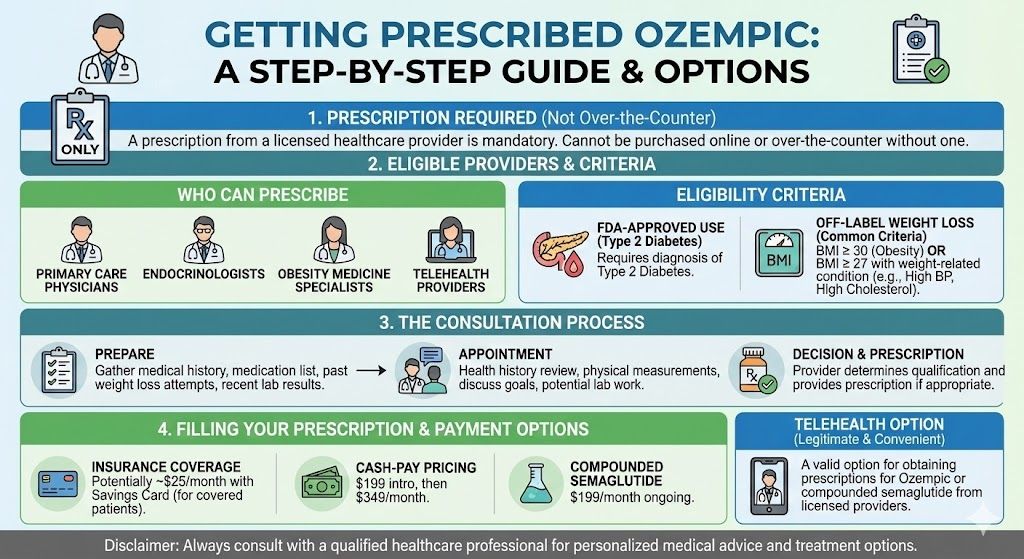
Key Takeaways: Getting Prescribed Ozempic
- Ozempic requires a prescription from a licensed healthcare provider—it cannot be purchased over the counter or online without a prescription.
- Multiple provider types can prescribe Ozempic, including primary care physicians, endocrinologists, obesity medicine specialists, and telehealth providers.
- You’ll need to meet eligibility criteria: FDA-approved use requires type 2 diabetes, while off-label weight loss requires BMI of 30+ or BMI of 27+ with weight-related health conditions.
- Prepare for your appointment by gathering your medical history, medication list, documentation of previous weight loss attempts, and recent lab results if available.
- The consultation includes health history review, physical measurements, discussion of treatment goals, and potentially lab work before a prescription decision.
- After receiving a prescription, you’ll choose how to fill it: insurance coverage (potentially $25/month with savings card), cash-pay pricing ($199 intro then $349/month), or compounded semaglutide ($199/month ongoing).
- Telehealth is a legitimate, convenient option for obtaining Ozempic or compounded semaglutide prescriptions from licensed providers.
Step 1: Determine If You’re a Good Candidate
Before seeking a prescription, understand whether you’re likely to qualify for Ozempic.
FDA-Approved Indications
Ozempic is FDA-approved for adults with type 2 diabetes to improve blood sugar control and to reduce cardiovascular risk in diabetic patients with established heart disease.
If you have type 2 diabetes, you’re a strong candidate for Ozempic. The medication helps control blood sugar while often producing weight loss as an additional benefit.
Off-Label Weight Loss Criteria
Doctors frequently prescribe Ozempic off-label for weight loss in patients who meet these criteria:
BMI of 30 or higher (obesity): You may qualify even without weight-related health conditions.
BMI of 27 to 29.9 (overweight) with comorbidities: You may qualify if you have at least one weight-related health condition such as high blood pressure, high cholesterol, prediabetes, sleep apnea, or cardiovascular disease.
Who Should Not Take Ozempic
Certain conditions disqualify you from taking Ozempic:
Absolute contraindications include personal or family history of medullary thyroid carcinoma, Multiple Endocrine Neoplasia syndrome type 2, and previous severe allergic reaction to semaglutide.
Pregnancy and breastfeeding are also contraindications. You should stop Ozempic at least 2 months before planned pregnancy.
Ozempic is only approved for adults 18 and older.
Our complete guide to Ozempic eligibility covers qualification criteria in detail.
Self-Assessment Questions
Before your appointment, consider:
- Do I have type 2 diabetes, prediabetes, or weight-related health conditions?
- What is my current BMI?
- Have I tried diet and exercise with limited success?
- Do I have any conditions that might disqualify me?
- What are my goals for treatment?
Having clear answers helps you communicate effectively with your provider.
Step 2: Choose Your Provider Type
Several types of healthcare providers can prescribe Ozempic. Each has advantages depending on your situation.
Primary Care Physician
Your regular doctor is often the most accessible starting point.
Advantages include established relationship and familiarity with your medical history, coordination with your overall healthcare, ability to manage routine prescriptions and monitoring, and often shorter wait times than specialists.
When to start here: If you have a good relationship with your primary care doctor and they’re comfortable managing GLP-1 medications, this is the simplest path.
Potential limitations: Some primary care providers prefer to refer GLP-1 prescriptions to specialists. Others may have less experience with these medications.
What to do: Call your doctor’s office and ask if they prescribe Ozempic or semaglutide for diabetes or weight management. If not, ask for a referral to an appropriate specialist.
Endocrinologist
Endocrinologists specialize in hormonal conditions including diabetes.
Advantages include deep expertise in diabetes management, experience with complex medication regimens, familiarity with GLP-1 medications and their nuances, and some insurance plans prefer or require specialist prescription.
When to choose an endocrinologist: If you have type 2 diabetes with complex management needs, complications from diabetes, other hormonal conditions, or if your primary care doctor recommends specialist management.
Potential limitations: Longer wait times for appointments (sometimes weeks to months), may be less focused on weight loss as primary goal, and referral may be required.
Obesity Medicine Specialist
These physicians specialize in medical weight management.
Advantages include focus specifically on weight loss and related health improvement, extensive experience with GLP-1 medications for weight management, comprehensive approach including nutrition and behavior support, and understanding of long-term weight management challenges.
When to choose obesity medicine: If weight loss is your primary goal, you want comprehensive support beyond just medication, you’ve struggled with weight long-term, or you want a provider who specializes in this area.
Finding one: The Obesity Medicine Association (obesitymedicine.org) has a provider directory. Many academic medical centers have obesity medicine programs.
Telehealth Providers
Telehealth platforms offer remote consultations with licensed providers who can prescribe Ozempic or compounded semaglutide.
Advantages include convenience of appointments from home, often faster appointment availability, no need for transportation or time off work, direct coordination with pharmacies, and access regardless of local provider availability.
When to choose telehealth: If you want convenience and quick access, local providers aren’t available or have long wait times, you’re comfortable with video consultations, or you prefer the efficiency of a streamlined process.
Legitimate telehealth considerations: Ensure the platform uses licensed healthcare providers in your state, requires a medical consultation before prescribing, asks appropriate health questions and reviews your history, and provides ongoing support and monitoring.
TrimRx provides comprehensive telehealth consultations with licensed providers who can prescribe compounded semaglutide at $199 monthly for qualifying patients.
Comparing Your Options
| Provider Type | Best For | Wait Time | Cost |
| Primary Care | Patients with existing relationship, simple cases | Days to weeks | Standard copay |
| Endocrinologist | Diabetes patients, complex cases | Weeks to months | Specialist copay |
| Obesity Medicine | Weight loss focus, comprehensive approach | Varies | Specialist copay |
| Telehealth | Convenience, quick access, cash-pay patients | Days | $50-150 typically |
Step 3: Prepare for Your Appointment
Thorough preparation increases your chances of a productive consultation and successful prescription.
Gather Your Medical History
Compile information about current health conditions, especially diabetes, prediabetes, high blood pressure, high cholesterol, sleep apnea, and cardiovascular issues.
Document your weight history, including your weight at various points in your life, highest and lowest adult weights, and any significant weight fluctuations.
List previous weight loss attempts, including diet programs you’ve tried (Weight Watchers, keto, calorie counting, etc.), exercise regimens, previous weight loss medications, and outcomes of each attempt (how much lost, how long maintained, why stopped).
Note any family history of obesity, diabetes, thyroid cancer, or cardiovascular disease.
Prepare Your Medication List
Create a complete list of all current medications, including prescription medications with doses and frequencies, over-the-counter medications, supplements and vitamins, and any recent medication changes.
Include medications you’ve tried in the past for diabetes or weight loss, with notes on why you stopped (side effects, ineffective, etc.).
Gather Recent Lab Results
If you have recent lab work, bring copies. Relevant tests include HbA1c (blood sugar control over 3 months), fasting glucose, lipid panel (cholesterol and triglycerides), kidney function tests, liver function tests, and thyroid function.
If you don’t have recent labs, your provider may order them during or after your appointment.
Calculate Your BMI
Know your current weight and height so your provider can calculate BMI. You can calculate it yourself:
BMI = weight (kg) / height (m)² or BMI = (weight in pounds × 703) / (height in inches)²
Reference points:
- BMI 25-29.9: Overweight
- BMI 30+: Obesity
- BMI 40+: Severe obesity
Write Down Your Goals
Be prepared to articulate what you want to achieve. Specific goals help your provider understand your motivation and tailor recommendations. Consider goals like improving blood sugar control (target HbA1c), losing a specific amount of weight, reducing or eliminating other medications, improving specific health conditions, and increasing energy and quality of life.
Prepare Questions to Ask
Write down questions you want answered during your appointment. See the “Questions to Ask Your Doctor” section below for suggestions.
Insurance Information
Bring your insurance card and know your pharmacy benefit details. Understanding your coverage helps with the prescription decision and planning.
Step 4: What Happens During Your Consultation
Understanding the consultation process helps you know what to expect and participate effectively.
Health History Review
Your provider will ask detailed questions about your current health conditions and their management, relevant family history (especially thyroid cancer, diabetes, heart disease), previous weight loss attempts and their outcomes, your current diet and exercise habits, your motivation for seeking treatment, and any symptoms you’re experiencing.
Be honest and thorough. Information you share helps your provider determine if Ozempic is safe and appropriate for you.
Physical Examination
The examination typically includes weight and height measurement, blood pressure check, heart and lung examination, potentially abdominal examination, and thyroid examination (checking for nodules or enlargement).
For telehealth appointments, you may need to provide your current weight and blood pressure (if you have a home monitor) or schedule follow-up for in-person measurements.
Laboratory Tests
Depending on your situation, your provider may order blood tests. Common tests include HbA1c to evaluate blood sugar control, fasting glucose, comprehensive metabolic panel (kidney and liver function), lipid panel, and thyroid function tests.
Some providers require labs before prescribing, while others may prescribe and order labs simultaneously for baseline monitoring.
Discussion of Treatment Options
Your provider will discuss whether Ozempic is appropriate for your situation, alternative medications that might also be suitable, expected benefits based on your health profile, potential side effects and how to manage them, the treatment timeline and what to expect, and how Ozempic fits with your other health management.
Prescription Decision
Based on the evaluation, your provider will determine if Ozempic is appropriate. If yes, they’ll write a prescription with the starting dose (typically 0.25mg weekly), titration schedule (how doses will increase), quantity (usually one month at a time initially), and refill authorization.
If your provider determines Ozempic isn’t appropriate, they should explain why and discuss alternatives.
Step 5: Questions to Ask Your Doctor
Asking the right questions ensures you understand your treatment and can make informed decisions.
About Your Eligibility
“Do I meet the criteria for Ozempic based on my health conditions?” “Are there any concerns about Ozempic given my medical history?” “Is Ozempic the best option for my situation, or should I consider alternatives?”
About the Treatment
“What dose will I start with, and how will it increase over time?” “How long before I should expect to see results?” “How long will I need to take Ozempic?” “What happens if I stop taking it?”
About Side Effects
“What side effects should I expect, especially at first?” “What side effects would require me to contact you?” “How can I minimize or manage common side effects?” “Are there any warning signs of serious problems?”
About Monitoring
“How often will I need follow-up appointments?” “What lab tests will you monitor, and how often?” “Should I track anything at home (weight, blood sugar, etc.)?”
About Cost and Access
“Will my insurance cover Ozempic?” “If not, what are my options for affording this medication?” “Are there savings programs I should know about?” “Can you prescribe compounded semaglutide as an alternative if cost is an issue?”
About Lifestyle
“What dietary changes should I make while taking Ozempic?” “How does exercise fit into my treatment plan?” “Are there foods or behaviors I should avoid?”
Step 6: After You’re Prescribed
Once you have a prescription, several steps remain before you start treatment.
Understand Your Prescription
Your prescription will specify the medication strength and form (Ozempic pen, typically 0.25mg or 0.5mg starting dose), the quantity (usually one pen containing multiple doses), and instructions (typically one injection weekly).
The standard titration schedule starts at 0.25mg weekly for 4 weeks, then 0.5mg weekly for 4 weeks, then 1mg weekly ongoing (or continuing to 2mg if needed).
Decide How to Fill Your Prescription
You have several options for obtaining Ozempic:
Through insurance: If your insurance covers Ozempic, have your pharmacy submit a claim. You may need prior authorization (see our insurance coverage guide). If approved, use the Novo Nordisk Savings Card to potentially pay as little as $25 monthly.
Cash-pay through NovoCare: Novo Nordisk offers direct pricing at $199 for the first two months and $349 monthly ongoing through NovoCare Pharmacy and participating retailers like Walmart and Costco. This doesn’t require insurance.
Compounded semaglutide: Compounded semaglutide through TrimRx at $199 monthly provides the same active ingredient at the lowest ongoing price.
See our Ozempic coupon and savings guide for complete information on all pricing options.
Fill Your Prescription
Once you’ve decided on your approach, take your prescription to your chosen pharmacy (retail, mail-order, or specialty), provide insurance information if using insurance, present savings cards or coupons if applicable, and confirm the price before the pharmacist fills it.
For compounded semaglutide or NovoCare, prescriptions are typically sent electronically directly from your provider.
Receive Your Medication
Ozempic pens should be stored in the refrigerator until first use. After first use, pens can be stored refrigerated or at room temperature (below 86°F) for up to 56 days.
The package includes the medication pen, needles for injection, and patient information leaflet with detailed instructions.
Learn Injection Technique
If this is your first injectable medication, you’ll need to learn proper injection technique. Resources include the patient information leaflet with step-by-step instructions, instructional videos on the Ozempic website, your pharmacist can demonstrate technique, your provider’s office may offer injection training, and our injection guide walks through the process.
Schedule Follow-Up
Before leaving your initial appointment, schedule your follow-up visit. Typical follow-up timing is 4 weeks after starting (to assess initial tolerance), then at dose increases, and every 3 months once stable.
Follow-up appointments allow your provider to assess your response to medication, adjust dosing as needed, address any side effects, order monitoring lab work, and refill your prescription.
Step 7: Starting Your Treatment
With prescription in hand and medication ready, here’s what to expect as you begin.
First Injection
Choose a day of the week for your weekly injection and stick with it. Take your first injection at 0.25mg as prescribed.
Injection sites include your abdomen (at least 2 inches from navel), front of your thigh, and upper arm (if someone else is administering).
Rotate injection sites each week to prevent skin irritation.
Managing Initial Side Effects
Common side effects during the first few weeks include nausea (the most common), decreased appetite, constipation or diarrhea, stomach discomfort, and fatigue.
Strategies to minimize side effects: Eat smaller meals, avoid fatty or greasy foods, eat slowly and stop when you start feeling full, stay hydrated, and be patient as your body adjusts (side effects typically improve after 4-8 weeks).
Dose Titration
Follow your provider’s titration schedule:
- Weeks 1-4: 0.25mg weekly (adjustment period)
- Weeks 5-8: 0.5mg weekly
- Week 9+: 1mg weekly (or higher if needed)
The gradual increase allows your body to adjust and minimizes side effects. Don’t increase your dose faster than prescribed.
Lifestyle Integration
Ozempic works best combined with healthy lifestyle habits:
Nutrition: Focus on protein, vegetables, and whole foods. Ozempic reduces appetite, making it easier to eat less, but food quality still matters. See our nutrition guide for Ozempic.
Exercise: Regular physical activity enhances weight loss and improves overall health. Even walking helps.
Sleep and stress: Poor sleep and high stress can work against weight loss. Prioritize both.
Track Your Progress
Monitor your journey by weighing weekly (same day, same time, same conditions), tracking how you feel (energy, appetite, side effects), noting blood sugar if diabetic, and keeping a food journal if helpful.
Share this information with your provider at follow-up appointments.
Getting Prescribed Through Telehealth
Telehealth has become a popular, legitimate option for obtaining GLP-1 prescriptions. Here’s how the process works.
How Telehealth Prescribing Works
You complete a health questionnaire online, providing detailed medical history. A licensed healthcare provider reviews your information and schedules a video or phone consultation. During the consultation, the provider asks additional questions and discusses your goals. If appropriate, the provider writes a prescription. The prescription is sent to a pharmacy (either a partner pharmacy or your preferred pharmacy).
Is Telehealth Legitimate for Ozempic?
Yes, telehealth is a legitimate way to obtain prescriptions for Ozempic or compounded semaglutide when the platform uses licensed healthcare providers authorized to practice in your state, requires a proper medical consultation before prescribing, asks comprehensive health questions and reviews your history, provides ongoing medical support and monitoring, and follows appropriate prescribing guidelines.
Advantages of Telehealth
Convenience: Appointments from home, often with flexible scheduling Speed: Typically faster appointment availability than in-person specialists Access: Available regardless of local provider options Efficiency: Streamlined process from consultation to prescription Cost: Often lower visit costs than specialist appointments
What to Look For in a Telehealth Platform
Licensed providers: Verify that healthcare providers are licensed in your state Medical consultation: Ensure a real medical evaluation is required (not just a questionnaire) Ongoing support: Look for platforms offering follow-up care, not just prescriptions Transparent pricing: Clear information about consultation costs and medication pricing Legitimate pharmacy partnerships: Prescriptions filled through licensed pharmacies
Telehealth for Compounded Semaglutide
Many telehealth platforms specialize in providing compounded GLP-1 medications, which offer the same active ingredient at lower cost. TrimRx provides comprehensive medical consultations with licensed providers, compounded semaglutide at $199 monthly, ongoing medical support throughout your treatment, and guidance on dosing, nutrition, and maximizing results.
What If You’re Not Prescribed Ozempic?
Sometimes providers determine Ozempic isn’t appropriate. Here’s how to respond.
Understand the Reason
Ask your provider to explain specifically why they won’t prescribe Ozempic. Common reasons include contraindications (medical conditions that make Ozempic unsafe), not meeting eligibility criteria (BMI too low, no qualifying conditions), need for additional testing before making a decision, preference for trying other treatments first, and provider’s personal practice patterns (some prefer not prescribing GLP-1s).
Address the Underlying Issue
If the reason is addressable, work with your provider. For example, if you need to try lifestyle changes first, ask for specific goals and a timeline for reassessment. If you need lab work, complete it and schedule a follow-up. If you need to try another medication first, discuss how long before you can reconsider Ozempic.
Seek a Second Opinion
If you believe Ozempic is appropriate for your situation but your provider disagrees, you can seek another opinion from a different primary care doctor, an endocrinologist or obesity medicine specialist, or a telehealth platform.
Different providers have different practice patterns. Some are more willing to prescribe GLP-1 medications than others.
Consider Alternatives
If Ozempic specifically isn’t an option, alternatives include:
Wegovy: If you want semaglutide for weight loss, Wegovy is FDA-approved for that indication and may be prescribed more readily.
Other GLP-1 medications: Mounjaro/Zepbound (tirzepatide), Trulicity, Saxenda, or others may be appropriate.
Compounded semaglutide: If your provider won’t prescribe brand-name Ozempic, they might prescribe compounded semaglutide, or you can access it through telehealth platforms.
Non-GLP-1 options: Other weight loss medications, structured programs, or metabolic surgery may be appropriate depending on your situation.
If Cost Is the Barrier
Sometimes providers hesitate to prescribe expensive medications due to cost concerns. If this is the issue, explain that you’re aware of affordable options. New cash-pay pricing makes brand-name Ozempic available at $349 monthly, and compounded semaglutide is available at $199 monthly.
Frequently Asked Questions
Can I get Ozempic from my regular doctor?
Yes, your primary care doctor can prescribe Ozempic if they’re comfortable managing GLP-1 medications. Many primary care physicians prescribe Ozempic for patients with type 2 diabetes as part of routine diabetes management. For weight loss prescriptions, some primary care doctors prescribe freely while others prefer to refer to specialists. Call your doctor’s office and ask if they prescribe Ozempic or semaglutide for diabetes or weight management. If they don’t, ask for a referral to an endocrinologist or obesity medicine specialist. Alternatively, telehealth platforms offer convenient access to licensed providers who specialize in GLP-1 prescriptions.
How long does it take to get an Ozempic prescription?
The timeline varies by provider type. Primary care appointments are often available within days to a few weeks, though follow-up for labs or prior authorization may add time. Specialist appointments (endocrinologist, obesity medicine) may take weeks to months depending on availability. Telehealth platforms typically offer the fastest access, with appointments often available within days and prescriptions issued during or shortly after the consultation. The total time from initial appointment to having medication in hand ranges from a few days (telehealth with cash-pay) to several weeks (specialist with insurance requiring prior authorization).
Do I need to see an endocrinologist to get Ozempic?
No, you don’t need to see an endocrinologist. While endocrinologists certainly can prescribe Ozempic, so can primary care physicians, obesity medicine specialists, and telehealth providers. Endocrinologist referral may be appropriate if you have complex diabetes management needs, diabetes complications, other hormonal conditions, or if your insurance requires specialist prescription for coverage. For straightforward cases, especially for weight management, your primary care doctor or a telehealth provider can handle the prescription without specialist involvement.
Can I get Ozempic online?
Yes, you can get an Ozempic or semaglutide prescription through legitimate telehealth platforms. The process involves completing a health questionnaire, having a consultation with a licensed healthcare provider (video or phone), and receiving a prescription if you qualify. The prescription is then filled through a licensed pharmacy with delivery to your home. Important: Be cautious of websites offering Ozempic without a prescription or medical consultation—these are not legitimate and may provide counterfeit or unsafe products. Legitimate telehealth always requires a real medical consultation with a licensed provider.
What do I say to my doctor to get Ozempic?
Be honest and direct about your goals. Explain why you’re interested in Ozempic—whether for diabetes management, weight loss, or both. Share your relevant health history including current conditions, previous weight loss attempts, and what hasn’t worked. Describe how your weight or blood sugar affects your daily life and health. Ask if Ozempic is appropriate for your situation. Don’t try to manipulate or exaggerate symptoms—your provider needs accurate information to make safe prescribing decisions. If your provider recommends something else, ask them to explain why and whether you can try Ozempic if the alternative doesn’t work.
How much does it cost to get prescribed Ozempic?
Getting the prescription involves a consultation cost plus the ongoing medication cost. Consultation costs vary: primary care visits are typically $100-250 without insurance (often covered by insurance with copay), specialist visits run $200-400 without insurance, and telehealth consultations typically cost $50-150. Medication costs depend on how you fill your prescription: with insurance plus savings card, potentially $25 monthly; cash-pay through NovoCare is $199 for the first two months then $349 ongoing; and compounded semaglutide through TrimRx is $199 monthly. The most affordable path for many patients is telehealth consultation ($50-150 one-time) plus compounded semaglutide ($199 monthly ongoing).
What happens at an Ozempic appointment?
During your appointment, your provider will review your complete medical history, current medications, and family history. They’ll discuss your weight history and previous weight loss attempts. They’ll perform a physical examination including weight, height, blood pressure, and potentially other assessments. They may order or review lab tests. They’ll discuss whether you meet the criteria for Ozempic and whether it’s safe for your specific situation. If appropriate, they’ll explain how Ozempic works, what side effects to expect, and write a prescription with instructions. The appointment typically takes 20-40 minutes for an initial consultation.
Can I get Ozempic without having diabetes?
Yes, doctors frequently prescribe Ozempic off-label for weight loss in patients without diabetes. You’ll need to meet weight-based criteria: BMI of 30 or higher (obesity), or BMI of 27-29.9 with at least one weight-related health condition like high blood pressure, high cholesterol, prediabetes, or sleep apnea. Off-label prescribing is legal and common when a physician determines it’s appropriate. However, insurance typically won’t cover Ozempic without a diabetes diagnosis, so you’ll likely need to use cash-pay pricing ($349 monthly) or compounded semaglutide ($199 monthly). For weight loss specifically, you might also ask about Wegovy, which is semaglutide FDA-approved for weight management.
How often do I need to see a doctor while on Ozempic?
Typical follow-up schedules include an initial follow-up at 4 weeks after starting to assess initial tolerance and response, then follow-up at each dose increase (when moving from 0.25mg to 0.5mg to 1mg), and quarterly appointments once you’re on a stable maintenance dose. During follow-ups, your provider assesses your response to medication, manages any side effects, orders monitoring lab work (typically HbA1c and metabolic panel), and provides prescription refills. Telehealth makes follow-up convenient—many platforms offer easy check-ins and ongoing support. Some patients need more frequent monitoring if they have complex health conditions or experience issues with the medication.
Can a nurse practitioner prescribe Ozempic?
Yes, nurse practitioners (NPs) and physician assistants (PAs) can prescribe Ozempic in most states. These advanced practice providers are licensed to prescribe medications, including controlled and specialty medications like Ozempic. Many telehealth platforms utilize NPs and PAs for consultations and prescriptions. The scope of practice varies somewhat by state, but in general, NPs and PAs can independently evaluate patients and prescribe Ozempic when appropriate. Whether you see a physician, NP, or PA, the evaluation process and prescribing criteria are the same.
Taking the Next Step
Getting prescribed Ozempic involves finding the right provider, preparing for your consultation, meeting eligibility criteria, and deciding how to access the medication affordably. The process is straightforward once you understand the steps.
For most patients, the fastest path is scheduling an appointment with a provider who prescribes GLP-1 medications—whether your primary care doctor, a specialist, or a telehealth platform. Come prepared with your medical history, medication list, and clear goals for treatment. Be honest about your health situation and previous weight loss attempts.
Once prescribed, choose the option that best fits your budget. If you have insurance coverage, the savings card can reduce costs to $25 monthly. For cash-paying patients, the new NovoCare pricing of $349 monthly makes brand-name Ozempic more accessible than ever. Compounded semaglutide at $199 monthly provides the most affordable ongoing option.
The key is taking action. Many people spend months researching and hesitating when they could already be experiencing results. If you meet the eligibility criteria and don’t have contraindications, effective treatment is available.
Get started today with a telehealth consultation through TrimRx. Licensed providers evaluate your eligibility, answer your questions, and provide access to compounded semaglutide at $199 monthly for qualifying patients.
For patients who may benefit from tirzepatide’s potentially superior weight loss results, compounded tirzepatide at $349 monthly provides another excellent option.
Your journey to better health starts with a prescription. Take the first step today.

Transforming Lives, One Step at a Time
Keep reading

Online Ozempic Prescription Texas
You can get an Ozempic prescription online in Texas through a licensed telehealth provider without an in-person visit. Texas telehealth law allows providers to…

Online Ozempic Prescription California
You can get an Ozempic prescription online in California through a licensed telehealth provider without an in-person visit. California’s telehealth laws allow providers to…

Weight Loss Clinic Online Texas: Your Options
An online weight loss clinic in Texas gives you access to GLP-1 medications like semaglutide and tirzepatide through a fully virtual process. You complete…


