Mounjaro Cash Price: Your Options
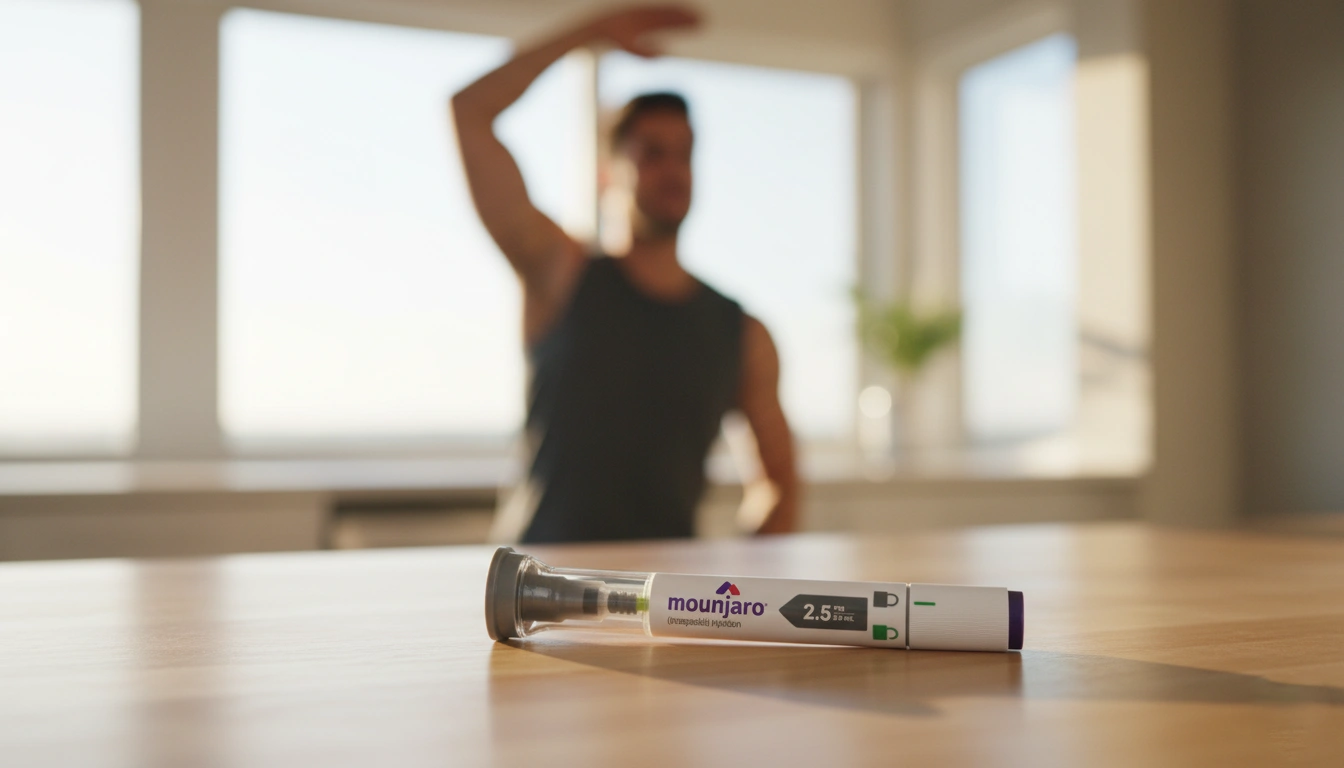
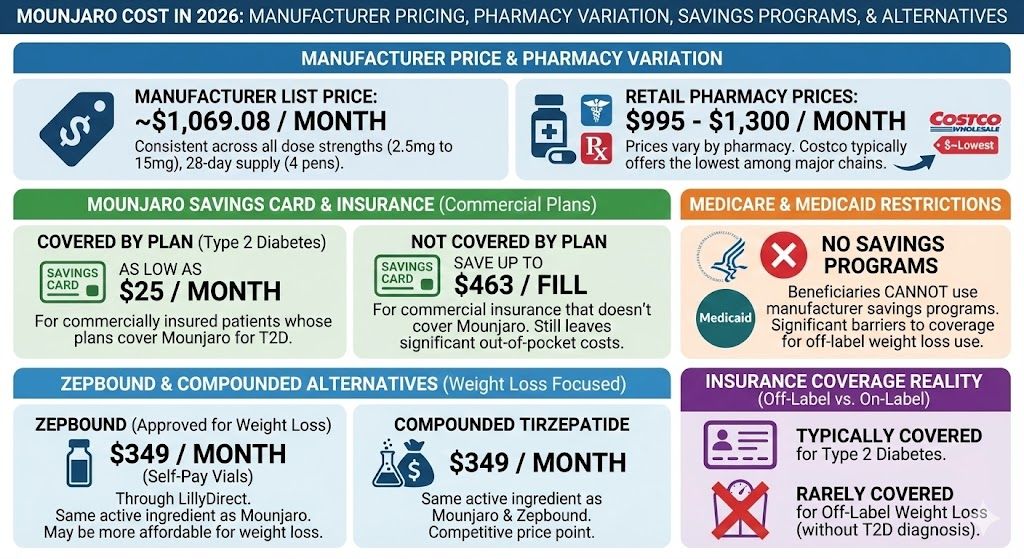
Mounjaro without insurance costs approximately $1,050 to $1,200 per month at most retail pharmacies. That’s the cash price for a four-week supply regardless of dose strength. Eli Lilly, the manufacturer, prices all Mounjaro pen configurations at roughly the same level, so your cost doesn’t change much whether you’re on the 2.5 mg starting dose or the maximum 15 mg dose. If that number makes you pause, you’re not alone. Let’s break down exactly what Mounjaro costs out of pocket, what discounts exist, and where to find tirzepatide for a fraction of the brand-name price.
Mounjaro Cash Price by Dose
Mounjaro (tirzepatide) follows a gradual dose escalation. Most patients start at 2.5 mg and increase every four weeks based on their response and tolerability. Each dose comes in a box of four single-use, pre-filled injection pens covering one month of weekly injections.
Here’s what a one-month supply costs without insurance at major retail pharmacies:
| Dose | Monthly Cash Price |
|---|---|
| 2.5 mg | $1,050 – $1,175 |
| 5 mg | $1,050 – $1,175 |
| 7.5 mg | $1,050 – $1,200 |
| 10 mg | $1,050 – $1,200 |
| 12.5 mg | $1,075 – $1,200 |
| 15 mg | $1,075 – $1,200 |
The flat pricing across doses surprises many patients. Someone just starting their Mounjaro starting dose pays essentially the same as someone who has been on the medication for months at a higher strength. There’s no cost ramp-up to match the dose ramp-up.
Prices vary by pharmacy, sometimes by $50 to $100 for the same dose. Costco and independent pharmacies often come in at the lower end, while CVS and Walgreens tend to sit slightly higher. Always compare a few options in your area before filling.
Why Mounjaro Costs So Much
Three factors keep Mounjaro’s price elevated.
Patent exclusivity. Eli Lilly holds the patent on tirzepatide, meaning no generic version is available at retail pharmacies. Without competition from other manufacturers, Lilly controls the price. This situation won’t change until the patent expires or a generic is approved, neither of which is happening soon.
Manufacturing complexity. Mounjaro is an injectable biologic, not a simple pill. The pre-filled pen system, sterile manufacturing environment, and cold-chain shipping requirements all add production costs. That said, the retail price is far higher than what manufacturing alone would justify.
Market demand. GLP-1 medications are experiencing unprecedented demand. When a product has a long list of patients eager to start treatment, the manufacturer has zero incentive to lower the price. If anything, demand pressure has kept prices firm or pushed them higher since Mounjaro launched.
The result is a medication that works exceptionally well but sits financially out of reach for a large portion of patients paying out of pocket.
Discount Programs and Savings Cards
Several options exist for reducing Mounjaro’s cash price, though each comes with limitations.
Eli Lilly Savings Card: Lilly offers a manufacturer savings card that can reduce Mounjaro’s cost to as low as $25 per month for eligible patients. The key word is “eligible.” You need commercial insurance that covers Mounjaro for this card to work. If you have Medicare, Medicaid, TRICARE, or no insurance at all, this card doesn’t apply to you.
GoodRx Coupons: GoodRx typically brings Mounjaro’s price down to the $950 to $1,100 range. As we covered in our Mounjaro GoodRx cost breakdown, these coupons help but still leave you with a hefty monthly bill.
SingleCare and RxSaver: These competing discount platforms offer pricing similar to GoodRx, sometimes landing a few dollars cheaper at specific pharmacies. Worth checking, but don’t expect dramatic differences.
Patient Assistance Programs: Eli Lilly runs a patient assistance program for uninsured or underinsured patients who meet income requirements. If you qualify, the medication may be available at no cost. The application process involves income verification and can take several weeks, but it’s worth exploring if your household income falls below the threshold.
The Real Cost of Paying Cash for Mounjaro
Let’s put the numbers in perspective. At $1,100 per month, a year of brand-name Mounjaro costs $13,200. Two years costs $26,400. These aren’t hypothetical numbers for many patients, because tirzepatide is designed for long-term use.
The financial pressure creates a pattern that works against patients. Someone starts Mounjaro, sees great results over three or four months, then realizes they can’t sustain the cost. They stop treatment and, predictably, the weight comes back. Research has consistently shown that discontinuing tirzepatide leads to significant weight regain as the medication’s appetite-suppressing and metabolic effects wear off.
A 2023 study in JAMA Internal Medicine found that participants on tirzepatide lost between 15% and 20.9% of their body weight over 72 weeks. But those results only hold while the medication continues. When cost forces early discontinuation, you’ve essentially spent thousands of dollars for temporary weight loss.
Citation: Jastreboff, A.M., et al. “Tirzepatide Once Weekly for the Treatment of Obesity.” JAMA Internal Medicine, 2023. PubMed
So the real question isn’t just “what does Mounjaro cost per month?” It’s “what does it cost to stay on tirzepatide long enough for it to actually work?”
Compounded Tirzepatide: A Different Price Point Entirely
Compounded tirzepatide has fundamentally changed the affordability equation. It uses the same active ingredient as Mounjaro but is prepared by licensed compounding pharmacies and prescribed through telehealth providers at a dramatically lower cost.
Compounded tirzepatide through TrimRx starts at $179 per month. Here’s what that looks like compared to brand-name Mounjaro over time:
| Timeframe | Brand Mounjaro (Cash) | Compounded Tirzepatide (TrimRx) | Savings |
|---|---|---|---|
| 3 months | ~$3,300 | Starting at ~$537 | ~$2,763 |
| 6 months | ~$6,600 | Starting at ~$1,074 | ~$5,526 |
| 12 months | ~$13,200 | Starting at ~$2,148 | ~$11,052 |
Over a year, the savings can exceed $11,000. That’s the difference between a treatment plan you abandon after a few months and one you can actually sustain.
How Compounded Tirzepatide Compares to Brand Mounjaro
The active compound, tirzepatide, is identical. Both the brand-name and compounded versions work through the same dual GIP/GLP-1 receptor mechanism that reduces appetite, slows gastric emptying, and improves metabolic function.
The practical differences come down to delivery and packaging. Mounjaro uses pre-filled, disposable injection pens. Compounded tirzepatide typically comes in a vial, and you draw each dose with an insulin syringe. The injection process is the same small subcutaneous shot, just with an extra preparation step that takes about a minute.
Compounding pharmacies are regulated by state pharmacy boards and must follow established quality and safety standards. Compounding has been a standard part of pharmacy practice for decades, used whenever a commercial product doesn’t meet a patient’s specific needs or, as in this case, when cost makes the brand-name version inaccessible.
Patients who switch from Mounjaro to compounded tirzepatide, or who start directly with the compounded version, report similar experiences with appetite suppression, weight loss patterns, and side effects. The tirzepatide results timeline tracks comparably regardless of the source.
Which Option Makes Sense for You
Brand-name Mounjaro works well if your insurance covers it with a low copay, you qualify for the Eli Lilly savings card and pay $25 per month, or you strongly prefer the convenience of pre-filled pens and can afford the cash price.
Compounded tirzepatide makes more sense if you’re paying entirely out of pocket, your insurance doesn’t cover Mounjaro or requires a copay that’s still too high, or you need a sustainable long-term cost structure.
For most cash-pay patients, the math points clearly toward compounded tirzepatide. Paying $179 per month instead of $1,100 doesn’t just save money today. It makes it possible to stay on treatment long enough to reach your goals and maintain them.
Getting Started
TrimRx offers compounded tirzepatide starting at $179 per month, prescribed through an online consultation with a licensed provider. No insurance needed, no prior authorization, and medication ships directly to your home. Take the eligibility quiz to see your options and pricing.

Transforming Lives, One Step at a Time
Keep reading
Mounjaro Cost on GoodRx: Price Breakdown
Mounjaro (tirzepatide) on GoodRx typically costs between $950 and $1,100 per month depending on your dose and pharmacy, though prices fluctuate. That’s with a…
Mounjaro Starting Dose: Finding the Right Level
Mounjaro’s starting dose is 2.5 mg injected once weekly, and every patient begins here regardless of their weight, health goals, or prior medication history….
Mounjaro Starting Dose for Weight Loss: What You Need to Know
The starting dose of Mounjaro for weight loss is 2.5 mg injected once weekly for the first four weeks. This is the same starting…


