Mounjaro Cost: What You’ll Pay in 2026 (With and Without Insurance)
You’ve heard that Mounjaro produces impressive weight loss results, potentially better than Ozempic, and you’re wondering what it costs. The pricing information you’re finding seems all over the place: some sources quote over $1,000 monthly while others mention $25. You want to understand what you’ll actually pay based on your insurance situation and what options exist if you’re paying out of pocket.
Here’s what you need to know: Mounjaro’s manufacturer list price is approximately $1,069 to $1,080 per month, but most people don’t pay this amount. Patients with commercial insurance that covers Mounjaro can use the savings card to pay as little as $25 per month. For those without coverage, retail pharmacy prices typically range from $995 to $1,300 depending on the pharmacy. Unlike Wegovy and Ozempic, Eli Lilly hasn’t introduced dramatic cash-pay price reductions for Mounjaro specifically, though the weight loss version (Zepbound) has self-pay options starting at $349 monthly. For the most affordable access to tirzepatide, compounded versions at $349 monthly provide the same active ingredient at significant savings.
This guide covers everything about Mounjaro costs, including exact pricing at pharmacies, insurance coverage analysis, savings programs and their requirements, how Mounjaro compares to Zepbound (same medication, different indication), and affordable alternatives for those paying out of pocket.
Key Takeaways: Mounjaro Cost in 2026
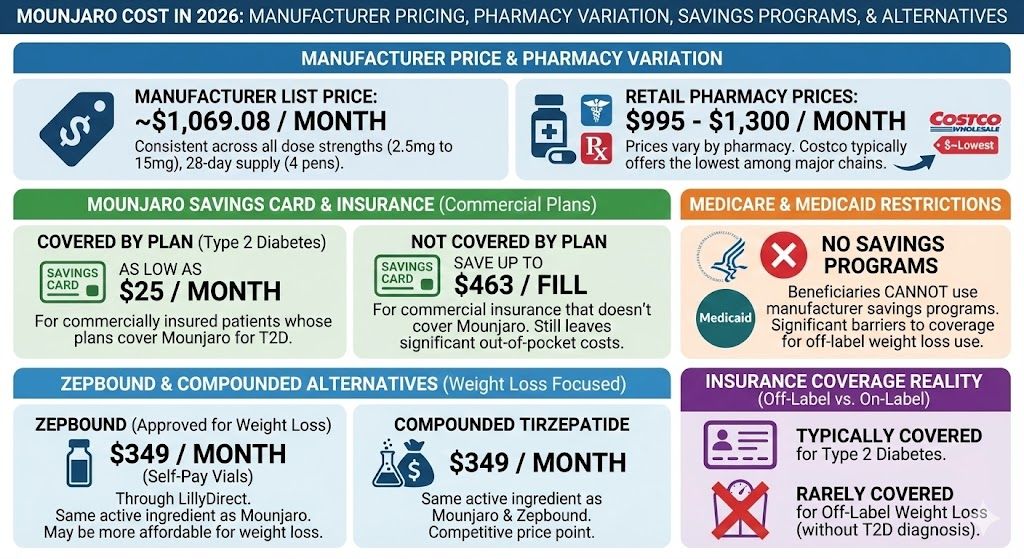
- Mounjaro’s manufacturer list price is approximately $1,069.08 per month (28-day supply of four pens), consistent across all dose strengths from 2.5mg to 15mg.
- Retail pharmacy prices vary from $995 to $1,300 monthly depending on the pharmacy, with Costco typically offering the lowest prices among major chains.
- The Mounjaro Savings Card reduces costs to as low as $25 monthly for commercially insured patients whose plans cover Mounjaro for type 2 diabetes.
- Patients with commercial insurance that doesn’t cover Mounjaro can save up to $463 per fill using the savings card, though this still leaves significant out-of-pocket costs.
- Medicare and Medicaid beneficiaries cannot use manufacturer savings programs and face significant barriers to coverage for off-label weight loss use.
- Zepbound (same active ingredient, approved for weight loss) offers self-pay vial options starting at $349 monthly through LillyDirect, which may be more affordable than Mounjaro for weight loss purposes.
- Compounded tirzepatide at $349 monthly provides the same active ingredient as both Mounjaro and Zepbound at a competitive price point.
- Insurance typically covers Mounjaro for type 2 diabetes but rarely covers it when prescribed off-label for weight loss without a diabetes diagnosis.
Understanding Mounjaro’s Pricing Structure
Mounjaro pricing involves several price points depending on how you access the medication.
Manufacturer List Price
Eli Lilly sets the wholesale acquisition cost for Mounjaro at $1,069.08 per month (28-day supply). This list price applies to all dose strengths, from the 2.5mg starter dose through the 15mg maximum dose. Each monthly supply includes four pre-filled pens for weekly injections.
This list price is what wholesalers pay to acquire Mounjaro and serves as the basis for pharmacy pricing and insurance calculations.
Retail Pharmacy Prices
Actual pharmacy prices vary based on individual pharmacy markup and location. Current pricing at major pharmacy chains:
Costco: approximately $995 to $1,075 (typically lowest among chains) Rite Aid: approximately $1,083 Target (CVS): approximately $1,087 CVS: approximately $1,087 to $1,100 Walgreens: approximately $1,112 to $1,150 Average retail: approximately $1,294
Using pharmacy discount cards like GoodRx can reduce prices to approximately $995 to $1,062 at participating pharmacies, representing savings of $200 to $300 compared to full retail.
Annual Cost Projection
At list price, Mounjaro costs approximately $12,829 to $12,960 annually. At typical retail prices of $1,100 to $1,300 monthly, annual costs reach $13,200 to $15,600. Even with discount card pricing around $1,000 monthly, annual costs exceed $12,000.
No Direct-to-Consumer Cash Pricing for Mounjaro
Unlike Novo Nordisk’s recent price reductions for Wegovy and Ozempic (now available at $349 monthly for cash-pay patients), Eli Lilly has not introduced similar direct-to-consumer pricing for Mounjaro specifically. The company has focused its self-pay pricing efforts on Zepbound, the weight-loss approved version of tirzepatide.
This means cash-paying patients seeking Mounjaro face higher prices than those seeking Zepbound for the same active ingredient.
Insurance Coverage: The Critical Factor
Insurance coverage dramatically affects what you’ll pay for Mounjaro.
Coverage for Type 2 Diabetes
Mounjaro is FDA-approved for type 2 diabetes, and many insurance plans cover it for this indication. Coverage typically requires prior authorization demonstrating type 2 diabetes diagnosis, inadequate blood sugar control with current medications, and meeting plan-specific criteria.
When insurance covers Mounjaro for diabetes, the Mounjaro Savings Card can reduce your cost to as little as $25 monthly. This combination of insurance coverage plus savings card represents the most affordable way to access brand-name Mounjaro.
Coverage for Weight Loss (Off-Label)
Mounjaro is widely prescribed off-label for weight loss, but insurance rarely covers this use. Most insurance plans explicitly exclude coverage for weight loss medications or require a diabetes diagnosis for Mounjaro coverage.
If your doctor prescribes Mounjaro for weight loss without a diabetes diagnosis, expect your insurance to deny coverage. In this case, you’ll face retail pricing or need to explore alternatives like Zepbound (FDA-approved for weight loss) or compounded tirzepatide.
How to Check Your Coverage
Before starting Mounjaro, verify your coverage by calling your insurance company’s member services and asking specifically about Mounjaro coverage, what indication it’s covered for (diabetes versus weight loss), prior authorization requirements, and your estimated cost-sharing amount.
Request your pharmacy run a test claim to determine your actual out-of-pocket cost before committing to treatment.
Coverage Tiers and Cost Sharing
Even when insurance covers Mounjaro, you’ll have cost sharing:
Deductible: You pay full price until meeting your annual deductible. High-deductible plans may require $2,000 to $5,000 in spending before coverage kicks in.
Copay: Plans with copay structures typically charge $30 to $150 for specialty medications like Mounjaro.
Coinsurance: Plans using coinsurance charge a percentage (typically 20% to 40%) of the medication cost. At 30% coinsurance on the $1,069 list price, you’d owe approximately $320 monthly before any savings card assistance.
The Mounjaro Savings Card can help cover these cost-sharing amounts, potentially reducing your out-of-pocket cost to $25.
Medicare and Medicaid Coverage
Government insurance programs face significant limitations for Mounjaro access.
Medicare Coverage
Medicare Part D can cover Mounjaro when prescribed for type 2 diabetes but cannot cover it for weight loss. Federal law prohibits Medicare from covering medications prescribed solely for weight loss purposes.
For Medicare beneficiaries with type 2 diabetes, Mounjaro may be covered, but you cannot use the manufacturer savings card due to federal anti-kickback regulations. Your cost depends entirely on your Part D plan’s formulary placement, tier, and cost-sharing structure.
Medicare beneficiaries wanting tirzepatide for weight loss without a diabetes diagnosis face full retail pricing with no manufacturer assistance available. In this situation, Zepbound’s self-pay pricing ($349 to $499 monthly through LillyDirect) or compounded tirzepatide ($349 monthly) provides more affordable access.
Medicaid Coverage
Medicaid coverage for Mounjaro varies by state. Most state programs cover it for type 2 diabetes with prior authorization requirements. Coverage for weight loss is rare and depends on individual state policies.
Like Medicare, Medicaid beneficiaries cannot use manufacturer savings programs. Your cost (if covered) typically involves minimal copays for Medicaid recipients who qualify.
VA and TRICARE
Both VA and TRICARE classify Mounjaro as non-formulary, meaning coverage requires prior authorization and demonstration that formulary alternatives have been tried unsuccessfully. Coverage is typically limited to type 2 diabetes indications.
Mounjaro Savings Programs
Eli Lilly offers savings programs that can significantly reduce costs for qualifying patients.
Mounjaro Savings Card: For Insured Patients With Coverage
The primary savings program for commercially insured patients whose plans cover Mounjaro.
Eligibility requirements include commercial (private) health insurance that covers Mounjaro, prescription for an FDA-approved use (type 2 diabetes), and valid HIPAA authorization.
Benefits include paying as little as $25 for a 1-month, 2-month, or 3-month supply. Maximum savings are $150 per 1-month fill, $300 per 2-month fill, or $450 per 3-month fill. The separate annual maximum is $1,950 per calendar year. The card allows up to 13 prescription fills per calendar year. Current program expires December 31, 2026.
Savings Card: For Insured Patients Without Coverage
Patients with commercial insurance that doesn’t cover Mounjaro can still access savings.
Requirements include commercial drug insurance that does not cover Mounjaro and a prescription for an FDA-approved use.
Benefits include savings of up to $463 off your 1-month prescription fill, with maximum monthly savings of $463 and a separate maximum annual savings of $6,019 per calendar year. The card allows up to 13 prescription fills per calendar year.
With this program, you’d pay approximately $600 to $830 monthly ($1,069 minus $463 maximum savings), still a significant expense but better than full retail.
Who Cannot Use Savings Programs
The savings card explicitly excludes patients with Medicaid, Medicare, Medigap, DoD, VA, TRICARE/CHAMPUS, or any state patient or pharmaceutical assistance program. Uninsured patients (those with no commercial insurance at all) also cannot use the savings card.
Patient Assistance Programs
Eli Lilly’s charitable foundation (Lilly Cares) provides certain Lilly medicines at no cost to qualifying patients with significant financial need. However, current reports indicate limited availability for Mounjaro specifically through this program.
For uninsured patients or those not qualifying for assistance, pharmacy discount cards (GoodRx, SingleCare) represent the primary cost-reduction option, bringing prices to approximately $995 to $1,062 monthly.
Mounjaro vs Zepbound: Same Medication, Different Pricing
Understanding the relationship between Mounjaro and Zepbound helps identify the most affordable access to tirzepatide.
Same Active Ingredient
Mounjaro and Zepbound both contain tirzepatide as the active ingredient. They work identically in your body. The difference is FDA approval and, consequently, insurance coverage and pricing programs.
Mounjaro is FDA-approved for type 2 diabetes. Zepbound is FDA-approved for chronic weight management (obesity/overweight with comorbidities) and obstructive sleep apnea.
Zepbound Self-Pay Pricing
Eli Lilly has introduced more aggressive self-pay pricing for Zepbound through LillyDirect:
Zepbound 2.5mg vial: $349 per month Zepbound 5mg vial: $499 per month Zepbound 7.5mg, 10mg, 12.5mg, 15mg vials: $499 per month (with Zepbound Self Pay Journey Program)
These prices are available through LillyDirect Self Pay Pharmacy Solutions with home delivery or pickup at Walmart pharmacies. They apply to single-dose vials (not the pre-filled pens).
Which Is Better Value for Weight Loss?
If you’re seeking tirzepatide for weight loss:
With insurance covering one medication: Use whichever your insurance covers with the savings card to potentially pay $25 monthly.
Without insurance coverage for either: Zepbound vials at $349 to $499 monthly through LillyDirect offer better value than Mounjaro at $995+ monthly.
With diabetes diagnosis: You might get Mounjaro covered by insurance, potentially paying $25 with the savings card, which is the most affordable option.
Pen vs Vial Considerations
Mounjaro comes only in pre-filled pens at retail pricing. Zepbound offers both pens (at similar pricing to Mounjaro) and vials (at reduced self-pay pricing through LillyDirect).
Vials require drawing medication with a syringe, which involves slightly more preparation than using pre-filled pens. For the $550+ monthly savings compared to Mounjaro retail, most people find this trade-off worthwhile.
Total Treatment Cost Analysis
Understanding complete treatment costs helps with financial planning.
Treatment Duration
Most people need 12 to 18 months of tirzepatide treatment to achieve significant weight loss. Clinical trials showed average weight loss of 22.5% of total body weight over approximately 72 weeks. Many people require ongoing treatment to maintain weight loss.
12-Month Cost Comparison
For one year of treatment at various price points:
Mounjaro with insurance + savings card: approximately $300 ($25 × 12) Zepbound vials through LillyDirect: approximately $4,739 ($349 × 2 months + $499 × 10 months) Mounjaro with discount card: approximately $12,000 ($1,000 × 12) Mounjaro at retail: approximately $13,000 to $15,600 Compounded tirzepatide: approximately $4,188 ($349 × 12)
18-Month Cost Comparison
For typical treatment duration:
Mounjaro with insurance + savings card: approximately $450 Zepbound vials through LillyDirect: approximately $7,737 Mounjaro with discount card: approximately $18,000 Compounded tirzepatide: approximately $6,282
The Insurance Coverage Difference
The cost difference between having insurance coverage versus not is dramatic. A patient with coverage paying $25 monthly spends $450 over 18 months. A patient without coverage paying retail spends $19,000+ over 18 months. This 40x cost difference makes insurance coverage status the single most important factor in Mounjaro affordability.
Comparison to Other GLP-1 Medications
Understanding how Mounjaro compares to alternatives helps inform your decision.
Mounjaro vs Ozempic
Mounjaro (tirzepatide) works on two receptors (GLP-1 and GIP), while Ozempic (semaglutide) works on one receptor (GLP-1). Clinical trials showed Mounjaro produces greater weight loss (22.5% versus 14.9% average).
Mounjaro list price: $1,069 per month Ozempic list price: $997.58 per month Ozempic cash-pay (through NovoCare): $349 per month (after $199 intro)
For cash-paying patients, Ozempic is now significantly less expensive than Mounjaro due to Novo Nordisk’s recent price reductions.
Mounjaro vs Wegovy
Both are effective for weight loss. Wegovy (semaglutide 2.4mg) is FDA-approved specifically for weight loss.
Mounjaro list price: $1,069 per month Wegovy list price: $1,349 per month Wegovy cash-pay (through NovoCare): $349 per month (after $199 intro)
Wegovy’s new cash-pay pricing makes it more affordable than Mounjaro for patients paying out of pocket, despite showing less weight loss in clinical trials.
Our comparison of Ozempic versus Mounjaro covers the differences in detail.
Compounded Tirzepatide
Compounded tirzepatide contains the same active ingredient as Mounjaro and Zepbound. Compounded tirzepatide through TrimRx costs $349 per month.
This pricing is competitive with Zepbound vials and significantly less expensive than Mounjaro at retail. Compounded versions come in vials rather than pre-filled pens.
Cost Comparison Summary
| Medication | List Price | Cash-Pay/Self-Pay | With Insurance + Savings |
| Mounjaro | $1,069 | $995-1,062 (discount cards) | $25 |
| Zepbound (vials) | $1,086 | $349-499 (LillyDirect) | $25 |
| Ozempic | $998 | $349 (NovoCare) | $25 |
| Wegovy | $1,349 | $349 (NovoCare) | $0 |
| Compounded tirzepatide | N/A | $349 | N/A |
| Compounded semaglutide | N/A | $199 | N/A |
Strategies for Reducing Mounjaro Costs
Here’s how to find the best price for your situation.
Step 1: Check Insurance Coverage First
Contact your insurance to determine if Mounjaro is covered for your specific indication (diabetes versus weight loss). If covered, the $25 savings card price is your best option.
Step 2: Consider Zepbound if Seeking Weight Loss
If you want tirzepatide for weight loss and don’t have a diabetes diagnosis, Zepbound may be easier to get covered by insurance (since it’s FDA-approved for that purpose) and offers better self-pay pricing through LillyDirect ($349 to $499 versus $1,000+ for Mounjaro).
Step 3: Compare All Options
For cash-paying patients, calculate costs across options:
- Zepbound vials via LillyDirect: $349-499/month
- Compounded tirzepatide: $349/month
- Compounded semaglutide: $199/month
- Mounjaro with discount card: $995-1,062/month
The first three options are all dramatically less expensive than Mounjaro at retail.
Step 4: Use HSA/FSA Funds
Regardless of which option you choose, using Health Savings Account or Flexible Spending Account funds provides tax advantages, effectively reducing costs by 20-30%.
Step 5: Shop Pharmacies
If purchasing Mounjaro at retail, compare prices between pharmacies. Costco typically offers the lowest prices among major chains. Use GoodRx or similar discount cards to find the best available price.
When Each Option Makes Most Sense
Mounjaro makes sense if:
- You have type 2 diabetes AND insurance covers Mounjaro
- You can pay $25 monthly with the savings card
- Your doctor specifically recommends Mounjaro for diabetes management
Zepbound makes sense if:
- You want tirzepatide specifically for weight loss
- Your insurance covers Zepbound, or
- You’ll use the LillyDirect self-pay pricing ($349-499/month)
- You’re comfortable with vials instead of pens
Compounded tirzepatide makes sense if:
- You want the lowest ongoing monthly cost for tirzepatide
- You’re comfortable with vial-and-syringe administration
- You don’t have insurance coverage for brand-name options
- You want consistent $349/month pricing without program complexity
Compounded semaglutide makes sense if:
- You want the absolute lowest cost option ($199/month)
- You’re open to semaglutide rather than tirzepatide
- Slightly lower average weight loss (14.9% vs 22.5%) is acceptable
- Budget is your primary concern
Frequently Asked Questions
How much does Mounjaro cost per month without insurance?
Mounjaro costs approximately $1,000 to $1,300 per month without insurance, depending on the pharmacy. The manufacturer list price is $1,069.08 for a 28-day supply. Using pharmacy discount cards like GoodRx can reduce prices to approximately $995 to $1,062 at participating pharmacies. Unlike Wegovy and Ozempic, Eli Lilly hasn’t introduced direct-to-consumer cash pricing for Mounjaro specifically. However, Zepbound (same active ingredient, approved for weight loss) offers self-pay pricing starting at $349 monthly through LillyDirect. For patients seeking tirzepatide without insurance, Zepbound vials or compounded tirzepatide at $349 monthly provide significantly more affordable access than Mounjaro’s retail pricing.
Can I get Mounjaro for $25 with the savings card?
Yes, you can get Mounjaro for $25 monthly, but only if you have commercial health insurance that covers Mounjaro AND you’re using it for an FDA-approved indication (type 2 diabetes). The Mounjaro Savings Card covers up to $150 of your monthly cost-sharing, reducing copays or coinsurance to as low as $25. Patients with government insurance (Medicare, Medicaid, VA, TRICARE) cannot use the savings card. Uninsured patients also cannot access the $25 pricing. If your commercial insurance covers Mounjaro but with high cost-sharing, the savings card can help, but if your plan doesn’t cover Mounjaro at all, you’ll face much higher costs even with savings card assistance (approximately $600+ monthly after maximum savings).
Does insurance cover Mounjaro for weight loss?
Insurance rarely covers Mounjaro for weight loss because it’s FDA-approved only for type 2 diabetes. Most insurance plans explicitly exclude coverage for weight loss medications or require a diabetes diagnosis for Mounjaro approval. If your doctor prescribes Mounjaro off-label for weight loss without a diabetes diagnosis, expect your insurance to deny coverage. For weight loss specifically, Zepbound (same medication, FDA-approved for weight loss) may have better insurance coverage prospects, though many plans still exclude weight loss medications. Patients seeking GLP-1 medications for weight loss without insurance coverage should compare Zepbound’s self-pay pricing ($349-499 monthly), compounded tirzepatide ($349 monthly), or compounded semaglutide ($199 monthly) rather than paying Mounjaro’s retail price.
Is Mounjaro covered by Medicare?
Medicare Part D can cover Mounjaro when prescribed for type 2 diabetes but cannot cover it for weight loss. Federal law prohibits Medicare from covering medications prescribed solely for weight loss purposes. Medicare beneficiaries with diabetes may have Mounjaro covered, but cannot use the manufacturer savings card due to federal anti-kickback regulations. Your out-of-pocket cost depends on your specific Part D plan’s formulary placement and cost-sharing structure. Medicare beneficiaries wanting tirzepatide for weight loss without a diabetes diagnosis should consider Zepbound’s self-pay pricing ($349-499 monthly through LillyDirect) or compounded tirzepatide ($349 monthly), as these options don’t require Medicare coverage.
What’s the difference between Mounjaro and Zepbound?
Mounjaro and Zepbound contain the identical active ingredient (tirzepatide) and work exactly the same way in your body. The difference is FDA approval and resulting insurance/pricing implications. Mounjaro is approved for type 2 diabetes; Zepbound is approved for chronic weight management and obstructive sleep apnea. Insurance may cover one but not the other depending on your diagnosis. Importantly, Eli Lilly offers self-pay pricing for Zepbound vials ($349-499 monthly through LillyDirect) that doesn’t exist for Mounjaro. For patients paying out of pocket for weight loss treatment, Zepbound vials are significantly more affordable than Mounjaro at retail pricing, making Zepbound the better choice for cash-paying patients seeking tirzepatide.
How does Mounjaro cost compare to Ozempic?
Mounjaro costs approximately $1,069 monthly at list price, while Ozempic costs approximately $998 at list price. However, the real difference appears in cash-pay options. Novo Nordisk recently introduced $349 monthly cash-pay pricing for Ozempic through NovoCare (with $199 introductory pricing for the first two months). Eli Lilly hasn’t introduced similar pricing for Mounjaro, making Ozempic significantly less expensive for cash-paying patients despite being the slightly less effective medication for weight loss. Clinical trials showed Mounjaro (tirzepatide) produces 22.5% average weight loss compared to Ozempic’s (semaglutide) 14.9%. The choice involves weighing superior effectiveness (Mounjaro) against dramatically lower cost (Ozempic at $349 versus Mounjaro at $1,000+).
Is compounded tirzepatide the same as Mounjaro?
Compounded tirzepatide contains the same active ingredient as Mounjaro and works identically in your body. The chemical compound, mechanism of action, and effectiveness are the same. Compounded versions are prepared by FDA-registered compounding pharmacies using pharmaceutical-grade tirzepatide. The differences are delivery method (vials versus pre-filled pens), regulatory status (compounded versus FDA-approved), and price ($349 monthly compounded versus $1,000+ monthly for Mounjaro at retail). When prepared properly by licensed compounding pharmacies, compounded tirzepatide provides equivalent treatment at a fraction of brand-name cost. Compounded tirzepatide through TrimRx at $349 monthly matches Zepbound’s self-pay pricing while avoiding program complexity.
Why is Mounjaro so expensive?
Mounjaro is expensive for several reasons. Patent protection gives Eli Lilly exclusive rights to manufacture tirzepatide until patents expire, preventing generic competition. Research and development costs for conducting extensive clinical trials (SURPASS and SURMOUNT programs) are built into pricing. Manufacturing complexity for dual-agonist peptide medications requires sophisticated biotechnology processes. High demand with supply constraints allows premium pricing without competitive pressure. Unlike Novo Nordisk, which recently reduced Wegovy and Ozempic cash prices to $349 monthly, Eli Lilly has maintained higher pricing for Mounjaro while directing self-pay savings to Zepbound vials. For patients needing tirzepatide without insurance coverage, Zepbound vials or compounded tirzepatide offer significantly better value than Mounjaro at retail.
What’s the cheapest way to get tirzepatide (Mounjaro/Zepbound)?
The cheapest legitimate options for tirzepatide depend on your situation. With commercial insurance covering Mounjaro or Zepbound, using the savings card reduces costs to $25 monthly. For cash-paying patients, Zepbound single-dose vials through LillyDirect cost $349 monthly for the starter dose and $499 for higher doses. Compounded tirzepatide through TrimRx costs $349 monthly regardless of dose level. Both options are dramatically less expensive than Mounjaro at retail ($1,000+). For the absolute lowest cost and you’re open to semaglutide instead of tirzepatide, compounded semaglutide at $199 monthly provides effective GLP-1 treatment, though with slightly lower average weight loss (14.9% versus 22.5%).
How long do I need to take Mounjaro for weight loss?
Most people need 12 to 18 months of tirzepatide treatment to achieve significant weight loss. Clinical trials demonstrating Mounjaro/Zepbound’s effectiveness (SURMOUNT program) ran for approximately 72 weeks, with participants losing an average of 22.5% of total body weight. Many people require ongoing medication to maintain weight loss, as research shows weight regain when treatment stops. Given this timeline, total cost matters significantly: 18 months of Mounjaro at retail pricing costs approximately $18,000+, while 18 months of compounded tirzepatide costs approximately $6,282. The $12,000+ difference makes exploring affordable alternatives essential for sustained treatment.
Making Informed Decisions About Mounjaro Costs
Mounjaro pricing presents a stark divide based on insurance coverage. Patients with commercial insurance covering Mounjaro for type 2 diabetes can access the medication for $25 monthly using the savings card. Patients without coverage face $1,000+ monthly costs that make sustained treatment financially challenging.
For those seeking tirzepatide specifically, several options exist beyond Mounjaro at retail pricing. Zepbound vials through LillyDirect offer the same medication at $349 to $499 monthly for self-pay patients. Compounded tirzepatide provides equivalent treatment at $349 monthly with simpler pricing structure. Both represent dramatic savings compared to Mounjaro’s retail cost.
For patients where tirzepatide versus semaglutide isn’t a critical distinction, the recent price reductions on Wegovy and Ozempic make semaglutide dramatically more affordable. At $349 monthly cash-pay (or $199 for compounded semaglutide), these options cost 65% to 80% less than Mounjaro at retail, though with somewhat lower average weight loss (14.9% versus 22.5%).
The key is matching your treatment choice to your insurance situation and budget:
With insurance covering Mounjaro or Zepbound: Use insurance plus savings card for $25 monthly Without insurance, wanting tirzepatide: Zepbound vials ($349-499) or compounded tirzepatide ($349) Without insurance, flexible on medication: Compounded semaglutide ($199) for maximum affordability
Whatever path you choose, effective GLP-1 treatment is more accessible than Mounjaro’s list price suggests. Compounded tirzepatide at $349 monthly through TrimRx provides the same active ingredient as Mounjaro at a fraction of retail cost. For those preferring semaglutide, compounded semaglutide at $199 monthly offers the most affordable entry point to GLP-1 weight loss treatment.

Transforming Lives, One Step at a Time
Keep reading

How to Get Mounjaro in Texas: Telehealth Options
Getting Mounjaro (tirzepatide) in Texas is accessible through your existing doctor, a weight loss clinic, or a telehealth provider that prescribes and ships compounded…
How to Get Mounjaro in California: Step-by-Step
Getting Mounjaro (tirzepatide) in California is a straightforward process whether you go through your primary care doctor, an in-person weight loss clinic, or a…
Mounjaro Doctors Near Me: How to Find a Provider
Finding a doctor who prescribes Mounjaro (tirzepatide) comes down to three main options: your existing primary care physician, a specialist in obesity or endocrinology,…


