Mounjaro Weight Loss Results: Clinical Data and Real Outcomes
Mounjaro has become the most talked-about weight loss medication for a reason: the results are unprecedented. Clinical trials show average weight loss of 22.5% of body weight, substantially exceeding what any previous medication has achieved. For someone starting at 250 pounds, that translates to potentially losing over 55 pounds.
But headlines and averages only tell part of the story. What does the full distribution of results look like? How long does it take to see these outcomes? What factors influence whether you’ll be a high responder or achieve more modest results? And how do Mounjaro’s results compare to other options like Ozempic?
This guide examines the clinical evidence behind Mounjaro’s weight loss results, providing the complete picture you need to set realistic expectations. We’ll look at the actual trial data, the timeline for results, what different levels of weight loss look like in practice, and what factors influence individual outcomes.
This guide covers:
- What the SURMOUNT clinical trials actually found
- The distribution of results beyond just averages
- How Mounjaro compares to semaglutide (Ozempic/Wegovy)
- Month-by-month timeline for weight loss
- Translating percentage weight loss to pounds at various starting weights
- Factors that affect how much you’ll lose
- Health improvements beyond the scale
- Current costs and access options
- Realistic expectations for your situation
Key Takeaways
- Clinical trials show 22.5% average weight loss over 72 weeks with tirzepatide (Mounjaro’s active ingredient) at the highest dose
- Over half of participants lost 20% or more of their body weight, with many losing 25% or higher
- Results significantly exceed semaglutide, with tirzepatide producing roughly 50% more weight loss on average
- The dual mechanism (GLP-1 plus GIP) may explain the enhanced effectiveness compared to GLP-1-only medications
- Dose matters significantly, with higher doses producing substantially greater weight loss
- Timeline is gradual, requiring 12-18 months for full results due to the titration schedule
- Health markers improve dramatically, including blood sugar, blood pressure, cholesterol, and liver function
- Individual variation exists, with some patients losing 30%+ while others lose 10-15%
- Costs are higher than semaglutide, with brand-name Zepbound at $349-499/month and compounded tirzepatide at $349/month through TrimRx
- Long-term treatment is typically necessary to maintain results, as with other GLP-1 medications
The SURMOUNT Trials: What the Research Shows
The most reliable data on tirzepatide for weight loss comes from the SURMOUNT clinical trial program. These large-scale trials provide the evidence base for understanding what results are realistic.
SURMOUNT-1: The Landmark Trial
SURMOUNT-1 enrolled 2,539 adults with obesity (BMI 30+) or overweight (BMI 27+) with at least one weight-related condition, excluding patients with diabetes. Participants received either tirzepatide (at doses of 5mg, 10mg, or 15mg) or placebo, along with lifestyle intervention counseling.
After 72 weeks (approximately 17 months), the results were striking:
| Treatment Group | Average Weight Loss | Participants Losing 20%+ |
| Tirzepatide 5mg | 15.0% | 32% |
| Tirzepatide 10mg | 19.5% | 46% |
| Tirzepatide 15mg | 20.9% | 57% |
| Placebo | 3.1% | 3% |
The 15mg group, representing the highest dose, achieved average weight loss of 20.9% of starting body weight. When including only participants who completed the full trial on treatment (the “treatment-regimen estimand”), the average reached 22.5%.
In absolute terms, the average participant in the 15mg group lost approximately 52 pounds (23.6 kg). This represents a level of weight loss previously achievable only through bariatric surgery.
Distribution of Results
Averages are useful but don’t capture the full picture. The distribution of outcomes in SURMOUNT-1 shows remarkable results across the board:
At the 15mg dose:
- 96% of participants lost at least 5% of body weight
- 84% lost at least 10%
- 69% lost at least 15%
- 57% lost at least 20%
- 36% lost at least 25%
This distribution means the majority of patients achieved what would be considered dramatic weight loss. More than one-third lost a quarter or more of their starting body weight.
Compare this to semaglutide trials, where approximately 32% of participants lost 20% or more. Tirzepatide nearly doubles the proportion of patients achieving this level of weight loss.
SURMOUNT-2: Results in Patients With Diabetes
SURMOUNT-2 specifically studied tirzepatide in patients with Type 2 diabetes and obesity, a population that typically shows reduced weight loss response.
Results at 72 weeks:
| Treatment Group | Average Weight Loss | Average HbA1c Reduction |
| Tirzepatide 10mg | 12.8% | 2.1 percentage points |
| Tirzepatide 15mg | 14.7% | 2.1 percentage points |
| Placebo | 3.2% | 0.5 percentage points |
While weight loss was somewhat lower in diabetic patients (as expected), results still significantly exceeded what other medications achieve. The 14.7% average at the highest dose represents meaningful weight loss combined with dramatic blood sugar improvement.
SURMOUNT-3 and SURMOUNT-4
Additional trials in the program examined specific questions:
SURMOUNT-3 studied tirzepatide after an initial 12-week intensive lifestyle intervention. Participants who lost weight through diet and exercise first, then added tirzepatide, achieved total weight loss of approximately 26.6% from their original starting weight.
SURMOUNT-4 examined what happens when patients stop tirzepatide after successful weight loss. Participants who discontinued the medication regained a significant portion of lost weight, while those who continued maintained their results. This confirms that ongoing treatment is typically necessary for sustained benefit.
How Mounjaro Compares to Ozempic
The comparison between tirzepatide (Mounjaro/Zepbound) and semaglutide (Ozempic/Wegovy) is one of the most relevant questions for patients considering weight loss medication.
Head-to-Head Data
The SURPASS-2 trial directly compared tirzepatide to semaglutide in patients with Type 2 diabetes. While the primary endpoint was blood sugar control, weight loss was also measured:
| Treatment | Average Weight Loss |
| Tirzepatide 5mg | 7.6% |
| Tirzepatide 10mg | 9.3% |
| Tirzepatide 15mg | 11.2% |
| Semaglutide 1mg | 5.7% |
Tirzepatide produced substantially greater weight loss at all doses compared to semaglutide 1mg (the dose used in Ozempic).
Comparing Trial Results
When comparing results across different trials (which has limitations), the pattern is consistent:
| Medication | Maximum Dose | Average Weight Loss | Patients Losing 20%+ |
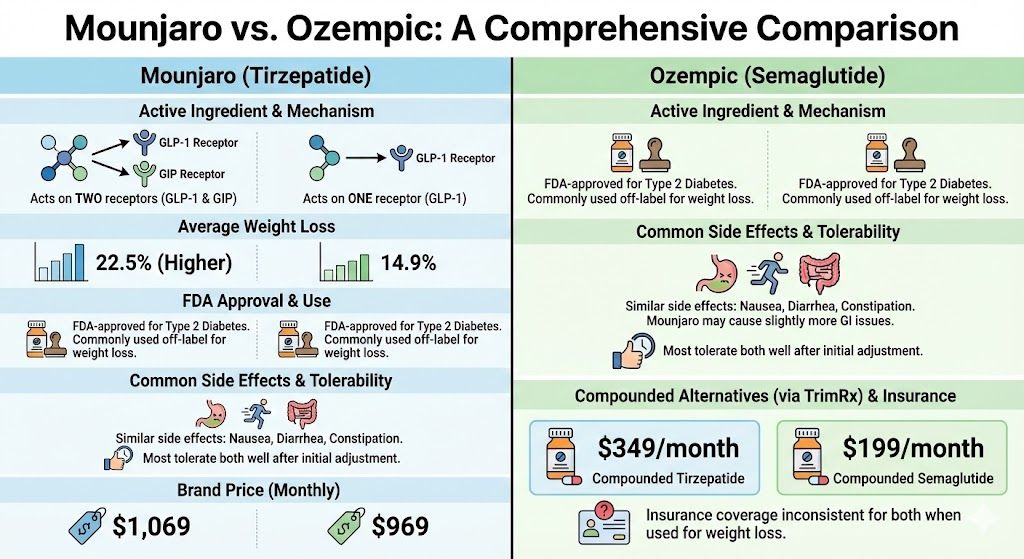
| Tirzepatide | 15mg | 20.9-22.5% | 57% |
| Semaglutide | 2.4mg | 14.9% | 32% |
Tirzepatide produces approximately 50% more weight loss on average than semaglutide. This translates to meaningful additional pounds lost for most patients.
Why the Difference?
The enhanced effectiveness of tirzepatide likely relates to its dual mechanism. Semaglutide activates only GLP-1 receptors. Tirzepatide activates both GLP-1 and GIP (glucose-dependent insulinotropic polypeptide) receptors.
GIP was historically thought to promote weight gain, but research now suggests that at pharmacological levels, GIP activation may enhance weight loss through mechanisms including improved fat metabolism, enhanced insulin sensitivity, and additional effects on appetite regulation.
The combination of both receptor types appears synergistic, producing effects greater than either pathway alone.
Which Should You Choose?
The choice between tirzepatide and semaglutide involves several factors:
Tirzepatide may be preferable if:
- Maximum weight loss is your primary goal
- You have significant weight to lose
- You’ve tried semaglutide with suboptimal results
- Cost is manageable
Semaglutide may be preferable if:
- Cost is a primary concern ($199/month for compounded semaglutide vs. $349/month for compounded tirzepatide)
- You’re satisfied with 15% average weight loss potential
- Tirzepatide isn’t available or accessible in your situation
- You tolerate semaglutide well and are achieving good results
For detailed semaglutide information, see our guides on Ozempic weight loss results and how much weight you can lose on Ozempic.
Timeline: When to Expect Results
Like semaglutide, tirzepatide follows a gradual titration schedule that affects when results appear.
The Dosing Protocol
Tirzepatide treatment progresses through escalating doses:
| Weeks | Dose | Purpose |
| Weeks 1-4 | 2.5mg weekly | Initial adjustment |
| Weeks 5-8 | 5mg weekly | First therapeutic level |
| Weeks 9-12 | 7.5mg weekly | Increasing effect |
| Weeks 13-16 | 10mg weekly | Higher therapeutic level |
| Weeks 17-20 | 12.5mg weekly | Approaching maximum |
| Weeks 21+ | 15mg weekly | Maximum dose |
This means reaching the maximum dose takes approximately five months. Full results require additional months at the highest dose.
Month-by-Month Expectations
Based on clinical trial data and the dosing schedule, here’s a realistic timeline:
Month 1 (2.5mg): Minimal weight loss, typically 3-6 pounds. This phase is primarily about adjustment. Appetite changes may begin appearing.
Month 2 (5mg): Weight loss accelerates. Cumulative loss typically 8-12 pounds. Appetite suppression becomes more noticeable.
Month 3 (7.5mg): Continued acceleration. Cumulative loss typically 15-20 pounds. Visible changes often become apparent.
Month 4 (10mg): Strong weight loss continues. Cumulative loss typically 22-30 pounds. Clothing size changes are common.
Month 5 (12.5mg): Approaching peak effectiveness. Cumulative loss typically 30-40 pounds. Transformation becomes obvious.
Months 6-9 (15mg): Peak weight loss period. Cumulative loss typically 40-55 pounds. Most dramatic results occur during this phase.
Months 10-18: Continued loss but gradually slowing. Final results approach. Total loss typically 50-65+ pounds for average responders at higher starting weights.
These figures are approximations for patients starting with significant weight to lose. Individual timelines vary based on starting weight, dose tolerance, and personal response.
Comparing Timeline to Semaglutide
Tirzepatide’s timeline is similar to semaglutide’s in structure but may produce visible results slightly faster at equivalent timepoints due to the greater magnitude of effect. Both require patience during early months and produce most dramatic results between months 4-9 at therapeutic doses.
Translating Results to Pounds
Percentage weight loss becomes more meaningful when translated to actual pounds at various starting weights.
At 180 Pounds Starting Weight
Using the 22.5% average from trials:
- Average expected loss: 40 pounds
- Likely end weight: 140 pounds
- High responder (25%+): Could reach 135 pounds or lower
At 200 Pounds Starting Weight
- Average expected loss: 45 pounds
- Likely end weight: 155 pounds
- High responder: Could reach 145-150 pounds
At 220 Pounds Starting Weight
- Average expected loss: 49-50 pounds
- Likely end weight: 170-171 pounds
- High responder: Could reach 160-165 pounds
At 250 Pounds Starting Weight
- Average expected loss: 56 pounds
- Likely end weight: 194 pounds
- High responder: Could reach 180-185 pounds or lower
At 280 Pounds Starting Weight
- Average expected loss: 63 pounds
- Likely end weight: 217 pounds
- High responder: Could reach 200-210 pounds
At 300 Pounds Starting Weight
- Average expected loss: 67-68 pounds
- Likely end weight: 232-233 pounds
- High responder: Could reach 210-220 pounds
Understanding the Range
These calculations use the 22.5% average. In reality:
- About 43% will lose less than 20% (still substantial)
- About 57% will lose 20% or more
- About 36% will lose 25% or more
- Some exceptional responders lose 30%+
Your individual result may fall anywhere in this range. Planning for average results while hoping for better is a psychologically healthy approach.
Factors Affecting Your Results
Several factors influence where you’ll fall in the distribution of outcomes.
Dose Achieved
Higher doses produce greater weight loss. The difference between 5mg and 15mg is substantial (15% vs. 22.5% average loss). If side effects limit you to lower doses, expect somewhat reduced results.
Most patients can tolerate the highest doses with gradual titration, but some require staying at 10mg or 12.5mg. Results at these doses are still excellent, just not quite as dramatic as at 15mg.
Adherence
Consistent weekly dosing is essential. Missed doses, irregular timing, or treatment gaps reduce blood levels and effectiveness. If cost is causing adherence issues, compounded tirzepatide at $349/month through TrimRx may be more sustainable than sporadic use of brand-name medication.
Dietary Response
Tirzepatide reduces appetite dramatically for most patients. How you respond to that reduced appetite affects results. Patients who use appetite suppression to improve diet quality and reduce caloric intake see the best outcomes. Those who continue eating calorie-dense foods (just in smaller amounts) may see reduced results.
Protein intake is particularly important. Adequate protein (0.7-1 gram per pound of goal body weight) preserves muscle mass and supports metabolism during rapid weight loss.
Physical Activity
Exercise isn’t required for weight loss on tirzepatide, but it helps. Patients who incorporate regular activity, particularly resistance training, tend to lose more weight and maintain better body composition. Exercise also provides metabolic and health benefits beyond calories burned.
Diabetes Status
Patients with Type 2 diabetes lose somewhat less weight on average (14.7% vs. 22.5% at maximum dose). If you have diabetes, calibrate expectations accordingly. The 14.7% average still represents excellent results and comes with substantial blood sugar improvement.
Starting Weight
Higher starting weights correlate with more absolute pounds lost. Someone starting at 300 pounds will likely lose more total pounds than someone starting at 180 pounds, even if percentage loss is similar.
Individual Biology
Genetic variation, metabolic profile, gut microbiome composition, and other individual factors create unpredictable variation in response. Two patients following identical protocols can see meaningfully different results. This variation isn’t fair or controllable, but it’s reality.
Previous Weight Loss History
Patients with extensive yo-yo dieting histories sometimes (but not always) show different responses than those without such histories. The effects are variable and unpredictable.
Health Improvements Beyond Weight Loss
The scale captures only one dimension of tirzepatide’s benefits. Clinical trials document substantial improvements in multiple health markers.
Blood Sugar and Diabetes Risk
Tirzepatide was originally developed as a diabetes medication, and its effects on blood sugar are dramatic:
- Average HbA1c reduction of 2.0-2.1 percentage points in diabetic patients
- Many patients achieve normal blood sugar levels
- Significant reduction in diabetes medication requirements
- Prevention or reversal of prediabetes in many patients
For patients with Type 2 diabetes, the combination of weight loss and direct metabolic effects can be transformative. Some patients are able to reduce or eliminate diabetes medications entirely (under medical supervision).
Blood Pressure
Weight loss from tirzepatide is associated with meaningful blood pressure reductions:
- Average reductions of 6-8 mmHg systolic in trials
- Many patients able to reduce blood pressure medications
- Improved cardiovascular risk profile
Cholesterol and Lipids
Lipid profiles typically improve significantly:
- Reduced LDL cholesterol
- Reduced triglycerides (often dramatically)
- Variable effects on HDL (sometimes increased)
- Overall improved cardiovascular risk markers
Liver Health
Non-alcoholic fatty liver disease (NAFLD) affects many patients with obesity. Tirzepatide has shown:
- Significant reductions in liver fat
- Improved liver enzyme levels
- Potential reduction in liver inflammation
- Possible slowing or reversal of liver disease progression
Studies specifically examining tirzepatide’s effects on liver disease are ongoing, but early data is promising.
Sleep Apnea
Obstructive sleep apnea is strongly linked to excess weight. Weight loss from tirzepatide often produces:
- Reduced apnea-hypopnea index (measure of severity)
- Improved sleep quality
- Some patients able to discontinue CPAP therapy
- Better daytime alertness and energy
Joint Pain and Mobility
Excess weight stresses joints, particularly knees, hips, and lower back. The substantial weight loss from tirzepatide typically produces:
- Reduced joint pain
- Improved mobility and physical function
- Increased ability to exercise and be active
- Better quality of life
Cardiovascular Events
While long-term cardiovascular outcome data for tirzepatide is still being collected, the improvements in risk factors (weight, blood sugar, blood pressure, lipids) strongly suggest cardiovascular benefits. Studies are underway to confirm this.
Understanding the Side Effect Profile
Knowing what to expect regarding side effects helps you prepare for treatment.
Gastrointestinal Effects
The most common side effects are gastrointestinal, similar to semaglutide but sometimes more pronounced at higher doses:
Nausea: Affects approximately 25-30% of patients, usually most prominent during dose increases and improving over time.
Diarrhea: Common, particularly during titration. Usually manageable and improving.
Constipation: Also common, sometimes alternating with diarrhea.
Vomiting: Less common but occurs in some patients, particularly at higher doses.
Decreased appetite: This is both a side effect and the intended mechanism. For most patients, it’s beneficial.
These effects are typically mild to moderate and improve as your body adjusts. The gradual titration schedule helps minimize their severity. Eating smaller meals, avoiding fatty foods, staying hydrated, and eating slowly can help manage symptoms.
Other Side Effects
Less common effects include:
- Fatigue, particularly during early treatment
- Injection site reactions (usually minor)
- Hair thinning in some patients during rapid weight loss (related to weight loss itself, not specific to the medication)
- Gallbladder issues in some patients (weight loss increases gallstone risk)
Serious Risks
Rare but serious potential risks include:
- Pancreatitis (severe abdominal pain requiring immediate medical attention)
- Gallbladder disease
- Thyroid tumors (observed in animal studies; human risk uncertain)
- Severe gastrointestinal problems in patients with pre-existing conditions
Tirzepatide is contraindicated for patients with personal or family history of medullary thyroid carcinoma or Multiple Endocrine Neoplasia syndrome type 2.
Costs and Access
Understanding the financial picture helps you plan for treatment.
Brand-Name Pricing
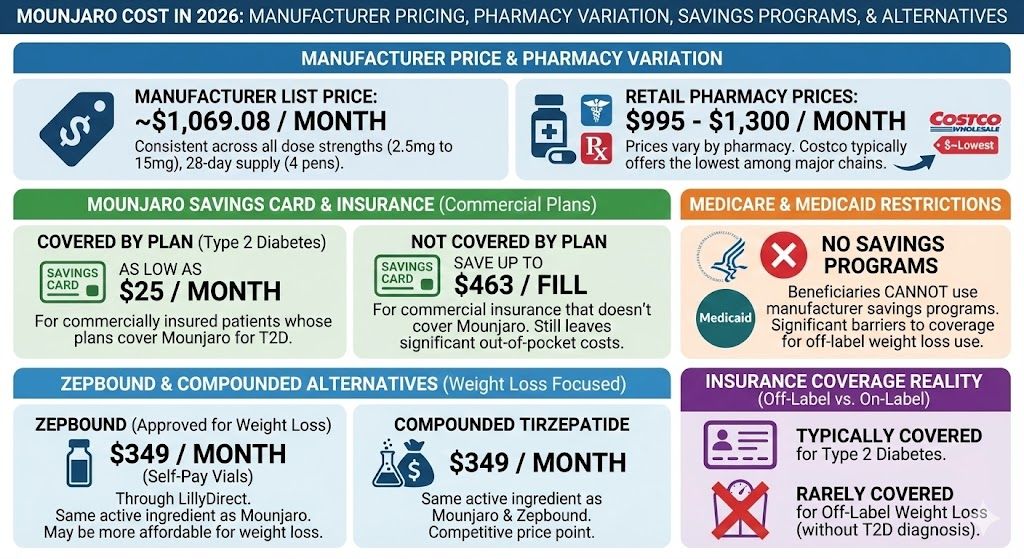
Mounjaro is FDA-approved for Type 2 diabetes, while Zepbound is the same medication approved for weight loss. Pricing differs by product and access route:
Mounjaro (for diabetes):
- List price: $1,069/month
- With insurance + savings card: As low as $25/month (for eligible patients)
- Cash price with discount cards: $995-1,062/month
Zepbound (for weight loss):
- List price: $1,086/month for pens
- LillyDirect self-pay (vials only): $349/month for 2.5mg, $499/month for 5mg and above
- With insurance + savings card: As low as $25/month (for eligible patients)
The LillyDirect pricing for Zepbound vials represents significant savings over list price but only applies to the vial formulation, not the pen injectors. The Self Pay Journey Program (requiring refills within 45 days) maintains the $499 pricing at higher doses.
Compounded Tirzepatide
Compounded tirzepatide provides an alternative at lower cost. Through TrimRx, compounded tirzepatide costs $349/month, regardless of dose level. This pricing is comparable to the brand-name entry-level pricing while offering flat-rate pricing as doses increase.
Compounded medications contain the same active ingredient prepared by compounding pharmacies rather than the original manufacturer. Quality depends on the compounding pharmacy’s standards, which is why choosing a platform that partners with FDA-registered compounding pharmacies matters.
Insurance Coverage
Insurance coverage for GLP-1 medications remains inconsistent:
- Many plans cover Mounjaro for Type 2 diabetes
- Fewer plans cover Zepbound for weight loss
- Prior authorization is typically required
- Coverage may have quantity limits or step therapy requirements
- Medicare cannot cover weight loss medications due to federal law
For detailed information on coverage and costs, see our Mounjaro cost guide.
Cost Comparison Summary
| Option | Monthly Cost | 12-Month Cost |
| Zepbound list price | $1,086 | $13,032 |
| Zepbound LillyDirect (vials) | $349-499 | $4,039-5,739 |
| Mounjaro with insurance | $25+ | $300+ |
| Compounded tirzepatide (TrimRx) | $349 | $4,188 |
| Compounded semaglutide (TrimRx) | $199 | $2,388 |
The cost differential between tirzepatide and semaglutide options is notable. Patients must weigh the additional cost against the additional weight loss tirzepatide typically provides.
Maximizing Your Results
Several strategies help you achieve the best possible outcomes.
Follow the Titration Protocol
Progress through doses as prescribed. Don’t try to accelerate the schedule (which increases side effects) or stay at lower doses unnecessarily (which limits results). The protocol is designed to balance effectiveness and tolerability.
Prioritize Protein
During rapid weight loss, muscle preservation matters enormously. Aim for 0.7-1 gram of protein per pound of goal body weight daily. This supports metabolism, preserves lean mass, and provides satiety.
Respond to Appetite Changes
When the medication reduces your appetite, use that opportunity to eat less and eat better. Don’t force yourself to eat when not hungry. Don’t clean your plate out of habit. Let the appetite suppression guide your portions.
Improve Diet Quality
Beyond eating less, eating better improves outcomes. Prioritize whole foods, vegetables, lean proteins, and complex carbohydrates. Minimize processed foods, added sugars, and calorie-dense but nutrient-poor options.
Stay Hydrated
Adequate water intake supports metabolism, helps manage side effects (particularly constipation), and can help with appetite management. Aim for at least 64 ounces daily, more if active.
Incorporate Physical Activity
Exercise isn’t required but significantly enhances results. Both cardiovascular activity (walking, swimming, cycling) and resistance training (weights, bodyweight exercises) provide benefits. Aim for 150 minutes of moderate activity weekly plus two resistance sessions.
Get Adequate Sleep
Sleep affects hunger hormones, willpower, and metabolism. Chronic sleep deprivation undermines weight loss. Prioritize 7-9 hours nightly and address any sleep disorders.
Manage Stress
Chronic stress elevates cortisol, which promotes fat storage and can trigger emotional eating. Find healthy stress management strategies that work for you.
Long-Term Considerations
Understanding the long-term picture helps you plan appropriately.
Maintenance Requirements
Research confirms that stopping tirzepatide leads to weight regain, similar to what’s seen with semaglutide. The SURMOUNT-4 trial showed participants who discontinued medication after successful weight loss regained a substantial portion of that weight within a year.
This means planning for ongoing treatment rather than viewing tirzepatide as a temporary intervention. The biological factors driving obesity don’t disappear after weight loss; medication manages them rather than curing them.
Sustainability of Costs
Given that long-term treatment is typically necessary, the cost equation matters. Can you sustain treatment at $349/month (compounded) or $499/month (brand-name) indefinitely? For many patients, affordability determines whether they can maintain their results long-term.
Tolerance and Long-Term Effectiveness
Data on very long-term tirzepatide use (beyond two years) is limited. Current evidence suggests the medication remains effective with continued use, but ongoing research will provide more clarity.
Transitioning Between Medications
Some patients may consider switching between tirzepatide and semaglutide based on cost, availability, or response:
- Switching from semaglutide to tirzepatide may produce additional weight loss
- Switching from tirzepatide to semaglutide may result in some weight regain, though results would still exceed baseline
- Transitions should be managed with provider guidance to ensure appropriate dosing
Who Is a Good Candidate for Mounjaro?
Tirzepatide may be particularly appropriate for certain patients.
Ideal Candidates
Patients seeking maximum weight loss: If your goal is achieving the greatest possible weight reduction, tirzepatide’s superior efficacy makes it the first choice among available medications.
Patients with significant weight to lose: Those with BMI well above 30 who need substantial weight loss may benefit most from tirzepatide’s enhanced effectiveness.
Patients with Type 2 diabetes and obesity: The combination of dramatic weight loss and blood sugar improvement makes tirzepatide particularly valuable for this population.
Patients who haven’t achieved desired results with semaglutide: Some patients who respond suboptimally to semaglutide may respond better to tirzepatide’s dual mechanism.
Patients who can sustain the cost: The higher cost is offset by better results, but only if you can maintain treatment long-term.
Consider Semaglutide Instead If
Cost is the primary concern: At $199/month for compounded semaglutide versus $349/month for compounded tirzepatide, the cost difference is significant over time.
You’re satisfied with 15% weight loss: If semaglutide’s average results would meet your goals, the additional cost of tirzepatide may not be justified.
Tirzepatide causes intolerable side effects: Some patients tolerate semaglutide better than tirzepatide.
You’re already succeeding on semaglutide: If you’re achieving your goals with semaglutide, switching may not provide enough benefit to justify the change.
Eligibility Requirements
Standard eligibility criteria for weight loss treatment with tirzepatide are similar to semaglutide:
- BMI of 30 or higher, OR
- BMI of 27 or higher with at least one weight-related health condition (hypertension, diabetes, dyslipidemia, sleep apnea, etc.)
Contraindications include personal or family history of medullary thyroid carcinoma, MEN2 syndrome, history of pancreatitis, and pregnancy or breastfeeding.
For general eligibility information, see our guide on who qualifies for Ozempic, which covers similar criteria.
Frequently Asked Questions
How much weight can you realistically lose on Mounjaro?
Clinical trials show average weight loss of 20.9-22.5% of body weight at the highest dose over 72 weeks. For someone starting at 250 pounds, this translates to approximately 52-56 pounds on average. However, individual results vary significantly. About 57% of participants lost 20% or more of their body weight, 36% lost 25% or more, and some exceptional responders lost over 30%. On the other end, some patients lose 10-15%, which is still substantial but below average. Factors affecting where you fall in this range include dose achieved, adherence, dietary response, activity level, and individual biology.
How does Mounjaro weight loss compare to Ozempic?
Mounjaro produces substantially greater weight loss than Ozempic. Clinical trials show tirzepatide (Mounjaro) achieves approximately 22.5% average weight loss versus 14.9% for semaglutide (Ozempic/Wegovy). This translates to roughly 50% more weight loss with tirzepatide. The proportion of patients achieving dramatic results (20%+ loss) is also much higher: 57% with tirzepatide versus 32% with semaglutide. The enhanced effectiveness likely relates to tirzepatide’s dual mechanism, activating both GLP-1 and GIP receptors rather than GLP-1 alone.
How long does it take to see results from Mounjaro?
Meaningful results typically begin appearing in months two to three as doses increase beyond the starting level. The titration protocol takes approximately five months to reach the maximum 15mg dose, so full effectiveness isn’t achieved until that point. Most dramatic weight loss occurs between months four and nine at higher doses. Clinical trials ran for 72 weeks (about 17 months) to capture full results. Expect gradual, progressive improvement rather than immediate transformation. The first month produces minimal visible change (typically 3-6 pounds) since you’re at the lowest dose.
What does 20% weight loss actually look like?
Twenty percent weight loss is visually dramatic and transformative for most people. For someone starting at 200 pounds, it means losing 40 pounds and reaching 160 pounds. At 250 pounds starting weight, it’s a 50-pound loss reaching 200 pounds. This level of weight loss typically means dropping two to three clothing sizes, significant changes in facial structure and body shape, visible transformation that others notice immediately, and substantial improvements in mobility and physical comfort. This is the level of result that generates the impressive before-and-after photos you see in media coverage.
Is Mounjaro worth the extra cost compared to Ozempic?
This depends on your priorities and circumstances. Mounjaro costs approximately $150/month more than semaglutide for compounded versions ($349 vs. $199). Over a year, that’s $1,800 additional. In exchange, you get approximately 50% more weight loss on average. For patients prioritizing maximum weight reduction, with significant weight to lose, or who haven’t achieved desired results with semaglutide, the additional cost may be justified. For patients satisfied with 15% average weight loss, concerned about budget, or already succeeding on semaglutide, the lower-cost option may be preferable.
Does Mounjaro work better than diet and exercise?
Yes, substantially. Intensive lifestyle interventions (structured diet and exercise programs with professional support) typically produce 5-7% weight loss. Mounjaro produces over three times this amount on average. Importantly, the combination of medication plus lifestyle modification produces the best results. Mounjaro makes dietary changes easier by reducing appetite and food preoccupation, while the lifestyle changes maximize the medication’s effectiveness. Viewing medication and lifestyle as complementary rather than alternatives produces optimal outcomes.
What side effects should I expect from Mounjaro?
The most common side effects are gastrointestinal: nausea (affecting 25-30% of patients), diarrhea, constipation, and decreased appetite. These effects are typically most pronounced during dose increases and improve as your body adjusts. The gradual titration schedule helps minimize severity. Eating smaller meals, avoiding fatty foods, and staying hydrated can help manage symptoms. Less common effects include fatigue, injection site reactions, and hair thinning during rapid weight loss. Rare but serious risks include pancreatitis and gallbladder problems. Report severe abdominal pain to your provider immediately.
Can I switch from Ozempic to Mounjaro?
Yes, patients can transition between medications. If you’ve been on semaglutide and want to try tirzepatide for potentially better results, the switch is straightforward. Your provider will determine appropriate starting dose based on your current semaglutide dose and guide the transition. Some patients who respond suboptimally to semaglutide achieve better results with tirzepatide due to the different mechanism. However, if you’re achieving your goals with semaglutide, switching may not provide enough additional benefit to justify the change and higher cost.
Will I regain weight if I stop taking Mounjaro?
Research strongly suggests yes, for most patients. The SURMOUNT-4 trial showed that participants who stopped tirzepatide after successful weight loss regained significant weight within a year, while those who continued treatment maintained their results. This pattern is consistent with semaglutide research and reflects the chronic nature of obesity. The biological factors driving weight gain don’t disappear after weight loss; medication manages them. Planning for ongoing treatment rather than viewing tirzepatide as temporary is more realistic. This makes sustainable cost an important consideration.
What results can I expect if I have Type 2 diabetes?
Patients with Type 2 diabetes typically lose somewhat less weight than non-diabetic patients on tirzepatide. Clinical trials show 14.7% average weight loss in diabetic populations versus 22.5% in non-diabetic populations at the highest dose. This is still excellent and substantially exceeds other weight loss medications. Additionally, diabetic patients experience dramatic blood sugar improvements, with average HbA1c reductions of 2.0-2.1 percentage points. Many patients are able to reduce or eliminate diabetes medications. The combination of meaningful weight loss plus blood sugar normalization makes tirzepatide particularly valuable for this population.
How do I know if Mounjaro is working for me?
Signs the medication is working include reduced appetite and hunger, feeling satisfied with smaller portions, fewer food cravings, diminished mental preoccupation with food, and progressive weight loss over time. These appetite effects typically appear within the first few weeks, even at starting doses, and precede significant scale changes. If you’ve been on treatment for three or more months at therapeutic doses (7.5mg+) and have experienced no appetite changes and no weight loss, the medication may not be working optimally for you. Discuss with your provider whether dose adjustment or alternative approaches might help.
Taking the Next Step
Mounjaro represents the most effective medication currently available for weight loss, with clinical trial results showing transformation that previously required surgery. The 22.5% average weight loss, with over half of patients achieving 20% or more, sets a new standard for pharmacological treatment of obesity.
The medication works best as part of a comprehensive approach that includes dietary improvements, physical activity, and long-term commitment to treatment. Understanding the gradual timeline, realistic expectations for your situation, and the importance of sustainability helps you approach treatment with appropriate perspective.
Ready to explore whether tirzepatide is right for you? TrimRx offers consultations with licensed providers and compounded tirzepatide at $349/month. Start your evaluation today.

Transforming Lives, One Step at a Time
Keep reading

How to Get Mounjaro in Texas: Telehealth Options
Getting Mounjaro (tirzepatide) in Texas is accessible through your existing doctor, a weight loss clinic, or a telehealth provider that prescribes and ships compounded…

How to Get Mounjaro in California: Step-by-Step
Getting Mounjaro (tirzepatide) in California is a straightforward process whether you go through your primary care doctor, an in-person weight loss clinic, or a…

Mounjaro Doctors Near Me: How to Find a Provider
Finding a doctor who prescribes Mounjaro (tirzepatide) comes down to three main options: your existing primary care physician, a specialist in obesity or endocrinology,…


