Not Losing Weight on Mounjaro: Common Causes and Solutions

You started Mounjaro expecting the weight to come off. Maybe it did at first, maybe it never really got going, or maybe you hit a wall after a few months of steady progress. Whatever the situation, you’re looking at the scale and wondering what went wrong.
The short answer: probably nothing. Weight loss on GLP-1 medications is rarely a straight line, and stalls are so common they’re essentially expected. But understanding why your progress has slowed is the first step toward getting it moving again.
This guide breaks down the most common reasons Mounjaro users stop losing weight and offers practical, research-backed solutions for each one.
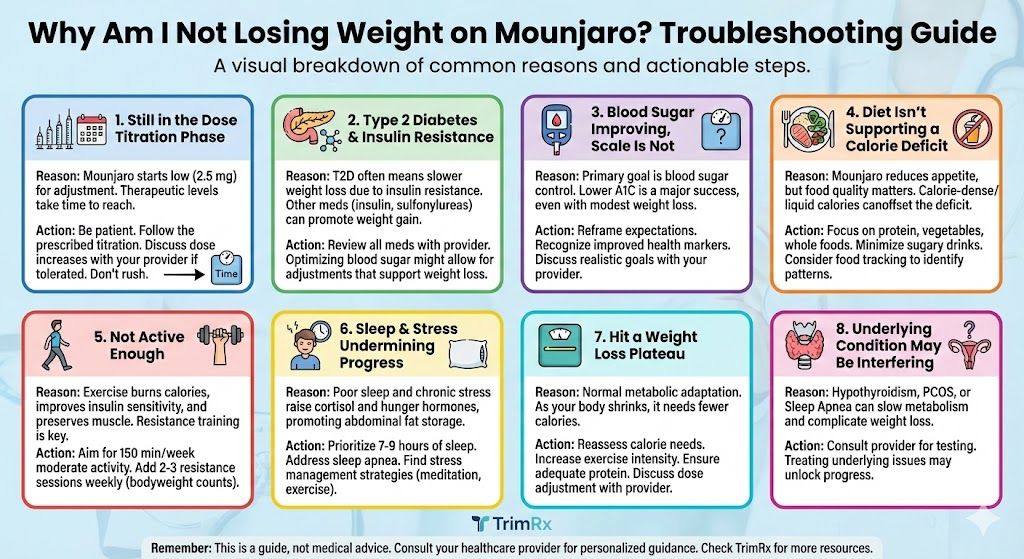
The Dose Isn’t High Enough Yet
Mounjaro follows a gradual titration schedule. You start at 2.5 mg, which is essentially a warm-up dose designed to help your body adjust. From there, the dose increases every four weeks: 5 mg, 7.5 mg, 10 mg, 12.5 mg, and finally 15 mg.
Weight loss typically becomes more pronounced at higher doses. In clinical trials, participants on 15 mg lost significantly more weight than those who stayed at 5 mg. If you’re still in the early weeks of treatment, patience is required.
The solution: Continue the prescribed titration unless side effects are intolerable. Most providers aim to get patients to at least 10 mg before assessing whether the medication is working. If you’ve been stuck at a lower dose due to GI issues, discuss strategies with your provider for managing side effects while continuing to titrate.
You’re Eating More Than You Realize
Mounjaro suppresses appetite, but it doesn’t control what you eat. Reduced hunger often leads people to eat less without conscious effort, which is part of how the medication works. But if you’re consuming calorie-dense foods, even smaller portions can provide more energy than your body needs.
Liquid calories are a frequent blind spot. Coffee drinks with syrup, juice, alcohol, and smoothies can add hundreds of calories without making you feel full. Highly processed snacks, fried foods, and items high in added sugar can also undermine your deficit.
The solution: Track your food intake for a week. You don’t need to do this forever, but a short audit often reveals patterns you weren’t aware of. Focus on whole foods: lean proteins, vegetables, fruits, whole grains, and healthy fats. Cut liquid calories first, as these have the highest impact with the least sacrifice.
You’re Not Eating Enough Protein
This one matters more than most people realize. When you lose weight, some of that loss comes from lean muscle tissue, not just fat. Research from a body composition substudy of the SURMOUNT-1 trial, published in Diabetes, Obesity and Metabolism, found that approximately 25% of weight lost on tirzepatide came from lean mass, with 75% coming from fat.
That 25% lean mass loss is concerning because muscle drives metabolism. Less muscle means fewer calories burned at rest, which makes further weight loss harder and regain easier.
Protein is the primary tool for preserving muscle during weight loss. But here’s the problem: Mounjaro reduces appetite so effectively that many people struggle to eat enough, period. When total food intake drops, protein intake often drops with it.
The solution: Prioritize protein at every meal. Aim for 0.7 to 1 gram of protein per pound of your goal body weight, or roughly 25 to 30% of your total calories. Even when you’re not hungry, make protein the non-negotiable part of what you do eat. Good sources include chicken, fish, eggs, Greek yogurt, cottage cheese, legumes, and tofu.
You’re Not Doing Resistance Training
Eating protein helps, but your muscles also need a reason to stick around. That reason is mechanical stress, the kind that comes from resistance training.
When you lose weight, your body no longer needs as much muscle to support and move a smaller frame. Without signals to maintain muscle mass, your body will shed it along with fat. This is true regardless of how you lose weight, whether through medication, diet, surgery, or any other method.
Resistance training tells your body that muscle is still needed. It doesn’t have to be complicated. Bodyweight exercises like squats, lunges, push-ups, and planks work. So do resistance bands or free weights if you have access to them.
The solution: Aim for two to three resistance training sessions per week, targeting all major muscle groups. You don’t need a gym membership. A 20-minute home workout with bodyweight exercises is enough to send the right signals to your muscles. If you’re only doing cardio, you’re missing a critical piece of the puzzle.
For more on the relationship between exercise and GLP-1 medications, see TrimRx’s guide on semaglutide 1-month results.
You’ve Hit a Metabolic Plateau
If you were losing weight and progress has stalled, you may be experiencing a plateau. This is a normal part of weight loss biology, not a sign that the medication has stopped working.
As your body gets smaller, it requires fewer calories to function. The calorie deficit that produced results at a higher weight may now be at or near maintenance level. Additionally, your body adapts to weight loss by becoming more efficient, a phenomenon sometimes called metabolic adaptation.
Plateaus typically occur after periods of significant loss. They can last anywhere from a few weeks to a couple of months.
The solution: Reassess your calorie intake based on your current weight, not your starting weight. Increase the intensity or duration of your physical activity. Make sure you’re getting adequate sleep, as sleep deprivation can stall weight loss. If you’ve been at a lower dose of Mounjaro, discuss with your provider whether it’s time to increase.
For strategies specific to breaking through stalls, check out TrimRx’s article on Ozempic plateaus.
Sleep and Stress Are Working Against You
Poor sleep and chronic stress create a hormonal environment that resists weight loss. Both elevate cortisol, which promotes fat storage (particularly around the midsection), increases hunger, and worsens insulin resistance.
Sleep deprivation also disrupts ghrelin and leptin, the hormones that regulate hunger and satiety. When you’re underslept, you feel hungrier and less satisfied after eating. Studies consistently show that people who sleep fewer than six hours per night have a harder time losing weight and maintaining weight loss.
Stress affects eating behavior beyond hormones. Emotional eating, stress snacking, and reaching for comfort foods are common responses to chronic stress, and they can easily erase a calorie deficit.
The solution: Prioritize seven to nine hours of sleep per night. Address sleep disorders like sleep apnea if they’re present, as these are common in people with obesity. Find stress management techniques that work for you, whether that’s exercise, meditation, therapy, or simply building more downtime into your schedule.
Other Medications Are Interfering
Certain medications can cause weight gain or make weight loss significantly harder. These include:
Antidepressants: Some SSRIs and tricyclic antidepressants are associated with weight gain over time.
Corticosteroids: Prednisone and similar medications promote fat storage and fluid retention.
Beta-blockers: Used for blood pressure and heart conditions, these can slow metabolism and reduce exercise tolerance.
Insulin and sulfonylureas: If you have type 2 diabetes and are taking these alongside Mounjaro, they may partially counteract the weight loss effects.
Antihistamines: Some over-the-counter allergy medications are linked to increased appetite and weight gain.
The solution: Review your complete medication list with your provider. Don’t stop any medications on your own, but ask whether alternatives exist that are weight-neutral. As your metabolic health improves on Mounjaro, you may be able to reduce or discontinue some medications under medical supervision.
An Underlying Condition Is Blocking Progress
Several medical conditions can slow or stall weight loss even when you’re doing everything right:
Hypothyroidism slows metabolism and makes weight loss difficult. Symptoms include fatigue, cold intolerance, dry skin, and constipation. A simple blood test can check thyroid function.
Polycystic ovary syndrome (PCOS) involves insulin resistance and hormonal imbalances that make losing weight challenging, particularly for women.
Insulin resistance means your body doesn’t respond efficiently to insulin, promoting fat storage rather than fat burning. This can persist even after starting Mounjaro and may require additional interventions.
The solution: If you’ve addressed lifestyle factors and still aren’t seeing results after 12 to 16 weeks at a therapeutic dose, ask your provider about testing for these conditions. Treating an underlying issue can unlock progress that was otherwise blocked.
You’re Expecting Too Much Too Fast
Clinical trials show that Mounjaro produces average weight loss of 15 to 22.5% of body weight over 72 weeks (about 16 to 17 months). That’s significant, but it’s also spread over more than a year.
Weekly weight loss is typically in the range of 0.5 to 2 pounds. Some weeks you’ll lose nothing. Some weeks you might even gain a pound or two due to water retention, hormonal fluctuations, or normal daily variation.
If you’re comparing yourself to dramatic before-and-after stories online, remember that you’re seeing highlight reels, not the messy middle. And those stories represent the most successful cases, not the average experience.
The solution: Shift your focus from the scale to other markers of progress. Are your clothes fitting differently? Has your waist circumference decreased? Are your blood sugar or blood pressure numbers improving? Do you have more energy? These are all signs the medication is working, even if the scale hasn’t moved this week.
When to Talk to Your Provider
Consider reaching out to your healthcare provider if:
You’ve been at a therapeutic dose (10 mg or higher) for 12 to 16 weeks without achieving at least 5% body weight loss.
You were losing weight and have stalled for more than six to eight weeks despite making adjustments.
You’re experiencing side effects that prevent you from eating adequately or exercising.
You suspect an underlying medical condition may be interfering.
Your provider can help determine whether a dose adjustment is appropriate, test for underlying conditions, or discuss alternative approaches if Mounjaro isn’t the right fit.
If you’re interested in telehealth weight loss support with access to compounded tirzepatide or semaglutide, TrimRx offers personalized care at accessible prices. Take the intake quiz to see if you qualify.
This information is for educational purposes and is not medical advice. Consult with a healthcare provider before starting any medication. Individual results may vary.

Transforming Lives, One Step at a Time
Keep reading

Why Am I Not Losing Weight on Mounjaro? Troubleshooting Guide
Mounjaro (tirzepatide) has generated significant buzz for its weight loss effects, even though it’s technically FDA-approved for type 2 diabetes management rather than weight…

Mounjaro First Month Results: What to Expect
During your first month on Mounjaro (tirzepatide), expect modest but meaningful weight loss. Clinical trial data from the SURMOUNT-1 study shows that participants lost…

Mounjaro 3 Month Results: What to Expect
After three months on Mounjaro (tirzepatide), most people lose between 4% and 7% of their starting body weight. Clinical trial data from the SURMOUNT-1…


