Not Losing Weight on Zepbound? Here’s What to Do

If you’ve been taking Zepbound and the scale isn’t moving the way you expected, you’re not alone, and you’re not necessarily doing anything wrong. Zepbound (tirzepatide) is one of the most effective weight loss medications available, with clinical trials showing average losses of 15% to 22.5% of body weight over 72 weeks.
But those are averages, and individual experiences vary widely. Some people see results quickly, others take months to gain momentum, and a small percentage don’t respond as expected at all.
The good news is that in most cases, there are identifiable reasons behind a stall, and many of them are fixable. Let’s walk through the most common causes and what you can do about each one.
You May Still Be on a Starter Dose
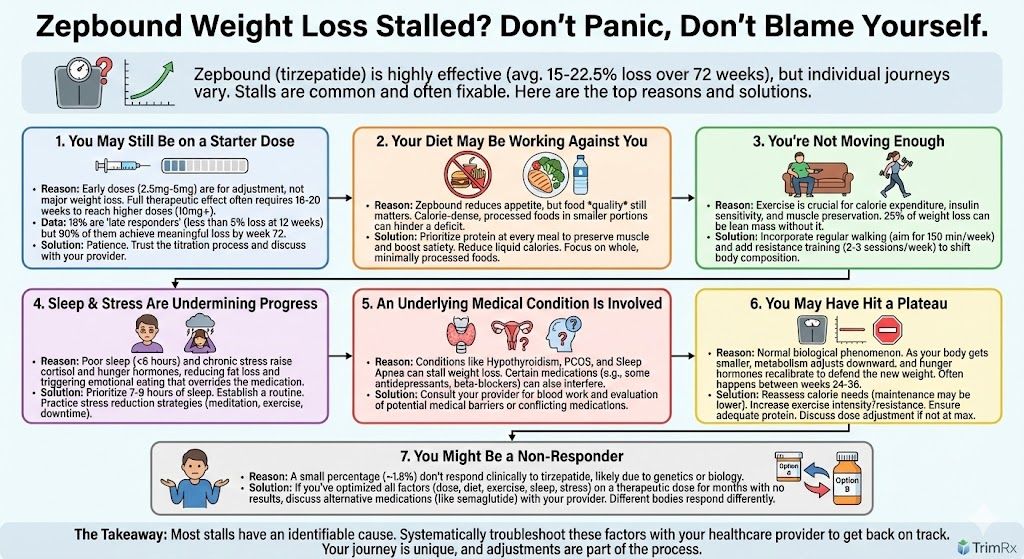
This is the most frequently overlooked explanation, especially for people who are early in treatment. Zepbound starts at 2.5 mg per week, which is an introductory dose designed to help your body adjust. It’s not the dose where significant weight loss typically occurs. The medication increases by 2.5 mg every four weeks, and it can take 16 to 20 weeks to reach the higher therapeutic doses of 10 mg or 15 mg.
If you’ve been on Zepbound for less than three months and haven’t seen much movement, that may simply mean you haven’t reached the dose where the medication’s full appetite-suppressing effects kick in. A post hoc analysis of the SURMOUNT-1 trial, published in Diabetes, Obesity and Metabolism in 2025, found that 18% of tirzepatide-treated participants had lost less than 5% of their body weight at the 12-week mark. These “late responders” hadn’t even finished dose escalation yet. But 90% of them went on to achieve clinically meaningful weight loss by week 72. The average time for late responders to reach 5% weight loss was about 25 weeks.
The takeaway: patience during the titration phase isn’t just recommended, it’s backed by data. If your provider is still increasing your dose, give the medication more time before concluding it isn’t working.
Your Diet May Be Working Against You
Zepbound reduces appetite significantly for most people, and that naturally leads to eating less. But the medication doesn’t override what you eat, only how much you want to eat. If the foods you’re choosing are calorie-dense, highly processed, or heavy in added sugars and fats, it’s possible to consume enough calories in smaller portions to slow or stall weight loss.
Consider this scenario: imagine someone on Zepbound who feels satisfied after half a meal instead of a full one, but that half-meal is still a large burger, fries, and a sugary drink. They’re eating less volume, yes, but the calorie density may still exceed what their body needs to create a deficit.
A few dietary adjustments that tend to make a real difference include prioritizing protein at every meal (lean meats, fish, eggs, Greek yogurt, legumes), which helps preserve muscle mass and promotes satiety. Reducing liquid calories from sodas, juices, specialty coffee drinks, and alcohol is another high-impact change. Choosing whole, minimally processed foods over packaged or fast-food options rounds out the foundation.
You don’t need a rigid meal plan. But being intentional about food quality, not just quantity, tends to accelerate results considerably.
You’re Not Moving Enough
Zepbound’s prescribing information recommends using it alongside a reduced-calorie diet and increased physical activity. Exercise alone doesn’t typically drive major weight loss, but it plays a critical supporting role. It increases your daily calorie expenditure, improves insulin sensitivity (which matters for how your body handles energy), and, most importantly, helps preserve lean muscle mass as you lose weight.
Losing muscle along with fat is a real concern with any significant weight loss. In the SURMOUNT-1 body composition substudy, about 25% of the weight lost on tirzepatide came from lean mass rather than fat. Resistance training, even two to three sessions per week, can help shift that ratio in a better direction.
If you’re sedentary, you don’t need to train for a marathon. Start with regular walking (aim for 150 minutes per week) and add some form of strength training. Even bodyweight exercises at home count.
Sleep and Stress Are Undermining Your Progress
These two factors are easy to underestimate, but they have a direct biological impact on weight loss. Poor sleep raises cortisol levels, increases hunger hormones (particularly ghrelin), reduces insulin sensitivity, and makes it harder for your body to lose fat even when you’re in a calorie deficit. Research consistently shows that people who sleep fewer than six hours per night have significantly harder times losing weight, regardless of what medication they’re taking.
Chronic stress follows a similar pattern. Elevated cortisol promotes fat storage, particularly around the midsection, and can trigger emotional or stress-related eating that overrides the appetite suppression Zepbound provides. The medication helps reduce physiological hunger, but it can’t fully counteract eating that’s driven by stress, boredom, or emotional triggers.
If you’re doing everything right nutritionally and still not seeing results, it’s worth examining your sleep habits and stress levels honestly. Prioritizing seven to nine hours of sleep per night, establishing a consistent sleep schedule, and finding manageable stress reduction strategies (exercise, meditation, therapy, or even just daily downtime) can meaningfully shift your results.
An Underlying Medical Condition May Be Involved
Several medical conditions can slow or stall weight loss even when medication and lifestyle factors are aligned. The most common culprits include hypothyroidism, which slows metabolism and can make weight loss difficult even with reduced calorie intake; polycystic ovary syndrome (PCOS), which involves insulin resistance and hormonal imbalances that resist standard weight loss approaches; and sleep apnea, which disrupts sleep quality and affects metabolic hormones.
Certain medications can also interfere. Beta-blockers, some antidepressants (particularly SSRIs and mirtazapine), insulin, corticosteroids, and some anticonvulsants are known to promote weight gain or make weight loss harder. If you’re on any of these, that doesn’t mean Zepbound can’t work for you, but it does mean your provider should factor them into your treatment plan.
If you suspect an underlying condition is playing a role, bring it up with your healthcare provider. Blood work to check thyroid function, fasting insulin, and other metabolic markers can help identify treatable barriers. TrimRx providers can help evaluate these factors as part of your telehealth consultation.
You May Have Hit a Plateau
If you lost weight initially and then progress stopped, you may be experiencing a weight loss plateau. This is a normal biological phenomenon. As your body gets smaller, it requires fewer calories to function, and your metabolism adjusts downward. Hormones like leptin (which signals fullness) decrease while ghrelin (which drives hunger) can increase. Your body is essentially recalibrating to defend its new, lower weight.
Research from the SURMOUNT trials shows that most people on tirzepatide reach a plateau between weeks 24 and 36, depending on their starting BMI. People who start at a lower BMI tend to plateau earlier.
Strategies for breaking through a plateau include reassessing your calorie intake (what created a deficit at your higher weight may now be maintenance-level), increasing exercise intensity or adding resistance training, ensuring protein intake is adequate (aim for 0.7 to 1 gram per pound of goal body weight), and discussing a potential dose adjustment with your provider if you haven’t yet reached the maximum tolerated dose.
For a deeper look at how semaglutide users can approach the same issue, TrimRx has a detailed guide on Ozempic plateaus that covers many of the same strategies.
You Might Be a Non-Responder
It’s worth acknowledging that a small percentage of people simply don’t respond well to tirzepatide. In the SURMOUNT-1 trial, about 1.8% of adherent participants lost less than 5% of their body weight over the full 72-week treatment period. Researchers don’t fully understand why this happens, but genetics, gut microbiome differences, and individual variation in hormone receptor sensitivity likely play a role.
If you’ve been on a therapeutic dose (10 mg or higher) for several months, have genuinely optimized your diet, exercise, sleep, and stress, and still aren’t seeing results, it may be worth discussing alternative medications with your provider. Switching from tirzepatide to semaglutide, or vice versa, is a conversation many patients have, and different medications can produce different results in different people.
When to Talk to Your Provider
As a general guideline, it’s reasonable to reassess your treatment plan if you’ve been on a maintenance dose (typically 10 mg or 15 mg) for at least 12 to 16 weeks and haven’t achieved at least 5% body weight loss, or if you were losing weight and have now stalled for more than eight weeks despite making adjustments.
Your provider can evaluate whether a dose change, medication switch, or additional testing for underlying conditions is appropriate. If you’re using TrimRx’s telehealth service, reaching out to your provider is straightforward and doesn’t require an office visit.
Not getting the results you expected? A TrimRx provider can help troubleshoot your weight loss and optimize your treatment plan. Start with the intake quiz to explore your options, including compounded tirzepatide starting at $179.
This information is for educational purposes and is not medical advice. Consult with a healthcare provider before starting any medication. Individual results may vary.

Transforming Lives, One Step at a Time
Keep reading
Zepbound Not Working: Troubleshooting Your Weight Loss
If Zepbound doesn’t seem to be producing the weight loss you expected, the medication probably isn’t the issue. Zepbound contains tirzepatide, a dual GIP/GLP-1…

Why Am I Not Losing Weight on Zepbound? 7 Reasons
You started Zepbound expecting significant weight loss, but the scale isn’t cooperating. Maybe you’ve lost a little and then stalled, or maybe you haven’t…

Zepbound Before and After: What Results to Expect
Zepbound (tirzepatide) produces some of the most dramatic before and after transformations of any weight loss medication available. Clinical trial data from the SURMOUNT-1…


