Ozempic Before and After Photos: Real Patient Transformations
Real Ozempic transformations vary widely, but clinical trial data gives us concrete numbers on what’s achievable. In the STEP 1 trial, 86% of participants lost at least 5% of their body weight, 69% lost at least 10%, and about half lost 15% or more. One third of participants achieved weight loss of 20% or more, approaching results typically seen with bariatric surgery. These numbers represent real people achieving real results over 68 weeks of treatment.
If you’re searching for before and after photos to understand what Ozempic results actually look like, you’re asking the right questions. While individual photos can be inspiring, understanding the full range of outcomes helps you set realistic expectations for your own journey.
What the Clinical Data Actually Shows
The most reliable data on semaglutide weight loss comes from the STEP (Semaglutide Treatment Effect in People with Obesity) clinical trial program. The STEP 1 trial, published in the New England Journal of Medicine, enrolled nearly 2,000 adults and tracked their progress over 68 weeks.
Here’s what researchers found:
The average participant lost 14.9% of their starting body weight. But averages only tell part of the story. The distribution of results shows that some people lost significantly more, while others lost less.
Breaking down the results by weight loss milestones:
| Weight Loss Achieved | Percentage of Participants |
|---|---|
| At least 5% | 86% |
| At least 10% | 69% |
| At least 15% | 50% |
| At least 20% | 32% |
These numbers matter because they show the range of realistic outcomes. Not everyone loses 15% or 20% of their body weight. But the vast majority, nearly 9 out of 10 people, achieve clinically meaningful weight loss of 5% or more.
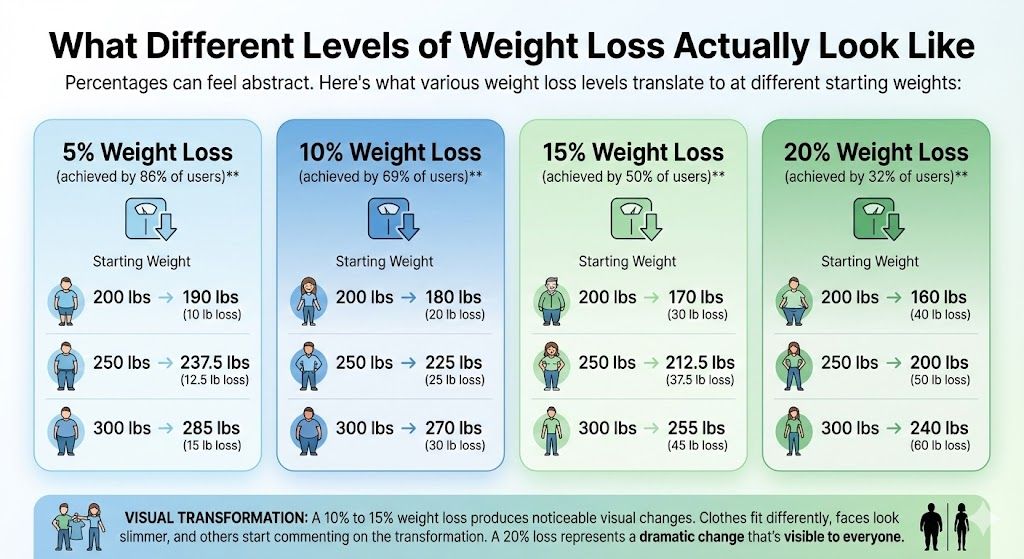
What Different Levels of Weight Loss Actually Look Like
Percentages can feel abstract. Here’s what various weight loss levels translate to at different starting weights:
5% Weight Loss (achieved by 86% of users):
- Starting at 200 lbs → 190 lbs (10 lb loss)
- Starting at 250 lbs → 237.5 lbs (12.5 lb loss)
- Starting at 300 lbs → 285 lbs (15 lb loss)
10% Weight Loss (achieved by 69% of users):
- Starting at 200 lbs → 180 lbs (20 lb loss)
- Starting at 250 lbs → 225 lbs (25 lb loss)
- Starting at 300 lbs → 270 lbs (30 lb loss)
15% Weight Loss (achieved by 50% of users):
- Starting at 200 lbs → 170 lbs (30 lb loss)
- Starting at 250 lbs → 212.5 lbs (37.5 lb loss)
- Starting at 300 lbs → 255 lbs (45 lb loss)
20% Weight Loss (achieved by 32% of users):
- Starting at 200 lbs → 160 lbs (40 lb loss)
- Starting at 250 lbs → 200 lbs (50 lb loss)
- Starting at 300 lbs → 240 lbs (60 lb loss)
A 10% to 15% weight loss produces noticeable visual changes. Clothes fit differently, faces look slimmer, and others start commenting on the transformation. A 20% loss represents a dramatic change that’s visible to everyone.
The Timeline of Visual Changes
Understanding when changes become visible helps set realistic expectations. Based on clinical trial data and real world observations:
Months 1 to 2: Weight loss is beginning, but visual changes are minimal. You might notice clothes fitting slightly looser. The scale shows progress before the mirror does.
Months 3 to 4: This is often when others start noticing changes. By this point, average weight loss is around 6% to 8% of starting weight. Face shape may look different, and you’re likely down at least one clothing size.
Months 5 to 6: Visual transformation becomes more apparent. Average weight loss reaches 10% to 12%. Most people see noticeable changes in photos compared to their starting point.
Months 9 to 12: This is typically when transformations are most dramatic. Weight loss approaches its maximum, averaging 14% to 15%. The difference between “before” and “after” photos becomes striking.
Beyond 12 months: The STEP 5 trial followed participants for two years and found that weight loss was maintained at around 15% through week 104 for those who continued treatment.
Real World Results vs. Clinical Trial Outcomes
Clinical trials represent ideal conditions with regular monitoring and support. What happens in everyday practice?
A study published in JAMA Network Open examined semaglutide results in regular clinical settings. At 6 months, patients achieved an average weight loss of 10.9%, with 87% losing at least 5% of their body weight.
These real world numbers are slightly lower than clinical trial results but still represent meaningful transformations. The study also found that 55% of patients achieved 10% or greater weight loss, and about 24% lost 15% or more at the 6 month mark.
Several factors explain why real world results sometimes differ from trials:
Dose variations. Not everyone reaches the highest doses used in trials. Some people stay at lower doses due to side effects or cost considerations.
Consistency. Clinical trial participants receive regular follow up that helps maintain adherence. Real world usage may be less consistent.
Support systems. Trials include structured lifestyle counseling that may not be available in routine clinical care.
Treatment duration. Some people stop treatment before reaching maximum results due to cost, side effects, or achieving their personal goals.
Why Before and After Photos Can Be Misleading
While transformation photos can be motivating, they come with important caveats:
Selection bias. People who achieve dramatic results are more likely to share photos publicly. Those with modest results rarely post their journeys online.
Timing matters. A photo taken at peak weight loss (around month 12) looks different from one taken at month 3. Without context, it’s hard to know what timeline a transformation represents.
Photography variables. Lighting, posture, clothing, and angles all affect how dramatic a transformation appears. The same person can look very different depending on how photos are taken.
Individual variation. Someone else’s results, even if authentic, may not predict your own outcome. Genetics, metabolic factors, starting point, and lifestyle all influence individual responses.
The most reliable way to understand potential outcomes is through clinical data that captures the full range of results, not just the best cases.
Factors That Influence Your Personal Results
Research has identified several factors that affect how much weight people lose on semaglutide:
Starting weight. People with more weight to lose often see larger absolute losses, though percentage losses tend to be similar across weight categories.
Diabetes status. People without type 2 diabetes tend to lose more weight than those with diabetes. The STEP 2 trial, which focused on participants with diabetes, showed average weight loss of 9.6% compared to 14.9% in STEP 1 (participants without diabetes).
Dose achieved. Higher doses generally produce greater weight loss. Those who tolerate and maintain the full therapeutic dose see better outcomes than those who stay at lower doses.
Treatment duration. Weight loss continues for approximately 12 to 15 months before plateauing. Stopping treatment early means missing out on additional potential weight loss.
Lifestyle factors. Combining medication with improved nutrition and physical activity enhances results. The medication reduces appetite, but food choices still matter.
Medication adherence. Consistent weekly dosing produces better outcomes than sporadic use. Missing doses interrupts the medication’s effects on appetite regulation.
Beyond the Scale: Other Changes to Expect
Weight loss is the most visible transformation, but people on Ozempic often report other meaningful changes:
Body composition shifts. Research from the STEP 1 body composition substudy found that semaglutide reduced total fat mass by 19.3% and visceral (belly) fat by 27.4%. The proportion of lean body mass actually increased relative to total body weight.
Waist circumference. Average waist reduction in clinical trials was approximately 5 to 6 inches over 68 weeks. This often translates to multiple pants sizes.
Face changes. Fat loss often shows in the face early, leading to a more defined jawline and cheekbones. This is often one of the first changes others notice.
Energy and mobility. Carrying less weight makes movement easier. Many people report improved energy levels and ability to be more active.
Health markers. Beyond appearance, improvements in blood pressure, cholesterol, blood sugar, and inflammatory markers often accompany weight loss.
Managing Expectations Realistically
Based on clinical data, here’s a realistic framework for expectations:
Most likely outcome (majority of users): Weight loss of 10% to 15% of starting body weight over 12 to 18 months. Visible transformation that others notice. Improved health markers.
Best case scenario (about one third of users): Weight loss of 20% or more. Dramatic visual transformation. Significant improvement in weight related health conditions.
Modest response (about 15% of users): Weight loss of less than 5%. Minimal visible change. May benefit from dose adjustment or considering alternative treatments.
If you’re in the modest response category after adequate time on therapeutic doses, discussing options with your provider makes sense. Some people respond better to different GLP-1 medications like tirzepatide.
What Happens After the Transformation?
One important consideration when viewing before and after photos: what happens long term?
The STEP 4 trial examined what happens when people stop taking semaglutide after achieving weight loss. Participants who switched to placebo regained about two thirds of the weight they had lost within one year. Those who continued the medication maintained their weight loss.
This finding underscores that semaglutide works best as ongoing treatment rather than a short term intervention. The impressive transformations you see require continued medication to maintain.
Starting Your Own Transformation
If you’re considering Ozempic or other semaglutide options for weight loss, the first step is determining whether you’re a good candidate. GLP-1 medications are typically appropriate for adults with a BMI of 30 or higher, or 27 or higher with weight related conditions like high blood pressure or prediabetes.
TrimRx offers telehealth consultations to help you understand your options. Compounded semaglutide provides an affordable path to treatment that might otherwise be cost prohibitive.
You can take the intake quiz to see if you qualify and learn more about getting started.
The Bottom Line
Real Ozempic transformations span a wide range, with most people achieving clinically meaningful weight loss of 10% to 15% of their starting weight. About one third of users see dramatic transformations of 20% or more, while a smaller percentage responds modestly.
Before and after photos can provide inspiration, but clinical data offers a more complete picture of what’s realistically achievable. Understanding the full range of outcomes helps you set appropriate expectations and recognize success when it happens, even if your results don’t match the most dramatic transformations you see online.
Your transformation will be uniquely yours, influenced by factors including your starting point, how you respond to the medication, and the lifestyle choices you make along the way.
This information is for educational purposes and is not medical advice. Consult with a healthcare provider before starting any medication. Individual results may vary.

Transforming Lives, One Step at a Time
Keep reading

Ozempic Results After One Year: What Long-Term Use Looks Like
A full year on Ozempic puts you in a category that most weight loss approaches never reach: sustained, medically supported treatment that has had…

Ozempic Results at 6 Months: Progress and What Comes Next
Six months on Ozempic is a significant milestone. By this point, most patients have reached a therapeutic dose, worked through the early adjustment period,…

Ozempic Results at 3 Months: What to Realistically Expect
Three months into Ozempic, most people are starting to see results that feel genuinely meaningful. By this point you’ve moved through the starting dose,…


