Ozempic Coupon and Savings: How to Get the Best Price
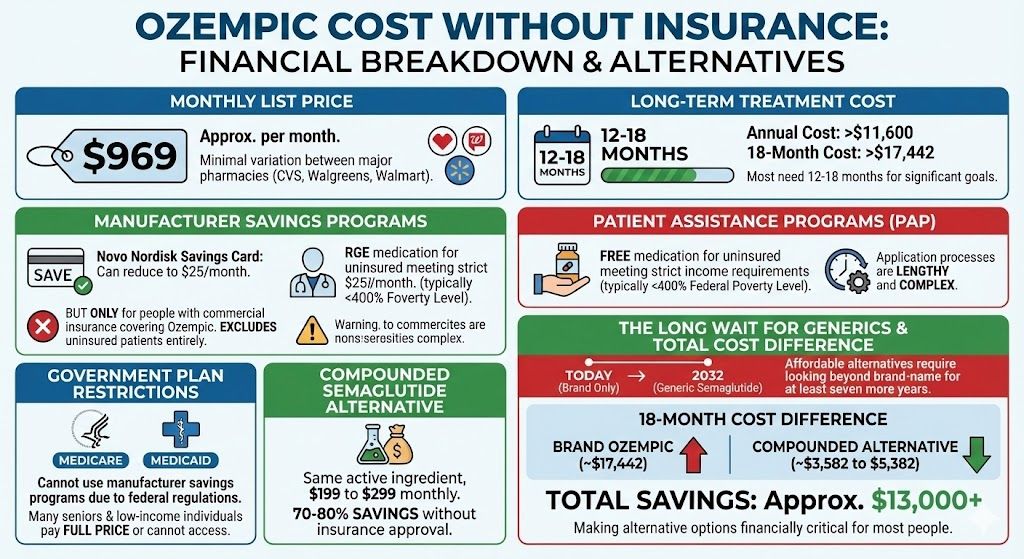
You’ve been prescribed Ozempic and you’re looking for ways to reduce the cost. Maybe you’ve seen advertisements for coupons and savings cards, or you’ve heard about new pricing options but aren’t sure which apply to your situation. With a medication that can cost nearly $1,000 per month at full retail price, finding legitimate savings makes a significant difference in whether you can afford treatment.
Here’s what you need to know: multiple savings options exist for Ozempic, and the best choice depends on your insurance situation. Patients with commercial insurance that covers Ozempic can use the Novo Nordisk Savings Card to pay as little as $25 per month. Cash-paying patients now have access to dramatically reduced pricing through NovoCare Pharmacy at $199 per month for the first two months (introductory offer through March 2026) and $349 per month ongoing. These new direct-to-consumer prices represent a 65% reduction from the $997 list price and make brand-name Ozempic accessible to far more people than before.
This guide covers every legitimate Ozempic savings option, including the manufacturer savings card and eligibility requirements, new cash-pay pricing through NovoCare and participating pharmacies, pharmacy discount cards and how much they actually save, patient assistance programs for low-income patients, and how current pricing compares to compounded alternatives.
Key Takeaways: Ozempic Savings Options
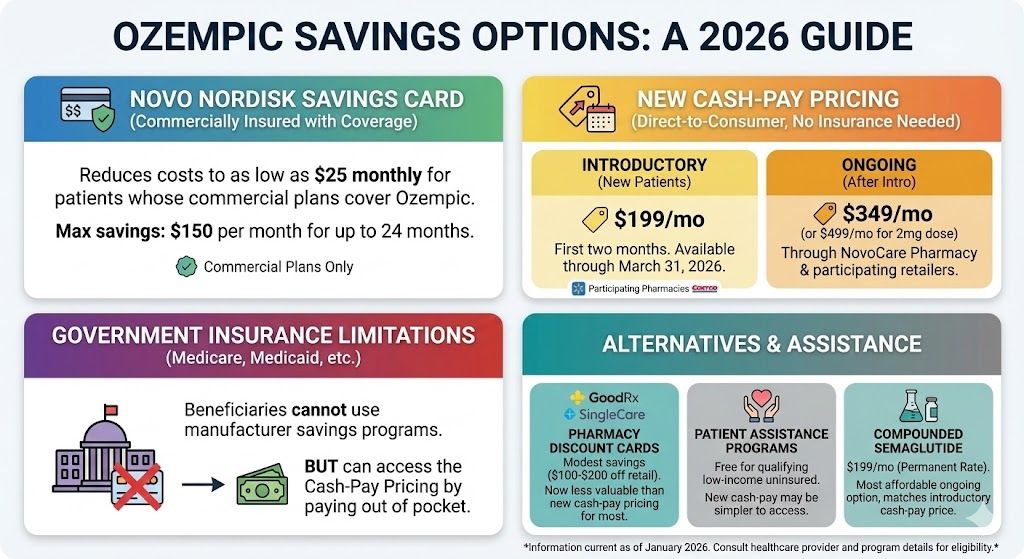
- The Novo Nordisk Savings Card reduces costs to as low as $25 monthly for commercially insured patients whose plans cover Ozempic, with maximum savings of $150 per month for up to 24 months.
- New cash-pay pricing launched November 2025 offers $199 per month for the first two months for new patients and $349 per month ongoing (or $499 for the 2mg dose) through NovoCare Pharmacy and participating retailers.
- The introductory $199 pricing is available through March 31, 2026, at over 70,000 retail pharmacies including Walmart and Costco.
- Medicare, Medicaid, and other government insurance beneficiaries cannot use manufacturer savings programs but can access the cash-pay pricing by paying out of pocket.
- Pharmacy discount cards (GoodRx, SingleCare) provide modest savings of $100 to $200 off retail but are now less valuable than the new cash-pay pricing for most patients.
- Patient assistance programs provide free Ozempic to qualifying low-income uninsured patients, though the new cash-pay pricing may be simpler to access.
- Compounded semaglutide at $199 per month remains the most affordable ongoing option, matching the introductory cash-pay price as a permanent rate.
Novo Nordisk Savings Card: For Insured Patients
The manufacturer savings card is the best option for patients with commercial insurance that covers Ozempic.
How the Savings Card Works
The Novo Nordisk Savings Card (also called the Ozempic Savings Offer) covers a portion of your out-of-pocket costs after your insurance processes the claim. If your insurance covers Ozempic but requires a copay or coinsurance, the savings card pays up to $150 of that amount, potentially reducing your cost to as little as $25 per month.
The card works at the pharmacy counter. You present both your insurance card and the savings card when filling your prescription. Your insurance processes the claim first and determines your cost-sharing amount. The savings card then covers up to $150 of your portion.
Eligibility Requirements
To qualify for the Ozempic Savings Card, you must have commercial (private) health insurance that covers Ozempic. This includes employer-sponsored insurance, individual marketplace plans, and other private insurance.
Your prescription must be for an FDA-approved use. For Ozempic, approved uses include type 2 diabetes management and cardiovascular risk reduction in patients with type 2 diabetes and heart disease.
You must not have government insurance including Medicare Part D, Medicaid, Medigap, TRICARE, VA benefits, or any state pharmaceutical assistance program. Federal regulations prohibit manufacturer copay assistance for government insurance beneficiaries.
Savings Card Benefits
Maximum savings: up to $150 per 1-month fill, $300 per 2-month fill, or $450 per 3-month fill.
Duration: The savings card remains active for up to 24 months as long as you maintain eligible commercial insurance.
Result: Many commercially insured patients pay $25 monthly for Ozempic when combining insurance coverage with the savings card.
How to Get the Savings Card
Visit ozempic.com or novocare.com to download and print the savings card immediately. You can also request a physical card by mail. Many healthcare provider offices have cards available. Call 1-888-793-1218 for assistance or to request a card.
Enrollment is free and takes only a few minutes. No extensive application or income verification is required for the savings card (unlike patient assistance programs).
Savings Card Limitations
The savings card only works if your insurance covers Ozempic. If your insurance denies coverage or explicitly excludes the medication, the savings card cannot be used because there’s no insurance claim for it to apply to.
The $150 monthly maximum means patients with very high cost-sharing (over $175) will still have some out-of-pocket expense after the savings card.
Off-label use may not qualify. If your doctor prescribes Ozempic off-label for weight loss (without a diabetes diagnosis), your insurance may deny coverage, making the savings card unusable.
New Cash-Pay Pricing: The 2026 Game-Changer
Novo Nordisk introduced dramatically reduced pricing for cash-paying patients in November 2025, fundamentally changing Ozempic affordability.
New Pricing Structure
Introductory offer for new patients: $199 per month for the first two months of treatment (0.25mg and 0.5mg doses). This offer is available through March 31, 2026.
Ongoing pricing: $349 per month for 0.25mg, 0.5mg, and 1mg doses. $499 per month for the 2mg dose.
These prices are available through NovoCare Pharmacy (Novo Nordisk’s direct-to-consumer pharmacy) with home delivery and at over 70,000 participating retail pharmacies including Walmart and Costco.
Who Qualifies for Cash-Pay Pricing
The cash-pay pricing is specifically for self-pay patients, meaning patients paying out of pocket without using insurance. This includes uninsured patients, patients whose insurance doesn’t cover Ozempic, patients who choose to pay cash rather than use insurance, Medicare and Medicaid beneficiaries paying out of pocket (since they can’t use insurance for weight loss).
Important: If you use insurance to fill your prescription, you cannot access the cash-pay pricing. You must choose one or the other.
How to Access Cash-Pay Pricing
Through NovoCare Pharmacy: Visit ozempic.com or novocare.com and select the self-pay option. You’ll need a valid prescription from your healthcare provider. Medication ships directly to your home.
At retail pharmacies: Present the GoodRx coupon or NovoCare savings offer at participating pharmacies like Walmart and Costco. The pharmacist processes the prescription outside of insurance at the reduced cash price.
Through telehealth platforms: Many telehealth providers can route prescriptions directly to NovoCare Pharmacy for the cash-pay pricing.
Comparison to Previous Pricing
Before November 2025, uninsured patients faced list pricing of approximately $997 per month, with discount cards reducing this to $825 to $900. The new $349 ongoing pricing represents a 65% reduction from list price and approximately 60% savings compared to the best previous discount card pricing.
This makes brand-name Ozempic dramatically more accessible. Previously, the roughly $1,000 monthly cost made Ozempic unaffordable for most cash-paying patients. At $349 monthly, it’s within reach for many more households.
Cash-Pay vs Insurance: Which Is Better?
For commercially insured patients with coverage: Using insurance plus the savings card for $25 monthly is still the best option if your plan covers Ozempic.
For commercially insured patients without coverage: If your plan doesn’t cover Ozempic, compare your out-of-pocket cost (after any savings card assistance) to the $349 cash-pay price. The cash-pay option may be less expensive.
For Medicare/Medicaid patients: You cannot use manufacturer savings programs, so the cash-pay pricing at $349 monthly is your best brand-name option.
For uninsured patients: The cash-pay pricing at $199 introductory/$349 ongoing is dramatically better than previous options and comparable to compounded alternatives.
Pharmacy Discount Cards: GoodRx, SingleCare, and Others
Pharmacy discount cards were previously the primary savings option for uninsured patients. They remain useful in specific situations but are now less valuable than the new cash-pay pricing.
How Pharmacy Discount Cards Work
Discount cards like GoodRx, SingleCare, RxSaver, and Optum Perks negotiate prices with pharmacies and pass savings to consumers. You search for your medication on their website or app, find the best price at nearby pharmacies, and present the coupon (digital or printed) when filling your prescription.
These cards are free to use, don’t require insurance, and can be used by anyone with a valid prescription.
Current Discount Card Pricing
As of November 2025, pharmacy discount cards offer Ozempic at approximately $825 to $950 at most pharmacies, with occasional prices as low as $800 at select locations. Prices vary by pharmacy, location, and current promotions.
When Discount Cards Still Make Sense
The new NovoCare cash-pay pricing ($349 monthly) is better than discount card pricing ($800+) in almost all cases. However, discount cards might still be useful if NovoCare Pharmacy has supply issues or delays, if you need medication immediately and can’t wait for home delivery, if a local pharmacy has a promotional price below the NovoCare price, or if you prefer using a specific pharmacy for convenience.
Limitations of Discount Cards
Discount cards cannot be combined with insurance. If you use a discount card, the transaction is processed as a cash purchase and doesn’t count toward your insurance deductible or out-of-pocket maximum.
Prices vary significantly. The price shown online may not match what the pharmacy charges at the counter. Always confirm pricing before the pharmacist fills the prescription.
The savings are modest compared to the new cash-pay options. Reducing price from $997 to $850 (a $147 savings) is far less impactful than the NovoCare pricing of $349 (a $648 savings).
Patient Assistance Programs
For low-income uninsured patients, Novo Nordisk offers programs that can provide free or heavily discounted medication.
Novo Nordisk Patient Assistance Program
This program provides Ozempic at no cost to qualifying patients who cannot afford their prescriptions.
Eligibility requirements include U.S. citizenship or legal residency, no health insurance coverage for Ozempic (completely uninsured or insurance doesn’t cover it), household income below specified thresholds (typically 400% of federal poverty level), and prescription for an FDA-approved indication.
For 2025, 400% of federal poverty level is approximately:
- Single person: $62,400 annual income
- Two-person household: $84,640
- Three-person household: $106,880
- Four-person household: $129,120
Application Process
Applications require extensive documentation including federal tax returns, recent pay stubs, bank statements, and other proof of income. Your healthcare provider must complete their portion confirming medical necessity and appropriate diagnosis.
Processing takes 4 to 6 weeks. Annual reapplication is required.
Is Patient Assistance Still Worth Pursuing?
With the new $349 cash-pay pricing, the calculus has changed for patient assistance programs.
Patient assistance is still valuable if your income truly qualifies (below 400% FPL) and you can navigate the application process, because free medication is better than $349 monthly.
However, the new cash-pay pricing may be preferable if you’re near the income threshold and might not qualify, if you want to start treatment immediately (rather than waiting 4-6 weeks), if you find the application process burdensome, or if you prefer the simplicity of a fixed monthly price.
For many patients, paying $349 monthly is simpler and faster than navigating assistance applications, even if they might qualify for free medication.
Comparing All Savings Options
Here’s how all Ozempic pricing options compare:
| Option | Monthly Cost | Who Qualifies |
| Insurance + Savings Card | $25 | Commercially insured with coverage |
| Cash-Pay Introductory | $199 | New self-pay patients (first 2 months) |
| Cash-Pay Ongoing | $349 | All self-pay patients |
| Cash-Pay 2mg Dose | $499 | Self-pay patients on highest dose |
| Pharmacy Discount Cards | $825-950 | Anyone (but less value now) |
| Patient Assistance | $0 | Low-income uninsured qualifying |
| Compounded Semaglutide | $199 | Anyone through telehealth |
| Retail (no discounts) | $997 | Anyone (but why pay this?) |
Decision Framework
If you have commercial insurance covering Ozempic: Use insurance plus savings card for $25 monthly.
If you have commercial insurance NOT covering Ozempic: Compare your out-of-pocket cost with savings card assistance to the $349 cash-pay price. Choose whichever is lower.
If you have Medicare or Medicaid: You cannot use manufacturer savings programs for copay assistance. For diabetes treatment, your plan may cover Ozempic. For weight loss, cash-pay at $349 monthly or compounded semaglutide at $199 monthly are your options.
If you’re uninsured with low income: Apply for patient assistance for free medication if you qualify and can wait for processing. Otherwise, cash-pay at $199 intro/$349 ongoing provides immediate access.
If you’re uninsured with moderate/higher income: Cash-pay at $349 monthly or compounded semaglutide at $199 monthly are your best options.
How Cash-Pay Compares to Compounded Semaglutide
The new cash-pay pricing changes the comparison between brand-name Ozempic and compounded alternatives.
Previous Comparison
Before November 2025:
- Brand-name Ozempic: $825-997 monthly (with discounts)
- Compounded semaglutide: $199 monthly
The 75% cost difference made compounded semaglutide the clear choice for cash-paying patients.
Current Comparison
With new pricing:
- Brand-name Ozempic: $349 monthly ($199 introductory)
- Compounded semaglutide: $199 monthly
The gap has narrowed significantly. Compounded semaglutide still saves $150 per month ($1,800 annually), but the decision is no longer as clear-cut.
Factors Favoring Brand-Name Ozempic
FDA-approved with standardized manufacturing and quality control. Pre-filled pen devices are more convenient than vials and syringes. No questions about potency or preparation quality. Insurance may eventually cover it (building relationship with insurance). Some patients prefer the assurance of brand-name medication.
Factors Favoring Compounded Semaglutide
$150 monthly savings ($1,800 annually) for ongoing treatment. Consistent $199 pricing regardless of dose level (brand-name is $499 for 2mg). No program complexity or eligibility requirements. Compounded semaglutide through TrimRx includes comprehensive medical support.
12-Month Cost Comparison
Brand-name Ozempic (cash-pay): $3,940 ($199 × 2 + $349 × 10) Compounded semaglutide: $2,388 ($199 × 12) Annual savings with compounded: $1,552
18-Month Cost Comparison
Brand-name Ozempic (cash-pay): $5,986 ($199 × 2 + $349 × 16) Compounded semaglutide: $3,582 ($199 × 18) 18-month savings with compounded: $2,404
For patients planning long-term treatment, compounded semaglutide still offers meaningful savings despite the reduced brand-name pricing.
Special Situations and Considerations
Certain situations require specific approaches to Ozempic savings.
Off-Label Weight Loss Prescriptions
Ozempic is FDA-approved for type 2 diabetes, not weight loss. However, doctors frequently prescribe it off-label for weight management.
Insurance implications: Most plans won’t cover off-label use. Even if your plan covers Ozempic for diabetes, it may deny coverage when prescribed for weight loss.
Savings card implications: The savings card requires prescription for an “FDA-approved use.” Off-label weight loss prescriptions may not qualify.
Best approach for weight loss: Consider asking your doctor about Wegovy (semaglutide approved for weight loss), which now has the same $349 cash-pay pricing as Ozempic. Alternatively, use the cash-pay pricing (which doesn’t verify indication) or compounded semaglutide.
Medicare Part D Beneficiaries
Medicare can cover Ozempic for type 2 diabetes but not for weight loss. You cannot use manufacturer savings programs with Medicare.
If you have diabetes: Your Part D plan may cover Ozempic. Check your formulary and cost-sharing. Recent legislation caps Medicare drug costs, which may help.
If you want Ozempic for weight loss: Medicare cannot cover it. Your options are cash-pay at $349 monthly, Wegovy at $349 monthly (also not covered for weight loss), or compounded semaglutide at $199 monthly.
Switching Between Options
You can switch between savings options as your situation changes.
From insurance to cash-pay: If you lose insurance coverage, you can immediately access cash-pay pricing.
From cash-pay to insurance: If you gain insurance coverage, you can start using the savings card with your next fill.
From brand-name to compounded: You can switch to compounded semaglutide at any time. The medication is the same active ingredient; just continue at your current dose.
Dose Changes and Pricing
Cash-pay pricing varies by dose:
- 0.25mg, 0.5mg, 1mg: $349 monthly
- 2mg: $499 monthly
If you titrate up to 2mg, your monthly cost increases by $150. This is another factor favoring compounded semaglutide, which typically has flat pricing regardless of dose.
How to Get an Ozempic Prescription
Savings programs require a valid prescription. Here’s how to obtain one.
Through Your Primary Care Doctor
Schedule an appointment to discuss Ozempic. Bring documentation of your health conditions (diabetes, weight-related issues). Be prepared to discuss previous treatments you’ve tried. Ask about prior authorization if using insurance.
Through Telehealth Platforms
Many telehealth services can prescribe Ozempic or semaglutide after an online consultation. These visits typically cost $50 to $150 and can be completed from home. Some platforms connect directly to NovoCare Pharmacy for cash-pay pricing.
Through Specialized Weight Loss Clinics
Medical weight loss clinics specialize in GLP-1 prescriptions. They’re familiar with insurance requirements and can help navigate coverage. Some offer bundled pricing including medication and ongoing support.
Prescription Requirements
Ozempic is a prescription medication. You cannot legally obtain it without a prescription from a licensed healthcare provider. Any source offering Ozempic without a prescription is not legitimate.
Your healthcare provider will evaluate whether Ozempic is appropriate for you based on your health history, current medications, and treatment goals.
Avoiding Scams and Unsafe Sources
The popularity of Ozempic has attracted scammers and unsafe suppliers. Protect yourself by knowing what to avoid.
Red Flags for Scams
No prescription required: Any source offering Ozempic without a prescription is illegal and potentially dangerous.
Prices far below market: If pricing seems too good to be true ($50 to $100 per month for brand-name Ozempic), it’s likely counterfeit or fraudulent.
International sellers: Medications from overseas may be counterfeit, improperly stored, or illegal to import.
Unlicensed online pharmacies: Verify any online pharmacy is properly licensed in the United States.
Counterfeit Medication Risks
Counterfeit Ozempic has been found in the market. Risks include incorrect dosing or no active ingredient, contamination with dangerous substances, improper storage degrading effectiveness, and no recourse if problems occur.
Safe Sources
Legitimate sources for Ozempic include NovoCare Pharmacy (Novo Nordisk’s direct pharmacy), major retail pharmacy chains (CVS, Walgreens, Walmart, Costco), licensed mail-order pharmacies contracted with your insurance, and telehealth platforms partnering with licensed U.S. pharmacies.
For compounded semaglutide, ensure the telehealth platform partners with FDA-registered compounding pharmacies that follow proper quality standards.
Frequently Asked Questions
How do I get the Ozempic savings card?
The Ozempic Savings Card is available free from Novo Nordisk. Visit ozempic.com or novocare.com to download and print a card immediately, or request a physical card by mail. You can also call 1-888-793-1218 for assistance. Many healthcare provider offices have cards available. The savings card requires no application process, income verification, or lengthy enrollment. Simply download, print, and present it at the pharmacy with your insurance card when filling your prescription. The card works automatically at the pharmacy counter, applying up to $150 in savings to your out-of-pocket cost. Remember, the savings card only works if you have commercial insurance that covers Ozempic. It cannot be used if you’re uninsured or have government insurance like Medicare or Medicaid.
Can I use an Ozempic coupon without insurance?
Yes, uninsured patients can now access Ozempic at dramatically reduced prices through Novo Nordisk’s new cash-pay program. New patients pay $199 per month for the first two months (introductory offer through March 31, 2026), then $349 per month ongoing for most doses ($499 for the 2mg dose). This pricing is available through NovoCare Pharmacy with home delivery or at over 70,000 participating retail pharmacies including Walmart and Costco. This is different from the manufacturer savings card, which requires insurance. The cash-pay pricing is specifically designed for patients paying out of pocket. Access it by visiting ozempic.com, selecting the self-pay option, and having your prescription sent to NovoCare Pharmacy, or by presenting the appropriate coupon at participating retail pharmacies. Pharmacy discount cards (GoodRx, etc.) also work without insurance but offer higher prices ($825-950) than the new cash-pay program.
Does GoodRx work for Ozempic?
Yes, GoodRx coupons work for Ozempic at most pharmacies, but they’re no longer the best option for most patients. GoodRx typically reduces Ozempic prices from approximately $997 to $825-950, saving $50-170 compared to retail. However, Novo Nordisk’s new cash-pay pricing offers $349 monthly (after a $199 introductory period), which is $475+ less than GoodRx pricing. GoodRx may still be useful if you need medication immediately and can’t wait for NovoCare delivery, if your local pharmacy has a promotional GoodRx price below $349, or if NovoCare has supply issues. For most patients, the NovoCare cash-pay pricing provides much better value than GoodRx coupons. Note that GoodRx coupons cannot be combined with insurance. The purchase is processed as cash and doesn’t count toward your deductible.
What is the cheapest way to get Ozempic?
The cheapest way to get Ozempic depends on your situation. For commercially insured patients whose plans cover Ozempic, using insurance plus the manufacturer savings card costs as low as $25 monthly. For low-income uninsured patients who qualify, the patient assistance program provides free medication. For everyone else paying out of pocket, the new cash-pay pricing offers $199 monthly for the first two months and $349 ongoing. Compounded semaglutide at $199 monthly through TrimRx remains the most affordable ongoing option, saving $150 monthly compared to cash-pay Ozempic after the introductory period. Over 18 months, compounded semaglutide saves approximately $2,400 compared to cash-pay brand-name Ozempic. The choice between brand-name at $349 and compounded at $199 involves weighing the $150 monthly savings against preference for FDA-approved medication with pre-filled pen convenience.
Can I use the Ozempic savings card with Medicare?
No, Medicare beneficiaries cannot use the Ozempic Savings Card or any manufacturer copay assistance program. Federal anti-kickback regulations prohibit pharmaceutical companies from offering copay assistance to patients with government insurance, including Medicare Part D, Medicaid, TRICARE, VA benefits, and other federal or state programs. If you have Medicare, your options for Ozempic are: (1) Medicare Part D coverage if you have type 2 diabetes and your plan covers Ozempic, with costs depending on your specific plan’s formulary and cost-sharing; (2) Cash-pay pricing at $349 monthly by paying out of pocket through NovoCare Pharmacy (your Medicare plan isn’t involved in this transaction); or (3) Compounded semaglutide at $199 monthly. Medicare cannot cover Ozempic for weight loss regardless of medical necessity, so weight loss patients must use cash-pay or compounded options.
How much is Ozempic with the savings card?
With the Ozempic Savings Card and qualifying commercial insurance coverage, you can pay as little as $25 per month for Ozempic. The savings card covers up to $150 of your monthly out-of-pocket cost (copay, coinsurance, or deductible amount) for up to 24 months. The exact amount you pay depends on your insurance plan’s cost-sharing structure. If your copay is $175, the savings card covers $150, leaving you with $25. If your copay is $100, the savings card covers all of it, and you pay $0. If your coinsurance is $300, the savings card covers $150, leaving you with $150. The savings card maximum is $150 per month for a 1-month fill, $300 for a 2-month fill, or $450 for a 3-month fill. Annual maximum savings are capped, so review current terms at novocare.com.
Is there now a generic version of Ozempic?
No, there is no generic version of Ozempic available in 2025. Novo Nordisk holds patents on semaglutide that extend through approximately 2032, preventing generic manufacturers from producing equivalent versions. This patent protection is why Ozempic remains expensive at list price. However, the landscape has changed significantly with Novo Nordisk’s new cash-pay pricing of $349 monthly, which provides brand-name Ozempic at a much more accessible price point than the $997 list price. Compounded semaglutide (containing the same active ingredient) is available at $199 monthly through telehealth platforms like TrimRx, but this is different from a generic. Compounded medications are prepared by licensed compounding pharmacies using pharmaceutical-grade semaglutide, not mass-produced by generic drug manufacturers. True generic semaglutide won’t be available until patents expire around 2032.
Can I use the Ozempic coupon for weight loss?
The manufacturer savings card technically requires prescription for an “FDA-approved use,” which for Ozempic means type 2 diabetes or cardiovascular risk reduction with diabetes. Weight loss is off-label. However, the cash-pay pricing through NovoCare ($199 intro, $349 ongoing) doesn’t verify your indication. If you’re paying cash, you can access the reduced pricing regardless of whether your prescription is for diabetes or weight loss. For weight loss specifically, you might also consider Wegovy, which is semaglutide FDA-approved for weight loss at the same $349 cash-pay pricing as Ozempic. Insurance is more likely to cover Wegovy for weight loss than Ozempic prescribed off-label. Compounded semaglutide at $199 monthly is another option that doesn’t involve indication restrictions. The choice depends on your insurance situation and whether FDA approval for your specific indication matters to you.
How do I know if my insurance covers Ozempic?
To determine if your insurance covers Ozempic, call your insurance company’s member services number (on your insurance card) and ask specifically if Ozempic is on your plan’s formulary, what tier it’s placed on (affects your copay), whether prior authorization is required, what your estimated out-of-pocket cost would be, and if it’s covered for your specific diagnosis (diabetes vs. weight loss). You can also check your insurance company’s online formulary or drug list if available. Ask your pharmacy to run a test claim, which shows what your insurance will cover before you commit to filling the prescription. Your doctor’s office may have staff who can verify benefits and handle prior authorization. If your plan covers Ozempic for diabetes, you can likely use the savings card to pay $25 monthly. If coverage is denied, compare your options: appeal the denial, use cash-pay pricing at $349, or consider compounded alternatives at $199.
What’s the difference between the Ozempic savings card and cash-pay pricing?
The Ozempic Savings Card and cash-pay pricing serve different patient populations. The savings card is for commercially insured patients whose insurance covers Ozempic. It pays up to $150 of your monthly cost-sharing (copay/coinsurance), potentially reducing your cost to $25. It works in conjunction with your insurance. Cash-pay pricing is for patients paying out of pocket without using insurance. This includes uninsured patients, those whose insurance doesn’t cover Ozempic, and those who choose to bypass insurance. The cash-pay price is $199 for the first two months (introductory), then $349 ongoing. You cannot use both simultaneously. If you have good insurance coverage, the savings card typically results in lower costs ($25) than cash-pay ($349). If you don’t have coverage, cash-pay at $349 is your best brand-name option. The key is determining whether your insurance covers Ozempic, then choosing the approach that results in the lowest out-of-pocket cost for your situation.
Maximizing Your Ozempic Savings
The Ozempic savings landscape has improved dramatically for patients in late 2025. Between manufacturer programs, new cash-pay pricing, and compounded alternatives, most patients can now access semaglutide treatment at affordable prices.
For commercially insured patients with coverage, the savings card at $25 monthly remains the gold standard. This combination of insurance plus manufacturer assistance makes brand-name Ozempic accessible at minimal cost.
For everyone else, the new cash-pay pricing at $349 monthly (after $199 introductory) represents a transformative change. What previously cost $1,000 monthly is now available for about a third of that price, making brand-name Ozempic feasible for many more patients.
Compounded semaglutide at $199 monthly remains the most affordable ongoing option, saving $150 per month compared to brand-name cash pricing. Over 18 months of treatment, that’s $2,400 in savings. Compounded semaglutide through TrimRx provides the same active ingredient with comprehensive medical support at the lowest available price point.
The right choice depends on your insurance situation, budget, and preferences. Patients who value FDA approval and pre-filled pen convenience may prefer brand-name at $349 monthly. Patients prioritizing maximum affordability may prefer compounded at $199 monthly. Both options now provide legitimate access to effective semaglutide treatment.
Whatever path you choose, avoid scams by obtaining medication only from licensed sources with valid prescriptions. The combination of legitimate savings programs and new pricing options means there’s no reason to risk counterfeit or unsafe products.
Get started with comprehensive medical support, clear guidance on dosing and diet optimization, and access to affordable GLP-1 treatment. Whether you choose brand-name with savings programs or compounded semaglutide at $199 monthly, effective treatment for diabetes management or weight loss is now more accessible than ever.

Transforming Lives, One Step at a Time
Keep reading

Online Ozempic Prescription Texas
You can get an Ozempic prescription online in Texas through a licensed telehealth provider without an in-person visit. Texas telehealth law allows providers to…

Online Ozempic Prescription California
You can get an Ozempic prescription online in California through a licensed telehealth provider without an in-person visit. California’s telehealth laws allow providers to…

Weight Loss Clinic Online Texas: Your Options
An online weight loss clinic in Texas gives you access to GLP-1 medications like semaglutide and tirzepatide through a fully virtual process. You complete…


