Ozempic Storage: Temperature, Travel and Handling Guide
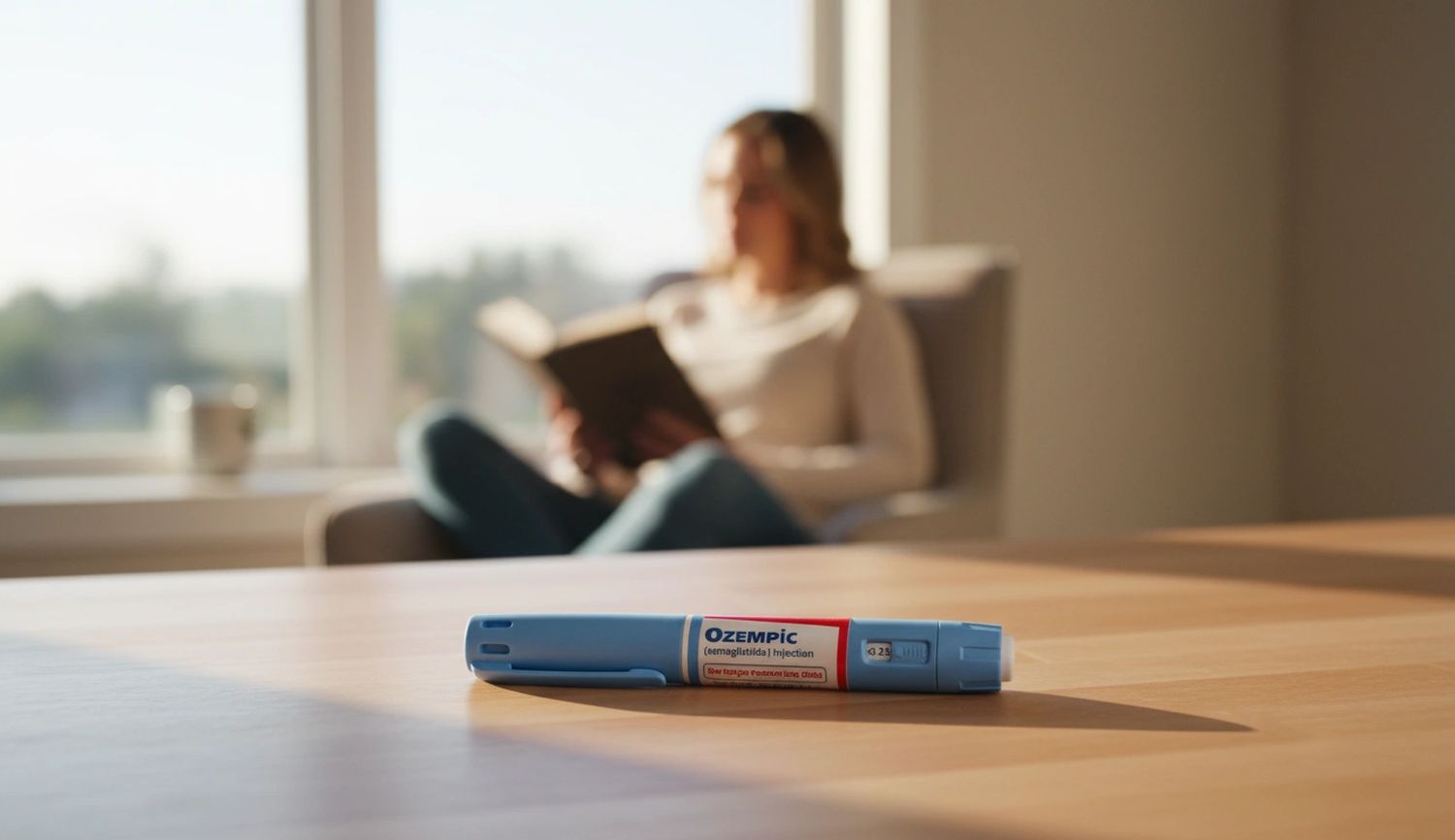
You just picked up your Ozempic prescription from the pharmacy, and now you’re wondering where exactly you should keep it. Does it need to stay in the refrigerator? What happens if it gets too warm during your commute home? Can you take it with you on vacation next month? And how will you know if improper storage has damaged your medication?
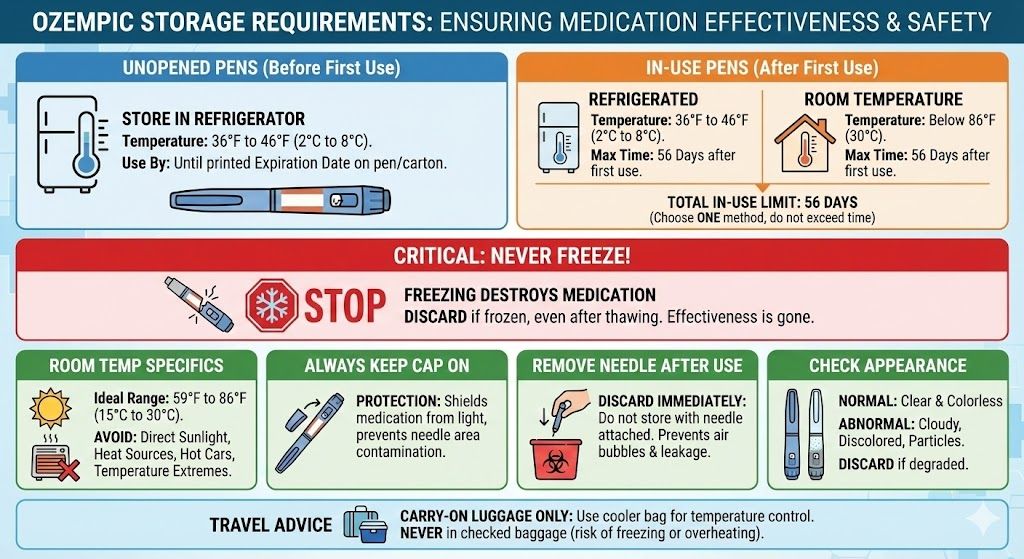
Here’s what you need to know: Ozempic requires specific storage conditions to maintain its effectiveness and safety. Unopened pens must be refrigerated at 36°F to 46°F until you’re ready to use them. Once you start using a pen, you can keep it either refrigerated or at room temperature below 86°F for up to 56 days. The medication must never freeze, and it should be protected from excessive heat and direct sunlight. Proper storage ensures the semaglutide remains stable and effective throughout your treatment.
This guide covers everything about Ozempic storage, from basic refrigeration requirements to traveling with your medication, recognizing signs of degradation, and handling storage emergencies. Understanding these principles helps you maintain medication quality and avoid the frustration and expense of replacing damaged pens.
Key Takeaways: Ozempic Storage Requirements
- Unopened Ozempic pens must be stored in the refrigerator at 36°F to 46°F (2°C to 8°C) until first use and remain good until the printed expiration date.
- In-use pens can be stored either refrigerated or at room temperature below 86°F (30°C) for up to 56 days after first use, regardless of which storage method you choose.
- Ozempic must never freeze, and frozen medication must be discarded even after thawing, as freezing destroys the medication’s structure and effectiveness.
- Room temperature storage means keeping the pen between 59°F and 86°F, away from direct sunlight, heat sources, and temperature extremes like hot cars.
- The pen should always be stored with the pen cap on to protect the medication from light and prevent contamination of the needle attachment area.
- Remove and discard the needle immediately after each injection rather than storing the pen with a needle attached, which can cause air bubbles and medication leakage.
- Properly stored Ozempic should remain clear and colorless throughout its shelf life, and any cloudiness, discoloration, or particles indicate the medication has degraded.
- For travel, keep Ozempic in carry-on luggage with appropriate temperature control using cooler bags if needed, never in checked baggage where temperatures can freeze or overheat medication.
Understanding Why Storage Conditions Matter
Semaglutide, the active ingredient in Ozempic, is a peptide medication with a complex molecular structure that degrades when exposed to improper conditions. Unlike simple chemical compounds that remain stable in various environments, peptides are sensitive to temperature, light, and physical stress.
Temperature Sensitivity
At the molecular level, semaglutide consists of a chain of amino acids folded into a specific three-dimensional structure. This structure must remain intact for the medication to bind properly to GLP-1 receptors in your body and produce its therapeutic effects.
Heat causes this molecular structure to unfold or change shape, a process called denaturation. Once denatured, the peptide cannot function correctly, and the medication loses effectiveness. This is similar to how cooking an egg changes its protein structure permanently.
Cold temperatures below freezing cause ice crystals to form within the medication solution. These ice crystals physically damage the peptide structure and can cause the medication to separate or aggregate. Unlike simple thawing of frozen water, frozen and thawed peptides don’t return to their original functional state.
Maintaining proper temperature ranges prevents both heat denaturation and freezing damage, keeping the medication in its intended, active form.
Light Exposure Effects
Light, particularly UV light and bright sunlight, can trigger chemical reactions that degrade peptide medications. This photodegradation breaks molecular bonds and changes the medication’s structure.
The Ozempic pen is designed with some light protection built into the cartridge and pen body, but this doesn’t make it immune to light damage. Extended exposure to direct sunlight or bright light accelerates degradation.
Storing the pen with its cap on provides additional light protection. The cap isn’t just for cleanliness; it serves as a light barrier that helps preserve medication stability.
Physical Stability
Shaking, dropping, or roughly handling the pen can also affect medication stability. Vigorous agitation can cause peptides to aggregate (clump together), forming particles that reduce medication effectiveness and could potentially trigger immune responses.
This is why you should never shake an Ozempic pen. If you need to mix the medication (which you generally don’t with Ozempic as it comes pre-mixed), you would gently roll it between your palms rather than shaking vigorously.
Why These Rules Are Strict
Pharmaceutical companies establish storage requirements based on extensive stability testing. They test how medications degrade under various conditions and determine the temperature ranges and duration limits that ensure the product remains safe and effective.
The storage requirements for Ozempic aren’t arbitrary. They represent the conditions under which Novo Nordisk can guarantee the medication will maintain at least 90% of its initial potency, the standard threshold for pharmaceutical products.
Using medication stored outside these parameters means you’re taking something with unknown potency. It might work partially, not at all, or unpredictably, making your treatment less effective and your results harder to predict.
Storing Unopened Ozempic Pens
When you first receive your Ozempic prescription, proper storage before first use is straightforward but important.
Refrigerator Storage Requirements
Place unopened Ozempic pens in your refrigerator as soon as you get home from the pharmacy. The ideal temperature range is 36°F to 46°F (2°C to 8°C), which is the normal operating range for most household refrigerators.
Store the pens in their original carton. The carton provides additional light protection and helps you track expiration dates. It also protects the pens from accidental damage.
The middle shelves of your refrigerator typically maintain the most consistent temperature. Avoid storing Ozempic in the refrigerator door, where temperature fluctuates each time you open the door. Don’t place it in the back of the refrigerator directly against the cooling element, where it might get too cold or freeze.
Never store Ozempic in the freezer or in the coldest parts of the refrigerator where freezing might occur. Most modern refrigerators have a temperature display. If yours shows temperatures below 36°F in any section, don’t store your medication there.
Shelf Life of Unopened Pens
Unopened Ozempic pens stored properly in the refrigerator remain effective until the expiration date printed on the carton and pen label. This expiration date is typically 18 to 24 months from the manufacturing date, though this varies by specific lot.
Always check the expiration date before using a pen. If the date has passed, don’t use that pen. Return expired medication to your pharmacy, which can properly dispose of it.
The expiration date applies only to unopened pens stored continuously at proper refrigerator temperatures. Once you open and use a pen, the 56-day in-use timeline begins regardless of the printed expiration date.
When You Pick Up Your Prescription
Getting your medication from the pharmacy to your home refrigerator requires some attention, especially in extreme weather.
In typical weather conditions, Ozempic can tolerate brief periods at room temperature during transport. Most people can drive directly home from the pharmacy and refrigerate their medication without issues.
In very hot weather (temperatures above 86°F), ask the pharmacy for an insulated bag or ice pack for transport. Many pharmacies provide these for temperature-sensitive medications. If not, bring a small cooler with ice packs when picking up your prescription.
Don’t leave Ozempic in a hot car while running other errands. Temperature inside parked cars can exceed 120°F on warm days, well beyond safe limits for medication storage. Go directly home, or bring a cooler to keep the medication cool if you have multiple stops.
In very cold weather (below freezing), the same principles apply in reverse. Don’t leave medication in a cold car where it might freeze. Transport it in an insulated bag close to your body heat, or inside the warm passenger compartment rather than in the trunk.
Storing Multiple Pens
If your prescription includes multiple pens (common with 90-day supplies), store all unopened pens in the refrigerator together in their cartons. Organize them so you can easily identify which pen expires first, using a first-in-first-out approach.
Some people write the date they received each pen on the carton to track freshness, though this isn’t necessary as long as you’re using the printed expiration dates.
Having multiple pens refrigerated ensures you always have backup medication properly stored if something happens to your in-use pen.
Storing In-Use Ozempic Pens
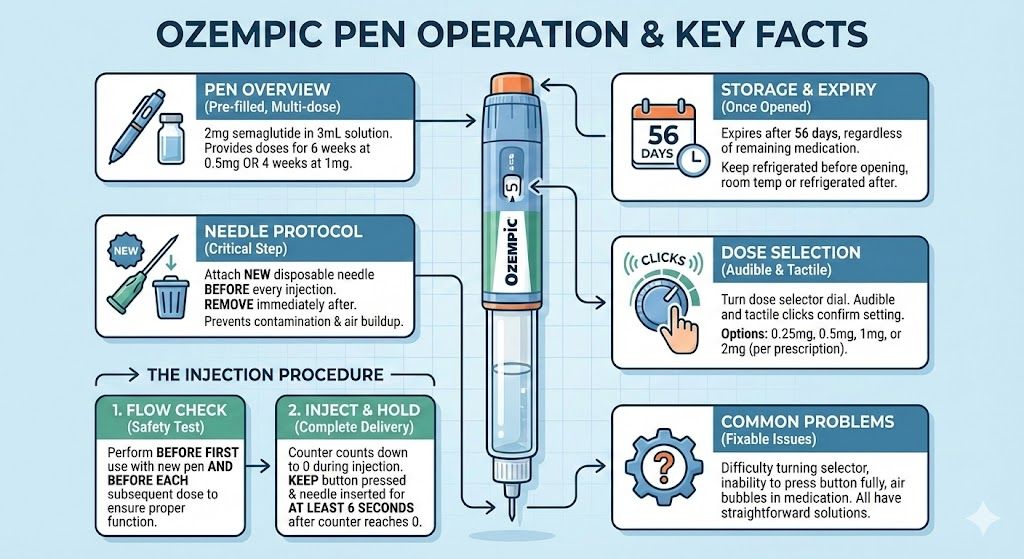
Once you’ve used a pen for the first time, storage requirements become more flexible but still important.
Room Temperature vs Refrigeration
After first use, you can choose to store your Ozempic pen either in the refrigerator or at room temperature. Many people prefer room temperature storage for in-use pens because cold medication stings more during injection. Letting the pen stay at room temperature eliminates the 30-minute warming wait before each weekly dose.
Room temperature storage means keeping the pen at temperatures below 86°F (30°C). This includes normal household temperatures of 68°F to 76°F that most people maintain year-round.
If you choose continued refrigeration, that’s perfectly acceptable too. Some people prefer refrigeration because it’s what they’re used to or because they feel more confident knowing the pen is at the coldest safe temperature. Both options work equally well for medication stability.
The key is that in-use pens can tolerate room temperature for their entire 56-day lifespan. You don’t need to worry about refrigerating once you’ve started using a pen unless you prefer to.
The 56-Day In-Use Limit
Regardless of storage temperature, in-use pens must be discarded 56 days (8 weeks) after first use. This timeline applies whether you store the pen in the refrigerator or at room temperature. The pen might still contain medication, but you cannot use it beyond 56 days.
When you first use a new pen, immediately write two dates on the label: the first-use date and the discard date (56 days later). For example, if you first use a pen on January 1st, write “First use: 1/1” and “Discard by: 2/26.”
This dating prevents you from accidentally using expired medication. The 56-day limit exists because stability testing shows the medication maintains its potency for this duration after the seal is broken and the pen is in use. Beyond 56 days, degradation may occur even with proper storage.
Where to Keep Room-Temperature Pens
If storing your in-use pen at room temperature, choose a location that’s cool, dry, and away from direct sunlight. Good options include:
A bathroom medicine cabinet (as long as it doesn’t get excessively steamy from hot showers). The cool, dark environment works well. However, if your bathroom regularly becomes very hot and humid, choose a different location.
A bedroom nightstand drawer. This keeps the medication out of direct light and at stable room temperature. It’s also convenient for remembering weekly doses if you establish a routine.
A kitchen cabinet away from the stove or other heat sources. Avoid cabinets above the stove or refrigerator (where heat from appliances can accumulate).
A dedicated medication storage box or drawer in a climate-controlled room. Some people keep all their medications in one organized location.
Avoid windowsills where direct sunlight hits, areas near heating vents or radiators, the top of the refrigerator (heat rises from the compressor), garages or cars where temperature isn’t controlled, and bathrooms that become very hot and steamy.
Keeping the Pen Capped
Always replace the pen cap after removing a needle. The cap protects the needle attachment area from contamination and dust. It also shields the medication from light exposure, which can gradually degrade semaglutide.
The cap should click into place when properly seated. If it’s loose or doesn’t click, check that you’re aligning it correctly with the pen body.
Never store the pen with a needle attached. Remove and dispose of the needle immediately after each injection. Leaving needles attached can allow air to enter the pen, potentially affecting dose accuracy for your next injection. It also increases contamination risk and creates a safety hazard.
Temperature Limits: What’s Too Hot or Too Cold
Understanding temperature boundaries helps you protect your medication in various situations.
The Freezing Danger
Ozempic must never freeze. Temperatures at or below 32°F (0°C) cause ice crystal formation that permanently damages the medication structure. Once frozen, Ozempic cannot be used, even after it thaws completely.
Freezing is more common than many people realize. It can happen in refrigerators set too cold, especially older models without precise temperature control. It occurs in cars during winter in cold climates. It can even happen in luggage cargo holds during air travel.
If you suspect your Ozempic has frozen (it appears icy, has ice crystals visible, or was in an environment at or below 32°F for an extended period), discard it. Don’t try to thaw and use it. The molecular damage is irreversible, and the medication will not work properly.
To prevent freezing in your refrigerator, check the temperature setting and adjust if needed. Most refrigerators should be set to around 37°F to 40°F, well above freezing but cool enough for food safety.
Don’t place Ozempic directly against the back wall of older refrigerators where the cooling coils are located, as this area can get cold enough to freeze liquids. Keep pens toward the front or middle of shelves.
The Heat Threshold
While Ozempic can tolerate room temperature below 86°F, higher temperatures accelerate degradation. Brief exposure to temperatures slightly above 86°F probably won’t destroy the medication immediately, but prolonged heat exposure will.
Temperatures above 100°F cause rapid degradation. This can happen quickly in parked cars during summer, where interior temperatures can reach 130°F to 150°F within an hour.
If your Ozempic has been exposed to temperatures above 86°F for more than a few hours, its potency may be compromised. The medication might look normal but have reduced effectiveness.
Signs that heat may have damaged your medication include changes in clarity (cloudiness or haziness), color changes (yellowing or any tint), or visible particles floating in the solution. However, heat-damaged medication might show no visible changes while still being degraded.
When in doubt about heat exposure, contact your pharmacy or healthcare provider for guidance. They can help you determine whether the medication should be replaced.
Safe Temperature Ranges Summary
- Unopened pens: 36°F to 46°F (refrigerated only)
- In-use pens: 36°F to 86°F (refrigerated or room temperature)
- Never: Below 32°F (freezing) or above 86°F for extended periods
These ranges provide the safety margins within which Novo Nordisk guarantees medication stability and potency.
Traveling with Ozempic
Travel requires planning to maintain proper storage conditions while on the move.
Air Travel Guidelines
Always pack Ozempic in carry-on luggage, never checked bags. Cargo holds in airplanes can get cold enough to freeze medication or hot enough on the tarmac to cause degradation.
The TSA allows medically necessary medications in carry-on bags, including injectable medications. You don’t need a prescription copy for domestic travel, though having it can be helpful. The medication should be in its original packaging with the pharmacy label visible.
Security screening may require additional inspection of the pen. Officers might ask to see it separately from other items. This is routine and shouldn’t cause delays.
You can also bring pen needles, alcohol wipes, and a sharps container in carry-on luggage. These are all permitted for medical purposes.
For international travel, check requirements for your destination countries. Some countries require documentation for injectable medications. The International Air Transport Association (IATA) website provides country-specific medication import rules.
Car Travel Considerations
For road trips, in-use Ozempic pens can stay at room temperature in the passenger compartment for the duration of your trip, as long as the car’s interior remains below 86°F.
Never leave medication in a parked car, especially in warm weather. Even with windows cracked, car interiors heat up dangerously fast. If you need to leave your car, take the medication with you.
In very hot climates or during summer travel, consider using a medication cooler bag with ice packs. These insulated bags maintain appropriate temperature for hours without refrigeration.
For winter travel in very cold climates, don’t leave medication in the car overnight where it might freeze. Bring it inside with you.
Using Cooler Bags and Ice Packs
Medication cooler bags are specifically designed to maintain temperatures in the safe range without freezing medication. They’re different from regular coolers designed for food and drinks.
When using a cooler bag, don’t let the medication come in direct contact with ice or frozen ice packs. Direct contact can cause freezing. Place a barrier (like a small towel or the medication’s carton) between ice packs and the pen.
Reusable gel ice packs work well because you can partially freeze them to be cold but not frozen solid. They maintain cool temperatures without the extreme cold of fully frozen ice.
Test your cooler system before important trips. Put a thermometer inside to verify it maintains temperatures between 36°F and 86°F.
Hotel and Accommodation Storage
When staying in hotels, use the room’s mini-fridge if available. Check that the fridge is actually cooling properly before storing your medication. Some hotel mini-fridges are turned off to save energy.
If there’s no refrigerator in your room, request one from the front desk. Hotels typically accommodate medical needs like medication storage.
For in-use pens that can be at room temperature, you can store them in a cool, dark location in your hotel room if the room temperature stays below 86°F. A drawer or closet away from windows works well.
At vacation rentals or stays with friends or family, ask permission to use refrigerator space for your medication. Most people are happy to accommodate medical needs.
Crossing Time Zones
Your injection schedule is based on weekly dosing, not specific times of day. When crossing time zones, you can take your dose at any convenient time on your scheduled day.
If crossing many time zones (international travel), you might shift your injection day by a day forward or backward to maintain a convenient schedule in your new location. For example, if you normally inject on Sundays but you’ll be in a time zone where Sunday happens at an inconvenient time, you might take Saturday’s dose instead, then continue weekly from that new day.
The flexibility in timing means time zones don’t significantly complicate Ozempic use, unlike medications requiring precise daily timing.
Duration of Travel Storage
In-use pens can be away from refrigeration for their entire 56-day lifespan if room temperature stays below 86°F. This means you could travel for several weeks without refrigeration and your medication remains fine.
For trips longer than 56 days where you’ll need a new pen, bring an unopened backup pen in a cooler bag with appropriate temperature control. Unopened pens must stay refrigerated or in cooler bags that maintain refrigeration temperatures.
Recognizing Degraded or Damaged Medication
Knowing when Ozempic has gone bad helps you avoid using ineffective medication.
Normal Appearance
Properly stored Ozempic should always be clear and colorless, looking like water. When you look through the pen’s cartridge window, the liquid should be completely transparent with no cloudiness, haziness, or color.
The solution should be free of any particles, debris, or floating matter. It should look exactly the same on day 56 of use as it did when you first opened the pen.
Signs of Degradation
Discard your Ozempic pen immediately if you notice any of these changes:
Cloudiness or haziness in the solution. The liquid should never look milky, foggy, or opaque. Any loss of crystal-clear transparency indicates degradation or contamination.
Color changes. Any yellow, brown, pink, or other color tint means the medication has degraded. Semaglutide should remain completely colorless throughout its shelf life.
Visible particles. Small floating particles, sediment at the bottom, or any solid matter in the solution indicates problems. Properly stored semaglutide remains a uniform solution without particles.
Unusual texture. If the medication appears thick, gel-like, or separated into layers, it has degraded.
The pen or cartridge looks damaged. Cracks in the glass cartridge, damage to the pen mechanism, or leakage of medication all require discarding the pen.
When Visual Inspection Isn’t Enough
Some medication degradation might not be visible. If you know your pen has been exposed to improper conditions (frozen, left in hot car, dropped repeatedly), the medication might be compromised even if it looks normal.
If your weight loss results suddenly decline without explanation, or if you notice your appetite suppression effect seems diminished, your medication potency might be reduced due to improper storage you weren’t aware of.
When in doubt about medication integrity, replace the pen rather than risk using degraded medication. Contact your pharmacy to explain the situation. Many insurance plans will cover replacement if medication was damaged through no fault of your own.
Documenting Storage Issues
If you suspect your medication was mishandled during shipping or by the pharmacy before you received it, document the issue immediately. Take photos of any visible degradation, note the dates and circumstances, and contact your pharmacy right away.
Most pharmacies will replace medication that was improperly stored before you received it. They want to ensure you’re getting effective medication and will work with you to resolve storage issues.
What to Do If Storage Goes Wrong
Despite best efforts, storage accidents happen. Knowing how to respond minimizes problems.
If Ozempic Freezes
If you discover your Ozempic has frozen or suspect it may have frozen, do not use it. The medication cannot be salvaged even after thawing.
Discard the frozen pen safely. Don’t attempt to thaw it and assess whether it “looks okay.” The molecular damage from freezing is permanent and invisible.
Contact your pharmacy to explain what happened. If the freezing occurred due to pharmacy storage or shipping issues (you received it frozen), they should replace it at no cost. If it froze in your home refrigerator, you’ll need to purchase a replacement, though sometimes insurance will cover replacement in these situations.
To prevent future freezing, check your refrigerator temperature and adjust settings if needed. Consider moving medication to a different shelf away from the coldest areas.
If Ozempic Gets Too Hot
If your medication was exposed to high heat (left in a hot car, shipped in hot weather without temperature control, stored near a heat source), assess the duration and severity of exposure.
Brief exposure (less than an hour) to temperatures slightly above 86°F is probably acceptable, especially for in-use pens. Extended exposure (several hours) to temperatures above 90°F or any exposure to extreme heat (above 100°F) means the medication should be replaced.
Check the medication’s appearance carefully. Any cloudiness, color change, or particles definitely require discarding the pen. However, heat-damaged medication might look normal, so visual inspection alone isn’t sufficient.
When in doubt, err on the side of replacement. Using degraded medication means you’re not getting proper dosing, which affects your results and could lead to side effects if you later switch to full-potency medication.
If You’re Unsure About Storage History
Sometimes you realize you can’t remember whether you refrigerated unopened pens when you first got them, or you find a pen and don’t know how long it’s been at room temperature.
For unopened pens that should have been refrigerated, if you cannot verify continuous refrigeration, contact your pharmacy. They can check their records of when it was dispensed. If it’s been more than a few days at room temperature, it should be replaced.
For in-use pens, if you can’t remember when you first used it, check whether you wrote the first-use date on the label. If not, and you’re uncertain about the 56-day timeline, it’s safer to discard it and start fresh with a new pen where you’ll track the date properly.
Power Outages and Refrigeration Loss
If you lose power and refrigeration, your Ozempic can tolerate several hours at room temperature without significant degradation. In-use pens are fine for days at room temperature below 86°F.
Unopened pens should be moved to a cooler with ice packs if the power outage will extend beyond 6 to 8 hours. Use barriers to prevent direct contact with ice.
If a power outage lasts more than 24 hours and you didn’t have alternative cooling, the safety of unopened pens becomes questionable. Contact your pharmacy for guidance on whether replacement is advisable.
In-use pens handle power outages better since they can be at room temperature for their entire 56-day lifespan anyway.
Special Storage Situations
Certain circumstances require adapted storage approaches.
Workplace Storage
If you need to store Ozempic at work (for instance, if your injection day falls on a workday and you prefer to inject at work), you have several options.
Ask your workplace if you can use a refrigerator in a break room for medication storage. Many workplaces accommodate this. Consider using a small labeled bag or container so your medication is identifiable and protected.
For in-use pens, you can keep the pen in a desk drawer or locker at room temperature if the workplace stays below 86°F. This is often more practical than negotiating shared refrigerator space.
Some people prefer to bring their pen from home on injection day rather than storing it at work long-term. This eliminates workplace storage concerns entirely.
College Dorm Storage
College students should store Ozempic in their dorm room mini-fridge if they have one. Notify your roommate that you’re storing medication that shouldn’t be disturbed.
If sharing a communal floor refrigerator, label your medication clearly with your name and “medication” to reduce the chance of it being moved or discarded during cleaning.
For room-temperature storage, a locked drawer or secure personal space works well. Dorm rooms can sometimes get quite warm, so monitor temperature if you’re using room-temperature storage.
Gym or Exercise Facility Storage
Don’t store Ozempic at gyms or exercise facilities. Temperature in gym lockers isn’t controlled and can get too hot. The risk of theft or accidental discard is also higher in public spaces.
If you need to have your medication with you at the gym (perhaps you’re going directly from work to gym to home), keep it in your gym bag rather than leaving it in a locker. Gym bags stay at ambient temperature and remain with you.
Better yet, leave medication at home or work rather than carrying it to the gym unnecessarily.
Storage During Natural Disasters
If you live in areas prone to hurricanes, earthquakes, or other disasters that might disrupt power or require evacuation, include your Ozempic in your emergency preparedness planning.
Keep a small cooler bag with ice packs in your emergency kit. If you need to evacuate, you can grab your medication, put it in the cooler, and maintain appropriate temperature for several days.
Consider asking your pharmacy for a small extra supply (a 7 to 14 day buffer) that you keep for emergencies. Some insurance plans allow this with proper documentation.
After disasters, if you’re unsure about your medication’s integrity, most relief efforts include provisions for replacing essential medications. Contact emergency services or relief organizations for help.
Living in Extreme Climates
In very hot climates where ambient temperatures regularly exceed 86°F, in-use pens need continued refrigeration rather than room-temperature storage. Unopened pens always need refrigeration regardless of climate.
In very cold climates, be vigilant about preventing freezing. Keep medication away from exterior walls that might get very cold or windows where cold drafts occur.
Some people in extreme climates invest in medication storage devices specifically designed to maintain precise temperature ranges. These small refrigerator-like units can be worthwhile for expensive medications if you’re in challenging climate conditions.
Organizing and Tracking Storage
Good organizational habits prevent storage-related problems.
Labeling System
Write essential dates directly on pen labels using permanent marker:
- Date you first used the pen
- Date the pen expires (56 days later)
- For unopened pens, highlight the printed expiration date if it’s hard to read
Clear labeling prevents accidental use of expired medication and helps you track your supply.
Creating a Medication Log
Some people keep a simple medication log noting:
- Date each new pen was started
- Expiration date for that pen
- Storage location (refrigerator or room temperature)
- Any storage incidents (power outages, temperature concerns, etc.)
This log doesn’t need to be elaborate. A note in your phone or a simple calendar notation works fine. The goal is having a reference if you’re ever uncertain about a pen’s history.
Supply Management
Keep track of how many pens you have on hand. If you’re prescribed a 90-day supply (typically 2 pens for most dosing schedules), make sure you know where both are stored and when each expires.
Set reminders to refill your prescription with enough lead time. Running out of medication on your injection day because you forgot to refill causes unnecessary stress.
Refrigerator Organization
Designate a specific spot in your refrigerator for Ozempic storage. This consistency helps you always know where to find it and reduces the chance of it getting misplaced or accidentally discarded.
Keep Ozempic separate from food to prevent contamination concerns. A designated medication drawer or shelf section works well.
Store pens in their cartons for protection and organization. The cartons also make it easy to see expiration dates at a glance.
Comparing Ozempic Storage to Other Medications
Understanding how Ozempic’s requirements compare to other common medications provides context.
Similar GLP-1 Medications
Other GLP-1 receptor agonists like Wegovy (also semaglutide), Mounjaro, and Zepbound (both tirzepatide) have similar storage requirements. These medications are all peptides with comparable temperature sensitivity.
Compounded semaglutide at $199 monthly through TrimRx has essentially the same storage requirements as brand-name Ozempic since it contains the same active ingredient. Vials of compounded semaglutide need refrigeration before first use and can be at room temperature during the in-use period.
Our comparison of Ozempic vs Mounjaro covers both medications’ properties, including storage needs. Compounded tirzepatide at $349 monthly follows similar storage guidelines to brand-name versions.
Other Injectable Diabetes Medications
Older insulin formulations often had stricter storage requirements and couldn’t tolerate room temperature as long as modern GLP-1 medications. Some insulins required continuous refrigeration even during use.
Newer insulin analogs have more flexible storage similar to Ozempic, typically allowing 28 days at room temperature. However, each specific insulin has its own requirements that must be followed.
The principle is the same across all injectable peptide medications: proper temperature control maintains medication effectiveness, while heat, freezing, or light exposure causes degradation.
Oral Medications
Most oral medications (pills and tablets) have much less stringent storage requirements than injectable peptides. Many oral drugs can be stored at room temperature with no special precautions beyond keeping them dry and out of direct sunlight.
This difference reflects the stability differences between simple chemical compounds (most oral drugs) and complex peptides (injectable biologics like Ozempic). The more complex molecular structure of peptides makes them more sensitive to environmental conditions.
Cost Implications of Improper Storage
Understanding the financial impact of storage mistakes emphasizes why proper handling matters.
Replacement Costs
Brand-name Ozempic costs approximately $969 per pen without insurance. If you damage a pen through improper storage, you’ll need to pay for a replacement. Insurance typically won’t cover replacement of medication damaged after you received it.
Even with insurance coverage or manufacturer savings programs, replacing damaged medication creates hassle, requires additional pharmacy trips, and might involve copays.
For people using compounded semaglutide at $199 monthly, replacement costs are lower but still significant. Proper storage protects your investment in treatment.
Treatment Interruptions
If you discover your medication is damaged right before your scheduled injection day and don’t have a replacement, you’ll miss that week’s dose. Missing doses can reduce treatment effectiveness and potentially increase side effects like nausea when you resume treatment.
Treatment interruptions also mean delayed results. Each missed week is a week you’re not progressing toward your weight loss goals.
Prevention Is Cheaper Than Replacement
A medication cooler bag costs $15 to $30 and can be used for years. A small thermometer to monitor refrigerator temperature costs $5 to $10. These small investments protect medication worth hundreds of dollars.
Establishing proper storage habits from day one prevents the much higher cost of replacing damaged medication or dealing with treatment interruptions.
Frequently Asked Questions
Can I put Ozempic in the freezer to make it last longer?
No, you should never put Ozempic in the freezer. Freezing permanently damages the medication’s molecular structure, making it ineffective. Even if frozen Ozempic thaws and looks normal, the peptide structure has been destroyed and cannot be repaired. The medication must be discarded if it freezes. Freezing doesn’t extend shelf life or preserve potency. The only way to properly store Ozempic is refrigeration at 36°F to 46°F for unopened pens or refrigeration or room temperature below 86°F for in-use pens. Never expose the medication to freezing temperatures at or below 32°F under any circumstances.
What happens if I accidentally left my Ozempic in a hot car?
If Ozempic was left in a hot car, its safety depends on the duration and temperature. Brief exposure (30 minutes or less) on a moderately warm day probably won’t destroy the medication, though it’s not ideal. Extended exposure (1 hour or more) or exposure on very hot days when car interior temperatures exceed 120°F likely compromised the medication. Check the solution carefully for cloudiness, color changes, or particles. Even if it looks normal, heat-damaged medication might have reduced potency. When in doubt, contact your pharmacy for guidance on whether replacement is advisable. To prevent this, never leave Ozempic in a parked car, bring it inside with you or use a cooler bag with ice packs for transport on warm days.
How long can Ozempic be out of the fridge during travel?
In-use Ozempic pens can remain at room temperature below 86°F for their entire 56-day in-use period. This means you can travel for weeks without refrigeration and your medication remains effective. For air travel, keeping the pen in your carry-on luggage at cabin temperature is perfectly fine. Unopened pens that haven’t been used yet require refrigeration or a cooler bag with temperature control to maintain 36°F to 46°F. The key is keeping in-use pens below 86°F and unopened pens refrigerated. With proper planning using cooler bags for unopened pens, you can travel anywhere while maintaining medication quality.
Should I store Ozempic with the needle attached?
No, never store Ozempic with a needle attached. Remove and discard the needle immediately after each injection. Leaving needles attached between uses causes several problems: air can enter the pen and affect dose accuracy, medication can leak from the needle, bacteria can enter through the exposed needle, and having an exposed needle creates a safety hazard. The pen should always be stored with the pen cap on and no needle attached. Attach a fresh, sterile needle only when you’re ready to inject, then remove it right after completing the injection. This practice maintains medication quality and ensures safe handling.
Can I tell if my Ozempic went bad just by looking at it?
Visual inspection can detect many signs of degraded Ozempic but not all. Properly stored semaglutide should remain clear and colorless like water throughout its shelf life. Cloudiness, any color tint, visible particles, or changes in texture clearly indicate the medication has gone bad and should be discarded. However, some medication degradation from heat exposure might not be visible. The solution might look normal while having reduced potency. If you know the medication was exposed to improper conditions like freezing or excessive heat, replace it even if it looks fine. When you’re uncertain about medication integrity, it’s safer to replace it than risk using degraded medication with unknown potency.
Does Ozempic need to be refrigerated after opening?
No, Ozempic doesn’t need to be refrigerated after opening, though you can continue refrigerating it if you prefer. Once you start using a pen (after first injection), you can store it either refrigerated or at room temperature below 86°F. Both storage methods work equally well for the 56-day in-use period. Many people prefer room temperature storage for in-use pens because the medication is more comfortable to inject at room temperature than when cold from the refrigerator. The choice between refrigeration and room temperature storage is yours, based on personal preference. Just ensure room temperature doesn’t exceed 86°F and always discard the pen after 56 days regardless of storage method.
What should I do if there’s a power outage and my Ozempic is in the fridge?
During a power outage, your refrigerator will stay cool for several hours if you keep the door closed. In-use pens handle power outages well since they can be at room temperature for their entire 56-day lifespan anyway. Move in-use pens to a room-temperature location if you’re concerned. For unopened pens that require refrigeration, they can tolerate several hours at room temperature without significant issues. If the power outage extends beyond 6 to 8 hours, move unopened pens to a cooler with ice packs to maintain refrigeration temperatures. Ensure pens don’t come in direct contact with ice to prevent freezing. After power is restored, return medication to normal refrigeration. If the outage lasted more than 24 hours without cooling, contact your pharmacy for guidance.
Can I keep Ozempic in my purse or bag all day?
For in-use pens, you can safely keep Ozempic in your purse or bag during the day as long as the temperature stays below 86°F. This makes the medication portable for work, travel, or daily activities. However, don’t leave your bag in situations where temperature might exceed safe limits, like in a parked car on a warm day or in direct sunlight. If you’re carrying medication in your bag, be mindful of temperature in the environments where you leave the bag. Consider using a small medication cooler bag if you’ll be in very warm conditions. Always keep the pen cap on to protect from light and physical damage. For unopened pens that require refrigeration, they shouldn’t be carried around routinely unless you’re using a cooler bag with temperature control.
How do I know if my refrigerator is too cold for Ozempic?
Most refrigerators should be set to 36°F to 40°F, which is ideal for both food safety and Ozempic storage. If your refrigerator has a temperature display, check that it’s within this range. If you notice frost buildup in unusual places (not in the freezer section), the refrigerator might be too cold. You can purchase an inexpensive refrigerator thermometer to verify the temperature where you store your medication. Place the thermometer on the shelf with your Ozempic and check it after a few hours. If it reads below 36°F, adjust your refrigerator’s temperature setting or move the medication to a warmer section of the refrigerator. The middle shelves typically maintain the most consistent, appropriate temperature. If Ozempic appears frozen or icy, the storage location is definitely too cold.
Is it better to store in-use Ozempic in the fridge or at room temperature?
Both storage options work equally well for medication stability during the 56-day in-use period. The choice comes down to personal preference. Room temperature storage offers more convenience since you can inject immediately without waiting for the pen to warm up, and cold medication causes more discomfort during injection. Refrigeration offers psychological reassurance for some people who prefer keeping medication as cool as possible. Some people switch between methods, refrigerating in summer when home temperatures are warmer and using room temperature storage in cooler months. The important factor is maintaining temperature below 86°F for room temperature storage and remembering the 56-day disposal deadline regardless of which method you choose. Try both methods if you’re unsure and see which you prefer.
Maintaining Medication Quality Through Proper Storage
Proper Ozempic storage is straightforward once you understand the basic principles: keep unopened pens refrigerated, maintain in-use pens below 86°F regardless of storage location, never allow freezing, and protect from excessive heat and light. These simple practices ensure your medication remains effective throughout treatment.
The flexibility to store in-use pens at room temperature provides convenience for daily life, travel, and various living situations. This flexibility exists because Novo Nordisk has thoroughly tested semaglutide stability at room temperature and determined it maintains full potency for 56 days when kept below 86°F.
Storage mistakes can be expensive and disruptive to treatment, making it worthwhile to establish good habits from your first dose. Simple precautions like tracking in-use dates, using cooler bags for travel, and checking medication appearance before each injection prevent the vast majority of storage-related problems.
If you’re ever uncertain about your medication’s storage history or integrity, consult your pharmacy or healthcare provider rather than risking using potentially degraded medication. Proper injection technique and site selection matter for treatment success, but none of that matters if improper storage has compromised medication quality.
Whether you’re using brand-name Ozempic or compounded semaglutide at $199 monthly through TrimRx, proper storage protects your investment in treatment and ensures you’re getting full therapeutic benefit. Get started with comprehensive medical support, clear instructions, and convenient online access to GLP-1 treatment that includes guidance on all aspects of successful medication management throughout your weight loss journey.

Transforming Lives, One Step at a Time
Keep reading
Ozempic Cost Without Insurance: Affordable Alternatives Guide 2026
You’re interested in starting Ozempic for weight loss, but when you call the pharmacy to check pricing, the number stops you cold. Nearly $1,000…
Foods to Avoid on Ozempic: Complete List and Meal Planning Tips
You started Ozempic a few weeks ago, and suddenly foods you’ve eaten your entire life are causing severe nausea, bloating, or hours of uncomfortable…

How to Maximize Weight Loss on Ozempic: Expert Tips and Strategies
You started Ozempic several weeks ago and you’re losing weight, but you wonder if you could be getting better results. Some people seem to…


