Semaglutide Dosage for Weight Loss: Complete Titration Guide

Getting semaglutide dosing right makes the difference between achieving excellent weight loss with manageable side effects versus struggling with nausea while seeing minimal results. If you’re starting semaglutide, switching from one dose to another, or trying to figure out why your weight loss has stalled, understanding proper dosing becomes crucial.
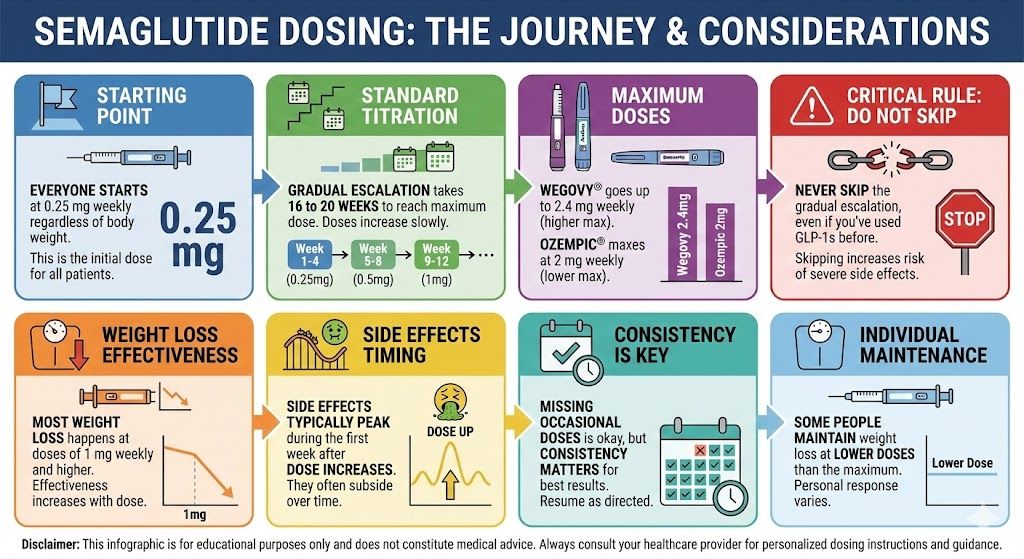
The standard approach starts everyone at a low dose of 0.25 mg weekly, regardless of body weight. Over the next four to five months, you’ll gradually increase through several dose levels until reaching a maintenance dose. This slow escalation helps your body adjust while minimizing side effects that drive many people to quit treatment prematurely.
This guide walks through the entire dosing journey, explaining what to expect at each level, when to increase your dose, how to handle missed injections, and what to do if side effects become problematic.
Key Takeaways: Semaglutide Dosing
- Everyone starts at 0.25 mg weekly regardless of body weight
- Standard titration takes 16 to 20 weeks to reach maximum dose
- Wegovy goes up to 2.4 mg weekly, Ozempic maxes at 2 mg weekly
- Never skip the gradual escalation, even if you’ve used GLP-1s before
- Most weight loss happens at doses of 1 mg weekly and higher
- Side effects typically peak during first week after dose increases
- Missing occasional doses is okay, but consistency matters for best results
- Some people maintain weight loss at lower doses than the maximum
Why Semaglutide Requires Gradual Dose Escalation
You might wonder why semaglutide can’t just start at a therapeutic dose if that’s where you’ll end up anyway. The answer lies in how your digestive system adapts to the medication.
Semaglutide works by slowing how quickly your stomach empties and amplifying satiety signals in your brain. When you introduce these effects suddenly at high doses, your gastrointestinal system rebels. Severe nausea, vomiting, and other side effects become almost guaranteed. Many people who experience this quit treatment within weeks.
Starting low and increasing slowly gives your body time to adapt. Your stomach adjusts to the slower emptying. Your brain recalibrates to the new satiety signals. By the time you reach therapeutic doses, your system has had months to accommodate the changes. This is why clinical trials establishing semaglutide’s effectiveness used gradual titration schedules, and real-world use follows the same approach.
The other benefit of gradual escalation is finding your optimal dose. Not everyone needs the maximum dose to achieve their weight loss goals. Some people get excellent results at 1 mg or 1.7 mg weekly. The slow increase lets you and your provider assess response at each level and decide whether continuing to escalate makes sense.
Standard Semaglutide Titration Schedule
The dosing schedule follows a consistent pattern across both Wegovy (the weight loss formulation) and Ozempic (the diabetes formulation, often prescribed off-label for weight loss).
Month 1: Starting at 0.25 mg Weekly
Your first four weeks happen at 0.25 mg once weekly. This starter dose serves primarily as an adjustment period rather than a therapeutic dose for weight loss. You’ll likely notice some appetite reduction, but dramatic weight loss is uncommon at this level.
Most people experience mild nausea during these first few weeks, typically lasting a day or two after each injection. The nausea usually isn’t severe enough to disrupt daily activities but can be noticeable. Some people sail through this phase with minimal side effects, while others find it challenging. Both responses are normal.
Weight loss during month one typically ranges from one to four pounds. Think of this month as preparation for the real weight loss that comes at higher doses.
Month 2: Increasing to 0.5 mg Weekly
After four weeks at the starter dose, you’ll double to 0.5 mg weekly. This dose increase often brings a temporary return of nausea for a few days as your system adjusts to the higher level. By the second or third week at 0.5 mg, side effects typically settle down.
This is when consistent weight loss usually begins. You’ll notice significantly reduced appetite between meals and feeling satisfied with smaller portions. The mental preoccupation with food that characterizes many people’s relationship with eating often starts to quiet at this dose.
Weight loss during month two typically ranges from three to six pounds for most people. You’re now starting to see real progress on the scale and might notice clothes fitting differently.
Month 3: Moving to 1 mg Weekly
Around week eight or nine, you’ll increase to 1 mg weekly. For many people, 1 mg represents the threshold where semaglutide’s effects become powerful. Appetite suppression is strong, food cravings diminish substantially, and weight loss accelerates.
Expect that familiar pattern of increased nausea for a few days after the first injection at the new dose, then improvement over the following weeks. At this point you’ve been on the medication for two months and your body is adapting more efficiently to dose changes.
Weight loss at 1 mg typically runs four to eight pounds during the month. Some people find this dose sufficient for their goals and choose to stay here rather than continuing to escalate. That’s a perfectly reasonable approach if results are good and side effects are manageable.
Month 4: Advancing to 1.7 mg Weekly
After at least four weeks at 1 mg, the next step is 1.7 mg weekly. This represents a significant jump and often produces the most dramatic phase of weight loss. The appetite suppression at this level can be quite strong, sometimes to the point where you need to consciously remind yourself to eat adequate nutrition.
The side effect pattern repeats with a few days of increased nausea after the first 1.7 mg injection, then gradual improvement. By this point in treatment, most people have developed effective strategies for managing these temporary symptoms.
Weight loss at 1.7 mg often hits five to ten pounds during the month, particularly during the first few weeks at this dose. This is when people typically see substantial changes in how their body looks and feels.
Month 5+: Reaching 2.4 mg Weekly (Wegovy) or 2 mg (Ozempic)
The final dose increase depends on which formulation you’re using. Wegovy goes up to 2.4 mg weekly, while Ozempic maxes out at 2 mg weekly. The clinical trials showing 14.9% average weight loss used the 2.4 mg dose, so Wegovy has a slight theoretical advantage.
Many providers wait until you’ve been on 1.7 mg for at least four weeks, sometimes longer, before making this final increase. Some people choose to stay at 1.7 mg if they’re getting good results and don’t want to risk increased side effects from the higher dose.
At maximum doses, weight loss continues but often at a slower pace than the rapid drops seen at 1.7 mg. You might lose three to six pounds monthly at this phase as your body approaches its new set point.
For detailed information about what weight loss to expect throughout this journey, check our complete month-by-month semaglutide results guide.
Differences Between Wegovy and Ozempic Dosing
While both medications contain semaglutide and follow similar titration schedules, some differences exist.
Wegovy is specifically formulated for weight loss with a maximum dose of 2.4 mg weekly. Each pen contains a single dose, so you use a new pen every week. The dosing schedule is standardized with clear monthly increases designed specifically for weight management.
Ozempic is approved for type 2 diabetes with a maximum dose of 2 mg weekly. The pens contain multiple doses, and the device allows you to dial different dose amounts. Doctors prescribing Ozempic off-label for weight loss typically follow the same titration schedule as Wegovy but stop at 2 mg instead of 2.4 mg.
That 0.4 mg difference between the maximum doses probably produces slightly better results with Wegovy, but the difference isn’t dramatic. Many people achieve excellent weight loss on Ozempic at 2 mg. The choice between them often comes down to insurance coverage and cost rather than clinical superiority.
For a detailed comparison, see our Wegovy vs Ozempic guide.
When to Increase Your Dose
The standard schedule provides general guidance, but individual circumstances sometimes call for adjustments.
Standard Timing
Most providers follow the schedule of increasing doses every four weeks. This gives your body adequate time to adjust at each level and lets you assess whether you’re experiencing good weight loss and tolerating side effects well.
Reasons to Stay Longer at a Dose
You might stay at a particular dose longer than four weeks if side effects are still problematic when the increase would normally happen, if you’re losing weight steadily and don’t feel ready to increase, if you have upcoming travel or events where you’d prefer stable medication levels, or if your provider wants to monitor specific health markers before escalating.
There’s no medical requirement to increase on exactly a four-week schedule. Some people spend six or even eight weeks at certain dose levels.
Reasons to Increase More Quickly
Occasionally, people tolerate a dose exceptionally well with minimal side effects and want to increase sooner. Most providers require at least three weeks at each dose before increasing, but some flexibility exists based on individual tolerance.
Never increase your dose faster than your prescribing provider recommends. The standard schedule exists for good reasons, and rushing through it typically leads to worse side effects without improving long-term results.
When You’ve Reached Your Goal Weight
If you achieve your target weight before reaching the maximum dose, discuss with your provider whether continuing to increase makes sense. Some people find their optimal maintenance dose is lower than the maximum, and that’s perfectly fine. The goal is sustainable weight management, not necessarily reaching the highest possible dose.
What to Do If You Miss a Dose
Missing an occasional injection happens. Life gets busy, you forget your medication while traveling, or your pharmacy runs out of stock. Here’s how to handle it.
If You Miss by 1-2 Days
Take your dose as soon as you remember. Then resume your regular weekly schedule from that new day. For example, if you normally inject on Mondays but forget and remember on Wednesday, take it Wednesday. Then your new injection day becomes Wednesday going forward.
If You Miss by 3-5 Days
You can still take the missed dose, but consider whether it makes sense to shift your injection day permanently or skip the missed dose and wait for your regular day. If only a day or two remain until your normal injection day, some providers recommend skipping the missed dose and resuming on schedule to avoid taking two doses too close together.
If You Miss a Week or More
Contact your provider for guidance. They might recommend dropping back to your previous dose level for one injection before returning to your current dose. This depends on how long you’ve been at your current dose and how well you were tolerating it.
Missing multiple consecutive weeks means semaglutide levels in your system have dropped substantially, so jumping back in at your previous dose could cause more side effects than if you’d maintained consistent dosing.
Consistency Matters
While missing occasional doses won’t ruin your progress, consistency produces the best results. Semaglutide has a long half-life of about one week, so it stays in your system between injections. This creates stable medication levels that optimize appetite suppression and weight loss. Frequent missed doses lead to fluctuating medication levels, potentially causing more side effects and less consistent weight loss.
Managing Side Effects at Each Dose Level
Side effects follow predictable patterns, typically peaking within a few days of dose increases then improving over the following weeks.
Nausea Management
Nausea is the most common side effect across all dose levels. It tends to be worst on the day of injection and the following day or two, then gradually improves.
Strategies that help include eating smaller, more frequent meals instead of three large ones, avoiding very fatty or greasy foods which slow digestion even further, staying well hydrated throughout the day, not lying down immediately after eating, and taking your injection in the evening after dinner rather than morning.
Some people find ginger tea, ginger candies, or ginger supplements help settle their stomach. Others discover that protein-focused meals sit better than carbohydrate-heavy ones.
Digestive Issues
Diarrhea and constipation both occur with semaglutide, sometimes alternating in the same person at different times. For constipation, increase water intake to 64 ounces or more daily, add fiber through vegetables or psyllium supplements, and consider a gentle stool softener if needed.
For diarrhea, stay hydrated to replace lost fluids, avoid foods that worsen loose stools, and let your provider know if it persists beyond the first few weeks at a new dose.
Fatigue
Some people experience fatigue, particularly in the first few weeks at new doses. This often improves as your body adapts to eating less food. Ensure you’re consuming adequate protein and calories despite reduced appetite. Severe or persistent fatigue warrants discussion with your provider.
When to Contact Your Provider
Reach out to your provider if side effects are severe enough to interfere with daily activities, if nausea leads to persistent vomiting that prevents adequate hydration, if you experience severe abdominal pain, if side effects don’t improve after two to three weeks at a dose, or if you’re considering stopping treatment due to side effects.
Many side effect issues can be managed with dosing adjustments or supportive strategies. Your provider might recommend staying at your current dose longer, temporarily dropping back to a previous dose, or implementing specific management techniques.
Maintenance Dosing and Long-Term Use
Once you reach your target dose and achieve significant weight loss, the focus shifts to maintenance.
Finding Your Maintenance Dose
Your maintenance dose is the amount that keeps your weight stable without excessive side effects. For some people, this is the maximum dose of 2.4 mg or 2 mg. For others, a lower dose like 1.7 mg or even 1 mg provides adequate appetite suppression for maintenance.
Some people find they can reduce their dose slightly after reaching goal weight and still maintain their loss. This often makes long-term treatment more comfortable and affordable. Discuss dose optimization with your provider once you’ve been maintaining your weight for a few months.
How Long to Stay on Semaglutide
Clinical trials studied semaglutide for 68 weeks, but many people continue indefinitely. When people stop semaglutide, they typically regain much of their lost weight within six to 12 months. The medication doesn’t permanently reset your metabolism or appetite regulation.
Think of semaglutide like blood pressure medication. It works while you’re taking it, but the underlying condition requires ongoing management. Many people view long-term semaglutide use as treatment for chronic obesity rather than a temporary weight loss solution.
Cost Considerations for Long-Term Use
Brand-name semaglutide costs $969 to $1,349 monthly, making long-term use prohibitively expensive for many people without insurance coverage. This is where compounded semaglutide becomes relevant. Compounded semaglutide costs $199 per month through TrimRx, making maintenance treatment financially sustainable.
For complete information about compounded options, read our comprehensive compounded semaglutide guide.
Dose Adjustments for Special Situations
Certain circumstances might require dosing modifications from the standard schedule.
If You’ve Used GLP-1 Medications Before
If you previously took semaglutide and stopped, then decide to restart, you’ll typically start back at the beginning of the titration schedule. Even if you were previously on 2.4 mg, starting at 0.25 mg and working back up minimizes side effects.
If you’re switching from a different GLP-1 medication like liraglutide or dulaglutide, your provider might accelerate the titration slightly since your body is already adapted to this class of medications. However, most providers still start at 0.25 mg for at least one to two weeks.
Switching from Ozempic to Wegovy
If you’re changing from Ozempic to Wegovy (or vice versa), the transition is straightforward since they’re the same medication. If you’re stable on Ozempic 1 mg, you’d continue at Wegovy 1 mg. The brands are interchangeable at equivalent doses.
The only adjustment comes if you’re at Ozempic’s maximum of 2 mg and want to increase to Wegovy’s 2.4 mg. Treat this like any dose increase, spending at least four weeks at 2 mg before going to 2.4 mg.
Age-Related Considerations
Older adults typically follow the same dosing schedule as younger adults. Age alone doesn’t require dose modifications. However, older adults might be more susceptible to side effects or have multiple medications that require monitoring, so closer provider oversight makes sense.
Kidney or Liver Issues
People with mild to moderate kidney or liver impairment can usually take semaglutide at standard doses. Those with severe impairment need individualized assessment. Semaglutide is primarily broken down through protein degradation rather than kidney or liver metabolism, but your provider will consider your specific situation.
Optimizing Your Results at Each Dose
Getting the most from semaglutide involves more than just taking your weekly injection.
Protein Intake Matters
At every dose level, prioritize protein consumption. When appetite drops dramatically, many people naturally eat less protein, which can lead to muscle loss alongside fat loss. Aim for 0.7 to 1 gram of protein per pound of your goal body weight daily.
Lean meats, fish, eggs, Greek yogurt, cottage cheese, protein shakes, and legumes help you meet protein targets even with reduced appetite.
Physical Activity Enhances Results
While semaglutide works even without exercise, combining medication with regular physical activity improves outcomes. You don’t need to become a gym fanatic. Walking 30 minutes daily, doing bodyweight exercises at home, or following online workout videos all contribute.
Resistance training particularly matters for preserving muscle mass during weight loss. Even two 30-minute strength sessions weekly help maintain metabolic rate and improve body composition.
Hydration Supports Weight Loss
Adequate water intake supports metabolism, helps manage side effects, and prevents constipation. Aim for at least 64 ounces daily, more if you’re physically active or live in hot climates.
Many people find that staying well hydrated reduces the intensity of nausea and other side effects.
Sleep and Stress Impact Results
Poor sleep disrupts hunger hormones (ghrelin and leptin) and can slow weight loss despite being on semaglutide. Aim for seven to nine hours of quality sleep nightly.
Chronic stress elevates cortisol, which promotes fat storage particularly around your midsection. Incorporating stress management through meditation, yoga, walking, or hobbies improves both your weight loss results and overall wellbeing.
Tracking Progress Beyond the Scale
Weight fluctuates daily due to water retention, bowel movements, and other factors. Taking measurements (waist, hips, arms, thighs), progress photos every few weeks, and noting how clothes fit gives you a more complete picture of progress than the scale alone.
Sometimes your body composition improves without dramatic scale changes, particularly if you’re building muscle while losing fat.
Frequently Asked Questions
What is the starting dose of semaglutide for weight loss?
Everyone starts at 0.25 mg once weekly regardless of body weight or previous medication experience. This starter dose helps your body adjust to the medication and minimizes side effects. You’ll stay at this dose for four weeks before increasing to 0.5 mg.
How long does it take to reach the maximum dose?
Following the standard titration schedule, you’ll reach the maximum dose in 16 to 20 weeks (about four to five months). Wegovy’s maximum is 2.4 mg weekly, while Ozempic maxes at 2 mg weekly. Some people reach their maximum dose slightly faster or slower depending on individual tolerance and provider recommendations.
Can I start semaglutide at a higher dose?
No, you should never start at doses higher than 0.25 mg weekly. Starting at higher doses dramatically increases side effects and often leads to people quitting treatment within weeks. The gradual titration schedule exists because it produces better long-term adherence and results. Even if you’ve used GLP-1 medications before, starting at 0.25 mg is standard practice.
What happens if I increase my dose too quickly?
Increasing doses faster than the standard schedule typically causes severe nausea, vomiting, diarrhea, and other gastrointestinal side effects. These symptoms might be bad enough to make you stop treatment entirely. The gradual schedule gives your body time to adapt at each level, making the entire journey more tolerable.
Do I need to reach the maximum dose to lose weight?
No, many people achieve excellent weight loss at doses lower than the maximum. Some people get great results at 1 mg or 1.7 mg weekly and choose to stay at those levels. The maximum dose produces the highest average weight loss in clinical trials, but individual results vary. Your optimal dose is whatever produces good weight loss with manageable side effects.
What if I’m not losing weight at my current dose?
Give each dose at least four to six weeks before judging effectiveness. Weight loss isn’t always linear, and temporary plateaus are normal. If you’ve been at a dose for eight weeks or more without weight loss, increasing to the next level often restarts progress. Also evaluate your eating habits, activity level, sleep quality, and stress, as these factors influence results regardless of dose.
Can I take semaglutide every other week instead of weekly?
Semaglutide is designed for once-weekly dosing. Taking it less frequently reduces effectiveness because medication levels drop too low between doses. The weekly schedule maintains stable levels in your system that optimize appetite suppression and weight loss. If you’re considering less frequent dosing due to side effects or cost, discuss alternatives with your provider rather than changing the schedule yourself.
What’s the best day of the week to take semaglutide?
Choose whatever day works best for your schedule. Many people prefer Friday or Saturday evenings so they can rest over the weekend if side effects occur. The specific day doesn’t matter for effectiveness, but consistency matters tremendously. Take it the same day each week for best results.
How do I switch from weekly to daily semaglutide?
There isn’t a daily version of injectable semaglutide currently available (though oral semaglutide exists for diabetes treatment). The weekly injection formulation is designed to maintain stable levels throughout the week. If you’re struggling with weekly injections, discuss concerns with your provider, but switching to daily isn’t an option with current formulations.
Can I split my weekly dose into smaller daily doses?
No, semaglutide is formulated for once-weekly administration. The long-acting formulation slowly releases into your system over seven days. Splitting it into daily doses won’t work properly and could cause unpredictable medication levels and side effects. Always use semaglutide exactly as prescribed with weekly dosing.
Getting Started with Proper Semaglutide Dosing
Understanding the dosing schedule before starting treatment helps set realistic expectations and improves your chances of success. The gradual titration from 0.25 mg to maximum doses over four to five months gives your body time to adjust while building toward the therapeutic levels that produce significant weight loss.
Whether you’re accessing brand-name Wegovy or Ozempic, or choosing more affordable compounded semaglutide, the dosing principles remain the same. Start low, increase gradually, stay consistent with weekly injections, and work closely with your provider to optimize results while managing side effects.
TrimRx provides compounded semaglutide at $199 per month with comprehensive medical oversight throughout your entire dosing journey. All-inclusive pricing covers consultations, medication at all dose levels, supplies, and ongoing support. Get started with an online consultation and begin your properly dosed path to successful weight loss.

Transforming Lives, One Step at a Time
Keep reading

GLP-1 Telehealth on the West Coast: CA, WA and OR
The West Coast has a reputation for progressive healthcare policy and high insurance coverage rates, and in many respects that reputation is earned. California,…

GLP-1 Telehealth in the Southwest: TX, AZ, NV and NM
The Southwest is a region of stark contrasts when it comes to healthcare access. Phoenix and Las Vegas are sprawling, fast-growing metros with expanding…

GLP-1 Telehealth in the Midwest: IL, OH, MI and IN
The Midwest doesn’t get as much attention in conversations about obesity and healthcare access as the South does, but the numbers tell a sobering…


