Semaglutide Weight Loss Clinics in Florida: Your Options

Florida has one of the highest concentrations of semaglutide weight loss clinics in the country, ranging from physician-led medical practices to med spas, cash-pay clinics, and telehealth providers that deliver directly to your door. Prices vary wildly, from under $200 per month through telehealth to over $1,500 at boutique clinics, so knowing what you’re actually getting for your money matters before you commit.
The GLP-1 boom has hit Florida especially hard. The state’s large retiree population, year-round warm weather (which means fewer layers to hide behind), and business-friendly regulations for med spas and compounding pharmacies have created an enormous market. That’s good news in terms of access, but it also means you need to be a smart consumer. Let’s sort through what’s available and help you find the right fit.
The Florida Clinic Landscape
Semaglutide providers in Florida generally fall into four categories. Each has a different price point, level of medical oversight, and overall experience.
1. Physician-Led Medical Weight Loss Clinics
These are traditional medical practices, often run by internists, endocrinologists, or bariatric medicine specialists, that have added GLP-1 prescribing to their services. You’ll find them in every major Florida metro: Miami, Tampa, Orlando, Jacksonville, Fort Lauderdale, and throughout the Gulf Coast.
A typical experience includes an initial consultation with a physician or advanced practice provider ($150 to $400), lab work (metabolic panel, A1C, thyroid function), a physical exam, and a treatment plan. Follow-ups are usually monthly. The prescription is sent to a pharmacy of your choice, or the clinic dispenses medication directly.
Pros: Highest level of medical oversight. Best for patients with complex health histories, multiple medications, or conditions like diabetes, PCOS, or cardiovascular disease. Insurance may cover the office visits even if it doesn’t cover the medication.
Cons: Total monthly cost can be high when you add consultation fees to medication costs. Brand-name semaglutide at Florida pharmacies runs $800 to $1,100 without insurance. Some clinics offer compounded semaglutide in the $300 to $500 range, but not all do.
2. Med Spas and Aesthetic Clinics
This is where Florida gets interesting. The state’s thriving aesthetics industry means hundreds of med spas now offer semaglutide alongside Botox, fillers, and body contouring. South Florida in particular has seen an explosion of these providers.
Med spa GLP-1 programs typically cost $300 to $800 per month, often with the medication included. Some offer package deals (three months prepaid at a discount, for example). The consultation is usually brief, sometimes conducted by a nurse practitioner or physician assistant with a supervising physician off-site.
Pros: Convenient locations, often walk-in friendly. Pricing is usually all-inclusive and straightforward. Many offer complimentary services like body composition analysis.
Cons: Variable medical oversight. Some med spas treat semaglutide prescribing as a transactional service rather than genuine medical care. Ask who your prescribing provider is, what their credentials are, and what happens if you experience side effects. If the answer is vague, keep looking.
Red flags specific to Florida med spas: Clinics that don’t require any health history before prescribing, offer to start you at high doses for “faster results,” sell multi-month packages with no refund policy, or can’t tell you the source of their compounded medication. Florida’s Board of Medicine has taken action against providers cutting corners with GLP-1 prescribing, so stick with clinics that take the medical side seriously.
3. Cash-Pay Primary Care and Urgent Care Add-Ons
A growing number of Florida primary care offices and even some urgent care chains now offer semaglutide as an add-on service. This often works well if you already have a relationship with the practice, since your provider knows your health history and can integrate weight loss treatment into your overall care.
Pricing varies, but these practices often charge a monthly program fee of $100 to $250 plus the cost of medication. If they dispense compounded semaglutide in-office, your total might land in the $250 to $450 range monthly.
Pros: Continuity of care with a provider who already knows you. Convenient if you’re already a patient. Reasonable pricing compared to specialty clinics.
Cons: Not all primary care providers have deep experience with GLP-1 dose titration and side effect management. Ask how many patients they’re currently managing on semaglutide and how they handle dose adjustments.
4. Telehealth Providers
Telehealth GLP-1 services are fully legal in Florida and have become the most popular route for cost-conscious patients. The process is entirely virtual: you complete a health questionnaire, consult with a licensed provider online, and receive your medication by mail.
Through a service like TrimRx, compounded semaglutide starts at $179 per month. That price includes the provider consultation and the medication. No office visits, no separate pharmacy charges, no hidden fees. The medication ships directly to your Florida address.
Pros: Lowest total cost in most cases. No driving to appointments (which in sprawling Florida metros can mean an hour round trip). Same active ingredient as brand-name Ozempic. Provider check-ins happen on a regular schedule.
Cons: No in-person exam or in-office lab work. If you need labs, you’ll go through your PCP or use an at-home testing service. Less suited for patients with complex medical situations who benefit from hands-on monitoring.
To see if you qualify, take the intake assessment.
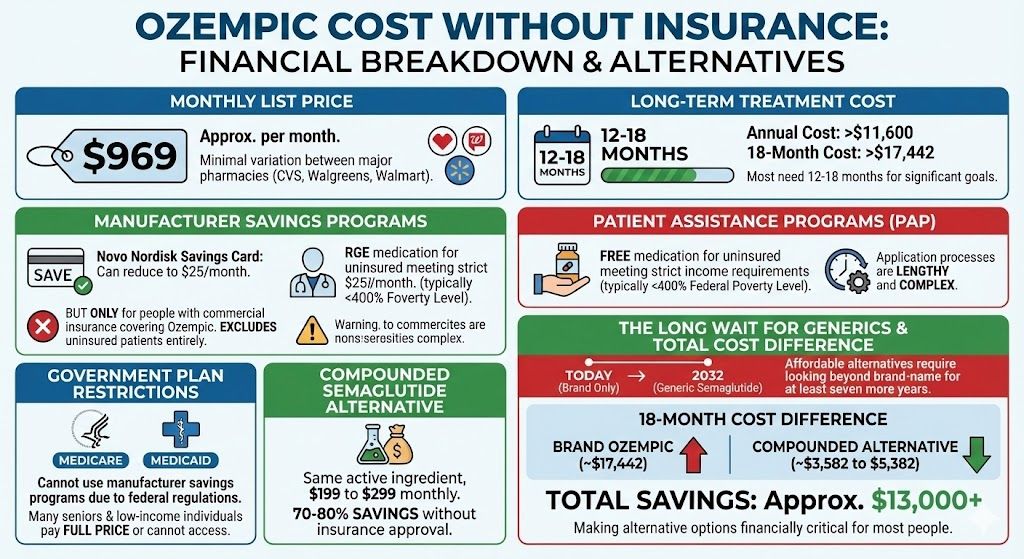
Cost Comparison Across Florida Options
| Provider Type | Monthly Cost Range | Includes Medication? | Office Visits Required? |
|---|---|---|---|
| Physician clinic | $400-$1,500+ | Sometimes (compounded); brand-name billed separately | Yes |
| Med spa | $300-$800 | Usually yes | Yes |
| Primary care add-on | $250-$450 | Usually yes (compounded) | Yes |
| Telehealth (TrimRx) | From $179 | Yes | No |
These ranges assume you’re paying cash. If your insurance covers Ozempic or Wegovy, your out-of-pocket cost through any in-person provider could drop to $25 to $150 per month depending on your copay. Check your plan before ruling out the insurance route.
For a detailed look at brand-name pricing with discount cards, our GoodRx Ozempic price guide breaks down what you’ll pay at major Florida pharmacy chains.
Florida-Specific Regulations to Know
Florida has some unique characteristics that affect the GLP-1 market:
Compounding pharmacy access. Florida is home to some of the largest compounding pharmacies in the country. This means compounded semaglutide is widely available and competitively priced compared to other states. However, quality varies between pharmacies. Look for providers who use 503B-registered compounding facilities, which are subject to FDA oversight and follow current good manufacturing practices.
Telehealth prescribing. Florida allows licensed providers to prescribe medications via telehealth after establishing a patient-provider relationship, which can happen through a virtual consultation. There’s no requirement for an in-person visit before receiving a GLP-1 prescription through telehealth, making virtual services fully accessible statewide.
Med spa regulation. Florida requires med spas to operate under a licensed physician’s supervision, but enforcement varies. The physician doesn’t have to be on-site for every patient interaction. This is why due diligence on your provider matters, especially at high-volume aesthetic clinics.
How to Vet Any Florida Provider
Regardless of which type of clinic you choose, run through this checklist:
Verify credentials. Look up your prescribing provider on the Florida Department of Health license verification site (flhealthsource.gov). Confirm their license is active and there are no disciplinary actions.
Ask about the medication source. Where does their semaglutide come from? A 503B compounding pharmacy? A 503A pharmacy? Directly from Novo Nordisk (brand-name)? If they can’t answer clearly, that’s a problem.
Understand the dosing protocol. Proper semaglutide treatment starts at 0.25 mg weekly and increases gradually. Any provider who starts you at 1 mg or higher without a clear medical reason is prioritizing speed over safety. For the standard approach, our semaglutide starting dose guide outlines what responsible titration looks like.
Clarify total costs upfront. Get the all-in monthly number: consultation, medication, shipping, follow-up visits, everything. Some clinics advertise a low medication price but tack on separate fees for each touchpoint.
Check the follow-up plan. You should have regular check-ins with your provider, whether in person or virtual. A prescription with no follow-up isn’t good medicine. Ask how often you’ll be seen and what the protocol is if you have side effects between appointments.
Choosing the Right Fit for Your Situation
Consider this scenario: a patient named Carlos lives in Tampa, works full time, and has a BMI of 34 with no other significant health conditions. He’s relatively straightforward, with no complex medical history. For Carlos, telehealth makes the most sense. He saves hundreds of dollars per month compared to a med spa, avoids scheduling hassles, and gets the same medication.
Now consider a different scenario: a patient named Angela lives in Miami, has type 2 diabetes, takes metformin and lisinopril, and has a history of pancreatitis. Angela’s situation calls for a physician-led clinic where her GLP-1 treatment can be coordinated with her existing medications and her provider can monitor for any pancreatic concerns.
Most people fall closer to the Carlos end of the spectrum, which is why telehealth has taken such a large share of the Florida GLP-1 market. But knowing where you fall helps you spend your money wisely.
For a realistic view of what to expect once you start treatment, our semaglutide weight loss timeline covers month-by-month progress.
The Bottom Line
Florida gives you more GLP-1 options than almost any other state. That’s an advantage, but only if you use it to find a legitimate, affordable provider rather than getting pulled into an overpriced program or a corner-cutting clinic. The medication does the heavy lifting regardless of where it’s prescribed. Your job is to find a provider who prescribes responsibly, prices fairly, and stays involved in your care after writing the script. For most Floridians without insurance coverage, telehealth with compounded semaglutide offers the best balance of quality, convenience, and cost.
This information is for educational purposes and is not medical advice. Consult with a healthcare provider before starting any medication. Individual results may vary.

Transforming Lives, One Step at a Time
Keep reading

Semaglutide for Prediabetes: Benefits and Considerations
Semaglutide is showing strong potential for prediabetes, with research demonstrating it can reduce the risk of progressing to type 2 diabetes by promoting significant…

Semaglutide Starting Dose: How to Begin
The standard starting dose of semaglutide for weight loss is 0.25 mg injected once weekly. This applies whether you’re using brand-name Ozempic, brand-name Wegovy,…

What Happens When You Stop Taking Semaglutide?
When you stop taking semaglutide, the appetite suppression fades within a few weeks, and most people regain a significant portion of their lost weight…


