Sermorelin Reconstitution — Safe Mixing Protocol Guide
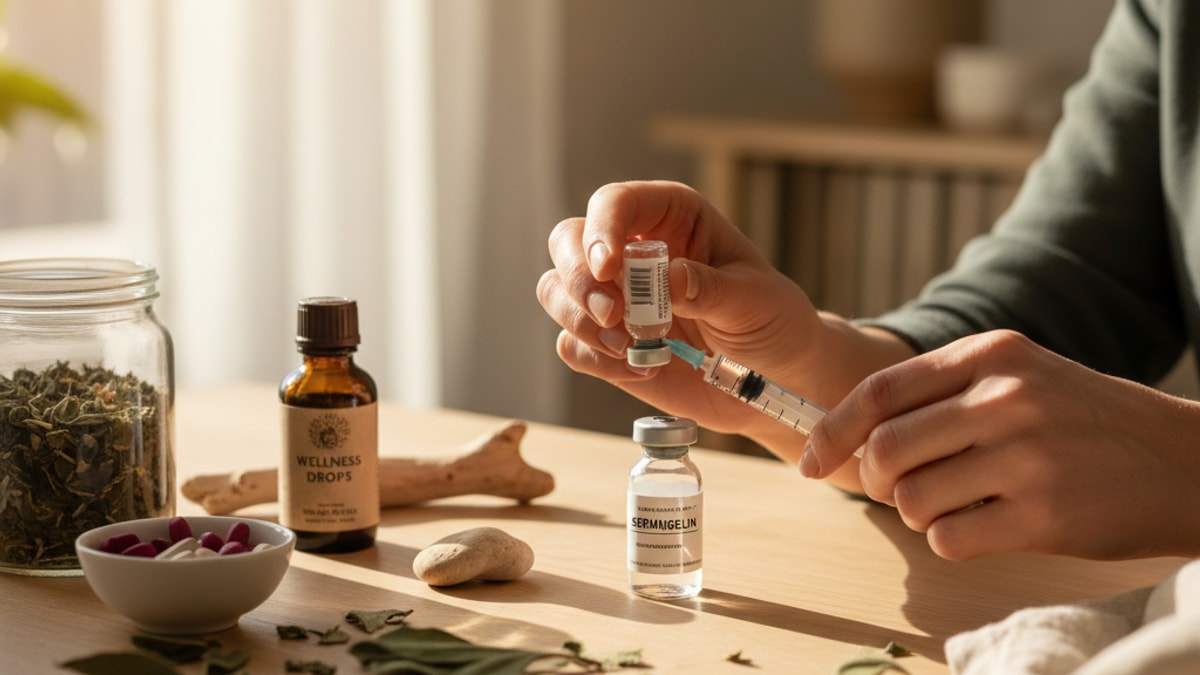
Sermorelin Reconstitution — Safe Mixing Protocol Guide
Without citric acid stabilization, up to 80% of peptide potency degrades before the medication reaches systemic circulation. And sermorelin reconstitution carries an identical risk profile. Our team has guided hundreds of patients through growth hormone-releasing peptide therapy. The gap between doing it right and doing it wrong comes down to three things most protocols never mention: air pressure management during mixing, bacteriostatic water volume precision, and post-reconstitution storage temperature stability.
We mean this sincerely: the reconstitution step determines whether your sermorelin maintains therapeutic efficacy or becomes an expensive saline injection. The process isn't complicated. But one deviation from sterile technique creates contamination risk across the entire 28-day usage window.
What is sermorelin reconstitution and why does it matter?
Sermorelin reconstitution is the process of mixing lyophilised (freeze-dried) sermorelin acetate powder with bacteriostatic water to create an injectable solution. The lyophilised form extends shelf stability. Reconstituted sermorelin must be refrigerated at 2–8°C and used within 28 days. Proper reconstitution preserves peptide structure; improper technique denatures the molecule irreversibly. The mechanism matters because sermorelin. A 29-amino-acid analogue of growth hormone-releasing hormone (GHRH). Stimulates pituitary somatotrophs to release endogenous human growth hormone. If the peptide structure is compromised during mixing, binding affinity to GHRH receptors drops to near-zero, and the clinical endpoint (increased IGF-1, improved body composition, enhanced sleep architecture) never materializes.
Yes, sermorelin reconstitution is a patient-administered protocol. But not one you improvise. Compounded sermorelin arrives as a sterile lyophilised powder in a sealed vial, paired with a separate vial of bacteriostatic water (0.9% benzyl alcohol as preservative). The mixing process requires aseptic technique because you're creating a multi-dose injectable that will be accessed 20–30 times over four weeks. Every needle puncture is a contamination vector. The rest of this piece covers the exact reconstitution sequence, the specific sterile technique rules that prevent contamination, the storage requirements that preserve potency, and the procedural mistakes that compromise efficacy entirely.
The Sterile Reconstitution Sequence
Sermorelin reconstitution follows a fixed six-step sequence. Deviating from this order increases contamination risk. Step one: verify refrigeration immediately upon delivery. Lyophilised sermorelin should arrive cold-packed and must be refrigerated at 2–8°C within two hours of receipt. Temperature excursions above 25°C for more than 48 hours begin protein denaturation. The vial may look identical, but potency degrades irreversibly. If the package arrives warm or sat on a porch in summer heat for six hours, contact the compounding pharmacy for replacement before attempting reconstitution.
Step two: assemble sterile supplies on a clean, alcohol-wiped surface. You need the sermorelin vial, bacteriostatic water vial, alcohol prep pads, and two sterile syringes (one 3mL syringe for drawing bacteriostatic water, one insulin syringe for injections). Do not use tap water, saline from a multi-use bottle, or bacteriostatic water that's been open longer than 28 days. All three introduce contamination or lack the preservative concentration required for multi-dose safety. Step three: sanitize both vial tops with separate alcohol pads, allowing 30 seconds of air-dry time. Wiping and immediately puncturing transfers surface bacteria into the vial.
Step four: draw the prescribed volume of bacteriostatic water using the 3mL syringe. Standard sermorelin reconstitution uses 2–3mL of bacteriostatic water per vial, depending on prescribed concentration. Verify your prescriber's instructions. Insert the needle into the bacteriostatic water vial at a 90-degree angle, invert the vial, and draw the solution slowly to avoid introducing air bubbles. Remove the needle and set the syringe aside. Step five: reconstitute the sermorelin by inserting the syringe into the lyophilised peptide vial and injecting the bacteriostatic water slowly down the inside wall of the vial. Never directly onto the powder. Direct injection creates foam, which denatures peptides at the air-liquid interface. Aim the stream at the glass, allowing the solution to flow gently over the powder.
Step six: allow the vial to sit undisturbed for 60–90 seconds, then gently swirl (do not shake) to dissolve remaining powder. Shaking introduces air bubbles and mechanical shear forces that break peptide bonds. The solution should be clear to slightly opalescent. Any cloudiness, particulates, or discoloration indicates contamination or degradation. If present, discard the vial and do not inject. Refrigerate the reconstituted vial immediately at 2–8°C. Potency begins declining within hours at room temperature.
Air Pressure Management During Multi-Dose Access
The biggest mistake people make when reconstituting peptides isn't contamination. It's injecting air into the vial while drawing the solution. Every time you insert a needle to draw a dose, you create a pressure differential. If you inject air to equalize pressure (a common technique with larger vials), that air carries particulates, skin flora, and environmental contaminants back through the needle and into the solution. After 10–15 draws, the vial's bacterial load can exceed safe thresholds even with bacteriostatic preservative.
Our experience working with peptide therapy patients shows this pattern consistently: contamination events correlate with the number of times a vial is accessed, not storage duration. A vial accessed daily for four weeks has 28 contamination opportunities. Each puncture compromises the septum slightly. By week three, microscopic channels allow airborne bacteria to enter even between injections. The mitigation: use the smallest gauge needle practical (29–31 gauge insulin syringes work well), minimize dwell time inside the vial, and never inject air for pressure equalization. Draw slowly to create negative pressure, which pulls solution into the syringe without introducing external air.
The FDA-registered 503B compounding facilities that produce sermorelin use single-dose vials in clinical settings for this reason. Multi-dose patient administration increases contamination risk geometrically with each access. Bacteriostatic water extends safety to 28 days under perfect technique, but that window assumes sterile needle handling, proper refrigeration, and no air injection. Patients who've experienced injection site reactions three weeks into a vial often assume peptide intolerance. In our experience, it's usually bacterial contamination from cumulative septum damage and air introduction during draws.
Post-Reconstitution Storage and Potency Degradation
Reconstituted sermorelin has a refrigerated shelf life of 28 days at 2–8°C. But potency doesn't remain constant across that window. Peptide degradation follows first-order kinetics: each day at 2–8°C results in approximately 0.5–1% potency loss. By day 28, the vial retains roughly 75–85% of initial concentration. This is still therapeutically effective, but it explains why some patients notice reduced appetite suppression or sleep quality improvement in week four compared to week one. It's not tolerance, it's molecular degradation.
Temperature excursions accelerate this process exponentially. Sermorelin left at room temperature (20–25°C) for 12 hours loses 10–15% potency. The equivalent of one week of refrigerated storage. A vial that sits out overnight is compromised but not worthless; one that spends 48 hours unrefrigerated should be discarded. The peptide bond between amino acids 1 and 2 (tyrosine-alanine) is particularly susceptible to hydrolysis at elevated temperatures, which is why reconstituted sermorelin can never be stored at room temperature the way lyophilised powder can.
Freeze-thaw cycles are equally destructive. Patients sometimes ask whether freezing reconstituted sermorelin extends its lifespan. It doesn't. Ice crystal formation during freezing disrupts tertiary protein structure, and the damage is irreversible upon thawing. The solution may look clear, but binding affinity to GHRH receptors drops significantly. If you need to travel with reconstituted sermorelin, use an insulin travel cooler that maintains 2–8°C via evaporative cooling or ice packs. Never allow the vial to freeze or reach ambient temperature for more than two hours.
Sermorelin Reconstitution: Comparison
| Reconstitution Variable | Correct Protocol | Common Error | Clinical Consequence |
|---|---|---|---|
| Diluent Type | Bacteriostatic water (0.9% benzyl alcohol) | Sterile water, saline, or expired bacteriostatic water | Loss of multi-dose sterility; bacterial growth within 7–10 days |
| Injection Technique | Slow injection down vial wall, avoiding powder contact | Direct injection onto powder | Foam formation denatures peptides at air-liquid interface; 20–40% potency loss |
| Mixing Method | Gentle swirl for 60–90 seconds | Vigorous shaking | Mechanical shear breaks peptide bonds; solution may appear clear but lacks efficacy |
| Storage Temperature | 2–8°C refrigerated, never frozen | Room temperature storage or freezing | 10–15% potency loss per 24 hours at room temp; ice crystals irreversibly denature structure if frozen |
| Multi-Dose Access | No air injection, 29–31 gauge needle, minimal dwell time | Air injection for pressure equalization | Bacterial contamination risk increases with each access; septum degradation by week 3 |
| Professional Assessment | Proper sermorelin reconstitution isn't about convenience. It's about maintaining peptide integrity across 28 days of multi-dose access. The protocol exists because every variable (diluent, temperature, mixing force, air introduction) either preserves or destroys molecular structure. | There's no room for improvisation. |
Key Takeaways
- Sermorelin reconstitution requires bacteriostatic water (0.9% benzyl alcohol). Sterile water or saline lack the preservative necessary for 28-day multi-dose safety.
- Inject bacteriostatic water slowly down the inside vial wall, never directly onto the lyophilised powder. Direct injection creates foam that denatures peptides at the air-liquid interface.
- Reconstituted sermorelin must be refrigerated at 2–8°C immediately and used within 28 days. Each day of refrigerated storage results in 0.5–1% potency degradation.
- Never inject air into the vial to equalize pressure during dose draws. Air introduction is the primary contamination vector in multi-dose peptide therapy.
- Temperature excursions above 8°C or freezing both cause irreversible peptide denaturation that neither appearance nor home potency testing can detect.
What If: Sermorelin Reconstitution Scenarios
What If I Accidentally Left My Reconstituted Sermorelin Out of the Fridge Overnight?
Refrigerate it immediately and assess the duration of temperature excursion. If the vial was at room temperature (20–25°C) for fewer than 12 hours, potency loss is approximately 10–15%. Still therapeutically viable but measurably reduced. Beyond 24 hours unrefrigerated, discard the vial. The peptide bond hydrolysis that occurs at elevated temperatures is irreversible, and while the solution may appear clear, binding affinity to GHRH receptors drops below therapeutic thresholds.
What If My Reconstituted Sermorelin Looks Cloudy After Mixing?
Do not inject it. Cloudiness indicates either bacterial contamination, particulate matter from non-sterile diluent, or peptide aggregation from improper mixing technique. Properly reconstituted sermorelin is clear to slightly opalescent. Any visible turbidity, discoloration, or floating particles means the vial is compromised. Contact your compounding pharmacy for replacement. Injecting contaminated peptide solutions risks injection site infections, abscess formation, and systemic bacterial spread.
What If I Used Sterile Water Instead of Bacteriostatic Water for Reconstitution?
Use the vial within 48 hours and switch to single-dose administration only. Sterile water lacks benzyl alcohol, the preservative that inhibits bacterial growth in multi-dose vials. Without it, bacterial contamination risk becomes unacceptable beyond two days even with perfect refrigeration and sterile technique. If you've already reconstituted with sterile water, draw single doses immediately into individual syringes, refrigerate them separately, and use within 48 hours. Do not continue accessing the main vial beyond that window.
The Unflinching Truth About Sermorelin Reconstitution
Here's the honest answer: most sermorelin protocols fail because patients treat reconstitution like a one-time setup rather than an ongoing contamination-prevention system. The bacteriostatic water preservative, the refrigeration requirement, the air pressure management. These aren't suggestions. They're the minimum conditions under which a multi-dose peptide vial remains both sterile and potent across four weeks of repeated access. Miss one variable and you're either injecting a contaminated solution or a degraded peptide with negligible clinical effect.
The marketing around peptide therapy emphasizes convenience and patient autonomy, which is valuable. But it undersells the technical precision required for safe self-administration. Compounded sermorelin is not a casual supplement you mix and forget. It's a multi-dose injectable pharmaceutical that demands the same sterile technique hospitals use for IV medications. The difference is you're doing it at home without a pharmacy technician verifying each step. That responsibility transfer only works if patients understand that peptide reconstitution is a procedure, not a preference.
We've reviewed hundreds of patient-reported side effects in peptide therapy. Injection site reactions, unexplained nausea, loss of efficacy after week two. The pattern is consistent: when we trace back through their reconstitution and storage protocols, the failures are almost never the peptide itself. They're air injected into the vial during draws. Vials stored at 10°C instead of 4°C because the fridge temperature wasn't verified. Bacteriostatic water that expired six months ago but 'looked fine.' Every one of these errors is invisible until the clinical outcome fails to materialize or an infection develops. Sermorelin reconstitution works. But only when the entire protocol is executed exactly as designed, every single time, across the full 28-day window.
Reconstituted sermorelin maintains therapeutic potency when stored correctly and accessed with sterile technique. But the margin for error is narrower than most patient education materials acknowledge. If the reconstitution process feels opaque or the storage requirements seem excessive, that's the signal to request prescriber clarification before attempting self-administration. The peptide works, but only if the chemistry remains intact from reconstitution through injection.
Frequently Asked Questions
How do I reconstitute sermorelin peptide correctly?
▼
Draw the prescribed volume of bacteriostatic water (typically 2–3mL) into a sterile syringe, inject it slowly down the inside wall of the lyophilised sermorelin vial — never directly onto the powder — and allow the solution to sit undisturbed for 60–90 seconds before gently swirling to dissolve. Direct injection onto the powder creates foam that denatures peptides. Refrigerate the reconstituted vial immediately at 2–8°C and use within 28 days.
Can I use sterile water instead of bacteriostatic water for sermorelin reconstitution?
▼
No — sterile water lacks benzyl alcohol, the preservative that inhibits bacterial growth in multi-dose vials. Without it, bacterial contamination risk becomes unacceptable beyond 48 hours even with perfect refrigeration. If you’ve already reconstituted with sterile water, draw single doses immediately into separate syringes, refrigerate them, and use within 48 hours. Do not continue accessing the main vial beyond that window.
How long does reconstituted sermorelin last in the refrigerator?
▼
Reconstituted sermorelin maintains therapeutic potency for 28 days when refrigerated at 2–8°C, but potency degrades approximately 0.5–1% per day due to peptide bond hydrolysis. By day 28, the vial retains roughly 75–85% of initial concentration, which remains therapeutically effective. Temperature excursions above 8°C or freezing accelerate degradation irreversibly — a vial left at room temperature for 24 hours should be discarded.
What happens if I inject air into the sermorelin vial while drawing a dose?
▼
Injecting air to equalize pressure introduces the primary contamination vector in multi-dose peptide therapy. Each air injection carries particulates, skin flora, and environmental bacteria into the solution, and repeated access degrades the septum — by week three, microscopic channels allow airborne bacteria to enter even between injections. Draw slowly to create negative pressure instead, which pulls solution into the syringe without introducing external air.
Why does my reconstituted sermorelin look cloudy or have particles?
▼
Cloudiness or visible particles indicate bacterial contamination, non-sterile diluent, or peptide aggregation from improper mixing. Properly reconstituted sermorelin is clear to slightly opalescent. Do not inject cloudy or particulate-containing solutions — they pose infection risk including injection site abscesses and systemic bacterial spread. Contact your compounding pharmacy for replacement and review your reconstitution technique with your prescriber.
Can I travel with reconstituted sermorelin?
▼
Yes, but temperature management is critical. Use an insulin travel cooler that maintains 2–8°C via evaporative cooling or ice packs — never allow the vial to freeze or reach room temperature for more than two hours. Lyophilised (unreconstituted) sermorelin tolerates ambient temperature up to 25°C for 24–48 hours, but reconstituted peptide degrades 10–15% per 12 hours at room temperature. Plan cooling logistics before travel.
How much does sermorelin cost compared to growth hormone injections?
▼
Compounded sermorelin costs approximately 60–85% less than recombinant human growth hormone (rHGH) therapy. Monthly sermorelin protocols typically range from $200–$400 depending on dose and compounding pharmacy, while rHGH therapy costs $1,000–$3,000 monthly. The cost difference reflects the mechanism: sermorelin stimulates endogenous GH release from the pituitary, while rHGH replaces the hormone directly. Efficacy profiles differ — rHGH produces higher peak IGF-1 levels, but sermorelin maintains physiological pulsatile release patterns.
What is the difference between sermorelin and other peptides like ipamorelin or CJC-1295?
▼
Sermorelin is a GHRH (growth hormone-releasing hormone) analogue that acts on pituitary somatotrophs, while ipamorelin is a ghrelin mimetic (growth hormone secretagogue) and CJC-1295 is a long-acting GHRH analogue with extended half-life. Sermorelin has a half-life of approximately 8–12 minutes and requires daily administration; CJC-1295 extends this to 6–8 days, allowing weekly dosing. Combination protocols (sermorelin + ipamorelin or CJC-1295 + ipamorelin) exploit synergistic pathways but require prescriber supervision due to increased GH pulse amplitude.
Who should not use sermorelin therapy?
▼
Sermorelin is contraindicated in patients with active malignancy, untreated hypothyroidism, or acute critical illness, as growth hormone elevation can accelerate tumor growth or worsen metabolic instability. Patients with a history of pituitary tumours, diabetic retinopathy, or severe obesity (BMI >40) require additional medical evaluation before starting therapy. Pregnant or breastfeeding women should not use sermorelin due to insufficient safety data. Always disclose full medical history to your prescribing physician before beginning peptide therapy.
Does sermorelin require a prescription?
▼
Yes — sermorelin is classified as a prescription peptide and cannot be legally obtained without a licensed prescriber’s order. Compounding pharmacies registered as FDA 503B facilities prepare sermorelin under state pharmacy board oversight, but the peptide itself requires medical evaluation, diagnosis of growth hormone deficiency or age-related decline, and ongoing prescriber monitoring. Over-the-counter or research-grade sermorelin sold without prescription is not pharmaceutical-grade and poses significant purity and safety risks.

Transforming Lives, One Step at a Time
Keep reading

Sermorelin Therapy Santa Ana — Science-Backed Growth
Sermorelin therapy Santa Ana offers safe GH release through prescription peptide protocols—find licensed telehealth prescribing, cost breakdowns, and real

How to Get Sermorelin? (Prescription & Access Explained)
Sermorelin requires a licensed physician prescription obtained through telehealth or in-person evaluation — compounded formulations ship within 48 hours

Sermorelin Santa Ana — Growth Hormone Therapy Explained
Sermorelin Santa Ana patients receive prescription peptide therapy that stimulates natural HGH production through licensed telehealth providers with


