Switching from Ozempic to Wegovy: A Complete Guide
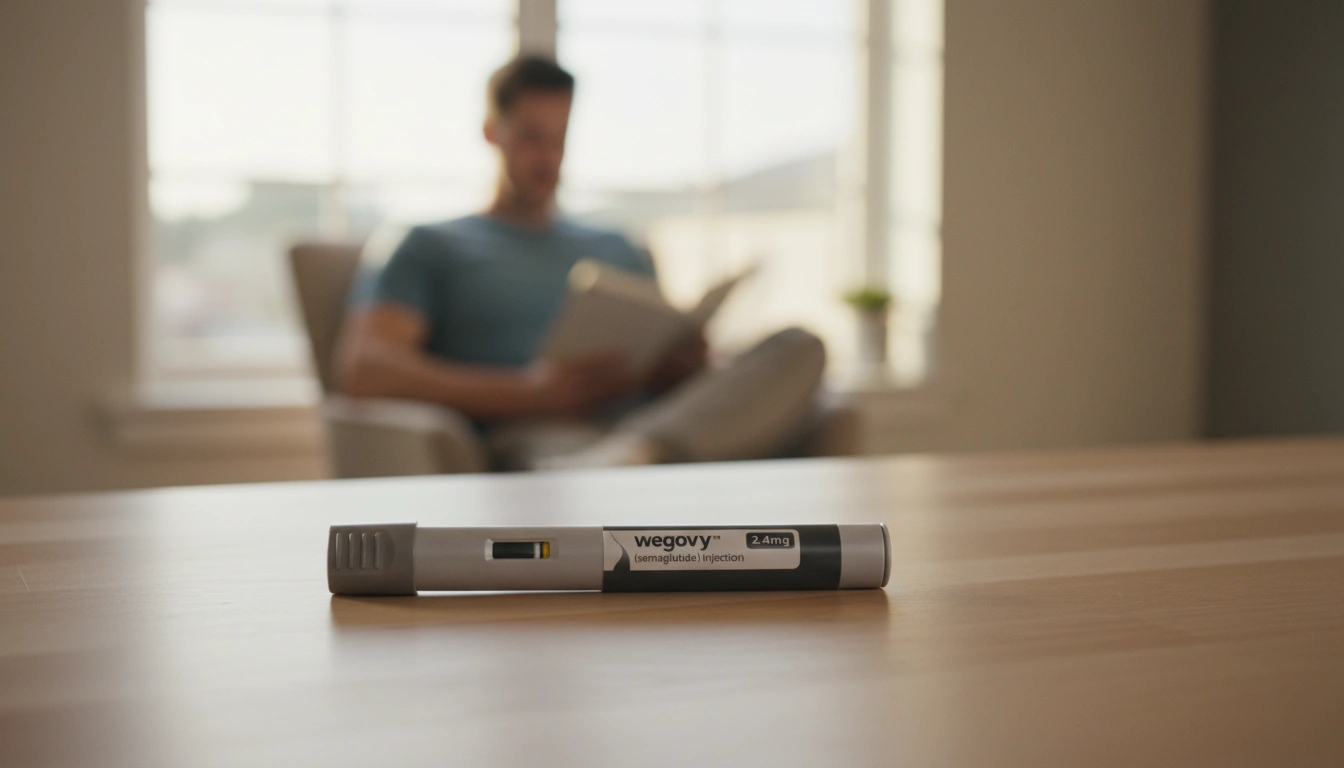
Switching from Ozempic to Wegovy is one of the simplest medication transitions you can make, because both contain the exact same active ingredient: semaglutide. The molecule is identical. What’s different is the FDA-approved indication (Ozempic for type 2 diabetes, Wegovy for weight management), the dosing tiers, and the maximum available dose. Most people switch because Wegovy offers a higher maximum dose (2.4 mg vs. Ozempic’s 2 mg), because their insurance covers Wegovy for weight loss but not Ozempic off-label, or because their provider wants them on the medication that’s specifically indicated for their primary treatment goal.
Here’s how the switch works, what changes, and what stays the same.
Why People Switch from Ozempic to Wegovy
The reasons generally fall into three categories.
The first is reaching Ozempic’s dose ceiling. If you’re on Ozempic 2 mg and still want or need additional appetite suppression and weight loss, Wegovy lets you go to 2.4 mg. That extra 0.4 mg might sound small, but for some patients it provides a meaningful bump in effectiveness, particularly those who responded well to each previous dose increase but still have weight to lose.
The second is insurance alignment. Many insurance plans cover weight loss medications only when prescribed under their approved indication. Ozempic is a diabetes drug. If you don’t have type 2 diabetes and you’re using Ozempic off-label for weight management, your insurer may deny coverage or require extensive prior authorization. Wegovy, being FDA-approved specifically for chronic weight management in adults with obesity or overweight with at least one weight-related condition, may actually be the easier medication to get covered for non-diabetic patients.
The third is clinical preference. Some providers prefer prescribing Wegovy for weight management patients because it’s the indicated medication for that purpose. From a liability and documentation standpoint, prescribing an FDA-approved weight loss drug for weight loss is more straightforward than prescribing a diabetes drug off-label. This matters more for some clinical settings than others, but it’s a factor.
Less commonly, patients switch because of Ozempic supply issues. When certain Ozempic doses are backordered, switching to the equivalent Wegovy dose keeps treatment uninterrupted.
How Ozempic and Wegovy Compare
Since the active ingredient is identical, the pharmacology doesn’t change. Your body processes semaglutide the same way regardless of which pen delivers it. But the packaging and dosing structure differ in ways that matter practically.
Ozempic’s available doses: 0.25 mg, 0.5 mg, 1 mg, and 2 mg. The pen is a multi-dose device where you dial the dose.
Wegovy’s available doses: 0.25 mg, 0.5 mg, 1 mg, 1.7 mg, and 2.4 mg. Each pen is a single-dose, prefilled device.
The notable additions in Wegovy’s lineup are the 1.7 mg and 2.4 mg tiers. That 1.7 mg step is actually useful because it provides a gentler escalation between 1 mg and the highest doses. On Ozempic, jumping from 1 mg to 2 mg is a 100% dose increase, which can cause a significant spike in side effects for some patients. Wegovy’s 1.7 mg step (a 70% increase from 1 mg) followed by 2.4 mg (a 41% increase from 1.7 mg) is a smoother climb.
The injection frequency is the same for both: once weekly, on the same day each week, at any time of day.
How the Transition Works
This is about as simple as medication switches get. You’re not changing molecules, so there’s no adjustment period, no washout, and no need to start over from a low dose.
The standard approach: take your last Ozempic injection as scheduled, then start Wegovy the following week at the equivalent or next-step dose.
Here’s how the doses map:
Ozempic 0.25 mg switches to Wegovy 0.25 mg. Ozempic 0.5 mg switches to Wegovy 0.5 mg. Ozempic 1 mg switches to Wegovy 1 mg. Ozempic 2 mg switches to Wegovy 2.4 mg (stepping up) or Wegovy 1.7 mg (if a more gradual increase is preferred).
That last scenario is the most common one, since many patients switching are doing so specifically to access doses above 2 mg. Your provider will decide whether to go directly to 2.4 mg or step through 1.7 mg first based on how you tolerated Ozempic 2 mg.
Let’s say a patient has been on Ozempic 2 mg for three months. Weight loss has slowed but side effects have been minimal. Their provider switches them to Wegovy 2.4 mg the week after their last Ozempic injection. The transition is seamless because their body is already fully adapted to semaglutide at a high dose.
Compare that to a patient who experienced significant nausea at Ozempic 2 mg. Their provider might move them to Wegovy 1.7 mg first, let them stabilize for four weeks, and then step up to 2.4 mg. More gradual, but less likely to cause intolerable side effects.
What to Expect After Switching
For equivalent-dose switches (Ozempic 1 mg to Wegovy 1 mg, for example), you should notice essentially nothing. Same molecule, same dose, same effect. Your appetite suppression, side effect profile, and weight loss trajectory should remain unchanged.
For dose-increase switches (Ozempic 2 mg to Wegovy 2.4 mg), you may experience effects similar to any other dose increase on semaglutide:
Temporarily increased nausea, particularly during the first week at the higher dose. This usually subsides within one to two weeks as your body adjusts. Slightly stronger appetite suppression, which is typically the goal of the switch. Possible changes in bowel habits (constipation or looser stools) that tend to normalize quickly.
The semaglutide timeline covers how weight loss generally progresses through semaglutide’s dose escalation. If you’re stepping up from 2 mg to 2.4 mg, expect any renewed weight loss to become apparent within two to four weeks at the new dose.
Will You Lose More Weight on Wegovy?
If you’re switching at an equivalent dose, no. Semaglutide is semaglutide. The brand name doesn’t change how the molecule works.
If you’re switching to access the higher 2.4 mg dose, potentially yes. Clinical trial data supports a dose-response relationship with semaglutide. The STEP 1 trial (Wilding et al., NEJM, 2021) demonstrated that semaglutide 2.4 mg produced an average weight loss of 14.9% of body weight over 68 weeks. While there isn’t a direct comparison trial between 2 mg and 2.4 mg specifically, the consistent dose-response pattern across semaglutide studies suggests that the higher dose provides additional benefit for most patients.
The real question isn’t whether 2.4 mg is better than 2 mg on paper. It’s whether that additional 0.4 mg makes a clinically meaningful difference for you specifically. For some patients, it’s the push that breaks a plateau. For others, the difference is marginal. Your provider can help set realistic expectations based on your history and response to semaglutide so far.
If you’ve already maximized on Wegovy 2.4 mg and you’re still plateaued, switching within the semaglutide family won’t help further. At that point, the conversation shifts to either lifestyle optimization or switching medication classes entirely to tirzepatide. The tirzepatide weight loss results show how the dual GIP/GLP-1 mechanism produces additional weight loss beyond what semaglutide achieves alone.
Managing the Practical Details
A few logistical things to keep in mind during the switch.
Prescription coordination: Make sure your Wegovy prescription is filled and ready before your last Ozempic dose. You don’t want a gap in treatment. Even a week or two without medication can lead to appetite rebound and disrupt your momentum.
Injection device differences: Wegovy pens are single-use, prefilled devices. You don’t dial a dose. You just inject the full contents. If you’ve been using Ozempic’s multi-dose pen, the Wegovy pen will feel slightly different in your hand, but the injection technique (subcutaneous, abdomen or thigh, rotate sites) is the same.
Storage: Both medications are stored in the refrigerator before first use. Wegovy pens can be kept at room temperature for up to 28 days after removal from the fridge. Same handling as Ozempic.
Injection day: You can keep the same day of the week you were using for Ozempic. No need to change your schedule.
Cost and Insurance Realities
This is where things get complicated, because coverage varies dramatically by plan.
Wegovy is covered by many commercial insurance plans for weight management, but prior authorization is almost always required. Your provider needs to document that you meet specific criteria, typically a BMI of 30 or higher, or 27 or higher with at least one weight-related comorbidity (hypertension, dyslipidemia, type 2 diabetes, obstructive sleep apnea, etc.).
If your insurance covered Ozempic (for diabetes or off-label for weight loss), it won’t necessarily cover Wegovy, and vice versa. These are processed through different coverage categories. Have your provider’s office run a benefits check before switching to avoid surprise costs.
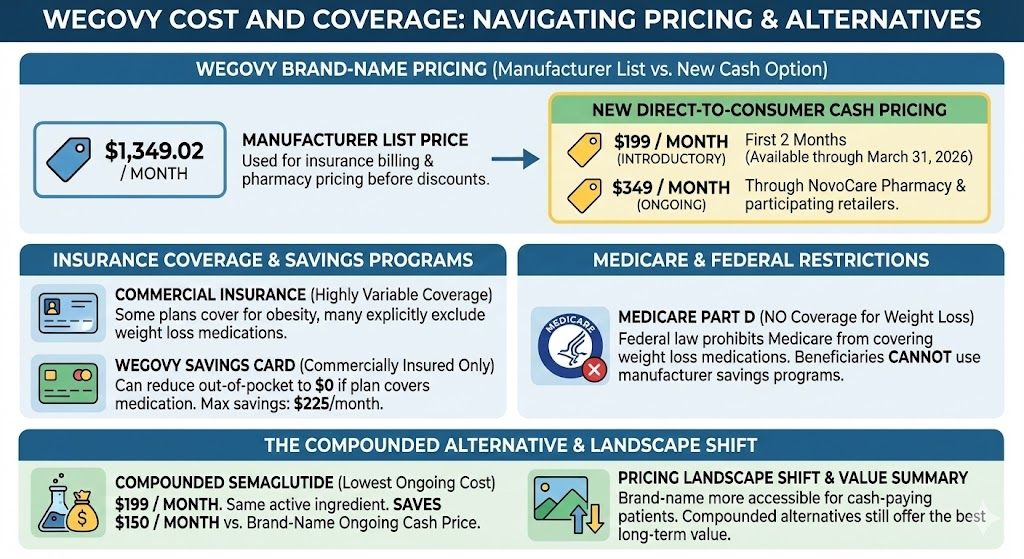
If neither brand option is affordable or covered, compounded semaglutide through TrimRx is an alternative worth considering. It provides the same active ingredient at a fraction of brand pricing, without insurance requirements. The Wegovy weight loss results article covers what semaglutide delivers at its higher doses, which applies equally to compounded formulations.
When Switching Doesn’t Make Sense
There are a few scenarios where staying on Ozempic is the better choice.
If your insurance covers Ozempic but not Wegovy, and you’re getting good results at your current dose, switching would increase your out-of-pocket cost without clear clinical benefit.
If you’re on Ozempic 1 mg or lower and still losing weight, you have dose increases available within Ozempic’s range before needing to consider Wegovy’s higher tiers.
If you’ve plateaued on Ozempic and your plateau is caused by dietary drift, muscle loss, or a medical condition rather than insufficient dosing, switching to Wegovy won’t address the actual problem. Fix the root cause first.
Making the Switch
If switching makes sense for your situation, coordinate with your provider to match your Wegovy dose to your current Ozempic level, verify insurance coverage before filling the new prescription, time the switch so there’s no gap between your last Ozempic injection and first Wegovy injection, and monitor for any changes in appetite or side effects during the first two to three weeks.
If you need provider support for managing this transition, TrimRx offers telehealth consultations with clinicians experienced in semaglutide prescribing. You can start with the intake quiz to get connected with a provider who can help determine the best dose and formulation for your goals.
This information is for educational purposes and is not medical advice. Consult with a healthcare provider before starting any medication. Individual results may vary.

Transforming Lives, One Step at a Time
Keep reading

How Long Can You Take Ozempic for Weight Loss In 2026?
There is no set time limit for taking Ozempic for weight loss. Current medical evidence supports long-term, ongoing use for as long as the…

Ozempic to Mounjaro: Making the Transition
Switching from Ozempic to Mounjaro means moving from a GLP-1 receptor agonist (semaglutide) to a dual GIP/GLP-1 receptor agonist (tirzepatide). Unlike switching between two…
Switching from Ozempic to Mounjaro: What to Expect
Switching from Ozempic to Mounjaro is one of the most common medication transitions in GLP-1 weight loss treatment, and for good reason. Both are…


