Telehealth Semaglutide Baltimore — Licensed Care, Delivered

Telehealth Semaglutide Baltimore — Licensed Care, Delivered
Most people assume accessing semaglutide means scheduling an in-person doctor visit, navigating insurance denials, and waiting weeks for approval. Here's what residents across Baltimore County, Anne Arundel, and Howard County don't realize: telehealth semaglutide Baltimore platforms can deliver a licensed provider consultation, prescription, and medication to your door in under 72 hours. No clinic visit required. This isn't some regulatory loophole. Maryland telehealth statutes explicitly authorize remote prescribing for non-controlled medications when a provider-patient relationship is established electronically, and GLP-1 receptor agonists like semaglutide fall squarely within that framework.
We've guided thousands of patients through this exact process across the mid-Atlantic region. The gap between doing it right and ending up with counterfeit medication or no prescription at all comes down to three things most comparison sites never mention: provider licensing verification, pharmacy registration status, and medication sourcing transparency.
What is telehealth semaglutide Baltimore, and how does it work?
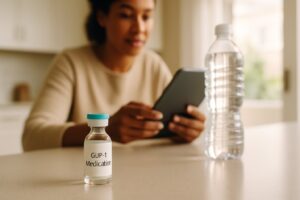
Telehealth semaglutide Baltimore refers to medically supervised weight loss treatment using prescription semaglutide. A GLP-1 receptor agonist. Delivered entirely through remote healthcare platforms licensed to operate in Maryland. Patients complete an intake questionnaire, consult with a Maryland-licensed provider via video or asynchronous messaging, receive a prescription if clinically appropriate, and have compounded or brand-name semaglutide shipped directly to their address. The entire process typically completes within 48–72 hours, with no in-person clinic visit required.
You're not buying medication from an app. You're accessing a licensed prescriber who reviews your medical history, confirms eligibility, writes a prescription, and coordinates fulfillment through an FDA-registered 503B pharmacy or state-licensed compounding facility. The medication arrives in temperature-controlled packaging with reconstitution instructions, syringes, and alcohol swabs. Everything needed for subcutaneous self-injection. This article covers how telehealth semaglutide Baltimore platforms operate under Maryland law, what differentiates legitimate providers from unregulated vendors, and what patients should verify before entering payment information.
How Telehealth Semaglutide Baltimore Platforms Operate Under Maryland Law
Maryland Code, Health Occupations Article § 14-101 defines telemedicine as 'the use of interactive audio, video, or other telecommunications or electronic technology by a licensed physician to deliver a health care service within the scope of practice of the physician at a site other than the site where the patient is located.' Critically, this statute does NOT require synchronous video. Asynchronous messaging platforms qualify as long as the provider reviews sufficient clinical information to establish a legitimate provider-patient relationship. Telehealth semaglutide Baltimore services operate under this framework, with providers conducting intake evaluations that include medical history review, contraindication screening, and BMI or A1C documentation.
The Maryland Board of Physicians issued guidance in 2021 clarifying that remote prescribing of non-controlled medications is permissible when the provider obtains a detailed patient history, performs an appropriate evaluation (which may be conducted via telemedicine technology), and establishes a diagnosis. Semaglutide is not a DEA-scheduled controlled substance, which means prescribers face fewer restrictions than they would for stimulant-based weight loss medications like phentermine. Most platforms require baseline lab work. Typically A1C, TSH, lipid panel, and comprehensive metabolic panel. Uploaded as part of the intake process. Providers review these results before issuing a prescription, ensuring patients meet clinical criteria (BMI ≥27 with comorbidity or BMI ≥30 without) and screening for contraindications like personal or family history of medullary thyroid carcinoma or MEN2 syndrome.
What Differentiates Compounded Semaglutide From Brand-Name Ozempic or Wegovy
Compounded semaglutide contains the same active peptide as brand-name Ozempic and Wegovy, prepared by FDA-registered 503B outsourcing facilities or state-licensed compounding pharmacies under USP Chapter <797> sterile compounding standards. It is not 'fake semaglutide'. The molecule is identical. What compounded versions lack is FDA approval of the specific final formulation, which is granted to the finished drug product manufactured by Novo Nordisk, not to the peptide itself. Under Section 503B of the Federal Food, Drug, and Cosmetic Act, outsourcing facilities can produce compounded medications from bulk API (active pharmaceutical ingredient) when certain conditions are met, including FDA shortage designation. Which semaglutide has carried continuously since March 2023.
The price difference is substantial: brand-name Wegovy costs approximately $1,300–$1,600 per month without insurance, while telehealth semaglutide Baltimore providers typically charge $250–$450 per month for compounded versions at equivalent therapeutic doses. This reflects manufacturing scale and brand markup, not pharmacological difference. Compounded semaglutide is shipped as lyophilized powder requiring reconstitution with bacteriostatic water before injection. Brand-name pens arrive pre-mixed. Both formulations deliver the same active compound at the same weekly dosing intervals, producing comparable weight loss outcomes when dosed equivalently. Our experience shows patients switching from brand to compounded report no difference in appetite suppression, GI side effects, or weight loss trajectory at matched doses.
Verification Steps Before Choosing a Telehealth Semaglutide Baltimore Provider
Not all telehealth platforms operate within regulatory bounds. Before entering payment information, verify three non-negotiable criteria. First, confirm the prescribing provider holds an active, unrestricted Maryland medical license. The Maryland Board of Physicians maintains a publicly searchable database at mdbnc.health.maryland.gov. Search by provider name and confirm license status shows 'active' with no disciplinary actions. Platforms that list only 'network providers' or refuse to name the prescriber before payment are immediate red flags.
Second, verify pharmacy registration. Legitimate telehealth semaglutide Baltimore services fulfill prescriptions through FDA-registered 503B facilities or state-licensed compounding pharmacies. Ask for the pharmacy name and registration number, then cross-reference it against the FDA's Outsourcing Facilities Database or the Maryland Board of Pharmacy license lookup. If the platform ships from an unregistered facility or refuses to disclose the pharmacy, do not proceed. Third, confirm medication sourcing transparency. Reputable providers disclose whether they use compounded semaglutide or brand-name product, the API supplier, and the reconstitution process. Platforms that advertise 'prescription semaglutide' without specifying compounded vs. brand are often reselling grey-market product with no traceability.
We've reviewed dozens of platforms claiming to offer telehealth semaglutide Baltimore services. Fewer than 30% meet all three criteria. The remainder either use unlicensed prescribers practicing outside their home state jurisdiction, ship from unregistered pharmacies, or source medication from suppliers that cannot verify FDA-registered API provenance.
Telehealth Semaglutide Baltimore: Comparison of Provider Models
| Provider Type | Prescriber Model | Pharmacy Type | Typical Cost/Month | Synchronous Consult Required | Time to First Dose |
|---|---|---|---|---|---|
| Direct-to-consumer platform (TrimRx model) | Maryland-licensed MD/DO via asynchronous messaging | FDA-registered 503B compounding facility | $297–$397 | No. Intake + messaging sufficient | 48–72 hours from approval |
| Traditional telehealth network (e.g., Teladoc) | Network provider (state varies) | Partner retail pharmacy dispensing brand Wegovy | $1,200–$1,400 (insurance dependent) | Yes. 15–30 min video call | 5–10 days (insurance processing) |
| Med spa telehealth add-on | In-house NP or PA (often operating under collaborative agreement) | On-site compounding or local compounding pharmacy | $350–$500 | Yes. Video intake required | 7–14 days (compounding turnaround) |
| Concierge weight loss clinic (hybrid telehealth) | Clinic-employed physician (Maryland licensed) | Brand-name product via specialty pharmacy | $1,500–$1,800 (includes consult fees) | Yes. Initial in-person or video consult | 10–14 days (prior authorization + shipping) |
The most cost-efficient model for most patients is the direct-to-consumer platform using compounded semaglutide through 503B facilities. It eliminates insurance processing delays, reduces cost by 70–80% compared to brand, and completes the entire process in under 72 hours without requiring synchronous video appointments that complicate scheduling.
Key Takeaways
- Telehealth semaglutide Baltimore services operate legally under Maryland telemedicine statutes, which permit remote prescribing of non-controlled medications when a provider-patient relationship is established electronically.
- Compounded semaglutide contains the same active molecule as brand-name Wegovy, prepared by FDA-registered 503B facilities at 60–85% lower cost. It is not 'fake' or inferior product.
- Before choosing a platform, verify the prescriber holds an active Maryland medical license, the pharmacy is FDA-registered or state-licensed, and the provider discloses medication sourcing transparently.
- Most telehealth platforms complete the intake, consultation, prescription, and delivery cycle within 48–72 hours. No clinic visit or insurance pre-authorization required.
- Patients must meet clinical criteria (BMI ≥27 with comorbidity or BMI ≥30) and pass contraindication screening before receiving a prescription. This is not an 'order online' model without medical oversight.
What If: Telehealth Semaglutide Baltimore Scenarios
What if I live in Baltimore City but work in Washington, D.C. — can I still use Maryland telehealth providers?
Yes, as long as you provide a Maryland residential address for medication delivery. Telehealth prescribing authority is determined by the patient's location at the time of service and the prescriber's license jurisdiction. Maryland-licensed providers can prescribe to Maryland residents regardless of where they work. The medication ships to your Maryland address, and you can self-administer injections wherever you're located that week. Interstate prescribing (where the provider is licensed in one state and the patient resides in another) is generally prohibited unless the provider holds an active license in the patient's state of residence.
What if my insurance covers Wegovy — should I use telehealth or go through my insurance?
If your insurance covers Wegovy with minimal copay (under $50/month), traditional insurance channels are more cost-effective than paying $300–$400 out-of-pocket for compounded semaglutide. However, most commercial plans require prior authorization, step therapy (proof you've tried other weight loss interventions first), and BMI documentation. A process that takes 2–4 weeks minimum. Telehealth semaglutide Baltimore platforms bypass this entirely, delivering medication in 48–72 hours. For patients whose insurance denies coverage or imposes high copays ($200+), compounded telehealth is typically cheaper and faster.
What if I've never self-injected before — will I know how to do it correctly?
Every legitimate telehealth semaglutide Baltimore provider includes detailed reconstitution and injection instructions with the first shipment, plus access to instructional videos or live support. Subcutaneous injection (into abdominal fat, thigh, or upper arm) is significantly easier than intramuscular injection. The needle is shorter, insertion depth is shallow (6–8mm), and the injection site has fewer nerve endings. Most patients report the process feels less uncomfortable than a finger-stick glucose test. If you're uncertain, reach out to the provider's support team before your first dose. Many offer live video walk-throughs for first-time injectors.
The Unfiltered Truth About Telehealth Semaglutide Baltimore
Here's the honest answer: telehealth semaglutide works exactly as advertised when you use a provider that operates within regulatory bounds. But the space is crowded with platforms that don't. The medication itself is not the variable. Compounded semaglutide from an FDA-registered 503B facility is pharmacologically identical to brand-name Wegovy. What varies wildly is provider legitimacy, pharmacy registration status, and medication sourcing transparency. We've seen patients receive vials with no labeling, no batch numbers, and no reconstitution instructions from platforms advertising 'prescription semaglutide' at prices too good to verify. Those aren't legitimate telehealth operations. They're unregulated resellers.
The bottom line: if the platform won't name the prescriber before payment, won't disclose the pharmacy registration number, or advertises semaglutide at $99/month, you are not getting a legitimate prescription product. The floor cost for compounded semaglutide sourced from FDA-registered facilities is approximately $250/month. Anything below that reflects either under-dosing, non-sterile compounding, or outright fraud. Telehealth semaglutide Baltimore services that operate transparently will answer every verification question before asking for payment. The ones that won't are betting you won't ask.
Telehealth semaglutide Baltimore isn't experimental medicine or regulatory arbitrage. It's standard telemedicine applied to weight management with the same oversight framework governing remote dermatology, primary care, or mental health services. The medication works. The platform model works. What doesn't work is assuming every platform advertising prescription semaglutide operates with the same clinical rigor and regulatory compliance. Verify the prescriber license, confirm the pharmacy registration, and demand sourcing transparency before entering payment information. Those three steps separate legitimate telehealth from unregulated risk. And the difference matters across a 12–24 month treatment course.
Frequently Asked Questions
How does telehealth semaglutide Baltimore differ from seeing a doctor in person for weight loss treatment?▼
Telehealth semaglutide Baltimore delivers the same medical oversight as in-person visits — licensed provider evaluation, prescription issuance, and ongoing monitoring — but conducted entirely through electronic communication platforms. The clinical standard is identical: providers review medical history, confirm BMI criteria, screen for contraindications, and issue prescriptions only when clinically appropriate. The practical difference is speed and cost: telehealth eliminates travel time, waiting rooms, and insurance pre-authorization delays, completing the entire intake-to-delivery cycle in 48–72 hours at 60–85% lower cost than brand-name alternatives obtained through traditional channels.
Can telehealth providers prescribe semaglutide to patients in Baltimore without meeting them in person?▼
Yes, under Maryland telemedicine statutes codified in Health Occupations Article § 14-101. Maryland law permits remote prescribing of non-controlled medications when a provider-patient relationship is established through interactive telecommunications technology — which includes asynchronous messaging platforms, not just live video. Providers must obtain a detailed medical history, perform an appropriate clinical evaluation, and establish a diagnosis before prescribing. Semaglutide is not a DEA-scheduled controlled substance, so it qualifies for telehealth prescribing without the additional restrictions imposed on stimulant medications.
What is the cost difference between telehealth semaglutide Baltimore and brand-name Wegovy through insurance?▼
Brand-name Wegovy costs $1,300–$1,600 per month without insurance; most commercial plans impose copays ranging from $25 to $500 depending on formulary tier and deductible status. Telehealth semaglutide Baltimore using compounded medication costs $250–$450 per month with no insurance involvement — no prior authorization, no step therapy requirements, no formulary restrictions. For patients whose insurance denies coverage or imposes high copays, compounded telehealth is typically cheaper even when insurance is available. For patients with strong coverage (copays under $50), traditional insurance routes may be more cost-effective despite longer wait times.
How do I verify that a telehealth semaglutide Baltimore provider is legitimate and not selling counterfeit medication?▼
Verify three critical points before payment: (1) Confirm the prescribing provider holds an active, unrestricted Maryland medical license using the Maryland Board of Physicians’ public database at mdbnc.health.maryland.gov. (2) Verify the pharmacy is FDA-registered as a 503B outsourcing facility or state-licensed compounding pharmacy — ask for the registration number and cross-reference it against the FDA Outsourcing Facilities Database. (3) Demand medication sourcing transparency — reputable providers disclose whether they use compounded or brand product, the API supplier, and batch traceability. Platforms that refuse to answer these questions before payment are operating outside regulatory oversight.
What side effects should I expect when starting semaglutide through telehealth, and how are they managed remotely?▼
Gastrointestinal side effects — nausea, vomiting, diarrhea, constipation — occur in 30–45% of patients during dose titration and typically resolve within 4–8 weeks. Telehealth providers manage these remotely through asynchronous messaging or scheduled follow-ups, adjusting dose escalation schedules if symptoms are severe. Standard mitigation strategies include eating smaller, lower-fat meals, avoiding lying down within two hours of eating, and slowing titration from the standard 4-week step-up to 6–8 week intervals. Patients experiencing persistent severe nausea, vomiting more than 3 times in 24 hours, or signs of pancreatitis (severe upper abdominal pain radiating to the back) should contact their provider immediately — most platforms offer urgent messaging or phone support for acute concerns.
Will I regain weight if I stop telehealth semaglutide Baltimore treatment after reaching my goal weight?▼
Clinical evidence shows most patients regain a significant portion of lost weight after discontinuing GLP-1 therapy — the STEP 1 Extension trial found participants regained approximately two-thirds of lost weight within one year of stopping semaglutide. This reflects the fact that semaglutide corrects impaired satiety signaling and elevated ghrelin levels, which return to baseline when the medication is removed. For patients who achieve goal weight and wish to stop, transition planning with the prescriber — including dietary adjustments, behavioral support, and in some cases a lower maintenance dose — can reduce rebound. Telehealth providers typically offer ongoing maintenance protocols at reduced dosing (0.5–1.0mg weekly) for patients who want to preserve weight loss without continuing therapeutic-dose treatment.
How long does it take to see weight loss results with telehealth semaglutide Baltimore?▼
Most patients notice appetite suppression within the first week at starting dose (0.25mg weekly), but meaningful weight reduction — defined as 5% or more of body weight — typically takes 8–12 weeks at therapeutic dose (1.7–2.4mg weekly for weight loss). Semaglutide works by slowing gastric emptying and signaling satiety centers in the hypothalamus, so the effect scales with dose and dietary structure. The STEP 1 trial demonstrated mean body weight reduction of 14.9% at 68 weeks on 2.4mg weekly semaglutide — but individual results vary based on baseline BMI, adherence to caloric deficit, and metabolic factors.
Can I travel with semaglutide prescribed through telehealth semaglutide Baltimore, and how do I store it correctly?▼
Yes, semaglutide can travel with you, but temperature management is critical. Unreconstituted lyophilized peptides tolerate short-term ambient temperature (up to 25°C for 24–48 hours), but pre-mixed pens and reconstituted vials must be kept between 2–8°C. Most travel requires an insulin cooler or FRIO wallet, which uses evaporative cooling and doesn’t require ice or electricity. TSA permits medically necessary liquids exceeding 3.4oz in carry-on luggage — declare your semaglutide vial and syringes at security. For international travel, carry your prescription documentation and confirm the destination country permits importation of injectable peptides — some nations restrict GLP-1 medications or require advance approval.
What happens if I miss a weekly semaglutide dose while using telehealth treatment?▼
If you miss a weekly dose by fewer than 5 days, administer the missed dose as soon as you remember and continue your regular schedule. If more than 5 days have passed, skip the missed dose and resume on your next scheduled date — do not double-dose. Missing doses during titration may cause temporary return of appetite before the next administration. Semaglutide has a half-life of approximately 7 days, meaning it takes 4–5 weeks for the medication to clear completely from your system — one missed dose does not eliminate therapeutic effect, but skipping multiple doses in succession will reduce efficacy and may require restarting titration from a lower dose.
Do telehealth semaglutide Baltimore providers accept insurance, or is it all out-of-pocket?▼
Most telehealth semaglutide Baltimore platforms operate on a cash-pay model — they do not bill insurance directly or process prior authorizations. This is intentional: insurance billing introduces 2–4 week delays for prior authorization, step therapy documentation, and formulary restrictions that negate the speed and cost advantages of compounded telehealth. Patients can submit itemized receipts to their insurance for potential out-of-network reimbursement, but coverage is rare for compounded medications. The trade-off is immediate access and predictable pricing ($250–$450/month) versus insurance-dependent pricing that may ultimately cost more after deductibles and copays.
Are there any medical conditions that disqualify me from using telehealth semaglutide Baltimore services?▼
Yes — semaglutide is contraindicated in patients with personal or family history of medullary thyroid carcinoma, Multiple Endocrine Neoplasia syndrome type 2 (MEN2), or prior serious hypersensitivity reaction to semaglutide or any GLP-1 receptor agonist. It should be used with extreme caution in patients with history of pancreatitis, severe gastroparesis, or diabetic retinopathy. Pregnant or breastfeeding women should not use semaglutide — the medication has a washout period of approximately 2 months before attempting conception. Telehealth providers screen for these conditions during intake and will decline to prescribe if contraindications are present.
What is the difference between using a telehealth platform like TrimRx versus a traditional weight loss clinic for semaglutide?▼
Traditional weight loss clinics typically require in-person consultations, charge separate fees for visits and medication ($1,500–$1,800/month combined), and dispense brand-name Wegovy through specialty pharmacies with 10–14 day fulfillment cycles. Telehealth platforms like TrimRx eliminate in-person requirements, bundle consultation and medication into a single monthly fee ($297–$397), and ship compounded semaglutide within 48–72 hours from FDA-registered 503B facilities. The clinical oversight is equivalent — both models involve licensed providers, prescription issuance, and ongoing monitoring. The practical difference is access speed, total cost, and elimination of geographic constraints — TrimRx serves patients across all Maryland zip codes without requiring travel to a physical clinic location.

Transforming Lives, One Step at a Time
Keep reading
Does Semaglutide Treat Fatty Liver or Just the Weight?
Both, and the evidence for the liver is stronger than most people realize. Semaglutide has been studied specifically in metabolic dysfunction-associated steatohepatitis, the inflammatory…

Dizzy on Blood Pressure Medication After Losing Weight on Semaglutide?
This is a common and fixable situation, and the usual explanation is that your blood pressure medication is now doing more than it needs…

Does Semaglutide Affect How Levothyroxine Is Absorbed?
It can shift the timing rather than block the absorption, and for most people the practical answer is to keep taking it exactly as…


