Wegovy Maintenance: Sustaining Your Results

Wegovy maintenance means staying on the medication at a dose that keeps your weight stable after you’ve finished the active loss phase. For most people, that’s the full 2.4 mg weekly dose, though some providers explore whether a slightly lower dose can do the job. The key takeaway from every major semaglutide trial is simple: continued treatment is what separates people who keep the weight off from people who regain it.
If you’ve spent months working through Wegovy’s dose escalation, watching the scale move, and feeling your relationship with food shift, the last thing you want is to lose that progress. Maintenance is the plan that protects it. And unlike the active weight loss phase, where everything feels new and intense, maintenance is quieter. It’s the long, steady phase where the real payoff of treatment accumulates.
How Wegovy’s Dosing Schedule Sets Up Maintenance
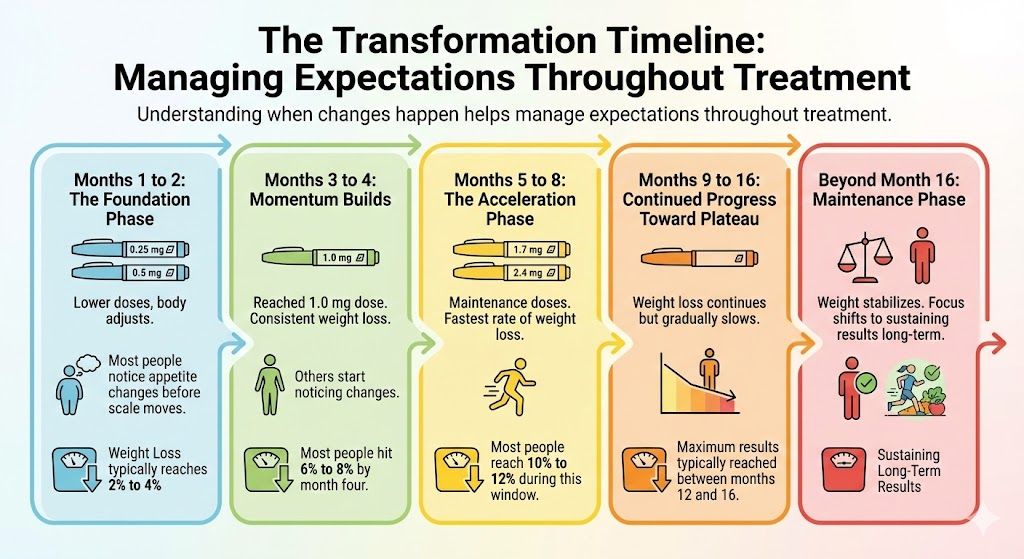
Wegovy follows a fixed escalation path. You start at 0.25 mg for four weeks, then move through 0.5 mg, 1.0 mg, and 1.7 mg before reaching the target dose of 2.4 mg. Each step lasts four weeks. By week 17, you’re at the full dose, and that’s where the FDA labeling expects you to stay.
Unlike tirzepatide, which has multiple dose options at the higher end (7.5 mg through 15 mg), Wegovy has a single target dose. There’s no 3.0 mg or 3.4 mg option to step up to if 2.4 mg isn’t enough, and there’s no officially designated “maintenance dose” below 2.4 mg.
That said, clinical practice doesn’t always follow the label to the letter. Some providers do experiment with lower maintenance doses, particularly 1.7 mg, for patients whose weight has been stable for several months and who want to reduce side effects or cost. This is off-label but not uncommon. The Wegovy weight loss results data comes from trials conducted at the 2.4 mg dose, so stepping below that means you’re in less charted territory.
What the Trials Tell Us About Staying On
The STEP 1 trial ran for 68 weeks with participants on semaglutide 2.4 mg. Average weight loss was about 15% of body weight. Then came the extension study, which tracked what happened after participants stopped the medication. The results, published by Wilding et al. in Diabetes, Obesity and Metabolism (2022), showed that participants regained roughly two-thirds of their lost weight within a year of stopping.
The STEP 5 trial provides the more encouraging long-term picture. This study kept participants on semaglutide 2.4 mg for a full two years without interruption. Weight loss continued through approximately week 60 before plateauing, and participants maintained an average loss of about 15% through the end of the study at 104 weeks.
Two things stand out from STEP 5. First, the weight loss plateau around week 60 is normal and expected. Your body reaches a new equilibrium where the medication’s appetite-suppressing effects balance against your body’s adaptive responses. Second, the fact that weight remained stable from week 60 through week 104 shows that maintenance on 2.4 mg works. The medication kept doing its job for the full two years.
These findings make a strong case that staying on Wegovy at the prescribed dose produces sustained results. The medication doesn’t stop working over time. It simply shifts from driving weight loss to maintaining it.
The Practical Side of Wegovy Maintenance
Living on Wegovy long-term feels different from the early months. Here’s what most people describe once they’ve settled into maintenance.
Side effects calm down significantly. The nausea that was your constant companion during dose escalation is usually gone or minimal. GI issues like constipation or sulfur burps tend to fade once your body fully adapts to the 2.4 mg dose. Most long-term users report that the medication feels like background noise rather than something that actively disrupts their day.
Your appetite finds a new normal. During active weight loss, appetite suppression can feel dramatic. Food becomes almost uninteresting. During maintenance, many people describe a more balanced experience. You have an appetite, but it’s manageable. Portions feel naturally smaller. The intense cravings that used to drive overeating are muted. This is the medication working exactly as intended for the long term.
Your weight will fluctuate, and that’s okay. A two to five pound range of fluctuation is completely normal during maintenance. Water retention, hormonal cycles, sodium intake, and dozens of other variables cause day-to-day and week-to-week shifts. The trend line is what matters, not any single weigh-in.
Can You Maintain on a Lower Dose?
This is one of the most common questions people ask once they’ve been stable for a while. The logic makes sense: if 2.4 mg got you here, maybe 1.7 mg can keep you here, with fewer side effects and potentially lower cost.
Some providers are willing to try this approach, and some patients do maintain successfully on 1.7 mg. But it’s important to go in with realistic expectations.
Let’s say a patient has been at her goal weight on 2.4 mg for four months. Her provider steps her down to 1.7 mg. For the first few weeks, nothing changes. Then around week six, she notices her appetite creeping back. She’s thinking about food more often. Portions start growing. By week ten, she’s gained four pounds.
At that point, the decision is clear: go back to 2.4 mg. And that’s a perfectly fine outcome. The trial period answered the question. Not every experiment works, and now she knows what her body needs.
Other patients step down and genuinely do fine at 1.7 mg or even 1.0 mg. The only way to find out is to try, with close monitoring and a willingness to adjust. If your provider suggests a step-down trial, give it at least eight to twelve weeks before drawing conclusions. Short-term stability doesn’t always predict long-term maintenance.
For patients who want to explore whether compounded semaglutide offers more dosing flexibility at a lower cost, TrimRx’s semaglutide options provide a range of doses that can be tailored to your maintenance needs.
Maintenance Beyond the Medication
Wegovy handles the hardest part of maintenance, keeping your appetite regulated so you’re not constantly fighting biological hunger signals. But the medication works best when it’s part of a broader approach.
Protein intake matters more during maintenance than most people realize. Adequate protein (roughly 0.7 to 1.0 grams per pound of goal body weight) helps preserve lean muscle mass, which supports your metabolic rate. On a GLP-1 medication that reduces overall food intake, making sure enough of what you eat is protein-rich takes intentional planning.
Resistance training is the other piece that pays outsized dividends during maintenance. Ozempic face and the general loss of facial and body volume that some people experience with significant weight loss is partially a muscle mass issue. Strength training two to three times per week helps maintain the muscle that gives your body its shape and keeps your metabolism from slowing more than necessary.
Sleep and stress management round out the picture. Poor sleep increases ghrelin (your hunger hormone) and decreases leptin (your satiety hormone), which can partially counteract the medication’s effects. Chronic stress does something similar through cortisol. Neither will completely override Wegovy, but both can make maintenance harder than it needs to be.
The Cost Question for Long-Term Use
Wegovy’s list price is over $1,300 per month without insurance. If you have coverage, your out-of-pocket cost depends on your plan, but prior authorizations and step therapy requirements can create hurdles even for covered patients. And insurance coverage for weight management medications remains inconsistent across plans and employers.
For long-term, potentially indefinite use, cost predictability matters. Some patients find that their insurance covers the first year but then requires reauthorization or drops coverage entirely. Others face formulary changes that shift Wegovy to a higher cost tier.
This is one reason many patients explore compounded semaglutide for maintenance. Through telehealth providers like TrimRx, compounded semaglutide offers a more affordable and consistent monthly cost without the insurance uncertainty. The medication is the same active ingredient at a fraction of the brand-name price. For someone planning years of treatment, the savings add up substantially.
When to Reconsider Your Maintenance Plan
Maintenance isn’t set-it-and-forget-it. Certain life events should trigger a conversation with your provider about whether your current plan still fits.
Significant life changes like menopause, major surgery, prolonged illness, or a shift in activity level can all affect how your body responds to semaglutide. If you notice your weight trending upward over several weeks despite no changes in your eating or movement patterns, that’s a signal to check in rather than white-knuckle through it.
If you’re considering switching to a different medication for cost or access reasons, your provider can help you make that transition without losing ground. Switching between semaglutide formulations is generally straightforward. Switching to a different drug class, like tirzepatide, involves more planning but can be a smart move for patients who want to try a dual-action approach.
The goal of maintenance is to make sustained weight management feel sustainable. Not effortless, but manageable. Not temporary, but built into your life the way any ongoing health treatment would be.
If you’re ready to explore your maintenance options or want to discuss a long-term plan with a provider, take the intake quiz to get started with TrimRx.
This information is for educational purposes and is not medical advice. Consult with a healthcare provider before starting any medication. Individual results may vary.

Transforming Lives, One Step at a Time
Keep reading

Wegovy Results at 6 Months: What the Data Shows
Six months into Wegovy is when the medication starts showing its full potential. By this point most patients have reached or are approaching the…

Wegovy Results at 3 Months: A Realistic Progress Check
Three months into Wegovy, you’re at a turning point. The early adjustment phase is behind you, the dose escalation is well underway, and your…

How to Get Wegovy Online: Step-by-Step
The process of getting Wegovy used to mean scheduling an in-person appointment with a physician, waiting weeks for availability, and then navigating pharmacy stock…


