What Exercise Protocols Help Arthritis? Evidence-Based Guide
Introduction
Exercise is the most effective non-surgical treatment for osteoarthritis. Not the most popular, not the easiest to sell, but the one with the largest and most consistent evidence base. Every credible OA guideline (ACR, OARSI, NICE, EULAR) puts it at the top. The hard part is doing it when your joint hurts.
At TrimRx, we believe that understanding your options is the first step toward a more manageable health journey, and you can take the free assessment quiz if you’re ready to see whether a personalized program is a fit for you.
Why Exercise Helps Damaged Joints
It seems counterintuitive. If your knee hurts, why move it more? Three reasons. First, cartilage is nourished by movement. Joint fluid circulates with motion, delivering nutrients that diffusion alone can’t supply. Second, the muscles around the joint absorb load. A strong quad spares the knee. A weak one passes everything to the cartilage. Third, exercise reduces systemic inflammation and improves pain modulation through central mechanisms.
Quick Answer: The IDEA trial (Messier 2013, JAMA) showed exercise plus 10% weight loss produced a 51% reduction in WOMAC pain, much greater than either alone.
The IDEA trial settled the case for combining diet and exercise. 454 overweight adults with knee OA were randomized to diet alone, exercise alone, or diet plus exercise for 18 months. Pain reductions: 28% diet, 19% exercise, 51% combined. Function and 6-minute walk distance also favored the combined group.
What you shouldn’t do is rest. Bed rest accelerates muscle loss and worsens stiffness. The mantra is “motion is lotion.”
Strength Training: The Foundation
Quad strength predicts knee OA outcomes better than almost any other variable. Weak quads correlate with cartilage loss, pain, and functional decline. Building them takes weeks of consistent work.
A 2020 Cochrane review (Goh et al.) of 32 RCTs found progressive resistance training reduced WOMAC pain by 6.6 points (0 to 100 scale) and improved function by 9.0 points. Effects were durable at 12-month follow-up.
For knee OA, the priority muscles are quads, glutes (especially gluteus medius), calves, and hamstrings. For hip OA, glutes and core. For hand OA, intrinsic hand muscles and forearm.
A starting protocol for knee OA: 2 to 3 days per week, 6 to 8 exercises, 2 to 3 sets of 10 to 15 reps. Examples include partial squats to a chair, step-ups, leg press, hamstring curls, calf raises, and side-lying hip abduction. Load should feel challenging by the last few reps but not painful.
Don’t skip lower-body strength because squats look scary. The literature is clear that load tolerance improves with progressive loading, not by avoiding it. Pain that settles within 24 hours after exercise is fine. Pain lasting longer means you went too hard.
Aerobic Exercise
Moderate aerobic activity reduces pain, improves cardiovascular health, and supports weight loss. The dose target is 150 minutes per week, the same as general health guidelines.
For knee OA, cycling is ideal. The pedaling motion loads the knee gently and builds quad strength. Start with 10 to 15 minutes at low resistance and build. Stationary or recumbent bikes work for most people. Outdoor cycling adds balance demands.
Walking is fine for most knee and hip OA, especially earlier-stage disease. The White 2014 study (Arthritis Care & Research) found that walking 6,000 steps per day was the inflection point for protecting against functional decline in knee OA. Aim for that as a floor.
Elliptical machines, swimming, and rowing are also low-impact options. Running is debated. Recreational running (under 20 to 30 miles per week) doesn’t increase OA risk in cohort studies and may be protective. Competitive volume running is different. If you run with knee OA, monitor symptoms carefully and back off if pain lingers.
Aquatic Exercise
Water reduces effective body weight to about 50% at waist depth and 25% at chest depth, easing joint load. Aquatic programs work well for people who can’t tolerate land-based exercise yet.
A 2016 Cochrane review (Bartels et al.) of 13 RCTs found aquatic exercise produced small to moderate reductions in pain and improvements in function, with high adherence rates. Effect sizes were similar to land-based exercise but with less pain during the session.
A typical aquatic program is 2 to 3 sessions per week of 45 to 60 minutes, including warm-up, aerobic work (water walking, jogging in deeper water), strength (water resistance with foam dumbbells), and cool-down. Many YMCAs and community pools run dedicated arthritis programs.
After 8 to 12 weeks of aquatic work, transitioning to land-based exercise often becomes possible. Use water as a starting point, not a permanent substitute, when you can.
Tai Chi and Mind-body Practices
Tai chi is the only mind-body practice with a strong recommendation in ACR 2019 guidelines. Multiple RCTs (Wang 2009, 2016) showed 12-week tai chi programs produced WOMAC pain reductions comparable to standard physical therapy in knee OA, with bonus benefits for balance, depression, and sleep.
Yoga has weaker but growing evidence. Modified poses help with hip and back OA. Avoid deep knee flexion poses if your knees flare.
Pilates can build core and hip strength gently. The mat-based version is more accessible than reformer work.
Flexibility and Range of Motion
Daily range-of-motion work prevents stiffness and contractures. For knee OA, that means active flexion and extension to your available range, calf and hamstring stretches, and hip mobility work.
5 to 10 minutes daily is enough. You don’t need long stretching routines. Gains in range of motion translate to better gait and easier daily tasks.
Weekly Programs by Joint
Knee OA Weekly Plan
Monday: 30 min cycling + 20 min lower-body strength (squats, step-ups, hamstring curls, calf raises, hip abduction).
Tuesday: 30 min walking + 10 min flexibility/mobility.
Wednesday: 45 min aquatic exercise or tai chi class.
Thursday: 30 min cycling + 20 min lower-body strength.
Friday: 30 min walking + 10 min flexibility.
Saturday: Active recovery, gentle stretching, or recreational activity you enjoy.
Sunday: Rest or light walking.
Hip OA Weekly Plan
Monday: 30 min stationary bike + glute and core strength (bridges, side-lying abduction, clamshells, planks).
Tuesday: 30 min walking + hip flexibility (90/90 stretches, figure-4, hip flexor stretch).
Wednesday: Aquatic or yoga class.
Thursday: 30 min bike + glute and core strength.
Friday: 30 min walking + flexibility.
Saturday: Recreational activity.
Sunday: Rest.
Hand OA Weekly Plan
Daily: 5 to 10 minutes of grip and finger exercises with putty or a stress ball, finger range of motion, thumb opposition. Splint use during aggravating tasks.
Plus aerobic and lower-body work as tolerated. Hand OA doesn’t excuse you from the rest of the program.
What to Do During a Flare
Don’t stop entirely. Reduce intensity, shift to less aggravating modalities, and keep moving. Aquatic exercise, gentle range of motion, and upper-body work can continue when knee or hip flares limit weight-bearing.
Use ice for acute swelling, heat for stiffness. NSAIDs (topical first) for a few days as needed. Most flares settle in 3 to 7 days. If pain persists beyond 2 weeks at significantly worse than baseline, see your clinician.
Key Takeaway: Aquatic exercise reduces pain and improves function with effect sizes similar to land-based work, with less pain during exercise (Bartels 2016 Cochrane).
Common Mistakes
Going too hard too fast. The biggest single error. Build over weeks, not days. Soreness is fine, sharp or worsening pain is a stop signal.
Skipping the warm-up. 5 minutes of low-intensity movement before harder work matters more for arthritic joints than for younger ones.
Avoiding strength training. The most evidence-based modality is the one most people skip. Quad strength is non-negotiable for knee OA.
Stopping when pain improves. Detraining loses gains in 4 to 6 weeks. Maintenance is forever.
Specific Exercise Progressions for Knee OA
Week 1 to 2: foundation. Quad sets (isometric quad contraction lying down), straight leg raises, seated knee extensions to comfortable range, glute bridges, calf raises. 1 set of 10 reps each, daily or every other day.
Week 3 to 4: add load. Wall squats to a chair (partial range), step-ups onto a 4 to 6 inch step, side-lying hip abduction with light ankle weight, hamstring curls (machine or resistance band). 2 sets of 10 to 12 reps, 2 to 3 days/week.
Week 5 to 8: progress depth and load. Squats to a higher chair with light dumbbells, step-ups onto 8 to 10 inch step, leg press at moderate load, single-leg balance with eyes closed. 2 to 3 sets of 10 to 15 reps.
Week 9 to 12: build durability. Loaded squats to comfortable depth, lateral lunges, deadlifts with light to moderate load, hip thrusts. 3 sets of 8 to 12 reps, 2 days/week strength + 2 to 3 days/week aerobic.
Beyond week 12: maintenance. The Bickel 2011 study showed 1 to 2 sessions per week maintain 90% of strength gains over 32 weeks. Most people need fewer sessions to maintain than to build.
Common Form Errors to Fix
Knees caving in during squats: weak glute medius. Add side-lying clamshells, single-leg glute bridges, lateral band walks.
Heels lifting in squats: tight calves or limited ankle dorsiflexion. Add calf stretches and ankle mobility work. Squat to a higher target if needed.
Lower back rounding in deadlifts or hip hinges: weak core or limited hip mobility. Reduce range, build core strength with dead bugs and bird dogs first.
Knee-only motion in step-ups (no hip drive): cue “push the floor away with your whole leg” and keep weight on the working heel.
Form matters more for OA than for younger lifters. Sloppy form converts a knee-friendly exercise into a knee-irritating one.
Exercise Dose for Weight Management
OA-related exercise has two roles: protect joints and support weight management. The doses differ.
For joint protection alone: 150 minutes/week moderate aerobic + 2 days strength is enough.
For weight loss: 200 to 300 minutes/week aerobic combined with calorie deficit. The Look AHEAD trial used 175 minutes/week aerobic plus structured diet to produce 8 to 9% weight loss in obese adults with type 2 diabetes.
For weight maintenance after loss: 200 to 300 minutes/week, per the National Weight Control Registry data.
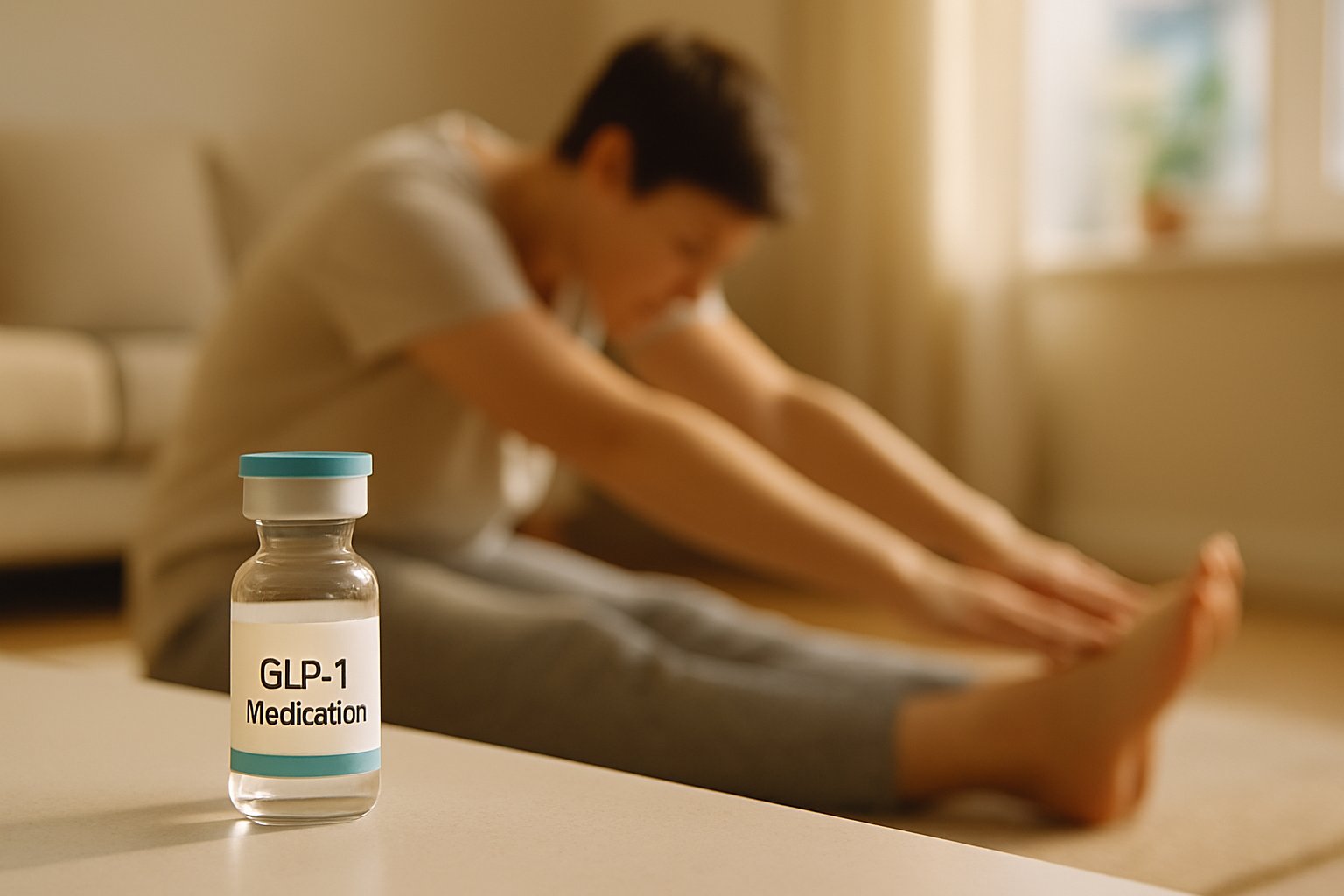
If you’re using GLP-1 medications, exercise needs don’t decrease. Resistance training becomes more important to preserve muscle mass during rapid weight loss, since rapid loss without resistance work takes 25 to 35% from lean mass instead of fat.
Getting Started When You’ve Been Sedentary
If you haven’t exercised in years, “150 minutes a week” sounds impossible. Start with 5 minutes daily of walking. Add 1 minute per week. By month 3 you’re at 20 to 25 minutes daily, near the target.
For strength, start with bodyweight movements: chair stands (sit-to-stand), wall pushups, calf raises, glute bridges. 1 set of 5 to 8 reps daily. Progress slowly. The first 4 to 6 weeks build neuromuscular coordination as much as strength.
A few sessions with a physical therapist front-loads the learning curve. Insurance covers PT with a referral in most plans. 6 to 8 sessions is usually enough to learn safe form and a home program.
Comparison of Exercise Modalities for Knee OA
| Modality | Pain reduction (WOMAC) | Joint loading | Best for |
|---|---|---|---|
| Progressive resistance | 6.6 pts (Goh 2020) | Variable | Building protective muscle |
| Aerobic walking | 5 to 7 pts | Moderate | Endurance, weight management |
| Cycling | 5 to 7 pts | Low | Knee-friendly cardio |
| Aquatic exercise | 5 to 8 pts | Very low | Severe OA, flares, arthritis-related fear |
| Tai chi | 6 to 9 pts | Low | Balance, comorbid anxiety/depression |
| Yoga | Modest | Variable | Flexibility, stress reduction |
Myth vs. Fact: Setting the Record Straight
Misconceptions about treatment can delay good decisions. Here are three worth correcting before you make any choices about your care.
Myth: Osteoarthritis means your cartilage is shot and surgery is the only fix. Fact: Most patients improve significantly with weight loss and exercise. The IDEA trial showed weight loss + exercise produced better outcomes than either alone. Joint replacement is for end-stage cases that fail conservative therapy.
Myth: GLP-1 medications can’t help joint pain. Fact: The STEP 9 trial (2024) showed semaglutide reduced WOMAC pain scores by 41.7 points in obese patients with knee OA, comparable to the effect size of NSAIDs. The mechanism is weight loss plus anti-inflammatory effects.
Myth: Glucosamine and chondroitin will fix your knees. Fact: The GAIT trial showed glucosamine and chondroitin produced no statistically significant pain reduction beyond placebo in most patients. Save the money. Weight loss and exercise have far stronger evidence.
The Path Forward with TrimRx
Managing your metabolic health shouldn’t be a journey you take alone. The science behind GLP-1 medications offers a new level of hope for people facing arthritis and the related challenges that come with it. By addressing root hormonal and metabolic causes, these treatments provide a path toward more stable energy, better cardiovascular health, and improved quality of life.
At TrimRx, we’re committed to providing an empathetic and transparent experience. We understand the frustrations of traditional healthcare: the long waits, the unclear costs, and the lack of personalized care. Our platform is designed to put you back in control of your health. By combining clinical expertise with modern technology, we help you access the treatments you need while providing the 24/7 support you deserve.
Our program includes:
- Doctor consultations: professional guidance without the in-person waiting room
- Lab work coordination: baseline health markers monitored properly
- Ongoing support: 24/7 access to specialists for dosage changes and side effect management
- Reliable medication access: FDA-registered, inspected compounding pharmacies prepare Compounded Semaglutide or Compounded Tirzepatide when branded medications aren’t the right fit
Sustainable health is about more than a number on a scale or a single lab result. It’s about feeling empowered in your own body. Whether you’re starting to research your options or ready to take the next step with a free assessment, we’re here to guide you with science-backed, personalized care.
Bottom line: TrimRx provides a streamlined, medically supervised path to access the latest advancements in arthritis and weight management, all from the comfort of home.
FAQ
How Long Until Exercise Reduces My Pain?
Most trials show meaningful improvement by 8 to 12 weeks. Strength gains take 4 to 6 weeks to show on tests. Pain reduction often parallels strength gains. Don’t quit at week 3.
Should I Exercise Through Pain?
Mild discomfort during and after exercise is fine if it settles within 24 hours. Sharp pain, swelling, or worsening pain over days means too much. Adjust the load or modality.
Is Running Bad for My Knees?
Recreational running (under 20 to 30 miles per week) doesn’t raise OA risk in cohort studies. Competitive high-volume running may. If you have knee OA and want to run, start with run-walk intervals on softer surfaces and monitor.
Do I Need a Personal Trainer or Physical Therapist?
A few sessions with a PT to learn proper form is valuable, especially if you’ve never done resistance training. Trainers can work too if they have arthritis experience. After 6 to 8 sessions, most people can self-manage with check-ins as needed.
What About CrossFit or HIIT with OA?
Possible but selective. Olympic lifts, deep loaded squats, and box jumps are usually too much for arthritic knees. Modified workouts with lower impact and partial range can work. Find a coach willing to scale.
Can Exercise Repair My Cartilage?
No. Cartilage doesn’t regenerate. Exercise prevents loss, reduces pain, builds protective muscle, and improves function, but it doesn’t regrow what’s gone.
How Many Sets and Reps for OA Strength Training?
Start with 1 to 2 sets of 10 to 15 reps per exercise, 2 to 3 days per week. Progress to 2 to 3 sets over 4 to 6 weeks as tolerance builds. Loads should feel challenging by the last few reps but not painful. The Goh 2020 Cochrane review (32 RCTs) supports this dose for knee OA, with effect sizes of 6.6 points WOMAC pain reduction.
Is Yoga Safe with Knee or Hip OA?
Mostly yes with modifications. Avoid deep knee flexion poses (full lotus, child’s pose with knees folded tight, deep squats) if those flare your symptoms. Hip-friendly variations of pigeon, warrior, and lunges work for most. A 2018 RCT (Cheung, Rheumatology) found a 12-week chair yoga program reduced WOMAC pain 8 points more than wait-list control in older adults with knee OA.
What About Pilates for Back and Hip OA?
Reasonable evidence for chronic low back pain and growing data for hip OA. A 2019 meta-analysis (Eliks, Disability and Rehabilitation) of 8 RCTs found mat Pilates reduced low back pain comparable to general exercise. Reformer Pilates costs more but offers spring-loaded resistance that some patients find joint-friendly.
Disclaimer: This content is for informational purposes only and does not constitute medical advice. It is not intended to diagnose, treat, cure, or prevent any disease or condition. Individual results may vary. Always consult a qualified healthcare professional before starting any weight loss program or medication.

Transforming Lives, One Step at a Time
Keep reading
Wegovy Prior Authorization Approved, Then Reversed: What Happens Now
Getting an approval and then losing it is worse than never being approved, and not only because of the medication. You made a plan…

Can the Wegovy Pill Hold the Weight You Lost on Semaglutide Injections?
Most likely yes, once you reach the maintenance dose. The risk is not the destination but the trip: switching means restarting titration on the…

Wegovy Alternatives: What Else Works for Weight Loss
If Wegovy isn’t working out, the strongest alternative is tirzepatide (Zepbound), which tends to produce more weight loss, followed by other GLP-1 options and…


