What Happens If You Stop Taking Mounjaro?
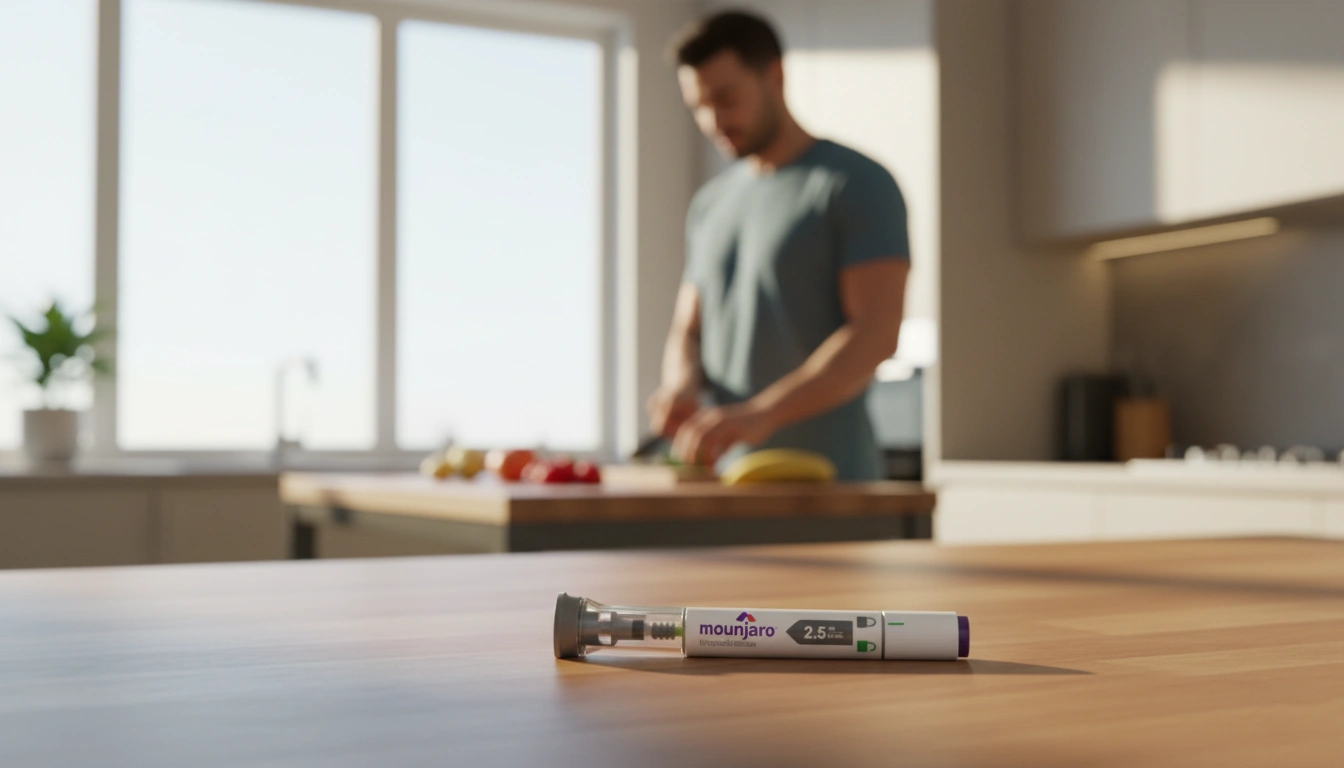
If you stop taking Mounjaro, your appetite will return to its pre-medication baseline within a few weeks, and most people regain a substantial portion of their lost weight over the following six to twelve months. The dual-action appetite suppression that tirzepatide provides through both GLP-1 and GIP receptors stops working once the drug clears your system. Clinical trial data confirms this pattern consistently, and understanding what to expect can help you make an informed decision about whether stopping is the right move.
This doesn’t mean stopping is never appropriate. There are legitimate reasons to discontinue, from pregnancy planning to intolerable side effects. But if you’re considering stopping because you’ve hit your goal and feel like you no longer need the medication, the evidence suggests that’s the scenario most likely to lead to regain.
How Quickly Mounjaro Leaves Your System
Tirzepatide has a half-life of about five days, which is slightly shorter than semaglutide’s seven-day half-life. After your last injection, it takes roughly three to five weeks for the medication to fully clear your body. During that window, effects taper gradually rather than cutting off all at once.
Most people don’t notice much during the first week or two. The medication is still circulating, and appetite suppression remains partially intact. The shift usually becomes noticeable around weeks three and four, when hunger starts to feel more familiar, more like the version of yourself that existed before Mounjaro.
By week five or six, the transition is essentially complete. The appetite suppression, the slowed gastric emptying, the quieted food noise: all of it fades. Your hormonal environment returns to the state that was driving weight gain before you started treatment.
The timeline is slightly faster than what people experience stopping Ozempic or Wegovy, owing to tirzepatide’s shorter half-life. But the end result is the same. Within about six weeks of your last injection, you’re operating without pharmacological support.
The Weight Regain Data
The SURMOUNT-4 trial, published in JAMA in 2024 by Aronne et al., is the most direct study on this question. Participants who had lost weight on tirzepatide over 36 weeks were randomized to either continue the medication or switch to placebo. Those who continued lost a bit more weight. Those who switched to placebo regained a significant amount, roughly two-thirds of what they had lost, over the following year.
To put real numbers on that: consider a patient who lost 55 pounds on Mounjaro over nine months. If they stop, the data suggests they’d regain approximately 35 to 40 of those pounds within the next year. Some people regain more, some less, but the average is striking.
The tirzepatide weight loss results during active treatment are among the most impressive in the GLP-1 class. Mounjaro produces greater average weight loss than semaglutide in head-to-head comparisons. But that also means there’s more weight to potentially regain, which makes the maintenance question even more important.
It’s worth noting that regain isn’t just about the scale. The metabolic improvements that come with weight loss on Mounjaro, including better insulin sensitivity, lower blood pressure, reduced inflammatory markers, and improved lipid profiles, tend to reverse as weight returns. Stopping the medication can mean losing health gains that go far beyond appearance.
What Changes Beyond the Scale
Weight regain gets the most attention, but several other shifts happen when you stop Mounjaro that are worth preparing for.
Appetite changes are the most immediate and noticeable. The food noise comes back. That quiet mental space where food wasn’t constantly occupying your thoughts fills back up with cravings, urges, and the kind of hunger that feels disproportionate to your actual caloric needs. Many people describe this as the hardest part of stopping, harder even than watching the scale climb.
Gastric emptying normalizes. While on tirzepatide, food sits in your stomach longer, contributing to prolonged fullness after meals. When the medication clears, digestion speeds up. Meals that used to carry you for five or six hours might leave you hungry in half that time. Snacking between meals often increases as a result.
Blood sugar stability shifts. Tirzepatide enhances insulin secretion and improves glucose regulation, even in people without diabetes. After stopping, blood sugar may become more variable, leading to energy crashes, increased sugar cravings, and that familiar cycle of eating to manage energy levels rather than actual hunger.
GI side effects resolve. If nausea, constipation, diarrhea, or sulfur burps were part of your Mounjaro experience, those symptoms will clear up within a few weeks of your last dose. For people who struggled with persistent side effects, this is a genuine relief.
Psychologically, the transition can feel disorienting. Many people on Mounjaro describe a fundamentally different relationship with food, one where they feel in control for the first time in years. Losing that sense of control when the medication wears off can trigger frustration, grief, and self-blame. Recognizing this as a predictable biological response rather than a personal failing is important for your mental health during the transition.
Why People Stop Mounjaro
Understanding the common reasons for stopping helps frame whether any of them apply to your situation.
Reaching a goal weight is the reason that sounds the most positive but carries the most risk. The instinct to stop when you’ve “arrived” is understandable, but obesity is a chronic condition. Reaching a goal weight on medication doesn’t mean the underlying biology has changed. The research on tirzepatide long-term use supports continuing treatment to maintain results rather than treating it as a finite course.
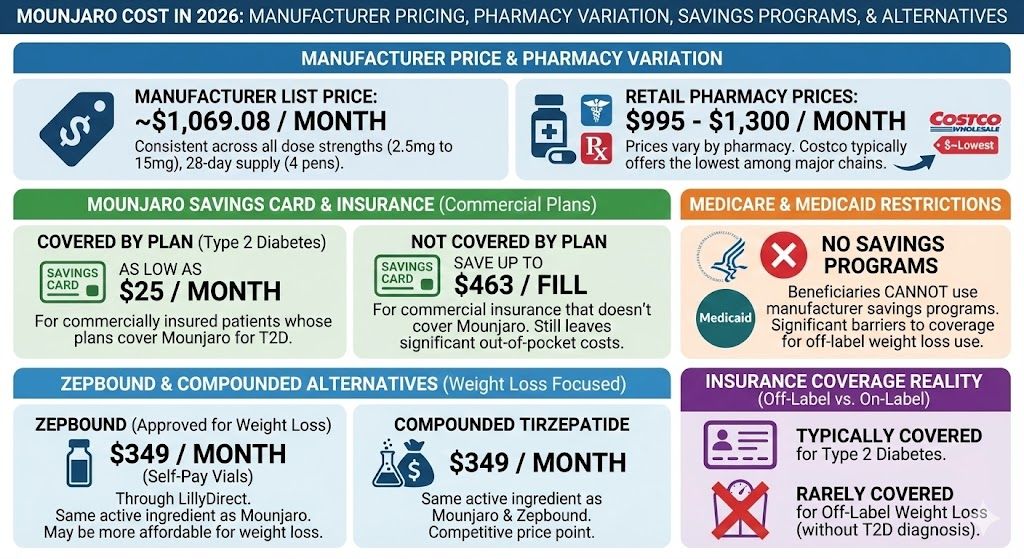
Cost pressure is real and often the deciding factor. Brand-name Mounjaro runs over $1,000 monthly without insurance, and coverage can be inconsistent. Before stopping for financial reasons, explore whether compounded tirzepatide through a telehealth service like TrimRx offers a sustainable alternative. Staying on a lower-cost version of the same medication is almost always a better outcome than stopping entirely.
Side effects that don’t resolve drive some patients to quit. Persistent nausea, severe constipation, or injection site reactions can make the day-to-day experience of Mounjaro feel unworkable. If this is your situation, talk to your provider about dose reduction before discontinuing. Sometimes dropping from 15 mg to 10 mg, or from 10 mg to 7.5 mg, resolves the issue while still providing meaningful weight management support.
Supply disruptions and insurance changes sometimes force an unplanned stop. If you suddenly lose access, contact your provider immediately about bridging options rather than simply going without.
Pregnancy planning requires stopping tirzepatide. The medication should be discontinued at least one month before attempting to conceive, and ideally longer. This is a planned, medically appropriate reason to stop, and your provider can help you manage the transition.
Strategies for Stopping Safely
If stopping is the right decision for your situation, approaching it strategically can soften the landing.
Taper when possible. Rather than going from your current dose to nothing, step down gradually. If you’re on 15 mg, drop to 10 mg for a month, then 7.5 mg, then 5 mg. This gives your body time to adjust incrementally rather than facing a sudden hormonal cliff. Not all providers recommend tapering, but many patients find it makes the transition more tolerable.
Build your support structure before you stop. Exercise routines, meal prep habits, protein targets, sleep hygiene: lock these in while you still have the medication backing you up. Creating these patterns from scratch is much harder once appetite has returned to baseline. Having them already established gives you a foundation to lean on.
Track your weight weekly, not daily. Daily weigh-ins after stopping will drive you crazy with normal fluctuations that look like rapid regain. Weekly check-ins give you an honest trend line without the noise. Decide in advance, with your provider, what amount of regain warrants restarting treatment.
Plan for the emotional side. Losing the sense of control that Mounjaro provided is a real psychological experience. Having a therapist, support group, or at minimum an honest conversation partner can help you process the transition without spiraling into self-blame. This is biology, not character.
Considering a Medication Switch Instead
If your reason for stopping Mounjaro is side effects, cost, or a sense that it’s not working well enough, stopping entirely might not be your best option. Switching medications keeps you on treatment while addressing the specific problem.
If side effects are the issue, switching from Mounjaro to a semaglutide-based medication can sometimes resolve GI problems that are specific to tirzepatide’s dual mechanism. Some people tolerate one drug class better than the other.
If cost is the barrier, moving from brand-name Mounjaro to compounded semaglutide can dramatically reduce your monthly expense while keeping you on an effective GLP-1 medication.
If weight loss has stalled, your provider might adjust your dose or explore whether the Mounjaro plateau strategies can get things moving again before you give up on the medication entirely.
The common thread is this: almost any continuation of GLP-1 treatment produces better long-term outcomes than stopping completely. If Mounjaro isn’t working for you in its current form, the answer is usually to modify the approach, not abandon it.
If you’re weighing your options or need help finding a sustainable long-term plan, take the intake quiz to connect with a TrimRx provider who can walk through your specific situation.
This information is for educational purposes and is not medical advice. Consult with a healthcare provider before starting any medication. Individual results may vary.

Transforming Lives, One Step at a Time
Keep reading

Mounjaro Results at 6 Months: What to Expect
Six months into Mounjaro treatment, most patients are well past the early adjustment phase and seeing some of their most significant weight loss. At…

How to Get Mounjaro in Texas: Telehealth Options
Getting Mounjaro (tirzepatide) in Texas is accessible through your existing doctor, a weight loss clinic, or a telehealth provider that prescribes and ships compounded…

How to Get Mounjaro in California: Step-by-Step
Getting Mounjaro (tirzepatide) in California is a straightforward process whether you go through your primary care doctor, an in-person weight loss clinic, or a…


