Why Am I Not Losing Weight on Mounjaro? Troubleshooting Guide
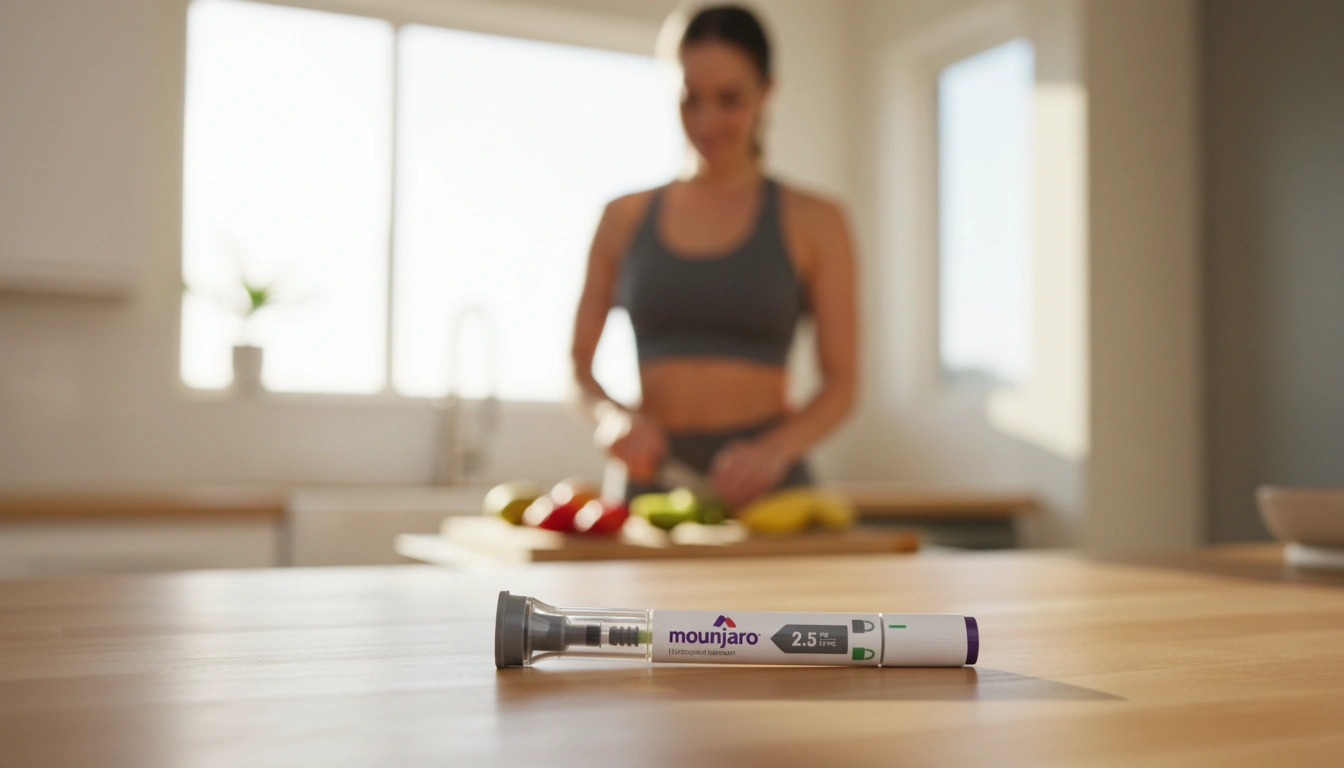
Mounjaro (tirzepatide) has generated significant buzz for its weight loss effects, even though it’s technically FDA-approved for type 2 diabetes management rather than weight loss specifically. In clinical trials, people with diabetes taking Mounjaro lost 12 to 25 pounds on average over 40 to 52 weeks, depending on the dose. That’s substantial, but it’s also not the whole story.
If you’re taking Mounjaro and the scale isn’t budging, there are several possible explanations. Some relate to the medication itself, some to the unique challenges of losing weight with type 2 diabetes, and some to lifestyle factors that affect everyone regardless of the drug they’re on. This guide walks through each potential cause and what you can do about it.
Understanding How Mounjaro Works
Mounjaro is a dual GIP/GLP-1 receptor agonist, meaning it activates two hormone pathways involved in blood sugar regulation, appetite control, and metabolism. It slows gastric emptying (so you feel full longer), reduces hunger signals in the brain, decreases food cravings, and improves how your body handles insulin.
For people with type 2 diabetes, the primary goal is improved blood sugar control. Weight loss is a secondary benefit, but it’s a significant one. The SURPASS-2 trial, published in the New England Journal of Medicine, found that participants on the highest dose of tirzepatide (15 mg) lost nearly twice as much weight as those on semaglutide 1 mg over 40 weeks, with reductions of up to 13% of body weight.
But those are average results. Individual responses vary, and if you’re on the lower end of that range or not seeing results at all, troubleshooting is in order.
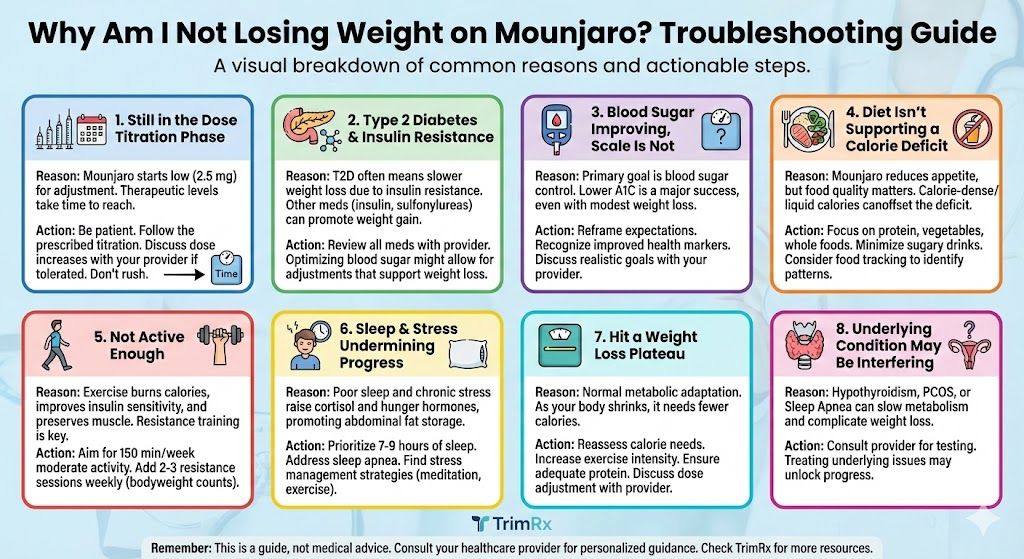
You’re Still in the Dose Titration Phase
The most straightforward explanation for slow or absent weight loss is that you haven’t reached a therapeutic dose yet. Mounjaro starts at 2.5 mg weekly, and that’s essentially a starter dose to help your body adjust. Most providers increase the dose by 2.5 mg every four weeks until you reach 5 mg, 7.5 mg, 10 mg, or higher.
Weight loss tends to be more pronounced at higher doses. In the SURPASS trials, participants on 15 mg lost significantly more weight than those on 5 mg. If you’ve only been on Mounjaro for a couple of months and are still at a lower dose, you may simply need more time.
What to do: Continue the prescribed titration schedule. If you’re tolerating the medication well, discuss with your provider whether moving to a higher dose makes sense for your situation. Don’t rush the process, as increasing too quickly can worsen side effects without improving results.
Type 2 Diabetes Makes Weight Loss Harder
Here’s an important reality: people with type 2 diabetes generally lose less weight on GLP-1 medications than people without diabetes. This has been consistently observed across clinical trials.
Why does this happen? Type 2 diabetes involves insulin resistance, meaning your body produces insulin but doesn’t use it efficiently. Elevated insulin levels promote fat storage and make it harder to access stored fat for energy. Even with appetite suppression from Mounjaro, the underlying metabolic dysfunction can slow weight loss.
Additionally, if you’re taking other diabetes medications alongside Mounjaro, some of them may promote weight gain or make weight loss more difficult. Insulin, sulfonylureas (like glipizide or glimepiride), and thiazolidinediones (like pioglitazone) are known to cause weight gain.
What to do: Talk with your provider about your complete medication regimen. In some cases, adjusting or discontinuing weight-promoting diabetes medications may be possible as Mounjaro improves your blood sugar control. Better A1C levels may allow for medication simplification, which can in turn support weight loss.
Your Blood Sugar Control Is Improving, But the Scale Isn’t Moving
Here’s something that can feel frustrating: Mounjaro might be working exactly as intended even if you’re not losing weight. The medication’s primary purpose is to lower blood sugar, and for many people with type 2 diabetes, that goal is being achieved even when weight loss is modest.
Improved A1C, lower fasting glucose, and reduced insulin requirements are all signs that Mounjaro is doing its job. Weight loss is a common benefit, but it’s not guaranteed for everyone, and it’s not the only marker of success.
What to do: Reframe your expectations. If your blood sugar is improving, that’s a meaningful health benefit in its own right. Weight loss may come more slowly than expected, or it may require additional lifestyle interventions. Discuss with your provider whether your current progress aligns with realistic goals.
Your Diet Isn’t Supporting a Calorie Deficit
Mounjaro reduces appetite for most people, which naturally leads to eating less. But the medication doesn’t dictate what you eat, only how much you want to eat. If the foods you’re choosing are calorie-dense, even smaller portions may provide more energy than your body needs to create a deficit.
Liquid calories are a common overlooked source. Sugary drinks, specialty coffees, fruit juices, and alcohol can add hundreds of calories without making you feel full. Highly processed foods, fried items, and foods high in added sugars can also undermine results.
What to do: Focus on food quality, not just quantity. Build meals around protein (which helps preserve muscle and promotes satiety), vegetables, whole grains, and healthy fats. Minimize liquid calories. Consider tracking your food intake for a week or two to identify patterns you might not be aware of.
For guidance on managing digestive side effects that might affect what you eat, see TrimRx’s guide on sulfur burps and GI issues.
You’re Not Active Enough
Physical activity isn’t the primary driver of weight loss (diet is), but it contributes in ways that matter. Exercise increases your daily calorie expenditure, improves insulin sensitivity (especially important for people with diabetes), and helps preserve muscle mass as you lose weight.
Resistance training is particularly valuable. When you lose weight, some of that loss comes from lean muscle tissue unless you’re actively working to maintain it. Lifting weights or doing bodyweight resistance exercises signals your body to hold onto muscle, which keeps your metabolism higher and shifts more of your weight loss toward fat.
What to do: Aim for at least 150 minutes of moderate activity per week (walking counts), plus two to three sessions of resistance training. You don’t need a gym. Bodyweight exercises like squats, lunges, push-ups, and planks can be done at home with no equipment.
Sleep and Stress Are Undermining Your Progress
Poor sleep and chronic stress both raise cortisol levels, increase hunger hormones, reduce insulin sensitivity, and promote fat storage, particularly around the midsection. These effects can partially counteract the benefits of Mounjaro.
If you’re consistently sleeping fewer than six hours per night or living with high levels of unmanaged stress, your body is working against your weight loss efforts on a hormonal level.
What to do: Prioritize seven to nine hours of sleep per night. Address sleep disorders like sleep apnea if present (which is common in people with type 2 diabetes and obesity). Find stress management strategies that work for you, whether that’s exercise, meditation, therapy, or simply building more downtime into your schedule.
You’ve Hit a Weight Loss Plateau
If you were losing weight initially and progress has stalled, you may be experiencing a plateau. This is a normal part of weight loss biology. As your body gets smaller, it requires fewer calories to maintain itself. Metabolic adaptation kicks in, and the calorie deficit that was producing results no longer does.
Plateaus are frustrating, but they don’t mean the medication has stopped working. They mean your body has adjusted to its new weight, and further progress may require recalibrating your approach.
What to do: Reassess your calorie intake (what created a deficit at a higher weight may now be maintenance-level). Increase exercise intensity or add new activities. Make sure you’re getting enough protein. If you’re not at the maximum tolerated dose of Mounjaro, discuss with your provider whether an increase is appropriate.
For more on breaking through weight loss plateaus, see TrimRx’s breakdown of Mounjaro 3-month results.
An Underlying Condition May Be Interfering
Beyond diabetes itself, several other conditions can slow or stall weight loss:
Hypothyroidism slows metabolism and can make weight loss extremely difficult. Symptoms include fatigue, cold intolerance, dry skin, and constipation. A simple blood test can check thyroid function.
Polycystic ovary syndrome (PCOS) involves insulin resistance and hormonal imbalances that make weight loss challenging, particularly for women.
Sleep apnea disrupts sleep quality and affects metabolic hormones. It’s common in people with obesity and type 2 diabetes and often goes undiagnosed.
What to do: If you’ve addressed lifestyle factors and still aren’t seeing results, ask your provider about testing for these conditions. Treating an underlying issue may unlock progress that was otherwise blocked.
When to Reassess Your Treatment Plan
Consider discussing your treatment with your provider if you’ve been at a maintenance dose (7.5 mg or higher) for at least 12 to 16 weeks without achieving at least 5% body weight loss, or if you were losing weight and have stalled for more than eight weeks despite making adjustments.
Your provider might consider increasing your dose if you’re not at the maximum, evaluating for underlying conditions, adjusting other diabetes medications that may be hindering weight loss, or discussing whether a different medication might work better for you.
If you’re interested in exploring weight loss medications with telehealth support, TrimRx offers compounded tirzepatide and semaglutide options at accessible prices. Take the intake quiz to see if you’re a candidate.
This information is for educational purposes and is not medical advice. Consult with a healthcare provider before starting any medication. Individual results may vary.

Transforming Lives, One Step at a Time
Keep reading

Not Losing Weight on Mounjaro: Common Causes and Solutions
You started Mounjaro expecting the weight to come off. Maybe it did at first, maybe it never really got going, or maybe you hit…

Mounjaro First Month Results: What to Expect
During your first month on Mounjaro (tirzepatide), expect modest but meaningful weight loss. Clinical trial data from the SURMOUNT-1 study shows that participants lost…

Mounjaro 3 Month Results: What to Expect
After three months on Mounjaro (tirzepatide), most people lose between 4% and 7% of their starting body weight. Clinical trial data from the SURMOUNT-1…


