Zepbound Results: How Much Weight Can You Lose in 3 Months?
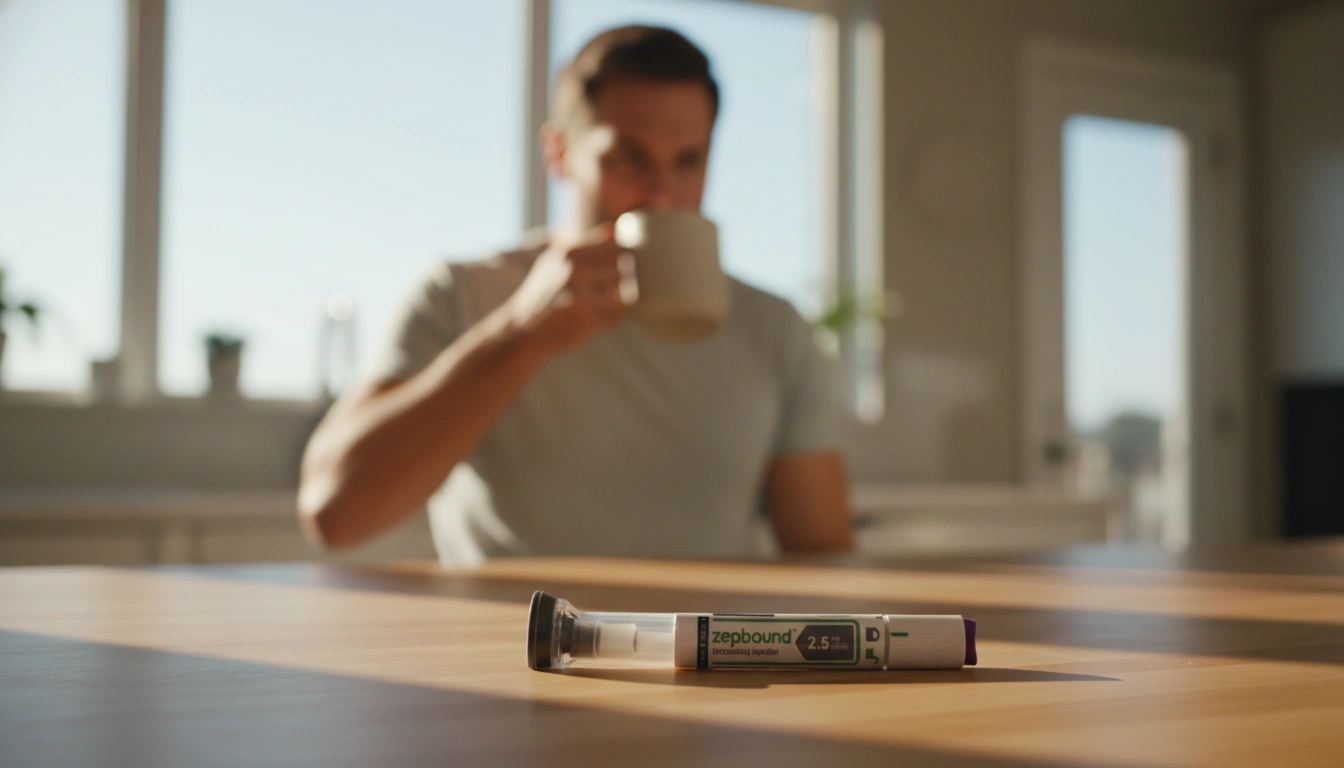
Most people lose between 5% and 8% of their body weight during the first three months on Zepbound (tirzepatide). For someone starting at 250 pounds, that translates to roughly 12 to 20 pounds by the 12 week mark. Clinical trial data shows that 82% of participants achieved at least 5% weight loss by week 12, which researchers consider a strong indicator of long term success with the medication.
Three months might feel like a long time when you’re eager for results, but it’s actually just the beginning of your Zepbound journey. The medication’s dosing schedule means you’re still in the titration phase at this point, working your way up to higher, more effective doses. Let’s look at what the research shows and what you can realistically expect.
What Clinical Trials Tell Us About Early Zepbound Results
The most comprehensive data on tirzepatide weight loss comes from the SURMOUNT clinical trial program. The SURMOUNT-1 trial, published in the New England Journal of Medicine, followed over 2,500 adults with obesity for 72 weeks and provides detailed insights into weight loss patterns at different time points.
At the 12 week mark, participants were still in the dose escalation phase. Depending on their assigned dose group, they had either just reached their target dose (5 mg) or were still increasing (those assigned to 10 mg or 15 mg). Despite this, early results were already meaningful.
A post hoc analysis of SURMOUNT-1 found that 82% of tirzepatide-treated participants were “early responders,” achieving at least 5% weight loss by week 12. This early response turned out to be a strong predictor of long term success. Early responders went on to lose an average of 22.5% of their body weight by week 72, while those who responded more slowly still achieved 11% average weight loss.
The Zepbound Dosing Timeline Matters
Understanding Zepbound’s dosing schedule helps explain why three month results vary. The medication starts at 2.5 mg weekly and increases every four weeks:
- Weeks 1 to 4: 2.5 mg (starting dose)
- Weeks 5 to 8: 5 mg
- Weeks 9 to 12: 7.5 mg
- Weeks 13 to 16: 10 mg
- Weeks 17 to 20: 12.5 mg
- Week 21 onward: 15 mg (maximum dose)
At the three month mark, you’ve only reached the 7.5 mg dose. This is still considered a lower dose, and many people see their most significant results after reaching 10 mg or higher. The gradual increase helps minimize side effects, but it also means patience is required.
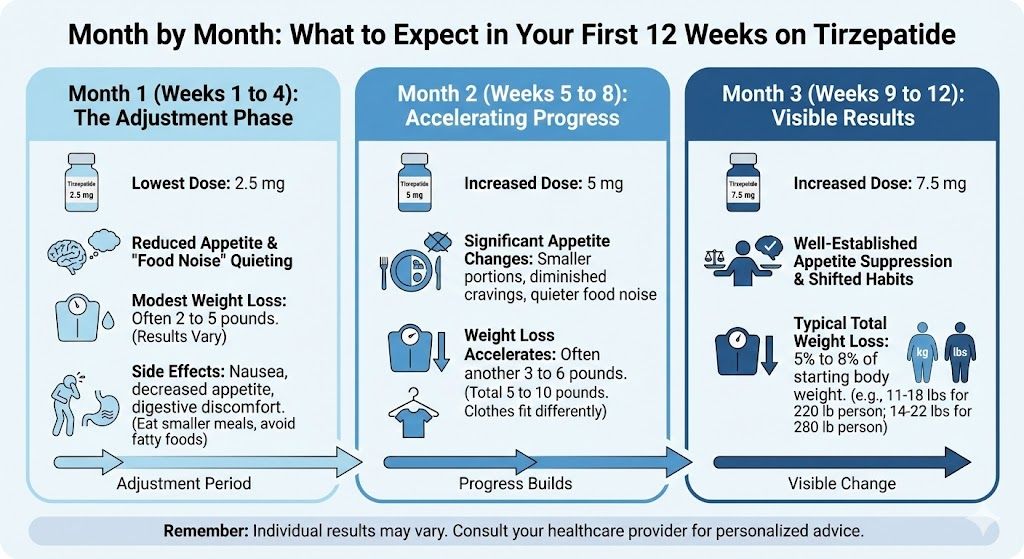
Month by Month: What to Expect in Your First 12 Weeks
Month 1 (Weeks 1 to 4)
The first month on tirzepatide is primarily about letting your body adjust. You’re on the lowest dose (2.5 mg), which is designed to minimize gastrointestinal side effects rather than maximize weight loss.
During this period, some people notice reduced appetite and early signs of “food noise” quieting down. Weight loss is typically modest, often 2 to 5 pounds. Some people see more, others less. Don’t be discouraged if the scale doesn’t move dramatically yet.
Side effects like nausea, decreased appetite, and occasional digestive discomfort are most common during this adjustment period. Eating smaller meals and avoiding fatty foods can help.
Month 2 (Weeks 5 to 8)
By month two, you’ve moved to the 5 mg dose, and most people start noticing more significant appetite changes. Food portions that once seemed normal now feel like too much. Cravings often diminish, and the constant mental chatter about eating starts to quiet.
Weight loss typically accelerates during this period. Many people report losing another 3 to 6 pounds, bringing their total to somewhere between 5 and 10 pounds. You might notice clothes fitting differently, even if the scale change seems modest.
Month 3 (Weeks 9 to 12)
The third month brings the 7.5 mg dose, and for many people, this is when results become more visible. Appetite suppression is usually well established by now, and eating habits have started to shift.
By the end of month three, total weight loss of 5% to 8% of starting body weight is typical for good responders. For a 220 pound person, that’s 11 to 18 pounds. For someone at 280 pounds, it could be 14 to 22 pounds.
Putting Three Month Results in Perspective
Here’s what 5% to 8% weight loss looks like at different starting weights:
| Starting Weight | 5% Loss | 8% Loss |
|---|---|---|
| 180 lbs | 9 lbs | 14.4 lbs |
| 200 lbs | 10 lbs | 16 lbs |
| 220 lbs | 11 lbs | 17.6 lbs |
| 250 lbs | 12.5 lbs | 20 lbs |
| 280 lbs | 14 lbs | 22.4 lbs |
| 300 lbs | 15 lbs | 24 lbs |
These numbers might seem modest compared to the dramatic transformations you see online. But remember: you’re only one quarter of the way through the typical treatment timeline. The SURMOUNT-1 trial showed average weight loss of 20.9% at 72 weeks for the 15 mg dose group. Most of that comes after month three.
Why Some People Lose More (or Less) in 3 Months
Individual results vary significantly, and several factors influence early weight loss:
Starting weight and metabolism. People with higher starting weights often see larger absolute losses, though percentage losses tend to be similar across weight categories.
Dose tolerance. Some people move through the titration schedule smoothly, while others need to stay at lower doses longer due to side effects. Slower titration means slower initial results but can lead to better long term outcomes.
Lifestyle factors. Zepbound works by reducing appetite, but what you eat still matters. People who combine the medication with improved nutrition and increased activity typically see better results than those who change nothing else.
Prior weight loss attempts. Your metabolic history can influence how your body responds. People who’ve done extreme diets or experienced significant yo-yo dieting may respond differently than those attempting weight loss for the first time.
Biological variation. Just like some people respond better to certain blood pressure medications than others, GLP-1 response varies between individuals. Researchers are still working to understand why.
How Zepbound Compares to Other Options
If you’re researching weight loss medications, you might wonder how Zepbound stacks up against alternatives like semaglutide (Ozempic, Wegovy).
The SURMOUNT-5 trial directly compared tirzepatide to semaglutide over 72 weeks. Tirzepatide produced 20.2% average weight loss compared to 13.7% with semaglutide. That’s a 47% greater relative weight reduction. Both medications are effective, but tirzepatide’s dual mechanism (targeting both GIP and GLP-1 receptors) appears to provide an edge.
At the three month mark specifically, both medications show meaningful but modest results since both require gradual dose increases. The real separation in outcomes becomes clearer after six months and beyond.
Signs You’re Responding Well at 3 Months
Weight on the scale is one measure, but other signs suggest the medication is working:
Reduced appetite. If you’re naturally eating less without feeling deprived, that’s a positive sign. The medication should make smaller portions feel satisfying.
Fewer cravings. Many people report that foods they once found irresistible now seem less appealing. Sweets, fried foods, and other trigger foods lose their pull.
Quieter “food noise.” That constant mental background chatter about eating, planning meals, and thinking about snacks often fades. People describe feeling more neutral about food.
Improved energy. Even modest weight loss can improve how you feel. Less weight means less strain on your body.
Better blood sugar. If you’ve been monitoring glucose levels, you might notice improvements even before significant weight loss.
What If You’re Not Seeing Results?
If you’ve reached the three month mark with minimal weight loss, don’t panic. Several factors could be at play:
You might need a higher dose. Since you’re only at 7.5 mg at week 12, there’s still significant room to increase. Many people see their best results at 10 mg or 15 mg.
Side effects might be limiting your dose progression. If nausea or other issues have slowed your titration, you may simply need more time at therapeutic doses.
Your expectations might need adjusting. If you’re comparing yourself to dramatic social media transformations, remember that those often represent best case scenarios or longer treatment periods.
If you’ve been at a full therapeutic dose for several weeks with less than 5% weight loss, discuss options with your provider. Some people respond better to different medications, and switching might be worth considering.
Looking Beyond 3 Months
Three months is really just the foundation. The SURMOUNT trials show that weight loss continues well beyond this point:
- At 6 months: Average loss of 15% to 17%
- At 12 months: Average loss of 19% to 21%
- At 18 months: Weight typically stabilizes at maximum loss
The key is consistency. People who stay on the medication and gradually reach higher doses see the best long term outcomes.
Getting Started With Tirzepatide
If you’re considering Zepbound or compounded tirzepatide for weight loss, the first step is determining whether you’re a candidate. GLP-1 medications are typically appropriate for adults with a BMI of 30 or higher, or 27 or higher with weight related health conditions.
TrimRx offers telehealth consultations and access to compounded tirzepatide at more affordable prices than brand name medications. You can take the intake quiz to see if you qualify.
The Bottom Line
Expect to lose between 5% and 8% of your body weight in the first three months on Zepbound, though individual results vary. This represents meaningful progress, even if it feels modest compared to what’s possible with longer treatment.
The three month mark is really just the beginning. You’re still in the dose escalation phase, and most people see their greatest results between months 4 and 12. Patience and consistency matter more than dramatic early losses.
What you experience in the first 12 weeks can help predict your long term success. If you’re losing weight, feeling reduced appetite, and tolerating the medication well, you’re likely on track for significant results ahead.
This information is for educational purposes and is not medical advice. Consult with a healthcare provider before starting any medication. Individual results may vary.

Transforming Lives, One Step at a Time
Keep reading

Fitness Test Coming Up on Zepbound? Protecting Strength and Endurance
The date changes what you should do, and the most useful adjustments are about fuel and timing rather than about the medication itself. Performance…

Best Diet for Zepbound to Maximize Weight Loss
If you recently started using Zepbound or you are thinking about it, you probably have one big question: what should you eat? The truth…
Lost Weight on Zepbound With a CPAP? When to Recheck Your Settings
Probably yes, and this is a conversation to have with your sleep clinician rather than a change to make yourself. Weight loss can reduce…


