Preventing Muscle Loss on GLP-1: Complete Evidence-Based Guide

Introduction
DEXA substudies of the STEP and SURMOUNT trials put a number on the lean-mass question. Roughly 25 to 40% of weight lost on semaglutide or tirzepatide is lean tissue. That’s not unique to GLP-1s, any rapid weight loss loses lean mass, but the scale of GLP-1 use has made the issue visible at population level.
Muscle isn’t just aesthetic. It’s metabolic reserve, postural support, glucose disposal capacity, and a strong correlate of mortality past age 50. Losing 10 lb of fat is a win. Losing 10 lb of muscle along with it is a problem.
The protocol that prevents most of that lean-mass loss is well established. Protein, resistance training, sleep, creatine, and patient pacing. Each lever helps. Stacked, they shift the body composition outcome by tens of pounds over a year.
At TrimRx, we believe that understanding your options is the first step toward a more manageable health journey. You can take the free assessment quiz if you’re ready to see whether a personalized program is a fit for you.
How Much Muscle Loss Is Normal on a GLP-1?
In the absence of any intervention, expect 25 to 40% of total weight lost to be lean tissue. For a patient who loses 50 lb, that’s 12 to 20 lb of lean mass. Some of that is water and connective tissue, not pure muscle, but skeletal muscle is the largest single component.
Quick Answer: 25 to 40% of GLP-1 weight loss is lean mass without intervention (STEP, SURMOUNT DEXA data)
A 2024 analysis in JAMA Internal Medicine by Prado et al. estimated that older adults (60+) and those with low baseline activity lose proportionally more lean mass than younger or more active patients. The lean-loss percentage isn’t a fixed property of the drug. It’s a function of inputs.
The clinically meaningful threshold is sarcopenic obesity, where fat-to-muscle ratio worsens despite total weight loss. Roughly 5 to 10% of older adults on GLP-1s meet that definition without a muscle-preservation protocol.
Why Does the Body Lose Muscle in a Calorie Deficit?
Because muscle is metabolically expensive. Resting energy expenditure correlates closely with lean mass. When the body senses a sustained energy deficit, it economizes by reducing the most demanding tissue. Without a mechanical signal saying otherwise, muscle gets pruned.
Resistance training is the mechanical signal. Adequate protein supplies the substrate. Sleep regulates the hormones that drive protein synthesis (testosterone, growth hormone, IGF-1). Each layer matters because they address different parts of the same problem.
GLP-1s amplify the issue because they produce larger and faster deficits than diet alone. The drug is doing 600 to 1,000 fewer calories per day of work for many patients. That’s the equivalent of a strict diet plus exercise, sustained for months, without conscious effort.
How Much Protein Do I Need?
1.6 g per kg of body weight per day, spread across three or four meals of 30 to 40 g protein each. A 180 lb (82 kg) adult targets roughly 130 g daily.
The Morton et al. 2018 British Journal of Sports Medicine meta-analysis identified 1.6 g/kg as the threshold above which resistance training plus protein produced no additional muscle gain in trained adults. In a calorie deficit, that threshold becomes a floor rather than a ceiling.
The Longland et al. 2016 American Journal of Clinical Nutrition trial tested 1.2 versus 2.4 g/kg protein in young men on a 40% calorie deficit with daily training. The high-protein group lost 10.5 lb of fat and gained 2.5 lb of muscle. The low-protein group lost 7.7 lb of fat and gained no muscle. Same training. Different substrate.
What About Leucine?
Leucine is the branched-chain amino acid that triggers muscle protein synthesis. Each meal should hit roughly 2.5 to 3 g of leucine to maximize the synthesis signal. That translates to roughly 30 g of complete protein from animal sources or 35 to 40 g from most plant sources.
Whey protein has the highest leucine concentration (about 11%). Eggs, dairy, beef, chicken, and fish all clear the threshold at 30 g servings. Plant proteins (soy, pea, hemp) need slightly larger servings or leucine fortification to match.
Spread protein evenly across meals. Three meals of 35 g each beats one 50 g meal and two 20 g meals, even at the same daily total. The muscle protein synthesis response saturates around 30 to 40 g per meal.
What Kind of Training Preserves Muscle Best?
Resistance training. Compound multi-joint lifts (squats, deadlifts, presses, rows, pull-ups, lunges) at 70 to 85% of one-rep max, three sets of six to twelve reps, two to four sessions per week.
The 2018 Wycherley et al. meta-analysis in Obesity Reviews pooled 14 trials of diet plus resistance training versus diet alone. Lifting preserved 93% of lean mass during weight loss. Diet alone preserved 64%. The gap was consistent across age, sex, and starting weight.
Cardio doesn’t preserve muscle. It improves cardiovascular fitness, which the drug doesn’t touch, but it doesn’t replace lifting for body composition. Walking, swimming, cycling, and yoga all have value. None of them substitute for resistance training in this context.
Does Creatine Help?
Yes. Creatine monohydrate at 5 g daily, no loading phase needed, improves strength performance and supports muscle preservation in caloric deficits. Hundreds of trials over four decades show consistent benefit with strong safety.
A 2022 Nutrients review by Antonio et al. covered creatine in weight-loss contexts. The summary: creatine plus resistance training plus adequate protein produces the best body composition outcomes in deficits. The effect is modest but additive.
Creatine doesn’t interact with GLP-1s. Take it at any time, with or without food, daily not just on training days. The 1 to 3 lb of initial weight gain on creatine is water in muscle cells, not fat. It’s a feature, not a side effect.
How Important Is Sleep?
Critical. The Nedeltcheva et al. 2011 Annals of Internal Medicine study randomized adults on a calorie deficit to 8.5 versus 5.5 hours of sleep. Both groups lost the same total weight. The short-sleep group lost 55% less fat and 60% more lean tissue. Same calories. Different body composition.
Sleep regulates the hormones that build and protect muscle: growth hormone (peaks in deep sleep), testosterone, IGF-1, and cortisol (chronic high cortisol catabolizes muscle). Seven to nine hours is the target. Consistent wake time matters more than total time in bed.
Most adults underestimate their sleep debt. A two-week sleep log tracking time to bed, wake time, and morning energy gives the real picture.
Does Titration Speed Matter?
Slower titration loses less lean mass. Faster appetite suppression means faster calorie reduction, which means more aggressive deficit, which means more lean tissue lost. Patients who escalate dose on the slowest tolerable schedule (every 8 to 12 weeks instead of every 4) tend to preserve more muscle.
This trade-off matters less for highly motivated patients lifting four days a week with high protein intake. It matters more for older adults, sedentary patients, or those struggling to hit protein targets.
A TrimRx personalized treatment plan can calibrate dose escalation based on side effects, weight-loss pace, and body composition goals. Faster isn’t always better.
What About HMB or Essential Amino Acids?
HMB (beta-hydroxy-beta-methylbutyrate) at 3 g daily has some evidence for reducing muscle protein breakdown in calorie-restricted older adults. The effect is small and the cost is moderate. It’s a reasonable addition for patients over 60, optional for everyone else.
Essential amino acid (EAA) supplements between meals can be useful for patients who struggle to hit protein targets with food. 10 to 15 g of EAAs with 2.5 g leucine triggers muscle protein synthesis with minimal calories. Useful as a 2 PM snack, not a meal replacement.
Whole-food protein wins on cost, satiety, and micronutrient density. Supplements are tools, not the protocol.
Key Takeaway: Resistance training 2 to 4 times weekly preserves roughly 93% of lean mass (Wycherley 2018)
How Do I Measure If It’s Working?
DEXA scans at baseline and 3 to 6 months are the most accurate. Most US cities have DEXA centers offering body composition scans for to . Track lean mass, fat mass, and visceral fat over time.
Strength benchmarks work too. Pick three or four key lifts (squat, deadlift, bench press, pull-up) and test every four to six weeks. Strength holding or climbing in a deficit is a strong indicator that muscle is being preserved.
Body measurements (waist, hips, thigh, arm) and progress photos every four weeks catch changes the scale misses. Muscle preservation often shows up as clothing fit and visible composition before it shows up in any single number.
How Do I Plan a Full Week?
Sample week for an intermediate patient: Monday lift (60 minutes), Tuesday walk 30 to 45 minutes, Wednesday lift, Thursday zone 2 cardio 40 to 60 minutes, Friday lift, Saturday longer cardio or recreational activity, Sunday walk and recover.
Food daily: 1.6 g/kg protein in three meals, 30 g fiber, 7 to 9 hours sleep. Creatine 5 g daily. Vitamin D if your level is low. Water 80 to 100 oz daily.
Run this for 12 weeks before evaluating. Body composition shifts are slower than scale weight changes. Patience plus consistency beats intensity plus erratic adherence every time.
What If I’m Losing Too Fast?
Slow it down. A 1 to 1.5% loss of body weight per week is the upper bound where lean mass preservation stays achievable. Above 2% weekly, muscle loss accelerates regardless of protein and training.
If you’re losing faster than that, options include staying at a lower dose longer before escalating, eating more (especially more protein), or adding a low-intensity training day for additional calorie expenditure paired with food intake.
This is counterintuitive. Patients chase the fastest possible weight loss, then feel weak, lose muscle, and rebound hard. Slower is more durable.
What Does a Protein-loaded Day Actually Look Like?
Breakfast (35 g protein): three eggs scrambled with cheese, half cup cottage cheese on the side, slice of whole grain toast. About 470 calories.
Mid-morning (20 g): single scoop whey shake with water, plus a piece of fruit. About 200 calories.
Lunch (40 g): 6 oz grilled chicken, two cups roasted vegetables, half a cup of quinoa or rice, olive oil. About 600 calories.
Afternoon snack (15 g): Greek yogurt with berries or two hard-boiled eggs. About 180 calories.
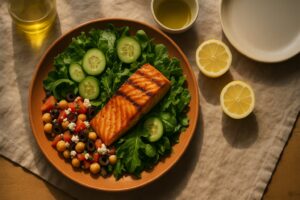
Dinner (45 g): 6 oz salmon or lean beef, large salad with chickpeas, sweet potato. About 650 calories.
Total: 155 g protein, 2,100 calories. Scale down by reducing carb portions for a smaller deficit, or by dropping the afternoon snack entirely if hunger isn’t an issue (most GLP-1 patients don’t need it).
How Does Age Affect the Protocol?
Older adults need more protein, not less. The anabolic resistance of aging means the same dose of protein triggers a smaller muscle protein synthesis response. Adults over 60 should target the upper end of the range, 1.8 to 2.0 g per kg daily, with at least 35 to 40 g per meal.
Resistance training matters even more past age 60. The natural rate of muscle loss is roughly 1% per year after 50 without intervention. Adding a GLP-1 deficit on top of that without lifting compounds the problem quickly.
Vitamin D status matters more in older adults too. Levels below 30 ng/mL correlate with worse muscle function. A daily 2,000 to 4,000 IU supplement is reasonable if testing shows low levels.
What About Women Specifically?
Women preserve muscle similarly to men with the same protocol but face two additional considerations. First, the smaller average body size means hitting 30 to 40 g protein per meal can feel like a lot of food. Whey or protein-fortified foods help. Second, perimenopausal and postmenopausal women lose lean mass and bone density faster, so the lifting and protein protocol becomes even more important.
Pregnancy and breastfeeding are absolute contraindications for GLP-1 use. Otherwise, the protocol is the same across sexes with intake scaled to body weight.
A TrimRx free assessment quiz screens for these factors and matches the medication and treatment plan to your specific case.
What’s the Order of Operations If I’m Starting From Zero?
Week 1: get protein right. Hit 1.2 to 1.6 g/kg daily. Don’t worry about lifting yet. Build the food habit first because it’s the larger driver.
Weeks 2 to 4: add lifting. Two full-body sessions weekly, basic compound movements, light weights. Build form before chasing intensity.
Weeks 5 to 8: add the third lifting session and stabilize protein at 1.6 g/kg. Add 5 g daily creatine. Address sleep if it’s under seven hours.
Weeks 9 to 12: progressive overload on lifts. Track strength weekly. Consider a baseline DEXA scan if body composition is a primary goal.
This sequence preserves muscle without overwhelming the patient. The most common failure mode is doing all four levers badly. Doing one or two levers well beats six lever attempts that don’t stick.
Bottom line: DEXA scans at baseline and 6 months track outcomes objectively
FAQ
How Much Muscle Do You Lose on Ozempic® Without Lifting?
Estimates from DEXA substudies of STEP trials range from 25 to 40% of total weight lost being lean tissue. The exact number varies by age, baseline activity, and protein intake. Older sedentary adults lose proportionally more.
Can I Rebuild Muscle After Losing It on a GLP-1?
Yes. Resistance training plus 1.6 g/kg protein during maintenance phase rebuilds muscle slowly, typically 0.5 to 2 lb per month in beginners, less in trained adults. The window for fastest regain is the first 6 to 12 months after the active loss phase ends.
Is Creatine Safe on Semaglutide?
Yes. Creatine has no known interaction with semaglutide or tirzepatide. The mild fluid retention can mask early scale losses by one to three pounds but doesn’t affect actual fat loss.
Do I Need a DEXA Scan?
Useful but not required. Strength tracking, measurements, and progress photos cover most of what DEXA shows. A scan is most valuable at baseline and again at 6 months if body composition is a primary goal.
Should I Take Protein Powder?
It’s a convenient tool for hitting daily targets. Whey at 25 to 30 g per scoop, mixed with water or milk, fills gaps when food is hard. Two scoops daily covers 50 to 60 g without much effort. Not required if whole food intake hits the target.
How Long Should I Lift Before Seeing Results?
Strength gains in two to four weeks. Visible composition changes at 8 to 12 weeks. DEXA-measurable lean mass preservation across the active loss phase. The mirror is the slowest indicator. Trust the scale, strength logs, and measurements first.
Are Bone Density Losses Also a Concern?
Yes for some patients. Rapid weight loss can reduce bone mineral density, especially in postmenopausal women. Weight-bearing exercise (lifting, walking, jumping) and adequate vitamin D and calcium intake protect bone alongside muscle. A DEXA scan also reports bone density and is useful for tracking both.
What’s the Single Biggest Mistake Patients Make?
Doing only cardio. Walking and zone 2 cardio are good for cardiovascular health but don’t preserve muscle. Patients who lift two to four times weekly with adequate protein land in a completely different body composition than patients who only walk and watch food intake.
Disclaimer: This content is for informational purposes only and does not constitute medical advice. It is not intended to diagnose, treat, cure, or prevent any disease or condition. Individual results may vary. Always consult a qualified healthcare professional before starting any weight loss program or medication.

Transforming Lives, One Step at a Time
Keep reading

Construction Work in Summer on a GLP-1
Summer on a job site means early starts, heavy physical work, direct sun or hot interiors, and lunch from a cooler or the back…

Colonoscopy Prep on a GLP-1
If you are on a GLP-1 and have a colonoscopy, upper endoscopy, or any procedure with sedation coming up, the single most important step…
Clergy and Community Meals on a GLP-1
For pastors, priests, rabbis, imams, chaplains, and other community leaders, food is part of the work. Potlucks, fellowship dinners, holiday meals, funeral receptions, and…


