What to Do If TSA Opens Your Semaglutide Cooler

Declare it before screening starts and this mostly does not happen. If it does, it is a routine inspection rather than a problem, and knowing one specific rule will save you the argument people worry about.
Medically necessary gel ice packs are permitted regardless of whether they are frozen, partially melted, or slushy. That is TSA’s own published position, and it is the point travellers most often do not know. Ordinary frozen items must be frozen solid to pass, and medically necessary cooling packs are exempt from that.
Notify the officer and present them for inspection. That is the entire procedure.
Declare it at the start
The single thing that makes screening fast.
Medically necessary liquids are exempt from the usual limit on container size and do not need to fit in a quart bag. They can be carried in reasonable quantities for your trip. What you have to do is tell the officer at the start of screening and separate them from your other belongings.
Practically:
Say it before your bags go on the belt. “I have medically necessary medication that needs to stay cold, plus ice packs and syringes.”
Take the medication bag out and present it separately rather than leaving it buried.
Keep everything together: medication, cooling element, needles, and pharmacy label in one accessible bag.
Do not bury it under clothing or in the bottom of a packed case.
Consider this scenario: a patient packs her cooler at the bottom of a carry-on under three days of clothes, says nothing, and is pulled aside when the bag alarms. Unpacking and repacking takes fifteen minutes with a queue behind her. The same cooler, declared and handed over at the start, takes about thirty seconds.
If they do open it
This is normal and it is worth knowing what to expect.
Medication may be visually inspected or X-rayed, and may be tested for traces of explosives with a swab.
Containers are not opened without your involvement. You can ask to be present and to handle the medication yourself rather than having an officer do it.
You can request a visual inspection instead of X-ray screening if you prefer, and say so at the start rather than partway through.
Needles are expected when carried with the medication they are for. The medication is what justifies them, which is why they travel together.
Final decisions rest with the officer at the checkpoint. Being organized and straightforward is more useful than quoting rules at them, though knowing the ice pack rule is worth having in reserve.
What to have with you
The pharmacy label, ideally still on the original carton. This is the single most useful item, since it connects the medication to you by name.
A letter from your provider if you are travelling internationally, or if you are carrying a large supply.
Needles kept with the medication, not in a separate bag.
A small travel sharps container.
If your medication is compounded, the label will be from a compounding pharmacy rather than a manufacturer. That is entirely ordinary and occasionally prompts a question, which the label itself answers. Our guide on what a compounding pharmacy is and how it works covers the distinction.
Protecting the cold chain during screening
The part that actually matters for your medication.
Do not let the pen or vial sit out of the cooler longer than necessary. Screening is brief, and repacking promptly is worth doing rather than chatting at the end of the belt.
Do not let medication rest directly against a frozen pack. Freezing damages this medication in a way that is worse than warming, and it can happen in minutes of direct contact. Keep a layer between them.
Repack properly rather than shoving things back in and sorting it at the gate.
Our guides on GLP-1 medications and travel and how to store compounded semaglutide or tirzepatide at home cover packing and storage principles.
A note on needles
Needles travel with the medication because the medication is what justifies them, and that is worth getting right rather than improvising.
Bring more than you need, keep them in the same bag, and carry a small travel sharps container so you are not looking for disposal in an unfamiliar airport. Our guide on GLP-1 injection sites covers technique, which is worth being confident about before injecting somewhere unfamiliar.
Never put it in checked baggage
Worth repeating in every travel article for a reason.
Cargo holds are not reliably temperature controlled, bags get delayed and lost, and you have no access to your medication for the duration.
Keep it in hand luggage, always, including on connecting flights where you might be tempted to check a bag at the gate.
What not to do
Do not argue about the ice packs. Cite the rule calmly if you need to, and let the officer inspect them.
Do not refuse inspection. That guarantees a longer process.
Do not remove the label to make the packaging tidier.
Do not split your medication across multiple bags so it looks like less. Keep it together and declare it.
Do not assume the rules are the same abroad. TSA governs US screening. Other countries have their own procedures, and international travel is worth researching separately.
If something goes wrong
If your medication is damaged, left out too long, or you are separated from it:
Do not use anything you are unsure about. Photograph the product and label with the lot number, note the exposure, and call the dispensing pharmacy before your next dose.
Cooling it properly afterward does not undo an excursion. That is worth knowing before you decide it is probably fine.
If you are away from home and need a replacement, your pharmacy is the first call rather than a local one.
When to call
Contact your pharmacy if the medication was out of temperature range for an extended period, if it froze, or if the solution has changed appearance. Contact your provider if a replacement will delay your dose by more than a few days.
The short version
Declare it before screening starts and present it separately, and most of this never happens. If they do inspect it, that is routine. The rule worth knowing is that medically necessary gel ice packs are permitted whether frozen, melted, or slushy, which is the point most travellers do not realize. Keep the label on, keep needles with the medication, and never check it into the hold.
If you want a provider who sorts your travel documentation before you fly, see whether TrimRx is a fit for you.
This information is for educational purposes and is not medical advice. Consult with a healthcare provider before starting any medication. Individual results may vary.

Transforming Lives, One Step at a Time
Keep reading
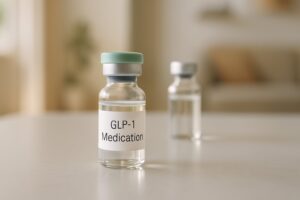
How to Handle a Delayed Flight With Semaglutide in Your Bag
Find ice before you find food. A few hours of delay is usually fine. A long delay, an overnight, or a cancellation turns a…
What to Do If Your Cooler Pack Melts on a Road Trip With Semaglutide
Call the dispensing pharmacy before your next dose, and record the details now while you remember them. A melted pack does not automatically mean…

How to Store Semaglutide in a Hotel Mini Fridge That Won’t Get Cold
Many hotel minibars are not refrigerators. They are thermoelectric cooled cabinets that hold a temperature somewhat below the room, which is fine for a…


