Your Pet’s Insulin and Your Ozempic in the Same Fridge
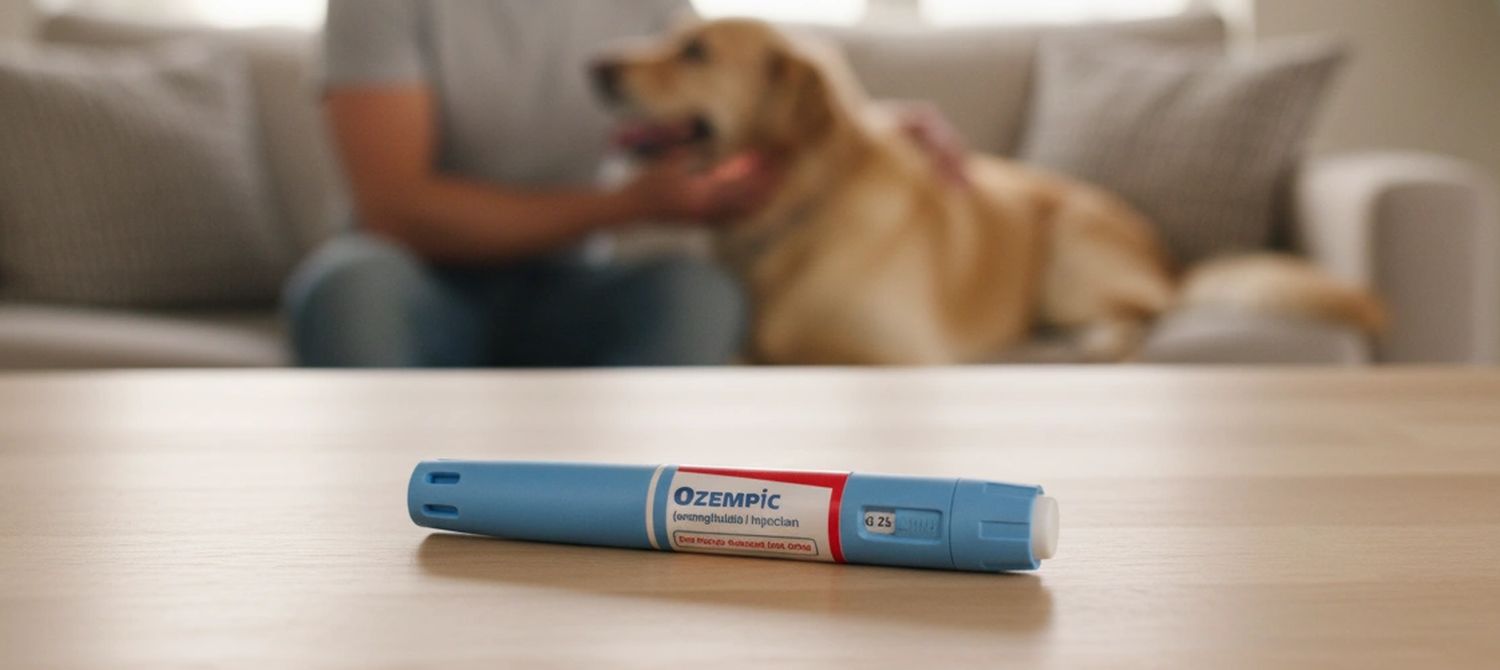
Diabetes is not only a human condition. Plenty of cats and dogs need daily insulin, and their owners become experts at injections. If you also take Ozempic or another GLP-1, you now have two injectable medications, two sets of supplies, and two routines sharing one fridge. Most of the time that is fine. But tired evenings and similar-looking boxes are exactly how mix-ups happen.
Why mix-ups happen
- Both medications live in the fridge, often on the same shelf
- Vials and boxes can look alike, especially if you use compounded semaglutide in a vial
- Injections happen at home, sometimes at the same time of day
- You are often tired, distracted, or juggling an impatient animal
A few simple habits remove almost all of the risk.
Separate and label
Use two clearly labeled containers, such as small plastic bins, one with your name and one with your pet’s name.
Put them on different shelves, so you never reach into the same spot for both.
Add a color code, like colored tape on the lid of each container.
Check the label every single time before you inject, yours or theirs.
Keep the routines apart
Your pet’s insulin schedule is set by your vet and is often tied to their meals. Your Ozempic is once a week. Give the two at different times of day, or in different rooms, so they never become the same task. Prepare one, give it, put it away, and only then start the other.
Never share syringes or needles
Some pet insulins are drawn up with syringes that are marked differently from the ones used for human medications. Never use your pet’s syringes for your medication or your syringes for theirs, even if they look similar. Keep each set of supplies in its own container.
Check the fridge itself
Both medications are sensitive to temperature. A study that tracked insulin, another temperature-sensitive injectable, found it was often kept outside the recommended temperature range, both in home refrigerators and when carried by patients.
Use a fridge thermometer, follow the storage instructions that came with your medication, and follow your vet’s or pharmacy’s instructions for your pet’s. Keep both away from the freezer compartment and the back wall, where items can freeze. Our guide on storing compounded semaglutide or tirzepatide at home covers the basics.
If a mix-up happens
If you injected your pet’s insulin by mistake, treat it as an emergency, because insulin can cause dangerously low blood sugar. Call 911 if you feel shaky, sweaty, confused, or faint. Otherwise call Poison Control at 1-800-222-1222 straight away for advice, and do not drive yourself anywhere.
If you gave your pet your medication, call your vet or an animal poison control line right away.
Write down what was given, how much, and when, so you can tell whoever you call.
Keep pets away from your supplies
Dogs in particular will chew almost anything, including pens, vials, and sharps containers. Keep your medication in the fridge or a closed cabinet, and keep your sharps container closed and up high. Never leave a used needle on a counter or table, even for a moment.
Sharps disposal
Used needles from you and your pet can be a hazard to anyone in the household. Use a proper sharps container and ask your pharmacy or local waste service how to dispose of it when it is full.
If your medication is compounded
Compounded semaglutide usually comes in a vial with a pharmacy label rather than a branded pen. Read that label carefully every time, and keep it in its original packaging so it never gets confused with your pet’s vial. Our guide on how to verify a compounding pharmacy covers what to check about where your medication comes from.
If you are new to Ozempic, our guide on the Ozempic starting dose covers what the first weeks usually look like.
Consider this scenario: a man gives his diabetic cat insulin every evening and keeps the cat’s vial on the same fridge shelf as his compounded semaglutide vial. One tired Sunday night, with the cat already fed and impatient, he reaches for his own weekly dose, picks up the wrong vial, and draws it into his syringe. Within the hour he is sweaty and shaky and needs emergency care. Separate labeled bins on different shelves, giving the two injections at different times, and checking the label before every injection would have prevented it.
When a pet sitter steps in
Travel adds another person to the mix. If a friend or pet sitter will be giving your pet’s insulin while you are away, show them exactly which container is the pet’s, and tell them plainly that the other one is yours and should not be touched. Leave written instructions from your vet, the vet’s phone number, and your pet’s feeding and injection times. If you can, take your own medication with you or store it somewhere separate while you are gone, following its storage instructions. For trips of a week or less, injecting before you leave can mean your medication does not need to stay behind at all.
The short version
If your pet takes insulin, keep your Ozempic and their medication in separate labeled containers on different shelves, give the injections at different times, and check the label every time. Never share syringes, check your fridge temperature, keep supplies away from curious pets, and know who to call if a mix-up happens.
If you want a provider who will answer practical questions about living with your medication, TrimRx includes ongoing provider access alongside treatment.
This information is for educational purposes and is not medical advice. Consult with a healthcare provider before starting any medication. Individual results may vary.

Transforming Lives, One Step at a Time
Keep reading
Taking Ozempic With COPD
Many people with COPD also have type 2 diabetes, and Ozempic or another GLP-1 is a common part of treatment. For some, losing weight…

Ozempic After a Stroke: What to Ask During Recovery
Many people who have a stroke also live with type 2 diabetes, and many of them take Ozempic or another GLP-1. In the weeks…

New Dentures on Ozempic: Eating Enough While You Adjust
Getting used to new dentures takes time. Your gums may be sore, chewing feels strange, and many foods suddenly seem like hard work. Most…


