GLP-1 Dosing Charts: Key Brand Variations
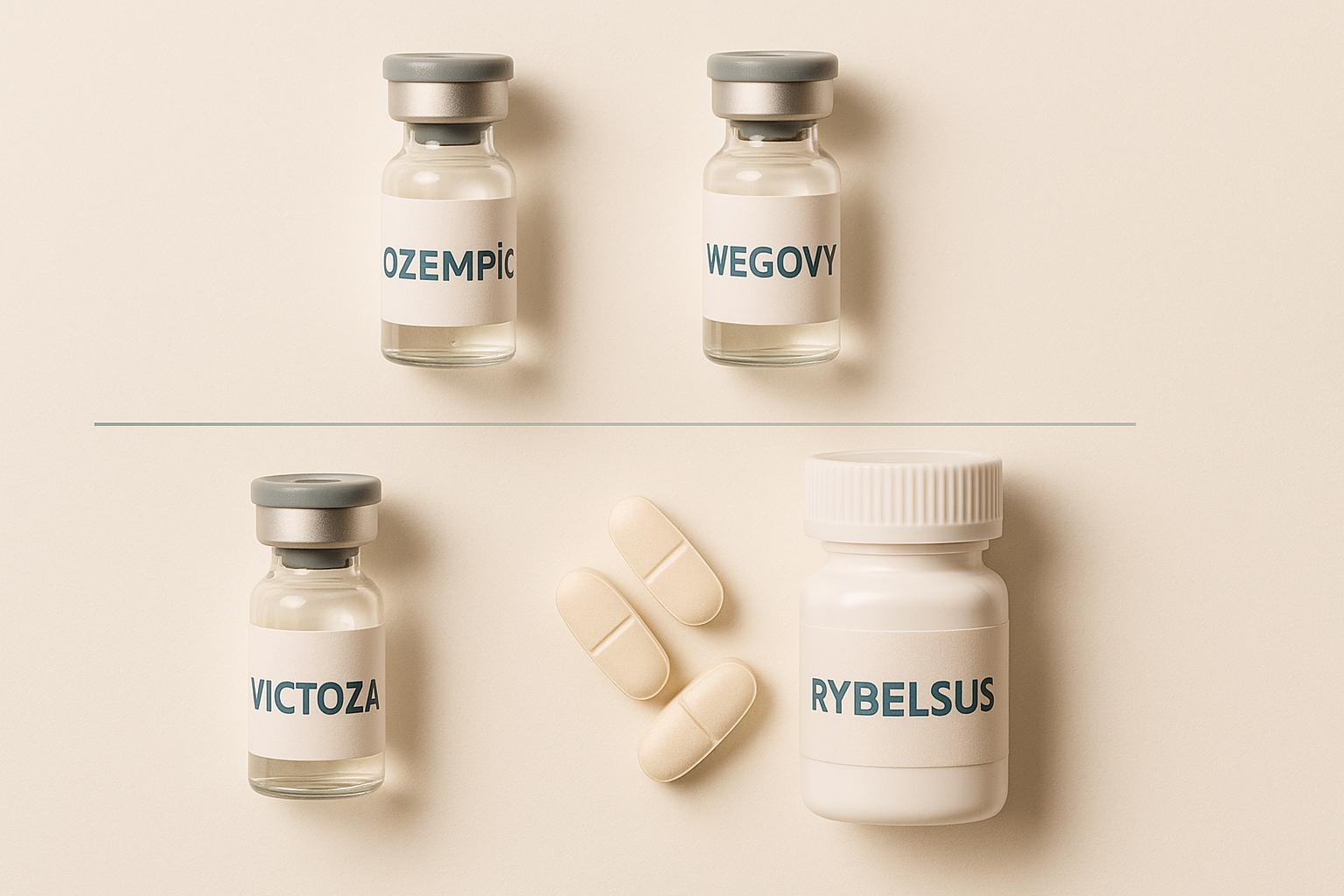
GLP-1 medications are transforming treatments for weight loss and type 2 diabetes. These drugs mimic a natural hormone to regulate blood sugar, slow digestion, and reduce appetite. Proper dosing, starting low and increasing gradually, is critical to minimize side effects like nausea and maximize results.
Here’s what you need to know:
- Medications Covered: Semaglutide (Ozempic®, Wegovy®, Rybelsus®), Tirzepatide (Mounjaro®, Zepbound®), Liraglutide (Victoza®, Saxenda®), and Dulaglutide (Trulicity®).
- Dosing Schedules: Weekly or daily formulations with specific titration plans to ensure safety and effectiveness.
- Key Differences:
- Weekly injections (e.g., Ozempic®, Mounjaro®) are more convenient for many.
- Daily options (e.g., Saxenda®, Rybelsus®) may suit those who prefer daily routines.
- Oral semaglutide (Rybelsus®) is the only pill-based option but requires strict timing.
- Titration Importance: Gradual dose increases help reduce side effects like nausea, vomiting, and digestive discomfort.
- Personalized Care: Providers tailor dosing plans based on goals, tolerance, and medical history.
Check the full article for detailed dosing charts and practical tips for managing treatment.
GLP-1 Agonists for Weight Loss: A Side-by-Side Comparison
GLP-1 Dosing and Titration Basics
Getting a handle on how GLP-1 medications are dosed is key to ensuring both safety and effectiveness. These medications are introduced at a low dose and gradually increased over time – this slow progression is intentional and vital.
Starting with a low dose allows your body to adjust, while gradual increases help you reach the maintenance dose that delivers the medication’s full benefits. Each GLP-1 medication has its own dosing schedule. Some require adjustments every four weeks, while others may change weekly or over a few months. Sticking to the prescribed titration schedule is essential for successful treatment.
Curious about why titration is so important? The next section dives into how it helps minimize side effects.
What is Titration?
Titration refers to the process of increasing a medication’s dose in small, controlled steps. Instead of jumping straight to a higher dose, your healthcare provider will carefully adjust the amount over time.
This slow approach is designed to reduce side effects. GLP-1 medications work by slowing digestion and curbing appetite. Starting with a lower dose gives your body and digestive system time to adapt to these changes.
The most common side effects of GLP-1 medications include nausea, vomiting, diarrhea, and constipation. These symptoms are far more likely to occur if the dose is increased too quickly. By following a gradual titration process, most people experience milder side effects that either become manageable or disappear entirely as their body adjusts.
Skipping titration steps or increasing doses too quickly can lead to severe nausea and vomiting, which might make continuing treatment difficult. That’s why healthcare providers rely on titration schedules developed through clinical trials, which determine the ideal pace for dose increases.
Typically, GLP-1 medications require staying at each dose level for at least four weeks before moving to the next. This waiting period ensures your body has time to adjust and allows your healthcare provider to monitor your tolerance. If severe side effects occur, your provider might extend the time at your current dose or even temporarily lower it.
These principles form the foundation for the dosing schedules outlined in the following sections.
Daily vs. Weekly Formulations
GLP-1 medications come in both daily and weekly formulations, offering flexibility to suit different preferences and lifestyles.
Weekly injectable GLP-1 medications – like Semaglutide (Ozempic® and Wegovy®), Tirzepatide (Mounjaro® and Zepbound®), and Dulaglutide (Trulicity®) – are administered just once every seven days, ideally on the same day each week. Many people find weekly injections more convenient, as they only need to remember one dose per week, making it easier to stick with the treatment long-term.
Daily injectable GLP-1 medications, such as Liraglutide (Victoza® and Saxenda®), require daily administration, typically at the same time each day. While this means more frequent injections, some people find that the daily routine helps them stay consistent with their medication schedule.
Oral GLP-1 medications, like Rybelsus® (oral Semaglutide), offer a pill-based option taken once daily. However, these come with specific instructions: you must take the pill on an empty stomach with no more than 4 oz of water, then wait at least 30 minutes before eating or drinking anything else. While this strict timing can be challenging for some, it eliminates the need for injections altogether.
Both daily and weekly formulations have shown success in clinical trials for managing blood sugar and aiding weight loss. Choosing between them often depends on personal preferences and lifestyle. Weekly injections are convenient with fewer administrations, while daily medications provide a steady routine that some people find easier to maintain.
The next sections will break down the specific dosing schedules for each type of formulation.
Semaglutide Dosing Charts
Semaglutide is available in two main forms: injectable and oral, each with its own dosing schedule. Following these schedules as prescribed is essential for effective treatment.
Below are the detailed titration schedules for both injectable and oral forms of semaglutide.
Ozempic® and Wegovy® (Injectable)
Both Ozempic® and Wegovy® contain semaglutide as their active ingredient, but they are designed for different purposes. Ozempic® is approved by the FDA for managing type 2 diabetes, while Wegovy® is approved for chronic weight management. Both medications are administered as once-weekly subcutaneous injections, but their dosing schedules differ slightly.
Ozempic® Dosing Schedule:
- Weeks 1-4: 0.25 mg once weekly (starter dose)
- Weeks 5-8: 0.5 mg once weekly
- Week 9 and beyond: 1 mg once weekly (common maintenance dose)
- Optional increase: After at least four weeks at 1 mg, the dose can be increased to 2 mg if further blood sugar control is needed.
The initial 0.25 mg dose helps reduce side effects as your body adjusts. Most patients remain at the 1 mg maintenance dose, though some may benefit from the higher 2 mg dose for better diabetes control.
Wegovy® Dosing Schedule:
Wegovy® features a longer titration schedule and higher maximum doses compared to Ozempic®:
- Weeks 1-4: 0.25 mg once weekly
- Weeks 5-8: 0.5 mg once weekly
- Weeks 9-12: 1 mg once weekly
- Weeks 13-16: 1.7 mg once weekly
- Week 17 and beyond: 2.4 mg once weekly (maintenance dose)
Reaching the full maintenance dose of 2.4 mg takes about four months. Clinical studies have shown that this higher dose leads to greater weight loss compared to the doses used for diabetes management. Each dose increase occurs after four weeks at the previous level, allowing time for your body to adjust.
If side effects like nausea persist, your healthcare provider may recommend staying at a lower dose for an additional four weeks before attempting an increase. Some patients find their ideal dose at 1 mg or 1.7 mg if these levels provide good results with fewer side effects.
Both Ozempic® and Wegovy® should be injected on the same day each week. The specific day is flexible, but be sure to rotate injection sites between the abdomen, thigh, or upper arm to avoid irritation.
Rybelsus® (Oral)
Rybelsus® is the only oral form of semaglutide and is FDA-approved for managing type 2 diabetes. Unlike the injectables, it requires daily dosing with strict timing instructions.
Rybelsus® Dosing Schedule:
- Month 1: 3 mg once daily (starter dose)
- Month 2 and beyond: 7 mg once daily (initial maintenance dose)
- Optional increase: After at least 30 days at 7 mg, the dose can be increased to 14 mg if needed for additional blood sugar control.
Taking Rybelsus® correctly is crucial for its effectiveness. It must be taken on an empty stomach with no more than 4 oz of plain water (about half a cup). After swallowing the tablet, you need to wait at least 30 minutes before eating, drinking anything other than water, or taking other medications. This timing is critical because food and beverages can significantly reduce how much of the medication your body absorbs.
Many people find it easiest to take Rybelsus® first thing in the morning and then wait 30 minutes before having breakfast or coffee. This routine helps ensure consistent absorption and simplifies the timing requirements.
The 3 mg starting dose is designed to help your body adjust with fewer side effects. Most patients transition to the 7 mg dose after the first month, and many remain at this level long-term.
Important Note: Rybelsus® should not be used alongside injectable semaglutide formulations. If you’re considering switching between oral and injectable options, consult your healthcare provider to ensure a smooth and safe transition.
Tirzepatide Dosing Charts
Tirzepatide follows a structured titration schedule, similar to semaglutide, but with dual-action benefits. Its unique mechanism targets both GLP-1 and GIP receptors, helping to suppress appetite, slow digestion, and improve insulin sensitivity. By mimicking the effects of two naturally occurring gut hormones, tirzepatide lowers blood sugar levels more effectively than medications targeting only one receptor.
"Tirzepatide is an injectable medication used to help lose weight and to control blood sugar levels. Unlike the other weight loss injections, that are GLP-1 receptor agonists, it has a powerful double action, being a GLP-1 and GIP receptor agonist." – Dorianne Green, Medical Writer
Clinical studies highlight impressive results: average weight losses of 15% at 5 mg, 19% at 10 mg, and 21% at 15 mg. Nearly 60% of patients taking 10 mg or 15 mg achieved a 20% or greater reduction in body weight. With a half-life of 5 days, tirzepatide is administered once weekly, on the same day each week, regardless of meals.
Mounjaro® and Zepbound® (Injectable)
Both Mounjaro® and Zepbound® contain tirzepatide and follow the same dosing schedule. The distinction lies in their FDA-approved uses: Mounjaro® is approved for treating type 2 diabetes, while Zepbound® is approved for chronic weight management. In 2024, Zepbound gained FDA approval for managing obesity in individuals with obstructive sleep apnea, further expanding its role in treatment.
These medications are given as once-weekly subcutaneous injections, with doses gradually increased over a five-month period to reach the maximum level.
Tirzepatide Dosing Schedule:
| Week | Dose (once weekly) | Purpose |
|---|---|---|
| Weeks 1–4 | 2.5 mg | Starting dose |
| Weeks 5–8 | 5 mg | Increase as tolerated |
| Weeks 9–12 | 7.5 mg | Increase as tolerated |
| Weeks 13–16 | 10 mg | Increase as tolerated |
| Weeks 17–20 | 12.5 mg | Increase as tolerated |
| Week 21 and beyond | 15 mg | Maximum dose |
The initial dose of 2.5 mg weekly helps the body adjust to the medication and minimizes side effects such as nausea, digestive discomfort, and diarrhea.
"Typically, healthcare providers start you off on the starter dose of 2.5 mg. The goal is to give your body time to adjust to the medication and potential side effects like nausea, digestive discomfort, and diarrhea. After taking this dose every week for a month (4 weeks), your provider may increase your dosage to 5 mg. And after another month, after evaluating your body’s response to the medication, your dosage may be increased again." – Gia Eapen, MD
After the initial month, doses increase by 2.5 mg every four weeks, depending on how well the medication is tolerated. While the maximum dose is 15 mg, some individuals may find 7.5 mg or 10 mg sufficient if they achieve good results with manageable side effects.
Important Dosing Guidelines:
- Never increase your dose by more than 2.5 mg at a time.
- Maintain at least four weeks between dose adjustments to reduce the risk of side effects.
- If a dose is missed, take it within 4 days (96 hours) of the scheduled time. If more than 4 days have passed, skip the missed dose and continue with the next scheduled dose.
- Avoid taking two doses within 3 days of each other, as this may lead to serious side effects.
Tirzepatide is available in pre-filled injector pens, making self-administration straightforward. Some doses (2.5 mg and 5 mg) are also offered in single-dose vials. Available strengths include 2.5 mg/0.5 mL, 5 mg/0.5 mL, 7.5 mg/0.5 mL, 10 mg/0.5 mL, 12.5 mg/0.5 mL, and 15 mg/0.5 mL.
Next, take a look at dosing schedules for other GLP-1 medications to round out your treatment options.
Other GLP-1 Medication Dosing Charts
Several GLP-1 medications follow their own unique dosing schedules, whether administered daily or weekly. Beyond semaglutide and tirzepatide, options like liraglutide and dulaglutide provide effective treatments for managing type 2 diabetes and supporting long-term weight management. Each has its own dosing plan tailored to specific needs.
Liraglutide (Victoza® and Saxenda®)
Liraglutide is available under two brand names: Victoza®, which is approved for type 2 diabetes and reducing cardiovascular risks, and Saxenda®, which is specifically for chronic weight management. Both require daily subcutaneous injections with gradual dose adjustments.
Liraglutide’s shorter half-life compared to weekly GLP-1 medications means it must be administered daily, but it offers flexibility in choosing the time of injection.
Saxenda® Dosing Schedule (Weight Management):
| Week | Daily Dose | Purpose |
|---|---|---|
| Week 1 | 0.6 mg | Starting dose |
| Week 2 | 1.2 mg | Increase as tolerated |
| Week 3 | 1.8 mg | Increase as tolerated |
| Week 4 | 2.4 mg | Increase as tolerated |
| Week 5 and beyond | 3.0 mg | Maintenance dose |
This gradual weekly increase helps to minimize gastrointestinal side effects, making the adjustment period more manageable.
Victoza® Dosing Schedule (Type 2 Diabetes):
| Timeframe | Daily Dose | Purpose |
|---|---|---|
| Week 1 and beyond | 0.6 mg | Starting dose |
| After at least 1 week | 1.2 mg | Increase if needed |
| After at least 1 week | 1.8 mg | Maximum dose |
For diabetes management, the dose starts at 0.6 mg daily and can be adjusted to 1.2 mg or 1.8 mg depending on the patient’s needs. Liraglutide is delivered through pre-filled, multi-dose pens that allow precise dosing over several days. While daily injections require consistency, the flexibility to administer at any time of day can help patients stick to the regimen.
In the U.S., Saxenda® costs approximately $1,300 per month.
Next, let’s look at dulaglutide, which offers a simpler, once-weekly dosing schedule.
Dulaglutide (Trulicity®)
Unlike liraglutide, dulaglutide, marketed as Trulicity®, is designed for weekly injections. It is used for type 2 diabetes management and cardiovascular risk reduction, with a straightforward dosing plan and fewer titration steps.
Trulicity® Dosing Schedule:
| Timeframe | Dose (once weekly) | Purpose |
|---|---|---|
| Initial dose | 0.75 mg | Starting dose |
| After at least 4 weeks | 1.5 mg | Standard maintenance dose |
| After at least 4 weeks | 3.0 mg | Increase if additional glycemic control is needed |
| After at least 4 weeks | 4.5 mg | Maximum dose |
Most patients begin at 0.75 mg weekly, with the standard maintenance dose typically set at 1.5 mg. If further glycemic control is needed, doses can be increased after at least four weeks at the previous level.
Trulicity® comes in single-dose, pre-filled pens that simplify the injection process by removing the need for manual needle attachment. It works by targeting only GLP-1 receptors, which sets it apart from medications with dual-action mechanisms.
sbb-itb-e2779c3
GLP-1 Dosing Comparison Table
Here’s a handy table summarizing the dosing schedules, delivery methods, and treatment goals for various GLP-1 medications. It’s a quick way to compare each medication’s approach to dosing and administration.
| Medication | Brand Name(s) | Delivery Method | Dosing Frequency | Starting Dose | Titration Schedule | Maximum Dose | Primary Indication |
|---|---|---|---|---|---|---|---|
| Semaglutide | Ozempic® | Subcutaneous injection | Once weekly | 0.25 mg | Increase every 4 weeks | 2.0 mg | Type 2 diabetes |
| Semaglutide | Wegovy® | Subcutaneous injection | Once weekly | 0.25 mg | Increase every 4 weeks | 2.4 mg | Weight management |
| Semaglutide | Rybelsus® | Oral tablet | Once daily | 3 mg | Increase after 30 days | 14 mg | Type 2 diabetes |
| Tirzepatide | Mounjaro® | Subcutaneous injection | Once weekly | 2.5 mg | Increase every 4 weeks | 15 mg | Type 2 diabetes |
| Tirzepatide | Zepbound® | Subcutaneous injection | Once weekly | 2.5 mg | Increase every 4 weeks | 15 mg | Weight management |
| Liraglutide | Saxenda® | Subcutaneous injection | Once daily | 0.6 mg | Increase weekly | 3.0 mg | Weight management |
| Liraglutide | Victoza® | Subcutaneous injection | Once daily | 0.6 mg | Increase after at least 1 week | 1.8 mg | Type 2 diabetes |
| Dulaglutide | Trulicity® | Subcutaneous injection | Once weekly | 0.75 mg | Increase every 4 weeks | 4.5 mg | Type 2 diabetes |
This table underscores the differences in dosing schedules, titration timelines, and delivery methods, helping healthcare providers and patients make informed decisions. Key takeaways:
- Dosing Frequency: Most GLP-1 medications, like semaglutide, tirzepatide, and dulaglutide, are administered weekly, which can improve convenience and adherence compared to liraglutide’s daily injections.
- Titration Schedules: Weekly medications typically follow a gradual four-week titration plan to reduce side effects. Liraglutide, however, has a faster adjustment period, with weekly dose increases for Saxenda® and at least one week for Victoza®.
- Maximum Dose: Tirzepatide offers the highest weekly dose at 15 mg, while dulaglutide caps at 4.5 mg. Semaglutide’s maximum dose varies by brand – 2.0 mg for Ozempic® and 2.4 mg for Wegovy®. Liraglutide reaches 3.0 mg daily for weight management and 1.8 mg for diabetes.
- Oral Option: Rybelsus® is the only oral GLP-1 medication, ideal for patients who prefer tablets over injections. However, it requires specific instructions for proper administration.
When it comes to treatment goals, the medications fall into two main categories: those targeting type 2 diabetes (Ozempic®, Rybelsus®, Mounjaro®, Victoza®, and Trulicity®) and those approved for weight management (Wegovy®, Zepbound®, and Saxenda®). These distinctions, along with differences in dosing and delivery, help tailor treatments to individual needs.
Switching Between GLP-1 Medications
Making the switch from one GLP-1 medication to another requires careful planning. Whether it’s due to side effects, insurance changes, or the need for better results, a safe transition ensures continued treatment and minimizes potential side effects. Interestingly, you don’t always start at the lowest dose of the new medication. Instead, your healthcare provider will evaluate your current dose, how long you’ve been on treatment, and the specific medication you’re switching to in order to maintain its benefits while reducing risks.
Understanding Washout Periods
Timing plays a crucial role when transitioning medications. A key factor is the "washout period", or the time it takes for the previous medication to leave your system. This period depends on the drug’s half-life. For weekly injections like semaglutide, tirzepatide, or dulaglutide, many providers recommend waiting about a week after your last dose to avoid treatment gaps. On the other hand, daily injections such as liraglutide, which has a shorter half-life of approximately 13 hours, may allow you to begin the new medication the very next day without much overlap.
Switching Between Semaglutide Brands
Switching from one semaglutide brand to another – for instance, from Ozempic® to Wegovy® – tends to be straightforward since both contain the same active ingredient. Often, you can continue with your current dose. For example, if you’re on 1.0 mg of Ozempic® weekly, you might move directly to a similar weekly dose of Wegovy®. The main difference lies in their uses: Wegovy® is typically titrated up to 2.4 mg for weight management, while Ozempic® is used at lower doses for diabetes. Your healthcare provider will adjust your treatment plan based on your goals.
Switching from injectable semaglutide to the oral version, Rybelsus®, requires extra attention. Since the oral form is less bioavailable, dose equivalence isn’t direct. For instance, if you’re transitioning from a lower dose of injectable semaglutide, your provider might start you on Rybelsus® 7 mg daily, then adjust as needed.
Transitioning to Tirzepatide
If you’re moving to tirzepatide (sold as Mounjaro® or Zepbound®), the process begins with a 2.5 mg weekly dose, followed by adjustments every four weeks based on your response. Tirzepatide has a dual-action mechanism, targeting multiple hormone pathways. Dosages may increase to 5 mg, 7.5 mg, 10 mg, or higher, depending on how well you tolerate it and how your body responds. Your provider will ensure the transition plan keeps your treatment consistent and effective.
Moving from Liraglutide to Weekly Options
Switching from daily liraglutide to a weekly GLP-1 medication requires adjustments based on your previous dose. For instance, when transitioning to semaglutide, your provider might start you at 0.5 mg weekly and then titrate as needed. Similarly, if moving to tirzepatide, the starting dose will be carefully selected to maintain continuity in your treatment.
Special Considerations for Dual-Receptor Agonists
Switching to or from tirzepatide may temporarily impact weight loss or blood sugar control due to its dual-receptor mechanism. This can require some fine-tuning of your dosage. Regular monitoring is essential, as temporary plateaus or changes might occur. If you have concerns, your provider can adjust your treatment plan to keep things on track.
Managing Side Effects During Transitions
Switching medications often comes with temporary side effects like nausea, fatigue, or digestive changes. These symptoms usually improve after a few weeks as your body adjusts. To reduce discomfort, stick with dietary habits that work for you, such as eating smaller meals, avoiding high-fat foods, staying hydrated, and eating slowly. If side effects persist or worsen, your provider may adjust your starting dose or slow the titration process.
Insurance and Cost Considerations
Sometimes, changes in insurance or medication availability make switching necessary. Collaborate with your healthcare provider to ensure a smooth transition without compromising your treatment goals.
Next, learn how personalized dosing with TrimRX can simplify and optimize your GLP-1 treatment plan.
Personalized Dosing with TrimRX

When it comes to adjusting treatments, one size doesn’t fit all. Personalized dosing is crucial for GLP-1 medications, as it ensures your dosage aligns with your body’s needs, weight loss goals, medical history, and tolerance levels.
At TrimRX, everything starts with a tailored consultation. Your medical history, past medication experiences, and lifestyle are carefully reviewed to create a dosing plan designed specifically for you. This process builds on the thoughtful titration methods mentioned earlier, allowing your dosage to adapt as you progress.
TrimRX offers access to a variety of GLP-1 medications, customizing both the starting dose and titration schedule to match your individual profile.
What sets TrimRX apart is its commitment to ongoing support. With unlimited check-ins, you can reach out to your healthcare team anytime you have questions or concerns. This ensures your dosing plan remains flexible and evolves based on your progress. Plus, free delivery removes any logistical barriers, making sure your medication arrives on time.
But TrimRX goes beyond just prescriptions. They also provide supplemental resources to help improve your treatment outcomes without complicating your dosing plan.
The expert guidance you receive means your provider can adjust your dosing in real-time. If side effects occur at a certain dose, they can slow down the titration process. On the other hand, if you’re tolerating the medication well but not seeing the desired results, your provider can modify the dosing schedule. This adaptable approach breaks away from rigid protocols, addressing your unique response to treatment and supporting a more effective weight loss journey.
Conclusion
Getting familiar with the dosing differences among GLP-1 medications is a key step for anyone starting or managing weight loss treatment. Medications like Semaglutide, Tirzepatide, Liraglutide, and Dulaglutide each come with their own unique dosing schedules designed to balance effectiveness with minimal side effects. These aren’t just small details – they play a big role in how your body adapts to the treatment and how well it supports your weight loss journey.
Gradual titration is a critical part of this process. It helps reduce side effects while giving your body the time it needs to adjust, ensuring the treatment works as intended without overwhelming your system.
Whether you prefer a daily, weekly, injectable, or oral option, the right choice will depend on your lifestyle and medical history. The best fit is always shaped by your individual needs.
Because of these dosing complexities, having personalized guidance is essential. Managing titration schedules and choosing the right formulation can feel overwhelming, but expert support can make all the difference. TrimRX simplifies this process with tailored consultations, flexible dosing options, unlimited check-ins, and free delivery – making sure your treatment aligns seamlessly with your goals and supports long-term success.
FAQs
How can I choose between daily and weekly GLP-1 medications based on my lifestyle?
When deciding between daily and weekly GLP-1 medications, it’s all about what fits your lifestyle and routine. Weekly injections can be a great choice if you prefer fewer doses and a more straightforward schedule. On the other hand, daily formulations might suit you better if you need the flexibility to adjust your treatment on a day-to-day basis.
Think about factors like how easily you can remember to take your doses, how your schedule looks, and your comfort level with injections. If you’re unsure which option is right for you, it’s always a good idea to discuss it with your healthcare provider – they can help you decide based on your needs and preferences.
What happens if I skip doses or don’t follow the recommended titration schedule for GLP-1 medications?
Not sticking to the recommended titration schedule for GLP-1 medications – like skipping doses or making adjustments on your own – can lead to a higher chance of side effects. These often include nausea, vomiting, and other types of gastrointestinal discomfort.
To keep these risks low and ensure the medication does its job, it’s crucial to follow the prescribed schedule exactly. If you miss a dose or start noticing side effects, reach out to your healthcare provider for advice on what steps to take next.
What should I know about switching from one GLP-1 medication to another?
Switching from one GLP-1 receptor agonist, like Semaglutide or Tirzepatide, to another requires careful planning to maintain the benefits of treatment while minimizing potential side effects – especially those affecting the gastrointestinal system. Since each medication has its own dosing schedule and unique properties, adjustments are often needed to ensure the transition is as seamless as possible.
To make this change safely and effectively, it’s essential to work closely with a healthcare provider. They can help develop a tailored plan that takes into account your medical history, treatment goals, and any potential risks. This personalized approach not only helps achieve the best possible outcomes but also reduces discomfort during the transition.
Related Blog Posts

Transforming Lives, One Step at a Time
Keep reading

GLP-1 Medications and Mental Health: What to Expect and When to Get Support
Most of what gets written about GLP-1 medications covers the body. Dosing, appetite, nausea, what to eat, what to expect on the scale. Less…

Mons Pubis Fat Loss on GLP-1s: The “Pubic Area” Change Nobody Mentions
One change that surprises people on GLP-1 medications rarely comes up in conversation: the mons pubis, the soft fat pad over the pubic bone,…

How to Adjust Weight Loss Goals on GLP-1 Medications
Adjust weight goals on GLP-1 meds by tracking body composition and labs, optimizing protein, activity, sleep, and working with your provider on dosing.


